👍🏻
Conductor:
Kirill Petrenko
Production
Amélie Niermeyer
Otello
Jonas Kaufmann
Jago
Gerald Finley
Cassio
Evan Leroy Johnson
Roderigo
Galeano Salas
Lodovico
Bálint Szabó
Montano
Milan Siljanov
Ein Herold
Markus Suihkonen
Desdemona
Anja Harteros
Emilia
Rachael Wilson
This performance of Verdi's Otello from Munich is unquestionably a masterpiece. We have here the ultimate domestic violence story. It was a simple regie production in modern dress with many pictures to be seen here. There are a few plot alterations. Normally Otello and Desdemona are married before the opera starts, but here they marry shortly after he returns from war, after the love duet. People enter and cover their bed with flowers.
In the past I have doubted that this opera was exactly right for Jonas Kaufmann, but now I may have to reconsider. He refrained from pushing, as do many tenors here, and won me over. This Otello is not black but he is also not beautiful. This is why it is so easy for him to believe that this particular woman doesn't love him. He believes in himself as a warrior but not as a lover. Jonas has created this character in the manner of the great performer he certainly is. We are lucky to live in his time.
The sets and staging focus on the couple and their relationship, and who better to play this couple than the great opera stage couple of our own era: Jonas Kaufmann and Anja Harteros. Anja is a stage creature. To come to her greatest triumphs requires the stage where she can show voice, movement, beauty, expression and I think perhaps most of all acting. In my mind I think of Desdemona as a light, relatively insignificant role. With Anja we have the greatest depths of tragedy. We have love and fear together in abundance. Like many others before and after, she prepares for her own death and does not think of escaping. It was a triumph.
And as if that were not enough we have the dream Iago of Gerald Finley, one of the greatest singing actors in opera. You need to overlook the outfit where he wears baggy pants and Adidas. He approaches Otello rather more intimately than one would generally expect, creating a new dimension to the opera. Our imaginations immediately leap to lovers. Could it be jealousy that motivates all this mayhem?
Petrenko was marvelous, as usual. In my group people complained that he is seen rather more during the drama than they would prefer. At the start they jumped immediately to film of Anja, which meant no shots of Petrenko.
This was a genuinely great thing. I'm going to watch it again tomorrow.
P.S. I did. It was wonderful the second time, too.
Showing posts with label Gerald Finley. Show all posts
Sunday, December 02, 2018
Saturday, November 11, 2017
ThaĂŻs on the Radio
Conductor: Emmanuel Villaume
Production: John Cox
Thaïs: Ailyn Pérez
Nicias: Jean-François Borras
Athanaël: Gerald Finley
Palémon: David Pittsinger
Because I am an admirer of Ailyn Pérez, I am listening to the Saturday radio broadcast of Jules Massenet's Thaïs. This production debuted with Renée Fleming in an HD simulcast, so I can still visualize the sets to a limited extent. Ailyn begins the opera in the blond wig seen below.
Towards the end her hair gets shorter and rattier. I've been following Ailyn Pérez since almost the beginning of the blog, and I am a fan. This is a perfect role for her. Finley is also very good. The applause was enthusiastic.
Tuesday, July 12, 2016
Meistersinger
Die Meistersinger streamed today from Glyndebourne. It was the same production we saw recently at the San Francisco Opera. This opera is all about Hans Sachs and Gerald Finley is his master. Hail.
Research indicates that this is from 2011. I still liked it.
#ad
Research indicates that this is from 2011. I still liked it.
#ad
Labels:
#ad,
+600,
Comedy,
Europe,
Gerald Finley,
German,
Great Britain,
Opera Only,
Reader Favorites,
Rev Video,
Wagner
Thursday, August 29, 2013
Cosi from Salzburg
CAST
Fiordiligi: Malin Hartelius,
Dorabella: Marie-Claude Chappuis,
Despina: Martina Janková,
Ferrando: Martin Mitterrutzner,
Guglielmo: Luca Pisaroni,
Don Alfonso: Gerald Finley,
Perhaps it was too soon for me to see another Cosi fan tutte. I think if you get enough opera lovers together, everything will find someone to dislikes it. We used to say "Gesmacksache!"
So I will just tell the things I liked. The Despina of Martina Jankova was fresh and entertaining. I don't know why I never noticed this before, but Don Alfonso only wins because he cheats by persuading Despina to do all the work for him.
The set was a giant spa with a bath in the center and palm trees all around. In the second act the bath is covered and the palms move outside. This was a very conservative production, but still someone wanted to know "Why?"
Both of our baritones, Luca Pisaroni as Guglielmo and Gerald Finley as Don Alfonso, were excellent. Christoph Eschenbach conducted some outstanding ensembles, the key to a successful Cosi.
Our audience was very pleased, with sustained rhythmic clapping that went on for a long time.
The disguises were lame, as usual. This time Ferrando gets Fiordiligi and Guglielmo rejects Dorabella, the consolation prize. Don Alfonzo drinks poison and dies. There's a lot to be explained here. How about Fiordiligi goes to Ferrando and Guglielmo stabs him? Wouldn't that make more sense?
I bought a program for Cosi and it lists the casts of every performance of Cosi at the Salzburg Festival. It makes for some fascinating reading.
Saturday, December 15, 2012
Richard Tucker Gala
This television presentation is selected from the entire concert for the Richard Tucker Gala which took place on November 11, 2012. We saw:
Gerald Finley, baritone, "Sibilar l'angui d'Aletto", Handel Rinaldo
Olga Borodina, mezzo-soprano, "Mon cœur s'ouvre à ta voix", Saint-Saëns Samson and Delilah
Ailyn Pérez, lyric soprano, Gavotte and Scene, Massenet Manon
Ildar Abdrazakov, bass, and Quinn Kelsey, baritone, Attila and Ezio's duet, Verdi Attila
Jamie Barton, mezzo-soprano, "O mon Fernand", Donizetti La Favorite.
Erwin Schrott, bass-baritone, "Ave, Signor", Boito Mefistofele
Giuseppe Filianoti and ensemble, Giuletta Act, Offenbach Tales of Hoffmann
Ailyn Pérez and Stephen Costello, tenor, cherry duet, Mascagni L'amico Fritz
Dmitri Hvorostovsky, baritone, "O du mein holder Abendstern", Wagner Tannhaeuser
Ildar Abdrazakov, "La calunnia", Rossini, Il barbiere di Siviglia
Liudmyla Monastyrska, dramatic soprano, "Nel di della vittoria... Vieni, t'affretta", Verdi Macbeth
Marcello Giordani, tenor, "Recitar! ... Vesti la giubba", Leoncavallo Pagliacci
Ailyn Pérez and Stephen Costello, tenor, Act II Finale, Verdi La Traviata
Ailyn Pérez and Stephen Costello, tenor, "Libbiamo", Verdi La Traviata
Chorus, "Va Pensiero", Verdi Nabucco
Some of the omitted numbers can be seen as shorts on this website.
As is usual with the Richard Tucker Society, there was a strong emphasis on heavy repertoire and heavy singing. To carry the flame of Richard Tucker is to carry the flame of the old style of opera of his era. Borodina and Barton are very heavy for the modern mezzo Fach. Barton gave a barn burning performance that received the first shouts of the evening.
Finley is the lightest of the basses and baritones, who are quite well represented. And Liudmyla Monastyrska is about the heaviest soprano out there today. She emphasizes Lady Macbeth and Abigaille, indeed sang the extremely heavy letter aria from Macbeth.
Ailyn Pérez is the lightest of the singers on the list above. She overcomes all with her lovely tone and wonderful charm. I wish her, indeed expect from her, good things.
Between the musical numbers are short interviews with Audra McDonald and clips of various types. The clips with Ailyn Pérez are the most interesting. Before her first aria she is shown marking in a rehearsal. Marking involves singing very lightly in a kind of imitation of real singing in order to practice timing and pronunciation with the other participants in the rehearsal. I'm trying to think when I have seen a film of someone marking. My own voice was not very loud, so the conductors would ask, "Markieren Sie sich?" Sigh. It is common and normal to rehearse in this half voice style of singing which is easier on the voice. It is unusual but not unknown for a singer to mark in a rehearsal that has an audience. The audience usually gets annoyed.
The other clip shows Ailyn singing with her dog, not the same clip as the one I posted. What makes this interesting is her husband Stephen Costello sitting patiently next to them waiting for this embarrassing moment to pass.
P.S. More things. It's over for Marcello Giordani.
Audra says "Someday you will say 'I first saw Ailyn Perez here.'" Sorry. I will say "I first saw Ailyn Perez at the Santa Fe Opera." Ailyn was most impressive in the excerpt from La Traviata. This opera will feature her next season in San Francisco.
Friday, April 20, 2012
Missa Solemnis
My free month of medici.tv is still running. Earlier Thursday they streamed the Beethoven Missa Solemnis from Amsterdam.
Royal Concertgebouw Orchestra
Nikolaus Harnoncourt conductor
Marlis Petersen soprano
Elisabeth Kulman alto
Werner GĂĽra tenor
Gerald Finley bass
The performance is surprisingly plodding and never seems to quite take off. I always feel that it is correct to get very carried away with Beethoven, something Harnoncourt doesn't seem to do. Nevertheless, one needs a Missa Solemnis every once in a while.
I wrote a lot about the form of this piece here.
Saturday, October 08, 2011
Anna Nicole, the Opera
Curiosity has killed the cat. It is completely dead. I could not overcome my desire to see Mark-Anthony Turnage's opera Anna Nicole. I can't decide. Does it help or hinder appreciation of it that I know virtually nothing about her? For instance, I didn't know she was from Texas. It kind of explains a lot.
I am pondering this opera in light of things I always say composers should do. This opera is definitely a chick flick. In the classic plot the heroine starts high and ends low. Then there's the Traviata plot where she begins low, goes high and then dies. It's hard to see any highs in the life of Anna Nicole Smith. In the opera her mother calls her an embarrassment.
I asked for interesting music. I find the style of the music suitable to the subject matter and reasonably entertaining. I asked for the composer to love singing and to write something that shows off the voice. I didn't get it. These singers are very fine, but they have not much to work with.
The whole thing would not be possible without the glorious work of Eva-Maria Westbroek. She looks disturbingly like the woman she is portraying and projects her essence. She carries the opera. She would have to. Alan Oke and Gerald Finley are wonderful. Pappano conducts.
I don't know what to think. It is a lot of fun through to the place where husband #2 dies. It gets gloomier from that point until it just peters out. This is the trajectory of her real life. It's a comedy until it isn't. As a comedy I liked it very much. How often do you hear the words "Yoko Ono" as a gag line?
I want to thank the librettist for making husband #2 seem lively and entertaining. It made that part of her life seem less grotesque. It is just as trashy as you would have imagined.
#ad
Wednesday, July 29, 2009
Saturday, November 08, 2008
Doctor Atomic Revisited

Edward Teller...........Richard Paul Fink
J. Robert Oppenheimer...Gerald Finley
Robert Wilson...........Thomas Glenn
Kitty Oppenheimer.......Sasha Cooke
General Leslie Groves...Eric Owens
Frank Hubbard...........Earle Patriarco
Captain James Nolan.....Roger Honeywell
Pasqualita..............Meredith Arwady
Conductor...............Alan Gilbert
Production..............Penny Woolcock
I panned Doctor Atomic when I first saw it in San Francisco. I hated the fact that a bomb hanging in the air seemed to be all it was about. Even more I hated the emptiness of the second act. The SF production was by Peter Sellars.
Sellars is also the librettist for Doctor Atomic, and he and John Adams have worked over the second act considerably. People keep talking practically to the end now.
The Metropolitan Opera production, by Penny Woolcock, is far more interesting. There's still a bomb hanging in the air, but it is tucked back out of the way except when referred to. She kept people in proximity who might be supposed to be talking to one another--what a concept. The actors waiting for the blast, the "cloud flower," put on their dark glasses, and at the end there is a white flash of light, followed by the sound of someone speaking in Japanese asking for water. There is a definite sense of having reached the end of the opera, something completely missing in the version put on in San Francisco.
I think the closeups of the HD broadcast also helped make the opera dramatically more interesting. Video design was by Leo Warner and Mark Grimmer. Alan Gilbert, an American and the new conductor of the New York Philharmonic, ably conducted.
Gerald Finley who sang Dr. Oppenheimer did not take any bows, unless I was so distracted I completely missed them. I remember Sasha Cooke who sang Kitty (very nice), followed by John Adams, followed by nothing. Finley would have come between them, I would have thought. I thought this represented an excess of self-criticism. He was not in ideal voice but sounded fine. The role is not easy to sing. I recommend that he drop it from his repertoire.
I liked very much the Pasqualita of Meredith Arwady. I always watch for Thomas Glenn who sang Robert Wilson again. No one is going to make their career from singing in Doctor Atomic, but in general the singing was enjoyable, with lots of pleasant coloratura, especially for Kitty and Pasqualita.
I took away the impression that the entire staff at Los Alamos was slightly wacky. Edward Teller has long been a personal favorite for general insanity. The opera is an improvement over the San Francisco version, but I feel like I've seen it enough. Is it a great opera? It has edged toward being an opera at all, but not far. No amount of beefing up the parts of Mrs. Oppenheimer and her maid will make this a chick flick. A real opera on this subject would be about extramarital sex at Los Alamos. It's better, but it's still pretty much a yawner.
Disturbing comment by John Adams in the intermission: Dr. Oppenheimer was more cultured than Aristotle. Huh? I don't know that cultured is precisely the word I would have used to describe Aristotle.
#ad
Friday, February 03, 2006
Le Nozze di Figaro
Conductor: Antonio Pappano
Production: David McVicar
Figaro: Erwin Schrott (bass)
Susanna: Miah Persson (soprano)
Marcellina: Graciela Araya (soprano)
Count Almaviva: Gerald Finley (bass)
Countess Almaviva: Dorothea Röschmann (soprano
I think Gerald Finley must be stalking me. When I’m in San Francisco, he’s there. When I am in London, there he is again. Don’t get the wrong idea – I don’t mind this. He’s a nice looking young man, but really, Gerald, I’m too old for you.
He is actually here at the Royal Opera playing the count in Mozart’s Le Nozze di Figaro – for me the essential Mozart piece for this Mozart year.
In this conservative Figaro production the stage was occupied by people not written in by Mozart and da Ponte, namely the count’s rather large staff of retainers, of which Figaro and Susanna are two. They are seen mopping, dusting, carrying, standing about and eavesdropping on everything. They come eagerly to the windows and doors to stare in at the action. One woman appeared to be a kind of housekeeper or mistress of ceremonies. I felt this worked extremely well, giving the drama a context in reality.
All three of the Mozart / da Ponte collaborations have the unique power of feeling contemporary in every era. In the case of Cosi we see ourselves and wish we didn’t. Perhaps this is true of Don Giovanni as well, but Figaro is the essential Mozart because we never feel the separation from the characters at any point. They love and hurt and feel jealousy exactly as we do. The opera keeps this sense of essential humanity as the decades and even centuries pass.
A complaint: Who knew that Marcellina had an aria? Who knew that Don Basilio had an aria? Why do I need to know this? Though I must admit that it is amusing to hear Marcellina, sung by Graciela Araya, take Susanna's side in the conflict between Figaro and Susanna now that she is her daughter-in-law and not her rival.
Gerald Finley is a lovely singer and he had some very nice music to sing here. I didn’t quite realize before how beautiful his voice is. All were very good without being great. This is only as it should be, because in Figaro life is the star.
I would have to ask my memory (DE) if I have seen any of these people before besides Finley. I rather liked the countess of Dorothea Röschmann, but then it’s hard to completely mess up her glorious music. Erwin Schrott and Miah Persson made a very attractive Figaro and Susanna.
At the end of the opera where they all sing about the joy of love, the lights came up to include all of us.
#ad
Friday, December 30, 2005
Favorites by Year 2005 👍🏻
I was still working when I began blogging. It was a present from my son. I traveled from the DC area where I lived to Zurich and San Francisco. I watched and blogged a lot about DVDs since the nearest opera company was in Washington. I reviewed 35 performances which included 27 DVDs and only 9 live performances in 4 different houses.
Favorite Performances
- Susan Graham's La Belle Epoche album of songs by Reynaldo Hahn. This album was my favorite thing to listen to while I worked. CD
- (CB) Zurich Giulio Cesare I traveled to Zurich on one of my many trips to see Cecilia Bartoli. This time she was doing Handel's Giulio Cesare in a relatively sedate production. The Egyptians wore
blue and white striped outfits. Cecilia was incredible. By this time I
had been a fanatical fan of Cecilia for over 10 years. I still love
her best. Travel **
- Licitra's Tosca in Washington Salvatore Licitra performed Tosca at the Washington National Opera. I have a soft place in my heart for tenors. Local **

- The Pearl Fishers in San Francisco Bizet's Pearl Fishers appeared at the San Francisco Opera (SFO) long before it came to the Met. What I appear to have enjoyed most were the very sexy Charles Castronovo and Norah Amsellem. Travel **
- (CB) Opera Proibita, both live and on CD. Berkeley This is the long ago time when Cecilia Bartoli still came to Berkeley virtually every year. I was the only one who noticed that she wasn't just waving her arms randomly but was instead conducting the orchestra. Travel **

- L'Amour de Loin by Saariaho (It doesn't get newer than this.) It took me a long time and several tries to get through this, but now it is coming to the Met with a Cirque de Soleil staging. The two lovers here are sung by Dawn Upshaw and Gerald Finley, both wonderful in modern repertoire. DVD
- Montserrat Caballé's video biography This is still recommended even if you have no idea who she is. "Casta diva" in the wind is still the best thing ever. DVD
Singer of the Year
Cecilia Bartoli was singer of the year for her wonderful Cleopatra and her Opera Proibita album.
Didn't like
People say I like everything, but actually that's not true. This year I didn't much like: The Rape of Lucretia because of the disturbing mixture of pagan history and Christian commentary; The Dangerous Liaisons by Susa is just musically boring; Doctor Atomic where the characters never seem to be talking to one another.
New to Me Opera
New operas this year came almost exclusively from DVD or video. There are a lot of wonderful performances in this list, but only Doctor Atomic is actually new.
- Adams' Doctor Atomic was live at SFO. This is new to everyone. **
- Barber's Vanessa was on DVD and starred Kiri te Kanawa.
- Bernstein's Candide was on DVD.
- Britten's The Rape of Lucretia (live in San Francisco) **
- Donizetti's Roberto Devereux was a DVD with Montserrat Caballe.
- Giordano's Fedora was on DVD.
- HalĂ©vy’s La Juive was on DVD.
- Larson's Rent was on DVD.
- Mozart's Mitridate Re di Ponto was on DVD.
- Monteverdi’s L’Incoronazione di Poppea with Maria Ewing was on DVD..
- Rossini's Il Viaggio a Reims was on DVD.
- Saariaho's L'Amour de Loin was on DVD.
- Susa's The Dangerous Liaisons was on Video.
- Verdi’s Stiffelio was on Video.
##20 top 20 all time
** live, live stream or live in HD
Things recommended to buy
#ad
Labels:
#ad,
+30,
Cecilia Bartoli,
Dawn Upshaw,
Fav,
Gerald Finley,
Lists,
MyFavorites
Friday, October 28, 2005
L'amour
👍🏻
When I wrote that opera was about love, it was just an observation. I made a list from a few opera plot books and picked out the ones that form the basis for opera theater repertoire throughout the world. And there it was. They are all about love with not one single exception.
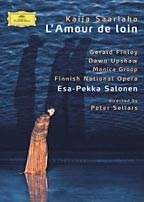
With L'Amour de Loin ("Love from afar," Music by Kaija Saariaho and Libretto (in French) by Amin Maalouf) we have a new opera about love, and in its five years of existence it has already been presented in Salzburg, Santa Fe and Finland. The subject is longing, longing for someone else, for somewhere else, for an existence outside oneself. This is the opera for me.
It is a DVD from 2005 at the Finnish National Opera, so I am not required to see it all at once as I would in the opera house.
The opera has three characters:
There is also a chorus who take on the character of Rudel’s friends, his dubious friends, and other characters in the drama. The chorus is also part of the orchestration, much as it would have been in the writing of Debussy. There are two harps, also like Debussy.
All long for what they do not have. The pilgrim travels back and forth between them and is the cause of all that happens. Without the pilgrim they would sit in their towers alone and discontented.
This production is simple. The towers are represented by metal winding staircases. The pilgrim’s boat is small and white in the center. The stage is covered with a thin layer of water in which the boat sails and the pilgrim walks.
Rudel expresses his desire for a distant love, and he is overheard by the pilgrim, who relates a brief story about a woman in Tripoli that he saw one day. She was, “beautiful without the arrogance of beauty, noble without the arrogance of nobility, pious without the arrogance of piety." The hero is fatally fascinated and describes a complete imaginary woman.
Oh my.
Part II
The camera shows briefly the orchestra pit, and it contains what appears to be a standard opera orchestra. Modern pits allow for the possibility of players sitting under the stage.
This cryptic sentence:
4(2pic,afl).3(ca).3(bcl).3(cbn)/4231/timp.4perc/pf(kbd)/str
describes the instrumentation.
woodwinds/brass/percussion/piano/strings
kbd next to pf means it is an electronic keyboard, perhaps a synthesizer. All we see is strings, two harps and maybe some woodwinds on the other side. It could be a piece by Berlioz or Debussy they are about to play. The list above from G. Schirmer seems to have missed the harps.
I am worrying about this because this ordinary, only somewhat large orchestra, these ordinary opera singers and the hidden chorus are making music with no obvious link to the music of Papa Haydn who first formalized the makeup of an orchestra. Once the ordinary looking conductor with his ordinary baton gives the downbeat, we don't see the orchestra any more. The singing is relatively ordinary, too, without too much irrational leaping about, a common feature of modern opera. There are even occasional trills and small ornaments such as an opera singer might do.
There is throughout the work no apparent meter. Instruments, themes, melodies sneak mysteriously into the stream of sound, play for a while and just as mysteriously depart. It is a sea of sound rather more like the ocean than Haydn. Or perhaps more like the Mediterranean Sea where the action takes place.
Part III
We come to opera for the ecstasy. Now I begin to fear that our hero who has stepped into the boat and is making his crossing to Tripoli will find at the other side that the love from afar is the only one that will sustain the ecstasy forever, that the reality of a real lover will pale beside it.
What is opera without passion? Has the fear of annihilation any chance beside it?
L'amour de loin is uncompromisingly modern and in spite of that may well be a masterpiece. Only its extreme difficulty would prevent it from becoming standard repertoire.
The visual images in this dvd are haunting. Perhaps I will buy it after all.
#ad
When I wrote that opera was about love, it was just an observation. I made a list from a few opera plot books and picked out the ones that form the basis for opera theater repertoire throughout the world. And there it was. They are all about love with not one single exception.
With L'Amour de Loin ("Love from afar," Music by Kaija Saariaho and Libretto (in French) by Amin Maalouf) we have a new opera about love, and in its five years of existence it has already been presented in Salzburg, Santa Fe and Finland. The subject is longing, longing for someone else, for somewhere else, for an existence outside oneself. This is the opera for me.
It is a DVD from 2005 at the Finnish National Opera, so I am not required to see it all at once as I would in the opera house.
The opera has three characters:
- Jaufré Rudel, a troubadour living in a tower in Aquitaine has had many lovers and longs for love at a distance, for the far away, unattainable lover of ideals and dreams. He is sung by Gerald Finley, baritone.
- Clémence, countess of Tripoli, living in a tower in Lebanon, left Toulouse when she was five and has longed to return ever since. She is sung by Dawn Upshaw, soprano.
- The pilgrim longs to see the east, especially the holy land; sung by Monica Groop, mezzo-soprano.
There is also a chorus who take on the character of Rudel’s friends, his dubious friends, and other characters in the drama. The chorus is also part of the orchestration, much as it would have been in the writing of Debussy. There are two harps, also like Debussy.
All long for what they do not have. The pilgrim travels back and forth between them and is the cause of all that happens. Without the pilgrim they would sit in their towers alone and discontented.
This production is simple. The towers are represented by metal winding staircases. The pilgrim’s boat is small and white in the center. The stage is covered with a thin layer of water in which the boat sails and the pilgrim walks.
Rudel expresses his desire for a distant love, and he is overheard by the pilgrim, who relates a brief story about a woman in Tripoli that he saw one day. She was, “beautiful without the arrogance of beauty, noble without the arrogance of nobility, pious without the arrogance of piety." The hero is fatally fascinated and describes a complete imaginary woman.
Oh my.
Part II
The camera shows briefly the orchestra pit, and it contains what appears to be a standard opera orchestra. Modern pits allow for the possibility of players sitting under the stage.
This cryptic sentence:
4(2pic,afl).3(ca).3(bcl).3(cbn)/4231/timp.4perc/pf(kbd)/str
describes the instrumentation.
woodwinds/brass/percussion/piano/strings
kbd next to pf means it is an electronic keyboard, perhaps a synthesizer. All we see is strings, two harps and maybe some woodwinds on the other side. It could be a piece by Berlioz or Debussy they are about to play. The list above from G. Schirmer seems to have missed the harps.
I am worrying about this because this ordinary, only somewhat large orchestra, these ordinary opera singers and the hidden chorus are making music with no obvious link to the music of Papa Haydn who first formalized the makeup of an orchestra. Once the ordinary looking conductor with his ordinary baton gives the downbeat, we don't see the orchestra any more. The singing is relatively ordinary, too, without too much irrational leaping about, a common feature of modern opera. There are even occasional trills and small ornaments such as an opera singer might do.
There is throughout the work no apparent meter. Instruments, themes, melodies sneak mysteriously into the stream of sound, play for a while and just as mysteriously depart. It is a sea of sound rather more like the ocean than Haydn. Or perhaps more like the Mediterranean Sea where the action takes place.
Part III
We come to opera for the ecstasy. Now I begin to fear that our hero who has stepped into the boat and is making his crossing to Tripoli will find at the other side that the love from afar is the only one that will sustain the ecstasy forever, that the reality of a real lover will pale beside it.
What is opera without passion? Has the fear of annihilation any chance beside it?
L'amour de loin is uncompromisingly modern and in spite of that may well be a masterpiece. Only its extreme difficulty would prevent it from becoming standard repertoire.
The visual images in this dvd are haunting. Perhaps I will buy it after all.
#ad
Subscribe to:
Posts (Atom)