Tuesday, March 08, 2005

EuroTrash

Discussion found in my email:
DC: Maybe Pamela R's eurotrash operas weren't all that bad. The Financial Times has a revue of Bavarian State Opera's ''Rigoletto" set in outer space -- a production designed to appeal to younger audiences -- and based on "Planet of the Apes". The Duke of Mantua is a gorilla, Monterone is an orangutan and there is a mixed simian chorus. Gilda is got up like Princess Leia and she dies in a plastic garbage bag. Tito Beltran sang the duke, but it couldn't be heard very well through his hairy mask. The audience showed the good taste to boo the performance.


Dr B: This all starts out innocently enough.
KC: Leave it to the Germans to come up with wacko ideas.
Perhaps they just can't stop their compulsion for tinkering?


BC: is there any chance we could drop "Eurotrash" as a critical term? I doubt it can be adequately defined and I think name-calling gets in the way of clear thought.
I do like the idea of audiences booing, though.


Dr. B: and now the plot thickens.
KR: BC wrote: "is there any chance we could drop "Eurotrash" as a critical term?"

My answer: NO! at least not from my perspective, and here it is:

It seems to me that some European directors, in a move to say something new in their version of old classics, have explored this new concept as a way of tagging the old plots as non-important to today's modern and very conflicted world. Ambiguity is the rule, and so operas should reflect that movement. Trovatore in non-traditional dress, and with a plaster-of-Paris head plunked stage left means that we should get it that while the plot lines of jealousy and delayed revenge are OK, it's an old story...life sometimes sucks, and we need to get on with it because...because...well, I (the director) am just tired of this old plot.

Verdi and his librettists, Cammarano and Bardare were not tired of this old plot. To them it rang with intensity and meaning. The plot was the message, and all else existed simply to further that end......(and to make a little money, Certo!).

In short, the concept of Eurotrash trivializes the great masterworks of opera, while seeming to serve them by not messing with the original language, but while thoroughly messing with everything else on the stage. To some of us, that is a gross insult, and to ward off criticism of their policies, directors have fallen back on certain tactics used by some of our current world leaders, which say in no uncertain terms, if you criticize our methods, there is something basically wrong with you.

Pamela Rosenberg proposed the bringing of the Eurotrash concept to San Francisco, which the San Franciscans refused to buy. Some could say it was a noble experiment, but it didn't sell. Lotfi Mansouri always said San Franciscans were too provincial and culturally naive to really appreciate opera, and he is gone (but not soon enough!). Maybe San Francisco could be a bastion of old-hat, traditional opera, and for my part, what could be wrong in that?

The term "Eurotrash" is a pejorative, but it also describes a whole concept of performing opera. Anyone familiar with opera knows what it is, and the fact that no one has really come up with another word to replace it seems, to me, to indicate that it serves well in its descriptive role.

.......But that's just my idea......I'm sure no one else has another.....


Dr. B: So then these two guys ( BC and DE) start their own arguement:

BC: So what you're saying is, all productions of, say, "Aida" have to conform to whatever Verdi and his librettist and impresario staged during V's lifetime: no electric lights, for starters, just candles, no instruments made after whenever Verdi died...same sets, same costumes. Anything else risks "insulting the intention of the original creators," because, how would we know? For "Walkure," you'd have to have real horses on stage-things that eat grass and poop and whinny, not pictures of horses on shields, not carnival-ride hobby horses hanging from the ceilings-because Wagner's libretto calls for...got it...pferden. Nnnnn? Anything else might insult Richard W. All Bach and Handel played on original instruments with tiny orchestras-never mind that our halls are gigantic now. Well, it's a point of view. Neville Mariner (I think) has made a pretty decent career out of exactly that attitude, and taught some valuable musical lessons thereby. But, ojalla!, what a harsh standard, How f*ng boring if every opera, play, dance piece, whatever had to be frozen in time: always the same set for, oh, I don't know, Carmen. No films made in the streets of Sevilla. West Side Story, it can't be Puerto Ricans vs. African Americans (the names don't work for Black folks, but never mind), oh, no, it always has to be whites (and Poles, at that). No concert versions of anything that was originally staged. The "Otello" I played in-nope: we only used 2 trombones and one trumpet (probably was 3 and 2 in the score) plus a CD of the fanfares. Pretty harsh, pretty damned harsh.


DE: I don’t recall saying anything about stage mechanisms---I was talking about the artistic intentions of the creators. For example, when Janacek tells us that Kata'a throws herself into the Volga, and that the villagers gather around her drowned body (after it is dragged out of the river)--so Kostalnicka can give her final cynical statement--I think the intent is pretty clear. I think this is part of what the opera is about. I think having the soprano flop into an inch of water on the stage--after two hours of completely naturalistic stage-craft--lovely stage-craft--is just silly--and having two guys in scrub suits wheel a stainless-steel gurney onto the stage and haul her out is just plain abominable--it interferes with the singing--and the feeling of the music--and is not there to advance the ideas of the creator.--but to insult and shock the audience. This is not my idea---this is what the famous German directors say about their work. Shock and awe indeed.
Weimar--and beware what comes next Mind you--I have no problem with folks doing this in their own theaters--I just don't want it done in a theater where I not only paid for a ticket but gave lots of money to the company.


BC: I wasn't crazy about that scene in KK, either; and didn't like the last tableau in Cosi, either, though it took one trivial plot device way too seriously (then, again, it made me think: Mozart treated war as a joke or prank--it wasn't clear there really was a war for those yoyos to go off to--but in this day and age can we really even THINK about war that way?...). the second part of your criticism, yeah, sure, I respect that. but the first part, like I say, how are we to know? saying "original intention" means you can't reinterpret anything, because you might just possibly maybe it could happen we can't be too careful--reinterpret anything.


DE: Yes indeed--there is a danger in trying to decide what the "original intent" was in many works of art--that's why we have art critics---to tell us that. But to cavil at that problem, is to evade the main point---. An Analogy would be too complain that we cannot tell how much saturated fat is really harmful, so why try to set any limits? I say--everyone can (or should ) agree that in general, for most folks, reducing saturated fat in the diet is a good idea--and I reject the diets which tell us to scarf up all the saturated fat we can find. I feel the same way (in general) about revisiting works of art. Finding new ways to present them is great--so long as one doesn't stomp all over the art. We can spend the next decade arguing over what is "stompimg"--and what is "interpretation"--and eventually we can become art critics!!!


Dr. B: Back to the main arguement.

DC: I agree with BC in a way. I'm guilty of using the term ET as a catch-all to describe production concepts so weird that they are alien to the opera or play involved. Maybe we need a new label for a production -- costumes, sets, lighting, stage directions -- so bizarre that it compromises the story and detracts from the beauty of the music. I am not against innovative productions, as such, because art has to have some meaning for today's audience; however, I don't think using icons from German Expressionism or tired old movies is an answer.


Dr. B: Isn’t this fun! My rather wet-blanket comment: “My opinion. I think the phenomenon is more important and more interesting than what you call it. Calling it Eurotrash is descriptive but also dismissive.” See previous entry on “the composers wishes.”

One more:
KC: Well, Eurotrash has such a wonderfully cheesy ring to it. One hates to abandon it wholesale.

But one man's trash is another woman's treasure (e.g.the modern-dress Alcina of 2002) so the term does leave a lot to be desired in the way of specific qualification.

And does it always have to apply to an outre take on a classic or can it apply to a new production?

Last season's Le Grand Macabre comes to mind as a candidate for the term whenever the thing was written.

Dr. B: Well, Herb Cain certainly would have used it. I loved Alcina, too, and it was definitely a pure example of Eurotrash.

Saturday, March 05, 2005

Turandot

Conductor:  Bertrand de Billy
Production:  Franco Zeffirelli

Turandot: Andrea Gruber (soprano)
Liù: Krassimira Stoyanova (soprano)
Calàf: Johan Botha (tenor)
Timur: Hao Jiang Tian (bass)

While I was in New York, I went to the Metropolitan Opera to see Turandot. I am a sucker for Turandot. When she says "His name is love," it's one of the greatest moments in opera.

I have been to the Metropolitan only once before when I sat in the orchestra. This time I was in the center of the dress circle, a wonderful place to sit, and especially wonderful for this fabulous production--they have revived the Zefferelli production. I believe the tiers are closer to the stage in the Metropolitan than they are in San Francisco, so the center of the dress circle feels like the best seat in the house. It's a great house, with great acoustics, great sight lines (for a horseshoe theater), with a great tradition.

In the lobby were costumes that had been worn by Renata Tebaldi in her appearances at the Met. She died that week.

The Metropolitan Opera is very traditional, very fuddy-duddy, very out of touch with the rest of the opera world.

Andrea Gruber appeared in the role of Turandot. Her big soprano voice has a harsh edge to it, hardly a drawback in the role of Turandot, who shouts at the top of her voice the entire time. I tend to think that this is a role to avoid (Lady Macbeth is another) unless you are very sure of your shouting abilities. Advice: sing it when you are young to get cast and advance your career, then avoid it like the plague once you can get away with it. It's the only Puccini role that's like this.

Saturday, February 26, 2005

Conversations

When my son Chris and I are together, we talk about abstractions. He says stuff like, “The practice of motivic development was completed by Beethoven.” And I answer something like, “Wagner carried it one step further.” This is pathetic.

Beethoven carried the process of motivic development within the structure of the sonata form as far as it could be carried. He stretched and rearranged the sonata form quite a lot, but it remained the conceptual framework for all his work. Wagner divorced the idea of motivic development entirely from the sonata form, from virtually any form unrelated to plot, and expanded it to gigantic proportions. He forms the logical conclusion of the idea, making him the culmination of the past and not at all the music of the future that he imagined.

If you don’t mind all that constant modulating, Wagner is wonderful. Except for Parsifal, of course. His use of the borrowed theme of the Dresden Amen which he repeats ad nauseum, always in its original borrowed harmonization, cannot be considered thematic development in any sense. It’s a mistake, a serious lapse in judgment, maybe even a sign of senility. The emperor has no clothes.

I apologize for telling such a sad story.

Thursday, February 24, 2005

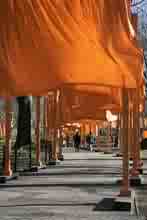
The Gates


I rode a bus so I could see what New York City looked like. Next to me was a woman who complained loudly as we passed Central Park about how much she hated the Gates exhibit. It was too orange, too expensive, too solid, too ugly, attracted too many people.

The next day I rode the same bus past the same part of the park and asked the woman next to me if she was from New York and if she liked the Gates—she answered yes and yes. She told of taking her 5 year old grandchild to walk in the park under the gates and that he said, “It makes you feel happy.”

Thank you Christo and Jeanne Claude. Thank you five year old. I hope you always remember it. It made me feel happy, too.

The composer’s wishes have nothing to do with it

Stravinsky conducted his own pieces. I remember listening to a recording of Stravinsky conducting one of his late choral pieces. It was all right there. Everything you heard in the performance was right there in the score. He added nothing—he took nothing away.

So was he right? Should we just do whatever is written down and quit making up our own meanings? Stravinsky is known to have wanted this. Nowadays this is actually possible. You can scan in a score and play it back as a midi file. You can find these kinds of files all over the internet. Ugh!

Life takes place in time and space. The experience of music changes with the passage of time, and performers are required to bring the music of the past into the present. The 100th time we hear something it goes dead on us. We can’t help that. That’s what the billboard 100 is about. It is a great challenge with wonderful rewards to make us hear the music again.

Carnegie Hall

In the middle of her career Renée Fleming began to emphasize the Richard Strauss repertoire, and by now she may be considered the reigning queen, especially now that Kiri and Jessye have moved on. In her recital at Carnegie Hall on February 21 she did some Strauss as encores, including my favorite “Wenn du es wuesstest”—or whatever the actual title is—which translates roughly as “If you only knew.” It can be described as a joyous outburst. It was a long and difficult recital, and she ran out of steam right after this and stopped. It certainly wasn’t because of loss of audience interest which reached its screaming peak here.

The Strauss style of singing, characterized by lightness of tone, silky smoothness in the legato and sweetness of phrasing, now permeates all her work.

The trick is to find where your own personal music intersects this piece. In the greatest artists this usually results in a personalization of expression that becomes that singer’s style. The music is different, the technical requirements are different, but the process itself is the same as it is for a pop singer. Billy Holiday made everything her own. Luciano Pavarotti makes everything his own.

And now Renée Fleming may be allowed to enter that company. She has owned Handel certainly. She did by far the most legato “Oh had I Jubal’s lyre” I’ve ever heard. Perhaps anything can benefit from the Strauss legato.

Schumann may be considered a precursor, an essential step in the path to Strauss. But Schumann is ever in danger of turning too sweet, and that occurred occasionally here.

I loved her exquisite presentation of Schumann’s “Mondnacht” with its complete lack of fear of too slow a tempo. I was beginning to think only Italians remembered how to do slow pieces. Breathtaking.

She did an interesting group of early Alban Berg (c. 1905) that she performed as if they were Debussy, giving them a marvelous sophistication. 1905 is after Berg began studying with Schoenberg and before Schoenberg’s breakdown into atonality in 1908.

If I were writing a real review I would have to talk about her gorgeous, glittery pink gown. I would have to mention Rebel, the players for the Purcell and Handel groups. That tall guitar was a theorboe. There was excellent integration between them and the singer. All were moving in the same direction to express her interpretations.

And the pianist's name for the second half was Hartmut Hoell.

She is ready to make the transition to goddess.

Wednesday, February 16, 2005

Paths to Expression

There are different paths to expression. I have been urging that a path be sought, that singers should remember the necessity to express and not merely to make beautiful sounds, but different composers, different eras, different personalities lead to different modes of expression.

The life of a professional singer usually consists of going from conductor to conductor, from coach to coach with each trying to impose his interpretation on the singer. It may in certain situations be necessary to resist this.

What is this about? You may have been wondering. This is part of worrying about Ben Heppner. The big voices in the heaviest repertoire must seek their own path.

The ideal for Wagner is the work of Kirsten Flagstad, a singer of awesome expressive abilities who expressed at the level of whole phrases, who made meaning in large masses while hardly seeming to notice the individual notes.

It is necessary in the heavy repertoire to stay safely within ones own limitations, to scale the performance to ones own voice. To withstand the conductor means knowing your own strengths and weaknesses, and sticking to them.

Saturday, February 05, 2005

3 Singers

I found Classic Arts Showcase early on Saturday morning on a community access cable network. I was immediately treated to 3 singers:

Marlene Dietrich singing “When the World was Young”
Gisela May doing two songs by Kurt Weill
Renata Scotto singing Liszt’s “Angelici Costumi”

I was not familiar with Gisela May but found her fascinating. The internet tells me she was “geboren am 31. Mai 1924,” and was the “star of Bertolt Brecht's East German ‘Berliner Ensemble’ theater.” The internet is so cool.

German is supposed to be spoken with a uvular R made by vibrating the uvula against the tongue, though classical singers are taught not to use it. My Spanish friend Dolores used to joke about it. She could do it but only on the word “Brot,” which she would then demonstrate. I couldn’t do it at all. Gisela May not only does it, she flaunts it. She can sustain it for an amazingly long time and makes it part of her interpretation of the song, especially in “Mackie Messer,” giving the whole thing a growling/purring tiger-like quality entirely compatible with her smoky voice.


The other two women we know very well. Dietrich was seen in a 1972 concert film. She is simply telling you a story about her own life, speaking directly to the audience in a very personal way.


And Renata Scotto is always herself, gesturing more than the other two women and bringing drama into even the smallest piece.

Thursday, February 03, 2005

Arts

In California I used to get the Classic Arts Showcase on channel 32.

This is a network of short films about the arts. They put on a caption telling you what you are about to see, run the film, which is never longer than 5 minutes to avoid fees, and then show the caption again at the end. That’s it. They run concert tapes, opera, ballet, pieces of movies and animated music. I would surf through the channels and occasionally strike gold.

One day I came upon a mysterious, dark young woman singing in English with wonderful intensity and nuance against a noir backdrop. I kept thinking, “I know who this is,” but could not retrieve a name. It gives me shivers now just thinking about the thrill I felt when I suddenly realized I was seeing a very young Ethel Merman. Who knew Ethel Merman could be this?

Wednesday, February 02, 2005

Netrebko

I like Anna Netrebko very much. She is one of the blessed ones who receive their own spot on 60 Minutes, where she appeared walking through the Haight in torn $1200 jeans.

I first heard her in the role of Lyudmila in Glinka’s Ruslan and Lyudmila where she made a huge impression on all my friends. She has a large voice with flexibility, trained in the dark Russian style. I like her not only for what she is but for what she aspires to be—an Italian opera singer. She assumes, correctly, that she cannot become the great star she wishes to be without transcending Russian repertoire.

Her Puccini is coming along very nicely, and she is acquiring more and more Italian phrasing. Recently I saw her in La Bohème where in the role of Musetta she burned up the stage, with small bursts of flame flying up wherever she stepped. She is cultivating her star quality.

Of course, my idea of proper Italian phrasing comes from the great Italians Jussi Bjoerling, Maria Callas and Kiri Te Kanawa. Why not a Russian Italian? "Room with a View" was recently released on DVD, including the two godlike performances of Italian arias by Kiri. Be sure to catch this.

I suggest to Anna that she focus on acquiring perfection in Italian repertoire and not try to conquer everything at the same time. I saw her in a recital where she displayed a completely clueless performance of some Strauss songs. Someone should have realized that she does not get these and prevented it.

This recital ended with a group by Rachmaninov. I am ok with the idea that she should avoid Russian opera for the sake of her larger career, but for the benefit of all of us she will please, never feel the need to rise above Russian song. Only the Russians have any idea how to properly perform these. What hope is there that the rest of us will achieve the truly Russian? Her performance was definitive.

It is important to aspire to greatness to have any hope of achieving it. I wish her the best.