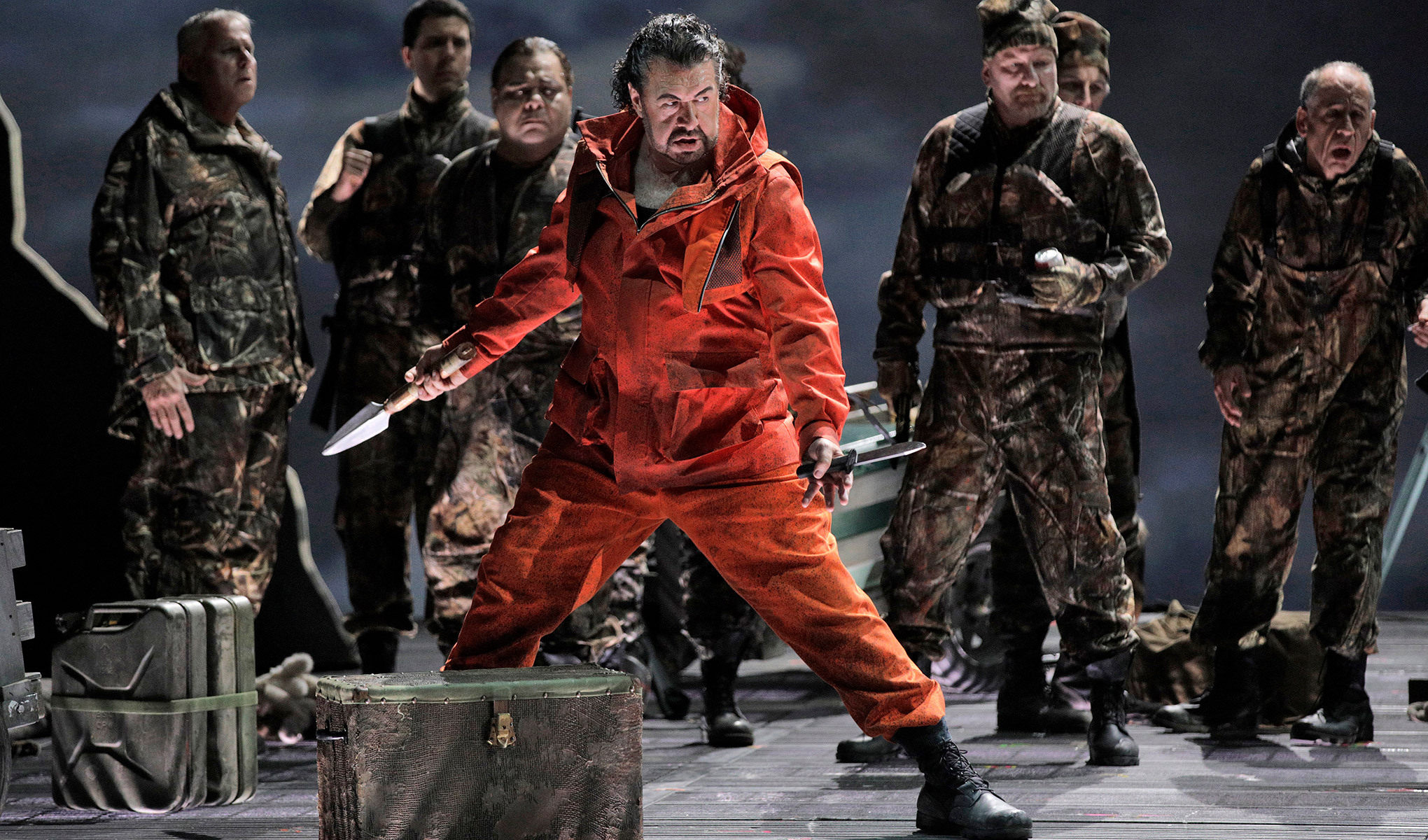
Showing posts with label Opera Only. Show all posts

Saturday, May 21, 2022

Lucia in HD


Conductor:  Riccardo Frizza
Director:  Simon Stone


Enrico Ashton, Lucia's brother:  Artur Ruciński (baritone)
Lucia Ashton:  Nadine Sierra (coloratura soprano)
Riamondo Bidebent, Lucia's tutor:  Christian Van Horn (bass)
Edgardo, Lucia's fiance:  Javier Camarena (tenor)


Host:  Anthony Roth Costanzo

The HD from the Met today was Donizetti's Lucia di Lammermoor in a new production by Simon Stone. It turns out I've already seen two productions by him:  Korngold's Die Tote Stadt from the Bayerische Staatsoper and Saariaho's Innocence from Aix en Provence.  He likes a lot of detail.  Today there was rather an astounding amount of detail, which, surprisingly, seemed to match the libretto.  He likes a small rotating set.  This one represented a small American town with a pawn shop, a church, etc.  There were two cars:  an orange Pinto and a pick up truck. The prop master was interviewed and said there might be about 1000 props.  The presence of cell phones, used rather frequently, places us in a narrow time period.  Thus the confusion when a drive in film of Bob Hope appeared.

It worked for me.  Lucia's brother was a drunk and a drug fiend whose budget is deeply in dept,  thus explaining his need for his sister to marry Arturo instead of Edgardo, the man she loves.

The singing was magnificent.  Nadine has a gorgeous voice, and Javier is one of the best lyric tenors around.  I've seen Ruciński before only in the La Boheme in outer space.  And Christian Van Horn is always wonderful.  The mad scene is often orchestrated for flute, but we were treated to the wonderful glass harmonica.  It seems the ideal sound to portray madness.

The combination of beautiful singing, great acting, and lots of dramatic detail,made this a wonderful performance for me.  And I need to report that the sound in the theater was much better today.

Saturday, December 18, 2021

Eurydice in HD


Eurydice................Erin Morley (soprano)
Orpheus.................Joshua Hopkins (baritone)
Orpheus’s Double....Jakub Józef Orlinski, countertenor 
Father.....................Nathan Berg (baritone)
Hades.....................Barry Banks (tenor)
Little Stone............Stacey Tappan (soprano)
Big Stone...............Ronnita Miller (mezzo)
Loud Stone............Chad Shelton (tenor)

Conductor............Yannick Nézet-Séguin 
Director................Mary Zimmerman 

The opera Eurydice by Matthew Aucoin on a libretto by Sarah Ruhl premiered in Los Angeles in 2020. It's based on a play by Sarah Ruhl and is in English. This is the Orpheus myth from the woman's point of view. It's a preferred topic for operas because it's about the power of music even over the gods. Orpheus can lure the gods into releasing Eurydice from hell. 

We are 20 minutes in and they have violated an important rule: there should be an aria, preferably for the soprano, in the first 10 minutes. So far just talky stuff. They tried all recitative operas at the beginning of opera, but it didn't work out. We go to hell and see Eurydice's father who still remembers life before death and how to read and write. He writes to Eurydice and sings about it. This is the closest we've come to an aria so far. 

Eurydice comes out in her bridal dress, and father watches her while he sinks back into the earth. Orpheus and Eurydice sing their vows, kiss and dance. Hades arrives and he has a conversation with Eurydice over the water cooler. He brings her the letter from her father. For me the lyrical bits don't go on nearly long enough. Eurydice goes off with Hades and Orpheus comes looking for her. 

I'm sorry. This just isn't happening for me.

Sunday, November 28, 2021

Cosi fan tutte in San Francisco


Conductor: Henrik Nánási 
Director: Michael Cavanagh 

Ferrando: Ben Bliss*
Guglielmo: John Brancy
Don Alfonso: Ferruccio Furlanetto
Fiordiligi: Nicole Cabell
Dorabella: Irene Roberts
Despina: Nicole Heaston 

The San Francisco Opera is currently showing Mozart's Cosi fan Tutte.  Starting this season if you do not want to go into a crowded opera house, you can for a fee watch the opera at home on live stream.  I would like to suggest that it should be possible to make this available to play later for the same fee.  This would allow friends in Europe to watch it.  It's the middle of the night there.

This production began in 2019 with Figaro as part of a Mozart/Da Ponte trilogy and will continue to its conclusion later this season in Don Giovanni.  All three operas are set in the same basic house structure.  In this opera the house is now a country club with sports, dining, and other facilities.  I felt that the concept worked very well.  In the picture above the guys are in the men's locker room.  I liked the look of it and felt that it served very well to clarify the story.  The singers were expected to be rather more athletic than is generally a good idea. 

My only problem with it was with the music.  The music sounded very much like a performance of a Mozart symphony--intense and dramatic.  It wasn't exactly bad, but didn't make me feel like I was seeing a comedy.  My overall take is positive.  This opera is often hated, and I overcame my tendency in this direction.  It was good to see Ferruccio Furlanetto.


Friday, November 19, 2021

Barbara Hannigan's Lulu


Barbara Hannigan returned to Brussels to repeat her famous Lulu performance.  She does a lot of en point dancing.  I reviewed it the first time around and found it complete fascinating.  I believe this performance made her career.


Saturday, October 23, 2021

Fire Shut Up in My Bones in HD

 
Charles, Father's girl friend, Billie, Father
 
Co-Directors:.. James Robinson and Camille A. Brown
Conductor: ......Yannick Nézet-Séguin 

Destiny/Loneliness/Greta:  Angel Blue
Billie, Charles' mother: .....Latonia Moore 
Charles: ...........................Will Liverman 
Char'es-Baby: .................Walter Russell III

Fire Shut Up in My Bones, 2019,  by Terence Blanchard on a libretto by Kasi Lemmons was shown in HD from the Metropolitan Opera today.  I'm sorry.  This didn't happen for me.  The singers were excellent, especially Angel Blue whom I very much admire, but I didn't enjoy the music.  That's the make or break for me.

I have decided to add more comments.  I tend to shy away from cruelty and crime within families.  I don't watch Law and Order SVU because it's all about the personal.  I never go to Madama Butterfly because it is about cruelty in intimacy.  Political and financial crimes don't bother me at all, but people abusing the innocent is just something I would rather not see.  The sexual abuse of children is the worst category.


Friday, October 15, 2021

Fidelio in San Francisco


Conductor Eun Sun Kim 
Director Matthew Ozawa

Leonore: Elza van den Heever 
Florestan: Russell Thomas 
Don Pizarro: Greer Grimsley 
Rocco: James Creswell 
Don Fernando: Soloman Howard 
Marzelline, Rocco's daughter: Anne-Marie MacIntosh * 
Jaquino:  Christopher Oglesby

Last night I attended the premier of a new production of Beethoven's Fidelio at the San Francisco Opera.  I'm going to work my way slowly through the production before going on to the music.

The single set is shown above.  It can be rotated, and the other side shows different spaces.  In Act II it looks different from Act I.  In Act I the back of the side presenting to us is covered with mirrors.  The director always sits in the middle of the orchestra to view his creation, but from my seat in the balcony circle the lights from the pit reflect in the mirrors to create a tremendous distraction.  The screens which drop down in the balcony are back, and they are shot from a lower angle which doesn't show the reflection.  I watched the screens.  [More about the screens later.]  No director ever seems to think of walking around the house to see what it looks like from other places.

Much of the drama of this production is created through costumes.  It's regie of course.  The last person in the upper left above might be Leonora dressed as a prison guard.

This will give you a better idea.  Left is Leonora, then Marzelline, then Rocco and last Jaquino.  It's probably the canon quartet.  Each of these people has a different role to play.  Leonora is in her guard's uniform.  Jaquino is wearing a business suit and Marzelline is wearing upscale office attire.  They seem to work in an office section of the prison.  Rocco who is supposed to be the boss is dressed no better than the prisoners without a uniform.  Jaquino is someone I have always seen as a flunky, so why is he in a business suit?  And why does Rocco look like a janitor?  I'm very confused.  This production does not give any clues about why Marzelline would prefer Fidelio.  The yellow outfits above are prisoners.

The one thing that makes Fidelio hard to stage is that in Act II while appearing to be still in the dungeon where Florestan has been hidden, there suddenly appears a fair sized mixed chorus to celebrate Leonora's rescue of Florestan [which she here accomplishes with a gun].  Until that point Leonora and Marzelline are the only women in the opera.  In this production the women are in the prison with their men and appear at the end when their men are released.  This sort of makes sense.

Enough about the production.  This was my first experience of our new conductor Eun Sun Kim.  She kept good tempos and maintained a suitable balance between the singers and the orchestra, things that make or break a performance.  The chorus was its usual spectacular self.

Russell Thomas sang a magnificent Florestan.  Greer Grimsley makes a good villain.  The make or break character is, of course, Leonora/Fidelio, here sung by Elza van den Heever.  She cried in the applause which was warm.  Everyone is so emotional about being back.  Elza, I hope you enjoyed your performance.

Which brings us back to the screens.  The San Francisco Opera is now offering live streams of its performances.  Streams require cameras, undoubtedly the same cameras that brought us the pictures on the screens that hang down in the balcony.  In addition streams bring money.  This makes me happy.  If you are unfamiliar with the San Francisco Opera, it provides a quality product.


Saturday, October 09, 2021

Boris Godunov in HD


Conductor...............Sebastian Weigle
Production..............Stephen Wadsworth 

Boris Godunov...........René Pape 
Prince Shuisky..........Maxim Paster 
Pimen .......................Ain Anger 
Grigory, Dmitry pretender......David Butt Philip 
Varlaam....................Ryan Speedo Green 
Simpleton*..............Miles Mykkanen

We saw in the movie theater the original 1869 version of Mussorgsky's Boris Godunov performed in the critical edition by Michael Rot. This is a different version of the opera than the one we saw in 2010, but the production is the same and the lead singer, René Pape, is also the same. In this version the character Marina does not appear. Here is a calendar for reference. 

1547 Ivan the Terrible tsar 
1552 Boris born 
1557 Feodar I born 
1582 Dmitry of Uglich born 
1584 Ivan died 
1585 Feodar tsar, Boris regent 
1591 Dmitry died 
1598 Feodor died, Boris became tsar 
1605 Boris died 

We may assume the time line for the opera begins when Feodar dies and Boris becomes tsar, and it ends when Boris dies. In real life people pretended to be Dmitry, and that is the basis for the plot. Boris is very reluctant to be tsar, but eventually agrees. Grigory pretends to be Dmitry and a story about how Dmitry didn't appear dead is added to support this. 

But that is the problem with this opera. For those of us who are ignorant of Russian history we have no idea what actually happened. Did Dmitry go off to Lithuania as a child only to reappear after Boris is tsar? Sometimes it seems he did and sometimes it seems he didn't. Boris seems not to have made up his mind whether or not he killed him. It's all rather confused. 

In this version, focused entirely on politics, there is a sameness to it all. I can see why people complained. The production and performances were all excellent, especially our star René Pape. I may have seen this enough.

Monday, September 27, 2021

Der fliegende Holländer from Bayreuth


Mary, Erik, Senta

Conductor: Oksana Lyniv
Director: Dmitri Tcherniakov
 
Daland:  Georg Zeppenfeld
Senta: Asmik Grigorian
Erik: Eric Cutler
Mary: Marina Prudenskaya
Der Steuermann: Attilio Glaser
Der Holländer: John Lundgren

Richard Wagner's Der fliegende Holländer streamed from Bayreuth this summer on July 25.  It's regie, of course.  That means that the staging is modernized.  During the overture a mother hangs herself.  It's rather wildly realistic looking.  This doesn't seem to be the traditional plot about a sailor.  I'm here for Asmik Geigorian.

The sailors sit around drinking in a bar and never go to sea.  The girls don't spin, but instead practice the spinning chorus.  Senta smokes.  Erik comes in and chases the other girls away.  He warns Senta that her father wants to find her a husband.  Erik and Senta are exes and fight like it.  

Asmik is 40 but here passes for younger.  She is good looking, her voice is strong and her acting good.  The sound of her voice does not particularly appeal to me.  For me it is the feeling in the music.

Daland brings the Dutchman home and introduces him to his daughter as her bridegroom.  She swears to be faithful until death.  This takes place around the dining room table.  She gets excited over him for no apparent reason.  The ho hum everydayness of the staging takes all the fizz out of it.  Asmik tries to make up for it, but it's too much to ask.

In Act III everyone is outside eating and drinking except the sailors who sit glumly.  The townspeople ridicule them until the Dutchman takes out his gun and shoots a few.  Ugh.  Everyone but Senta runs off.  Erik complains to Senta who sits staring.  They sing about eternity on the sea, but there is no sea.  The Dutchman throws Senta on the floor.  Mom comes in and shoots him.  Senta laughs and tries to comfort her.  That's it.  I'll probably never watch this again.  The chorus is excellent.

Friday, August 20, 2021

Pagliacci from Chicago


Conductor: Enrique Mazzola 
Director: Peter McClintock 
 
Canio: Russell Thomas 
Nedda: Ailyn Pérez 
Silvio: Lucas Meachem 
Tonio: Quinn Kelsey 
Beppe: Eric Ferring

You can see this cast of Leoncavallo's Pagliacci from the Lyric Opera of Chicago is impressive.  This copy has no subtitles in any language, so I have to rely on memory.

My memory, such as it is, tells me that this is the opera where they say "a venti-tre ore." Venti-tre is 23, so that means all are invited to a circus performance that begins at 11 pm. In Italy they might actually do this. They have dinner at 8 or 9 pm and go on from there. The American translations usually pretend it's earlier.

However, this is regie and the things going on have little to do with the original plot.  Here our theatrical troop is the cast of the TV show The Honeymooners.  It might very well be playing at 11 pm. They give out Pagliacci t-shirts to the chorus/audience.

Nedda, wife of Canio in both show and life, is tired of her husband and has become interested in Silvio, apparently a stagehand. She sings about this. The beautifull sung prologue is outside the Lyric Opera, and subsequent scenes are inside. Nedda sings in the wings next to the cables to draw the scenery. It's show business. Tonio wants her too. He goes after her and she hits him with her purse.

The second act is the comedy.  This is the Kramdens from the Honeymooners, apparently.  Forties/fifties furniture and clothing.  It's also in black and white like the TV show.  Adorable.  I believe Ralph was also a bus driver.  I have to say this concept completely works.  When the camera shows the stage and the wings, the color comes back.

These are all wonderful singing actors who bring this all to life.  I'm a Quinn fan and enjoy his work here, but his part is not large.  There is an argument on the internet over who gets to say the final line.  Apparently, in the score it is Canio who has just stabbed two people.  But here it is Tonio who plays Ed Norton.  "La comedia e finita.?  

If you can find it, watch it.

Thursday, August 12, 2021

Tristan und Isolde from Munich 👍🏻


Conductor -  Kirill Petrenko 
Production - Krzysztof Warlikowski 

Tristan - Jonas Kaufmann 
Isolde - Anja Harteros 
King Mark - Mika Kares 
Kurwenal - Wolfgang Koch 
Brangäne - Okka von der Damerau

This is Wagner's Tristan und Isolde from the Bayerische Staatsoper.  It's a regie production, naturally.  Almost everything from there is.  I'm not sure it provides a context.  They all wear modern clothing, and we don't seem to be on a ship.

Act I.

Tristan has traveled to Ireland to bring back the future bride of King Mark of Cornwall.  He is there in his official capacity as representative of Cornwall.  Actually Tristan and Princess Isolde have an already existing relationship.  In a war between the two kingdoms, Tristan has killed Isolde's fiance and been seriously wounded in the process.  Isolde with the help of Brangäne nursed him back to health.  

On the journey she tries to order him around.  He remains distant and sends his assistant, Kurwenal.  This bit is not precisely clear.  Brangäne prepares a potion that Tristan and Isolde are to share.  Tristan drinks half, and then Isolde drinks the rest.  They seem to think it will kill them, but instead they fall hopelessly in love.  I thought the sudden falling in love was well handled.  We appear to be doing social distancing in this production.  No one touches in this part.

Act II

Isolde keeps turning the lights on and off.  I'm not sure what that's about.  I've never seen this character portrayed as perverse.  A feature of this production is that we see the characters live on the stage and projected on the wall in the form of a film at the same time.  Brangäne blames herself for administering the potion, but Isolde blames the Love Spirit who spreads love all around.  Isolde sees herself without love as destined for death.

I am an hour and a half in and did not ever before realize what a bear of a part Isolde is.  Other characters make brief appearances.  Finally Tristan enters and they talk about their time traveling to Cornwall.  She feels that she loved him then, but he was there in the role of foe.  Now they cannot simply forget that they love one another.  There is much discussion of which is better:  day or night?  Night is chosen.  Tristan wants to die.  The picture above comes from this section.

In the real world they sit in chairs and sing, but in the film behind they meet in the bedroom.  I don't know why I like this, but I do.

They sing for a long time about death, then suddenly they take needles from a bowl on the table and give themselves shots.  Death?  The bed in the background is suddenly surrounded by water.  Then people begin to enter.  They are discovered.  King Mark tells his story, that it was Tristan who thought he should marry.  Isolde is hearing this story for the first time.

This hardly seems like the same opera.  We want these two singers together in this opera because they are together emotionally.

Isolde says that she will follow Tristan to his home.  Melot, the betrayer, complains and the two men draw swords.  The bald person reappears.  Melot stabs Tristan.

Act III

Bald people in uniforms drinking coffee?  This part of the production I don't get.  Tristan sits with them and drinks coffee.  Next to him they look like children.  All but one appear to be puppets. A return to childhood?  An English horn plays on the stage.  

Kurvenal sings to the puppet Tristan while Jonas sings.  Then they exchange places. The puppet in the yellow blouse is Isolde herself.  I don't think I realized before how little time Tristan and Isolde spend on stage together.  I feel like I have never seen this opera before.  Opera's greatest singing actors have brought it to life as never before.  Absolutely stunning.

Old age advice.  Do not mourn that your love cannot be fulfilled.  Rejoice that passion can come to you.

Monday, August 02, 2021

Katya Kabanova at West Edge


Conductor / Music Director - Jonathan Khuner
Production Director - Indre Viskontas

Katya - Carrie Hennessey
Kabanicha, mother in law -  Kristin Clayton
Boris, boy friend - Christopher Oglesby
Tichon, Katya's husband - Alex Boyer
Kudrjaš - Chad Somers
Varvara, Tichon's sister - Sarah Coit
Dikój, Boris's uncle  - Philip Skinner

Leoš Janáček's Káťa Kabanová (1921) played at the Bruns Amphitheater in the East Bay hills as part of the season for West Edge Opera.  It's sunny and hot when the sun is shining on you, and cold when it isn't.  You may rent yourself a blanket.  Luckily I brought a hat and a jacket.  This is normally the venue for what is lovingly called Cal Shakes, meaning UC Shakespeare, I assume.  Adjustments were made to accommodate the orchestra who played from under the stage.  In the current era where performing before an audience is difficult, I suppose they were lucky to get it.  I felt that the heat/cold situation was extreme and the acoustics, particularly for the singers, were bad.

I have seen this opera before at the San Francisco Opera before I began blogging.  I remember only the part where Katya throws herself into the Volga.  I felt that this staging introduced the characters and their relationships more successfully.  The stage didn't become cluttered with irrelevant people, because the tiny chorus seemed always to be offstage.  Everyone dresses in modern clothing.  The singers for Tichon and Boris look similar, but were clearly distinguished through their costumes.

This opera would probably best be described as verismo, concerned with the hum drum problems of ordinary people.  Katya and Tichon love one another, but then there is the boss/mother in law who expects to be always the center of attention.  She runs a business and Tichon works for her.  Katya seems to want to be a good girl, and when it transpires that she cannot manage this, she wants to be punished.  She goes around asking everyone to accommodate this desire, and when they don't, she kills herself.

I am a fan of Carrie Hennessey whose character pretty much carries this opera.  (Pun?)  I enjoy her work, and felt that the cast did a fine job.  This is not in line to become a favorite opera.


Wednesday, July 28, 2021

Tannhäuser from Bayreuth 👍🏻


Conductor: Valery Gergiev 
Director: Tobias Kratzer

Tannhäuser: Stephen Gould
Landgraf Hermann: Stephen Milleing
Elisabeth: Lise Davidsen
Wolfram von Eschenbach: Markus Eiche
Walther von der Vogelweide: Daniel Behle
Venus:  Elena Zhidkova
Shepard:  Katharina Konradi

Tannhäuser from Bayreuth from 2019, which can be found in Opera on Video, is a confusing mix of images.  The first scene suggests that we add it to the caravan series, since we see Tannhäuser, Venus and her troop wandering around in an RV in the guise of a carnival.  Venus drives.  They live outside the law.  When the vehicle runs out of gas, they siphon some from a nearby vehicle.  They go through the Burger King drive through and steal their food.  This is not realistic since you always have to pay before they give you anything.  A policeman tries to stop them and Venus runs him down, making Tannhäuser uninterested in going on with her.

In the second scene the curtain opens on an exterior shot of the Bayreuther Festspielhaus.  He is met by a bunch of guys in black outfits drinking beer out of the bottle.  They recognize him in his clown outfit and welcome him back.  At the end of the scene Venus arrives in her RV.

Lise Davidsen is utterly magnificent.  I adore her "Dich teure Halle."  Our boy is back in normal clothes.  Or at least the clothes suitable for the singing contest that is to come.  People begin to enter.  Outside Venus and her gang are trying to get inside.  This must play like a film inside the hall.  Venus steals a suitable outfit from one of the dressing rooms and participates in the ceremony.  This whole thing is like a movie with cameras behind the scenes.  Is that the trend of the future?

The contestants sing about love back and forth until Tannhäuser tells the crowd that he has been in Venusberg.  The women in the crowd all escape except for Elisabeth, Venus removes her disguise, and her group all appear together with Tannhäuser.  Elisabeth prevents the men from killing him, and he thanks her.  The scene is strange.  While Tannhäuser thanks Elisabeth, he is also happy to see Venus.  Someone calls the police.  The Landgraf curses Tannhäuser for admitting he was with Venus.

I am enjoying the idea that the teure Halle is the Festspieshaus itself.  A song contest with pieces that are more like songs would have been nice.  The story is concerned with salvation, and the music is a bit droning.   Tannhäuser chooses to go to Rome with the pilgrims and the giant black man in drag drapes a rainbow flag over the harp that accompanied the singers.

This is almost the Tannhäuser as comedy version. Frei im Wollen! Frei im Thun! Frei im Geniessen!  R.W. [Free in the wanting! Free in the doing! Free to enjoy!]  This seems to be the opposing of two life views that make up the struggle of modern life:  The path of individual freedom represented by Venus and the path of adhering to social norms represented by Elisabeth.  The sign outside the Festspielhaus seems to place Wagner on the side of freedom.  Our hero vacillates back and forth between them.  One gives him a life of earthly pleasure and the other brings salvation to his soul.  He seems to want both.

It ends horribly.  In the libretto first Elisabeth dies, and then he sees her body borne past him, and Tannhäuser dies.  In this version Tannhäuser goes off with Venus, Wolfram sees his opportunity and dresses up in Tannhäuser's clown outfit so Elisabeth will think he is the man she loves.  He seduces her in this disguise, and later we see her covered in blood.  She seems to have killed herself.  This is truly hideous.  

_____________________________________________

 P.S

I watched the film of Tannhäuser from Bayreuth in 2019 again because it is now playing again in Bayreuth in 2021 and I cannot go. Ekaterina Gubanova is Venus in the current version, and this may be an improvement.  I had already seen all the shocking parts, and was content to watch the whole opera.

I noticed the part where it is indeed Katarina Wagner who calls the cops, as a joke, I assume.  I saw that Wolfram puts on Heinrich's clown outfit, but isn't actually trying to fool Elisabeth.  She laughs and draws him into the van.  That puts a completely different spin on it.  It's too bad she doesn't love Wolfram who is quite charming.

The more I see and hear of Lise Davidsen, the more I admire, enjoy, respect and indeed love her.  She is very well suited to this role.  I am a long distance from having too much of her.  Es lebe die Lise.


Friday, July 23, 2021

Saariaho's Innocence


Conductor: Susanna Mälkki 
Production:  Simon Stone

Waitress:  Magdalena Kožená, 
Mother-in-law: Sandrine Piau,  \   Groom's parents
Father-in-law: Tuomas Pursio,  /
Bride: Lilian Farahani, 
Groom:  Markus Nykänen, 
Priest:  Jukka Rasilainen, 
Teacher:  Lucy Shelton

Kaaija Saariaho's new opera in 5 acts without intermission is called Innocence.  There is a film available from Aix en Provence which runs under 2 hours.  

Something terrible has happened before the start of the opera.  Research tells me that there are two groups:  The wedding party, and the teacher and her students who were present at a shooting that took place at their school 10 years before.  [It is strange to me that I am watching this on the 10th anniversary of a shooting in Oslo--irrelevant, or perhaps not.]  I found this in a review, and without it I would have had a hard time figuring out what was going on.

The father talks about another son he had and how he taught him how to shoot. This is dense and very complicated.  I think that they are reliving the tragedy.  This would be more possible with English subtitles. 

Attempt at a plot summary:  ten years ago at the International School in Helsinki one of the students stole his father's gun and shot a number of his fellow students.  Quite by accident the Waitress is serving a wedding in modern times.  Her daughter was one of the victims, and she recognizes the family.  The Groom is the brother of the boy who killed the others, including her daughter.  We learn that the murderer is out of jail and has been given another identity because he was a child at the time of the incident.  The Groom has not told his bride, whom he met in Bucharest.

The subtitles are in French, but I am hearing English occasionally.  One character speaks German. Some speak French.  Some characters change languages.  I hear other languages which I do not speak.

Some are wearing microphones:  the ones who only speak and the teacher.  The wedding party have no microphones.  I guess and suggest that this distinguishes people from the present from people from the past.

This is a story of modern times, a story where people think of shooting others around them.  Perhaps it is a suitable subject for an opera.  The thing I have seen recently which most resembles this is the recent production of Die Tote Stadt.  We seem to change from one reality to another with no transitions.  At the end everyone goes off on their own.

It's deeply gripping and very relevant.  I was drawn to it, but I would need more explanation and English subtitles.

Read more here.

____________________________________

It turns out it is more than a coincidence that I was reminded of the recent Korngold Die tote Stadt. The same guy directed both. Since I assign to the director the task of explaining the story, he is not focusing on that. 


Wednesday, July 21, 2021

New Fidelio Recording

Conductor - Marek Janowski,

Leonore - Lise Davidsen,
Florestan - Christian Elsner,
Rocco - Georg Zeppenfeld,
Don Fernando - Günther Groissböck,
Jaquino - Cornel Frey,

My copy of Beethoven's Fidelio with Lise Davidsen came in the mail today.  I loved her in the Royal Opera production, but there were a number of things that didn't quite succeed.  The men's chorus here is perfection.  O Welche Lust is a beautiful piece, beautifully done here. It wasn't very attractive at the Royal Opera.  On the first disc the voices are well balanced.

And then we come to Florestan and his big aria.  I'm used to Jonas Kaufmann, whom I once described as "a Florestan to die for," and Ben Heppner.  This one is too light, particularly when paired with Lise Davidsen.  She lightens her performance a bit.  I love Lise too much to turn it down, and she is incredible here.  Later in the act she lets it rip, and the Florestan can't really balance with her.  He's not that bad.  He just doesn't come up to Lise's standard.  This opera is hard to cast.  Who has come along to follow Jonas?  

In general I find this enjoyable.

Saturday, July 17, 2021

Lise in Die Walküre at BSO 👍🏻


Lise Davidsen sang Act I of Die Walküre at the Bayerische Staatsoper today with Jonas Kaufmann, Georg Zeppenfeld, and Asher Fisch .  I broke down crying it was so wonderful.  How can I pretend to review this?  

We were stomping our feet at home along with the distanced live audience.  Orchestra, conductor and soloists were all outstanding.  Lise is the fiercest Sieglinde I've ever seen.

__________________

I originally posted this on May 13 this year.  I have just finished listening to it for the third time.  It's absolutely wonderful, with two of my great operatic loves singing.  There is a Die Walküre series at Bayreuth this summer with Lise but not Jonas.  It's not being streamed.  But how could I possibly love it as much as this?  Wagner has never gone so deep into my heart.

Sunday, June 20, 2021

Die tote Stadt, Munich


Conductor: Kirill Petrenko 
Production: Simon Stone 

Paul (tenor):   Jonas Kaufmann
Marie/Marietta (soprano):   Marlis Petersen
Juliette (soprano):  Mirjam Mezak
Brigitta (mezzo-soprano): Jennifer Johnston
Frank-Fritz (baritone):  Andrzej Filonczyk

This performance of Erich Wolfgang Korngold's Die tote Stadt, 2019, finally came to me from the Bayerische Staatsoper in Munich.  I've been wishing for it.  It's a reminder that the current management disappears in the fall of 2021.  Goodbye to Petrenko.

We begin with Paul returning home where he has been away.  He removes sheets covering the furniture and throws everything to Brigitta.  Paul's young wife has recently died, and he has become obsessed with another young woman who looks like his dead wife.  Paul appears to be a screamer role.  I love Jonas but prefer him not screaming.  When he's not screaming, Jonas is glorious.  You know that.  He's a wonderful singer and actor with spectacular diction and a fabulous legato.  The rotating stage set seems to work well.

A blond woman comes in on a bicycle.  She enters the house through the window.  He appears to have invited her for dinner since the table is set.  She puts on one of his wife's dresses, and he calls her Marie.  She reminds him that her name is Marietta.  They sing Mariettas Lied.  It's very beautiful and intense.  It's Jonas.  What else would it be?  I like the production a lot so far.  [My favorite]

Very quickly we move to a flashback with a bald woman who must be his wife who died, and she must have died of cancer.  What a fast change, for this is also Marlis Petersen.  No hair, bare feet, hospital gown.

At the beginning of Act II we see Brigitta in a nun's uniform with other nuns.  She says this is her life now.  Marietta is having fun with a group of friends.  Paul drags her away and initiates sex.  Marlis Petersen may be just the right singing actress for her role.  She wears the unfeminine shoes throughout, except when she's barefoot, to protect her feet in this very athletic role.  The plot becomes confused, especially for me whose copy has no titles.

In Act III we still have the rotating building, but in each act the configuration has changed. A chorus of children appears and disappears without explanation.  And here we have Marie and Marietta in the same scene.  Then there are a crowd of bald Maries.  I have a feeling this is brilliant.  Jonas is having such a great career.  Both of these roles are bears.  That's reason enough not to perform it.  She's dancing around in his dead wife's wig, and he strangles her with it.  "Now you're just like her."  Just when we think she's dead, she comes out, gets on her bicycle and rides away.  I think I love it.

We return to the beginning with the return of Brigitta and Fritz.  Marietta returns for her roses.  Paul burns stuff including Marie's wig.  This is the best part of the regie.  Marie wore a wig because of her cancer treatments.  Jonas sings Marietta's Lied, and there is still ein Auferstehen.  I'm so glad I returned to see this.


Sunday, April 25, 2021

Fidelio from the Met


Conductor...............James Levine
Production..............Jürgen Flimm

Leonore.................Karita Mattila
Florestan...............Ben Heppner
Don Pizarro.............Falk Struckmann
Rocco...................René Pape
Marzelline..............Jennifer Welch-Babidge
Jaquino.................Matthew Polenzani
Don Fernando............Robert Lloyd

I think I like this production of Fidelio from 2000 quite a lot.  The cast alone is spectacular.  I have only one question.  Why would Rocco suggest Fidelio as a husband for his daughter when he is clearly already wearing a wedding ring?  Curious.  Rocco isn't at all clownish here.

Fidelio is good with money, so Rocco likes him.  Jaquino is very butch and waves around machine guns.  Yes, we've gone modern here. Why wouldn't Marzelline like Matthew Polenzani?  Does he ever get the girl?

Ben Heppner is glorious, though it is difficult to believe he's starving.  That's opera. I love every note of this piece.  Leonore and Florestan sing O namenlose Freude, the walls open up and Don Fernando arrives.  All is as it should be.  Karita Mattile is wonderful in this, but I would love to see my current obsession in this production.  When they say King, the titles say President.  So maybe this is the American's saving Europe scenario.

It's everything a great Fidelio should be.  Karita says that's her real hair.

Sunday, March 28, 2021

San Francisco Ring -- Götterdämmerung


Conductor - Donald Runnicles 
Director - Francesca Zambello 

Brünnhilde - Iréne Theorin 
Siegfried - Daniel Brenna 
King Gunther - Brian Mulligan 
Hagen, Alberich's son - Andrea Silvestrelli 
Gutrune, sister of Gunther - Melissa Citro 
Waltraute - Jamie Barton 
Alberich - Falk Struckmann 

Götterdämmerung completes the Richard Wagner Ring cycle.  This is my first time for this production.

Act I

The balance between the orchestra and the three Norns is terrible. Why is this always such a problem?  Why don't properly placed microphones solve this?  Instead of threads, these strands of fate are fat electrical cables, and when one breaks, the Norms die.

We see Siegfried and Brünnhilde after their night together still blissfully in love.  He gives her the ring and goes off to explore.  The Rhein valley looks like a refinery.  

Siegfried ends up at the posh home of Gunther, Hagen and Gutrune.  He has taken the tarnhelm with him and tells them where he got it.  He drinks a potion, falls immediately for Gutrune and forgets all about Brünnhilde.  

Now we are back with Brünnhilde where she waits for Siegfried.  Her sister Waltraute arrives.  I like very much Iréne Theorin.  I remember that she was an emergency replacement.  I'm not sure I think Jamie Barton is a Wagnerian.  Waltraute tells Brünnhilde about how much Wotan has changed.  

After Waltraute leaves, Siegfried returns with the tarnhelm on his head.  The other three parts of the San Francisco Ring had subtitles, but this one does not.  It's hard.  He takes the ring from Brünnhilde and leads her off.

Act II

Alberich shows up to lecture his son Hagen.  If the ring is so powerful, why doesn't it work for anyone but Alberich?  I have always wondered about this.  I'm trying to make it all the way to the end, but it's pretty rough going.  Gunther drags Brünnhilde onto the stage in front of a crowd of his subjects.  Siegfried has eyes only for Gutrune, and she for him.  Siegfried swears he doesn't know Brünnhilde, and she swears things, too, only hers are true and his are not.  I enjoy very much how Theorin enthusiastically jumps about in her role.

Act III

All the fun parts of this opera are in this act.  The Rhein maidens are back, and they are covered in plastic bags full of garbage.  Siegfried enters and I'm booing. He's carrying a military style rifle which the maidens take from him.  Perhaps none of them can rule the world with the ring because they haven't renounced love.  It's harder than you think. The bad acoustics at the San Francisco Opera House are all too apparent in this recording.  They give him back his gun and he goes off.

One both hates and loves Daniel Brenna's Siegfried.  One loves the singer and hates the character.  One is no longer charmed by his egotism.  I'm shouting at the screen "You f**d up buddy."  Hagen, Gunther and Siegfried are together.  Hagen gives Siegfried a potion to reverse the other one, and he tells the story of Brünnhilde in the ring of fire.  That means he lied when he swore he didn't know her.  So Hagen kills him.  The big discovery of this Ring cycle was Andrea Silvestrelli as Hagen.  Magnificent.

For the ending we return to Gutrune with Siegfried's body.  When Hagen tries to steal the ring from Siegfried's dead hand, S raises it in the air and Brünnhilde appears.  It works out as it should.  My favorite thing is Brünnhilde gets to be Brünnhilde again.  Big finish.  I'm crying.  The sheet of gold is back where it belongs.  It's all about women now.  A great ending.

We loved Donald Runnicles, and it's great to see him again.

Saturday, March 20, 2021

San Francisco Ring -- Siegfried


Conductor: Donald Runnicles 
Director: Francesca Zambello 

Mime: David Cangelosi 
Siegfried: Daniel Brenna *
The Wanderer (Wotan): Greer Grimsley 
Alberich: Falk Struckmann 
Fafner: Raymond Aceto 
Forest Bird: Stacey Tappan 
Erda: Ronnita Miller 
Brünnhilde: Iréne Theorin 

I am enjoying that at the beginning of Siegfried Mime is banging in the rhythm of the score.  We are up to the part of the San Francisco Ring that I have not seen before.  The last time I simply was too tired to do four long operas in a row.  This is part of the caravan series.  Mime and Siegfried live in a busted up caravan.  We actually get a bear--not an actual bear.  

Wotan comes in to check on Siegfried.  I actually love Greer's harsh, growly voice as Wotan.  Mime and the The Wanderer are exchanging riddles and Mime recognizes that this is Wotan.  He is too dumb to figure out who it is who has never known fear.  We figure this out easily.  How about someone who brings a live bear home with him?  The reforging of the sword is very convincing.  In retrospect I suspect that Mime is pretending not to know.

This scene with Alberich and The Wanderer is reminding my of my rule of 3 baritones.  "Never go to an opera with three baritones."  This is a hell of a lot of snarling and growling.  Wotan by himself is fine.  Wotan wanders from place to place seemingly to provide Wagner with someone to explain what is going on.  I insist on my no explaining/all showing philosophy.  These operas are so long because someone is always explaining something.

The character of Siegfried in the person of Daniel Brenna is enjoyable.  The production seems to work in spite of the fact that the dragon is a machine.  Theoretically the machine should disappear when Siegfried takes the Tarnhelm from Fafner.

I like more and more the Wotan of Greer Grimsley.  However, he summons Erda and then doesn't really ask her anything.  He predicts the end of the gods, including her.  Then when Siegfried breaks Wotan's spear with Notung, all truly is over.

This is very cool.  "Mother, behold your fearless child."  He's terrified of a sleeping woman.  Herr Wagner, at last you have done it.  He kisses her awake like sleeping beauty.  We waited a very long time, but this is the best thing ever.  He thanks his mother for giving him life.  If it only ended here!