Showing posts with label Rigo. Show all posts

Sunday, November 22, 2020

Rigoletto SFO stream


Conductor Nicola Luisotti 
Director Harry Silverstein 

The Duke of Mantua - Francesco Demuro 
Rigoletto - Željko Lučić
Gilda - Aleksandra Kurzak 
Maddalena - Kendall Gladden 

I appear to have missed this series of Rigoletto performances at the San Francisco Opera in 2012.  It's the same production as the one I saw in 2017.  I saw the second cast in 2012 which consisted of Marco Vratogna as Rigoletto, Albina Shagimuratova as Gilda and Arturo Chacón-Cruz as The Duke of Mantua.

We have more name artists than in the other presentations.  Perhaps this was Zeljko Lucic's preparation for his Met performance in 2013.  I like Željko Lučić in roles where he is truly nasty:  Iago, Scarpia.  That sort of thing.  Rigoletto is a truly tragic figure who demands more.  He was fine in the clownish rat pack version from the Met.  He does not replace Quinn Kelsey from 2017 in my heart.  "Cortigiani" should tear your heart.

This may be my first view of a performance by Aleksandra Kurzak, whom I know mostly for her relationship with Roberto Alagna.  I will have to listen to something more recent.  She very successfully brings us the youth and innocence of Gilda.  For this innocent child Rigoletto should have had an entirely different reaction.

The ending is excellent. Lučić rises to the occasion.  I'm sorry I missed them the other time.

Monday, July 22, 2019

Rigoletto from Bregenz

👍🏻
Conductor: Enrique Mazzola
Stage Director: Philipp Stölzl

Duke of Mantua: Stephen Costello,
Rigoletto: Vladimir Stoyanov,
Gilda: Mélissa Petit,
Sparafucile: Miklós Sebestyén​,
Maddalena: Katrin Wundsam,
Count Monterone: Kostas Smoriginas

There is a film of Verdi's Rigoletto from Seebühne, Bregenzer Festspiele, Bregenz from July 19, 2019, on Opera on Video. There is nothing in the outdoor setting at Bregenz on Lake Constance to provide reflecting surfaces for the singers' voices, and as a result they are miked.  This cannot be helped.

The setting is amusing.  The clown's mouth opens and The Duke is inside with the girl friend of the moment.  Gilda at home with Rigoletto is carefully chained to the clown's right hand to prevent her from falling.  It's all very lively looking and frightening. Gilda then sings "Caro nome" from the basket hanging below the balloon while the giant clown looks up at her.  I liked Mélissa Petit quite a lot.

Our Rigoletto is possibly a bit feeble minded.  I've always seen him played as though he only tried to be funny for the Duke, and was dark and angry the rest of the time.  The kidnapping of Gilda from her basket in the sky is far more exciting than I've ever seen before.  Only one man makes it up to her location, and she fights to knock him off, almost succeeding.  He cheats and chloroforms her.

The Duke sings from the top of a ladder, and Gilda is dragged around like a rag doll.  Perhaps she is an acrobat, or has a stunt double.  The big eyeballs come out and roll around.  If you find your opera stagings boring, this is not in that category.  It's a bit scary for me.  This is Rigoletto at the circus, which makes more sense than Rigoletto in Vegas.

I could go either way with Stephen Costello's Duke.  I see that he has sung it all around the opera world.  It seems a bit heavy for him but otherwise quite good.

Modern opera is all theater and only occasionally good singing.  Do people really require that much distraction today?  Perhaps.


Sunday, April 14, 2019

Rigoletto in Sacramento


Conductor: Michael Christie
Director: Michael Mori

Rigoletto……………………Joshua Jeremiah (baritone)
Duke…………………………Rafael Moras (tenor)
Gilda…………………………Monica Dewey (soprano)
Sparafucile………………..Kenneth Kellogg (bass)
Maddalena………………..Julie Anne Miller (mezzo)

This concert performance of Verdi's Rigoletto at the Sacramento Philharmonic and Opera had a real director who with a few tables and chairs successfully staged this complex opera in the area in front of the orchestra.  Coordination between the singers and the conductor appeared to be smooth, and occasionally a singer would look out into the audience in a way that looked like more than just wanting to face the audience, so I could not resist turning to see if there was something they were looking at.  Yes.  Large screens under the balcony focused on the conductor.  Professional hands at work.  Small details of the plot were clarified.

This is the last performance of the classic season in the Sacramento Community Center.  Next year Sacramento Philharmonic and Opera will perform in the Memorial Auditorium, Fremont Presbyterian (the presence of a  quality organ suggests a concert that includes organ), and the Cathedral of the Blessed Sacrament.  In the fall of 2020 they will return to the community center.

The singing was top notch.  Our Rigoletto both sang and acted well.  One forgets that the story is about Rigoletto until such an excellent actor shows us his emotions.  Rafael Moras sang the Duke of Mantua, very much a singing role.  He has a bright sound that many would love and a spectacularly penetrating high C.  We predict good things.

I liked the child-like portrayal of Gilda by Monica Dewey.  I also liked her Caro nome.  She is young and has already had her European debut.  Sparafucile was a real bass with a spectacular low f.  Everyone took their high notes.

We clearly have professional casting at work.  Congratulations for a marked step up in the quality of this semi-staged Verdi performance.  We all continue to be astonished that the orchestra improves steadily throughout this period when they have no regular conductor.

Thursday, December 13, 2018

Dmitri's Rigoletto

Conductor:  Constantine Orbelian

Rigoletto:  Dmitri Hvorostovsky, baritone
Gilda:  Nadine Sierra, soprano
Duke of Mantua:  Francesco Demuro, tenor
Sparafucile:  Andrea Mastroni, bass
Maddalena:  Oksana Volkova, contralto

This CD of Verdi's Rigoletto, I believe, is Dmitri Hvorostovsky's last recording.  It has been nominated for a 2018 Grammy.  It is a work I performed in my youth that stays in my heart.  I don't need help to keep track of the story, but a full libretto is provided.

You will want this for Dmitri.  Nadine Sierra is everywhere these days, and you may also want it for her.  Or you can listen on Amazon prime.
#ad

Thursday, February 22, 2018

Quinn Kelsey in Rigoletto

For me when it comes to Rigoletto this is the make or break aria.


I'm sorry we don't get the whole aria.

Wednesday, February 14, 2018

Rigoletto from the ROH


Conductor; Alexander Joel
Director: David McVicar

Duke of Mantua: Michael Fabiano
Rigoletto: Dimitri Platanias
Gilda: Lucy Crowe
Sparafucile: Andrea Mastroni
Maddalena: Nadia Krasteva

My local cinema brought me Rigoletto from the ROH in London.  They are attempting a realistic Rigoletto.  The duke's court is an actual orgy with nudity and obvious sexual brutality.  No wonder Rigoletto wants to keep his daughter away from them.  Usually the duke makes it with everyone but the rest of the court are relatively well behaved.  The story makes a lot more sense this way.

Michael was his usual fantastic self, but vocally I didn't get excited about the other singers.  If you want to understand this opera, this is the one.

Wednesday, July 12, 2017

Rigoletto from Orange

👍🏻
Mikko Franck - conductor
Charles Roubaud - director

Nadine Sierra - Gilda
Leo Nucci - Rigoletto
Celso Albelo - Il Ducca di Mantova
Stefan Kocán - Sparafucile
Marie-Ange Todorovitch - Maddalena

Host - Natalie Dessay who calls Nadine "formidable."

By modern opera standards this production of Rigoletto from Orange is very traditional, as long as you are happy with generic modern clothing which I no longer find that I mind.  The set is simple to make it blend in with the natural setting provided by this extremely well preserved Roman theater which is complete with stage.  Rigoletto wears a gold jacket while all the other guys wear black.

Those of us who saw him in Onegin love Stefan Kocán.  His Sparafucile works as a waiter at the Duke's party.  In his first scene he holds his low note while he walks across the wide stage.

Leo Nucci is Placido's age and performs more like a character actor.  I prefer a sung Rigoletto like Quinn Kelsey, but Leo is theatrically quite viable and moving.

I'm here for Nadine Sierra who comes in around 24 minutes into the opera.  She is really quite glorious and also gorgeous.  She does her cadenza lying on the stage.  Later when the action returns to the Duke's palace, they take a bis.

I love Rigoletto, and enjoyed this one very much.  Opera is everywhere now.  This is now available on medici.tv.

Here is a quote from Le Monde:

Sa voix au timbre pur, incisif et délicat, irradie de tendresse dans le médium et se couvre d’or dans les aigus qu’elle laisse flotter aux limites de l’audible. Le fameux « Caro nome » à la fin de l’acte I, cette rêverie amoureuse qui parle de sensualité, démultiplie la ligne ornementale en une envolée de notes parfaitement justes et calibrées, une ligne d’une musicalité raffinée. Dans l’abandon aux pulsions amoureuses, Nadine Sierra dévoile l’infinie tendresse d’une nature angélique, dans le temps suspendu d’un cœur qui tutoie les étoiles.

[Her voice with a pure, incisive and delicate tone radiates tenderness in the medium and is covered with gold in the treble that it lets float to the limits of the audible. The famous "Caro nome" at the end of Act I, this amorous reverie which speaks of sensuality, multiplies the ornamental line in a flight of perfectly accurate and calibrated notes, a line of refined musicality. In the abandonment to the love impulses, Nadine Sierra reveals the infinite tenderness of an angelic nature, in the suspended time of a heart that knows the stars.--Google Translate]

Monday, June 19, 2017

Rigoletto in San Francisco 👍🏻

👍🏻
Conductor: Nicola Luisotti
Director: Rob Kearley

Rigoletto: Quinn Kelsey (Hawaii)
The Duke of Mantua: Pene Pati † (New Zealand)
Gilda: Nino Machaidze * (Tiblisi, Georgia)
Matteo Borsa: Amitai Pati * † (New Zealand)
Countess Ceprano: Amina Edris † (New Zealand)
Count Ceprano: Anthony Reed † (Minnesota)
Marullo: Andrew G. Manea * † (Michigan)
Count Monterone: Reginald Smith, Jr. * (Atlanta)
Sparafucile: Andrea Silvestrelli (Italy)
Giovanna: Buffy Baggott (California)
A page: Erin Neff  (California)
An usher: Jere Torkelsen (Nebraska)
Maddalena: Zanda Švēde  (Latvia)

*San Francisco Opera debut †Current Adler Fellow

I included the entire cast from Verdi's Rigoletto so you could see how many of the cast members were Adler fellows.  In addition Zanda Švēde was Adler 2016, Quinn Kelsey is Merola 2002.  This is just bragging.  Two Georgias are represented, one in eastern Europe, the other in southern US.  And Quinn is native Hawaiian.  This is the present day world of international opera.

I enjoyed this very much.  The production seemed prettier, livelier.  Pene Pati started off a bit slow, but improved as he went along.  His high notes have a spectacular ring.  Nino Machaidze seems to have skipped hers, but was otherwise OK.

One is always searching for the wonderful, glorious portrayal of Rigoletto himself, and we found it today in Quinn Kelsey.  The second act aria was especially beautiful and received a suitable ovation.  This is the role that makes this opera, and Quinn covered the emotional gamut of this complex character.

I keep thinking how much we will miss the maestro.

Sunday, February 17, 2013

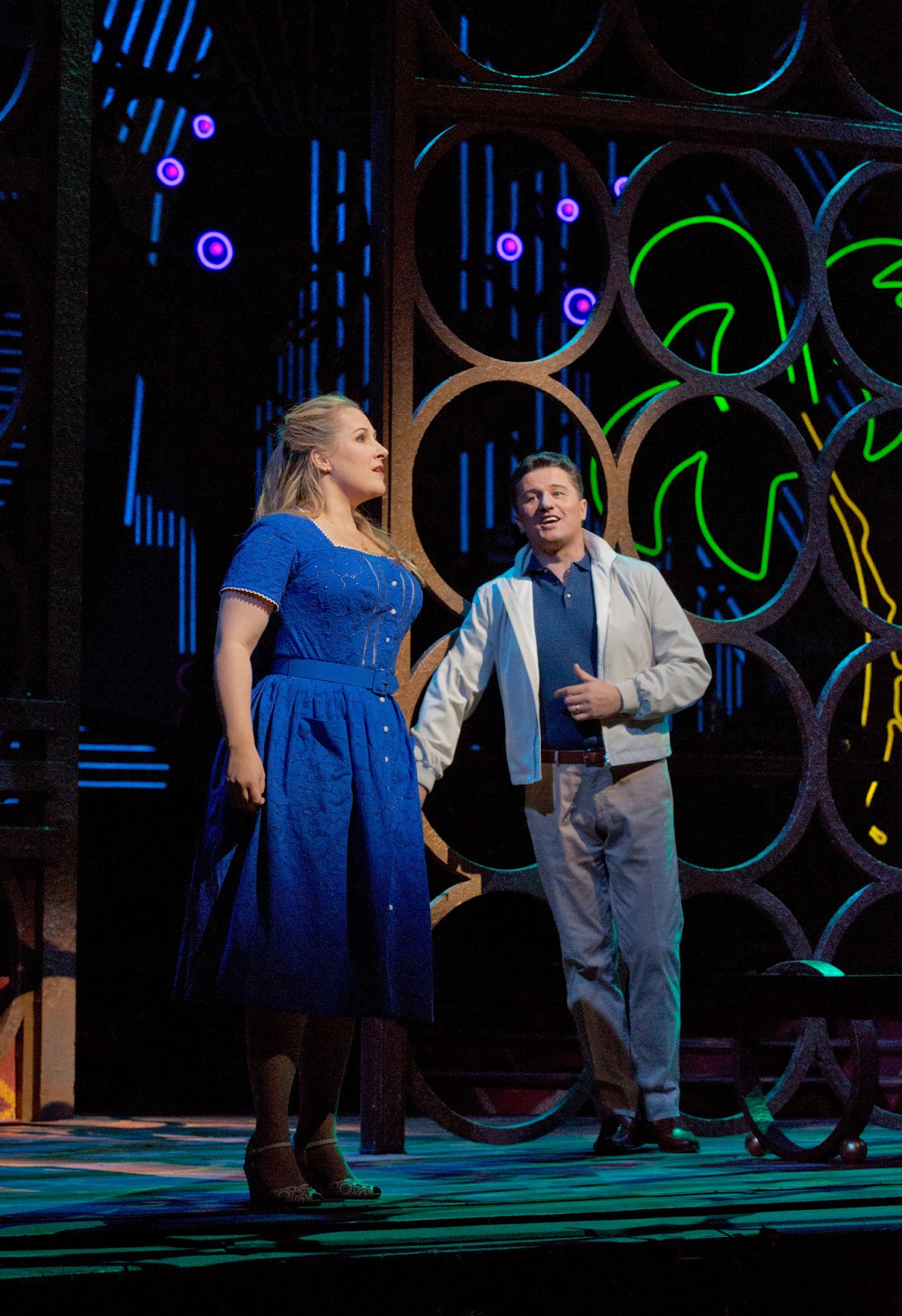
Neon Rigoletto


Poor Renée.  She worked so hard during the intermissions for the Metropolitan Opera's simulcast of Rigoletto trying to get the singers to comment on the production, but mostly they didn't really want to.  They were happy to tell which member of the rat pack they were supposed to be, but that was about it.

Rat Pack:

Rigoletto (Don Rickles):  Željko Lučić (baritone)
Duke of Mantua (Frank Sinatra):  Piotr Beczala (tenor)
Marullo (Dean Martin):   Jeff Mattsey (baritone)
Count Ceprano (Sam Giancana):   David Crawford (bass)

The rest of the cast:

Gilda:  Diana Damrau (soprano)
Maddalena:  Oksana Volkova (contralto)
Sparafucile:  Stefan Kocán (bass)
Monterone:  Robert Pomakov (baritone)

Conductor:  Michele Mariotti
Production:  Michael Mayer

I guessed Don Rickles before Lučić said it.  If you are unfamiliar with Mr. Rickles' work, here is a sample.    I can actually see a certain similarity.


The best neon was in the last scene where it was used spectacularly to illustrate the sound of lightning flashes found in Verdi's score.  I could see this in every Rigoletto.  Amazing.

The man who issues the curse, Monterone, was costumed as an Arab.  Your average American might shoot the Duke, but would not really think of cursing him.  I wonder if this is a scandal.

Hidden in all this glitz was the regular Rigoletto we all know.   Lučić and Diana Damrau, our Gilda, are part of the ensemble of the Frankfurt Opera and well acquainted.  They have even played Rigoletto and Gilda together before and maintained their already highly developed conceptions.  She commented that Gilda wasn't nearly so hard as Fille de Regiment, referring to the San Francisco production, I assume.  She was carried off inside an Egyptian sarcophagus and died in the trunk of a car.  She also skipped her high note at the end of "Caro nome."


The only character who seemed to really shine in this production, to take on the aura of his environment, was Piotr Beczala as the Duke.  Above we see him looking very young in his disguise as a student.  He seemed completely at home in his white dinner jacket and bow tie.  He relaxed into the character and had a wonderful time.

I've never had any real complaints about Renée Fleming's interviews before, but I must say it was foolish for her to ask Piotr about his up coming high note in "La donna e mobile."  He told her he tries not to think about it, but just asking the question jinxed it.  He came very close to blowing it completely.  So.  Never ask a tenor if he is worrying about an up coming high note.  You can ask him after if you want.  Just never before.  You'd think this was obvious. It's in a category with asking a horn player to do his solo standing on the stage.

This is a Rigoletto for an American audience.  Many of the cultural references meant nothing to the international artists playing them.  It worked fine for me.  A father's love for his daughter transcends time and place.  The rat pack image falls apart when you consider that it assumes that Frank Sinatra would ever have dared to fool around with Sam Giancana's wife.
#ad


Thursday, September 13, 2012

SFO Rigoletto


Last night I attended the San Francisco Opera's Rigoletto with the second cast:  Marco Vratogna as Rigoletto, Albina Shagimuratova as Gilda and Arturo Chacón-Cruz as The Duke of Mantua.

Vritogna is the same guy who sang Iago in 2009.  I thought his voice was a bit light for Verdi then, and I almost still do now.  Looking at his performance history, professionals in the business don't seem to share this opinion. He sings a lot of Verdi.  Rigoletto is considered early middle Verdi, almost bel canto, and can be sung lighter than Otello.  Vritogna was the best of the cast, and when the role called for him to rise, he rose to meet it.  His "Cortigiani" was conducted a bit fast by Maestro Luisotti, but was intense and lyrical nevertheless. As a human being, Rigoletto is a mess.  He already hated his boss before the deflowering of his daughter, but deep down inside he is very warm and sweet.  We saw this in this performance.

Shagimuratova was Queen of the Night in the recent Flute.  I liked her a lot more as Gilda.  Perhaps a curvy softness fits her character better than the sharp corners of Queen.  The tenor was ok, I guess.  My friend liked him.  I thought he sounded muffled.  The chorus was terrific.

I put in this picture of the staging so you can see the low stimulus nature of the sets and costumes.  Roman arches.  Occasional patches of color.  That's it.  The acting was also very low stimulus.  Lots of standing around doing nothing.  I've been watching Eurotrash a lot lately, and they keep everyone pretty busy and the sets quite messy.  They are going for high stimulus, low cost.

Something odd is going on at the San Francisco Opera. Until September 29 nothing is playing except Rigoletto.  After that it gradually evolves back into the normal style for a repertory house, which is what the San Francisco Opera has always been.

It is important to know there were a lot of empty seats.

[See Kinderkuchen History 1850-70]

Saturday, February 25, 2012

Sacramento Rigoletto


The characters and story in Rigoletto seem more real to me than most operas.  One could easily imagine real people doing these things.  Man hates job; boss seduces daughter; man seeks revenge on boss; even knowing everything, daughter still loves boss and takes the hit for him.  Verdi liked this plot because it was political:  boss is the king.  We don't really care about this aspect of the story.  Make him a rock star.  Perhaps that's what they intend to do at the Met next season.

I didn't pick up before that Gilda has only been living in Mantua with her father for 3 months, and that this provides an explanation for the fact that she seems to know nothing about him.

This was a full scale production with an interesting set (large violent pseudo-Italian paintings on each side of the Duke's palace) and outstanding period costumes.  It's all very conventional, but nice.  The staging for the Duke and Maddalena was a lot raunchier than I would have wanted to do.  Times are changing.

The best voice of the group was Andrew Gangestad as Sparafucile.  I see he's sung at the Met.  Maddalena was sung by a woman named Buffy Baggott.  Scott Ramsay as the Duke has a pretty but relatively light voice.  I could more easily imagine him in bel canto.  Katrina Thurman as Gilda was enjoyable to hear and an interesting actress.  Her Gilda seemed very real. 

The opera rides on Rigoletto himself.  It's such a complicated role.  He is disgusting, foolish, devoted, and truly tragic.  As Rigoletto, David Small rose to the occasion.

Tim Rolek did his usual good job.  No one took the high notes.

[See Kinderkuchen History 1850-70]

Tuesday, February 22, 2011

Ancient History


When I was 23, my college presented a fully staged version of Rigoletto with orchestra and the whole 9 yards. It has long lived in my imagination as something truly wonderful.

It turns out it has lived also on tape and now on CD. Lou Clayson who was a member of the faculty sang the Duke. Dan Elias who had had polio as a child and was genuinely crippled took off his brace and sang Rigoletto. My friend Gloris Blackburn was perfectly cast as Gilda, and I was Maddalena.  My mentor John Lewis was the conductor.

So yesterday I went to visit Gloris to hear the CD.   We looked at the old pictures and marveled at how young we were and how fabulous Lou looked in tights.  And how glorious it all sounded.

The orchestra was spectacular. John had a love/hate relationship with Verdi, complained about sopranos showing their tonsils on high notes and never gave an inch on tempos no matter how badly the singer was handling it. But the rhythmic excitement that is the heart of Verdi was stunning to the point of overwhelming.

It is nice to hear that he was as great as I had imagined him.

The singing is also wonderful. Lou didn't just look good. Dan had a very exciting tone to his voice, and Gloris was the perfect Gilda. She took all the high notes whether John liked it or not, and long stretches of "Caro nome" are completely unaccompanied, allowing the singer to add as much rubato as she wants.

I was fine. Gloris and I looked at each other and said "soprano."

I can't tell you how pleased I am to report that it was far more wonderful than I had remembered it.

Saturday, December 17, 2005

Rigoletto

Rolando and Anna, pronounced Anya I guess, were on the radio today in Verdi's Rigoletto. I thought the role a bit heavy for Villazon, but exactly right for Netrebko. I really love her singing.

Monday, August 22, 2005

Rigoletto

DR gave me the skinny on the Munich Rigoletto as planet of the apes. She says they paid 80000 Euros for it and pulled it after only two performances. The singers complained that they couldn't hear the orchestra with their heads inside ape masks. They would need to be wired like a quarterback's helmet. More money. Altogether a pretty serious fiasco.

Friday, March 11, 2005

Rigoletto

I’m particularly pleased with my Don Giovanni as Austin Powers idea because it illustrates better than I ever imagined possible the problem with opera today. The problem isn’t with opera—it’s with us. Austin and the Don are both men constantly on the make, men aggressively pursuing sexual encounters. Why don’t we feel the same desire to see Austin cast into hell?

It fills my requirement that the production must explain the action on the stage, and it fills it far better than most modern productions manage to do.

Does the Planet of the Apes concept explain anything about Rigoletto? Planet of the Apes is a parable about racial hatred. Rigoletto is a man whose physical deformities define his life but not his soul. He tries to maintain an island of beauty for himself, while living his life in the midst of debauchery. His job requires him to ridicule this debauchery for comic effect. How well he succeeds in this task is the plot of Rigoletto. Can he keep the inner goodness in the midst of outer evil? Ultimately he fails.

There’s also a feminist element that I’ve never seen exploited: the plot is also about masculine desires to keep their own females sexually pure and prevent them from growing up, an unwillingness to let women control their own destinies.

Casting the opera into Planet of the Apes makes it about prejudice against deformity. These prejudices explain why he’s a jester, but they don’t explain the rest of the plot at all. The actions of the court toward Rigoletto’s daughter are based on their perception that he is the same as they are and not on a perception of difference.

The tragedy of Rigoletto lies in the success of his pretense—it never occurs to them that he doesn’t share their values. We weren’t told how Rigoletto dressed. Is he dressed as a human in an ape suit? No, I cannot get this concept to cast any light on the plot of Rigoletto. He creates his tragedy. The others are merely the means. His deformities explain why these two very different types of people are thrown together, but Rigoletto creates his own fall.