Showing posts with label Rev Video. Show all posts

Friday, January 01, 2021

Messiah from San Francisco

This is a performance of Handel's Messiah from Grace Cathedral, an Episcopal cathedral on Nob Hill in San Francisco, by the American Bach Soloists.  They are the original instruments ensemble I visit regularly in Davis, but they perform Messiah only in Grace Cathedral, which is a bit far away for me.  They are seriously striving for an authentic style, and I think the effort here was very successful.  If you are not getting enough Messiah, I recommend this one.  Disclaimer--there is no historical basis for using a countertenor to replace the alto solo.  This is my usual complaint.


Saturday, October 31, 2020

Lucia di Lammermoor in San Francisco


ConductorJean-Yves Ossonce†
Production designer-Paul Brown

Normanno-Matthew O'Neill
Enrico Ashton-Gabriele Viviani †
Raimondo Bidebent-Oren Gradus
Lucia-Natalie Dessay
Alisa-Cybele-Teresa Gouverneur
Edgardo Ravenswood-Giuseppe Filianoti
Arturo-Andrew Bidlack

This is Natalie Dessay in San Francisco in 2008 singing Donizetti's Lucia di Lammermoor.   I attended and reviewed at that time.  This is Donizetti's most popular serious opera, but perhaps I only like the comedies. 

I've seen 6 different productions of this opera by now, and my favorite by a wide margin is the Zimmerman version with the fountain and the ghost.  The ghost is my favorite.  I understand they are retiring it, which seems very sad to me.  This one from San Francisco is rather dull.

I am enjoying Filianoti more this time.  The singing is fine. I have only seen 6, so from the ones I've seen, I prefer the one with Lisette and Javier I saw in 2018.  I apologize for all this comparing.

Saturday, October 19, 2019

Cabaret Revival


Master of Ceremonies  Alan Cumming
Sally Bowles  Michelle Williams

I am viewing a film of the 2014 Broadway revival of Cabaret.  I can easily see why Alan Cumming won a Tony for this.  I also remember him saying when it ended how glad he was to never have to wear the costume again.

The music is stimulating, but as the show goes on, NAZI salutes and arm bands appear.  This is the real thing with all the ugliness left in, something that doesn't usually happen in movies.  The politics is hard to take, but I'm glad I saw this.

Saturday, October 12, 2019

Porgy and Bess on Broadway


Bess - Audra McDonald
Porgy - Norm Lewis
Sportin Life - David Alan Grier

I am watching a “non-television” film of Gershwin's Porgy and Bess from the 2012 Broadway production.  Until I saw this, I did not realize that there are actually 2 so very different versions of this work.  Until now I have only been aware of the opera version where all the text is sung and accompanied by a standard opera orchestra, the original version from 1935.

The Broadway version is substantially shorter and includes spoken dialog written for this production.  The sound of the recording isn't good enough to understand most of this.  As an opera fan and musician, I very much miss the sound I am used to.  I'm getting more of a swing band sound here with a lot of brass, or perhaps it should be described as a pit band.  If there are violins, I'm not hearing them.  The singing is pretty good, but the backup kind of leaves them hanging.  I haven't kept in touch with the Broadway sound in the 21st century. Audra is classically trained, but I don't believe the others are.  This is just my opinion.

The aim here isn't opera but is instead to produce a realistic, life-like view of southern black culture.  It is felt that presentations by large opera companies don't achieve this.  There is a lot of realistic acting, occasionally approaching actual abuse.  I've seen Audra in a full length work before, live for Mahagonny, and she is astounding here.  She quit the run early because of illness.  I can see now that she spends a lot of time shouting, not a good idea for a singer.  I remember well going to sports events as a teenager and its effect on the voice.

Though Porgy and Bess has always been controversial, my own perspective doesn't really have anything to add to this argument.  Many count the entire story to be racist. Edwin DuBose Heyward who wrote both the libretto and the novel it is based on was southern white and of the planter class.  Read Audra McDonald's take on racism in Porgy and Bess here.

This is mind altering, not at all the Porgy and Bess of memory, but still one knows that it does not exist without Gershwin.  This particular version doesn't exist without Audra McDonald.  The general impression is one of intense raw power.  It's rather frightening.

I think it is regrettable that there is no commercial film of this.  I feel glad I saw it at all, but a commercial film would result in clearer sound, making the dialog easier to understand and the music more beautiful.  It did not woo me away from my operatic version.  I could almost count this as a new opera.


Tuesday, September 24, 2019

Opera on DVD Revised

These DVDs fill in some enormous gaps in Metropolitan Opera on demand video listings.  There are, of course, many more than what I'm showing.  I generally prefer to recommend currently or recently active performers.  For my recommendations from the Met on demand see here.

It is impossible to complete this list.  I include my favorites Jonas Kaufmann, Philippe Jaroussky, Cecilia Bartoli, Anna Netrebko, etc.

Baroque


The Met is woefully lacking in this area. I like:
 
L’Incoronazione di Poppea Monteverdi 2008 with Danielle de Niese
Dido and Aeneas Purcell Dido and Aeneas with Sarah Connolly
Giulio Cesare Handel Cecilia at Salzburg-Grammy nomination
Orlando Furioso Vivaldi Marie-Nicole Lemieux
Artaserse Vinci Artaserse with 5 Countertenors
Partenope Handel YouTube from San Francisco
Semele Handel Zurich Cecilia
Theodora Handel Theodora from Glyndebourne

I will need to do additional research to find the best version of Monteverdi's L'Orfeo, a very significant opera.  But the Danielle de Niese L’Incoronazione di Poppea is a fine Monteverdi example.

Two star Cecilia Bartoli, one from Zurich, Semele, and one from Salzburg, Giulio Cesare.  Operas chosen for the modern productions are Partenope and Theodora.  A modern production can improve a Baroque opera.
#ad


Classic

Orphée et Eurydice Gluck Vesseliina Kasarova
Don Giovanni Mozart Bartoli Zurich
Le Nozze di Figaro Mozart Netrebko Salzburg

The Met on demand has covered this genre, but I will keep searching for examples to add here.    The Gluck shown above is a wonderful performance of the Berlioz arrangement made for Pauline Viardot.

Saturday, April 20, 2019

La Forza del Destino at ROH

👍🏻
Conductor: Antonio Pappano
Original director: Christof Loy

Leonora: Anna Netrebko
Don Alvaro: Jonas Kaufmann
Don Carlo di Vargas: Ludovic Tézier
Padre Guardiano: Ferruccio Furlanetto
Fra Melitone: Alessandro Corbelli
Preziosilla: Veronica Simeoni
Marquis of Calatrava: Robert Lloyd
Curra: Roberta Alexander
Alcalde: Michael Mofidian

This production of La Forza del Destino from the Royal Opera in London emphasizes the already chaotic nature of this opera.  The plot is enhanced by staging the overture with scenes from the childhood of siblings Leonora and Don Carlo.  It is clear that Don Carlo hates his sister from long before her boyfriend shot their father.   A grown up Don Carlo is still playing with a red yo-yo from these scenes.  This is a visual clue so you will recognize Don Carlo as a grown up.

The opening scene of the shooting is by far the best staging I have seen of this difficult scene. Wonderful. You must believe that he intends no harm when he throws the gun to the floor. A further enhancement in the staging comes with projections of this death scene to show how it lives in Leonora's memory.

I love this chaotic opera, primarily for the music--it is some of the best Verdi--but would like very much to love it as theater as well.  It never quite works.  But here the opening is true to the plot and clearly outlined.  With our love of guns we still must ask ourselves, "What is he doing in her house with a gun in the first place?"

I'll admit I could do entirely without Preziosilla and her scenes.  Now that I realize "rataplan" came from Meyerbeer, I'm still not sure anything about the opera is improved by it.  Silliness in the deadly serious opera seems like nonsense.  It represents soldiers relaxing between killing people.  When Leonora sees her brother in this place, she knows she must go into hiding.

It's a terrible opera with glorious music and in this case spectacular singing.  Netrebko represents the
fear and horror that haunts Leonora with wonderful intensity.  Jonas is his usual spectacular self.  Tézier is a beautiful man who portrays Don Carlo's evil nature better than seems possible.  All this great music is wasted on useless vengeance.  I guess Rigoletto has a similar plot but hating your boss and hating your sister are rather different.  At least Rigoletto loves someone.

Wednesday, February 13, 2019

La Serva Padrona

Conductor:  Sigiswald Kuijken
Stage Director:  Ferruccio Soleri

Uberto....Donato Di Stefano
Serpina...Patrizia Biccirè
Vespone..Stefano Di Luca

I tried to watch this version of Pergolesi's La Serva Padrona, 1733, roughly contemporary with Handel's Orlando, but it was just people standing around singing with no translations.  The music is charming, but I wanted to know what was going on.

So I turned to this DVD from Accademia Barocca de I Virtuosi Italiani.

Conductor:  Corrado Rovaris
Stage Director:  Henning Brockhaus

Uberto....Carlo Lepore
Serpina...Alessandra Marianelli
Vespone..Jean Meningue

We are at the beginning of the rococo.  This one staged the opera as though we were at a circus where Uberto was the manager and Serpina one of the acts.  She refuses to get his chocolate and then threatens to marry a nasty military man who will probably beat her.  The third character seems to be a mime.  The music is still charming with the usual mixture of arias and recitatives.  There was a huge war over this in Paris in the days when there was still opera rioting.  It had something to do with Jean Jacque Rousseau.  Serpina tricks Uberto into marrying her, turning la serva into la padrona.  From our perspective it doesn't seem like much to get excited over.
#ad

Thursday, November 15, 2018

Jonas Kaufmann Operas on Blu-ray #ad

These are only the complete operas on Blu-ray or perhaps DVD.  There are 17 films of complete operas on YouTube.  There are also quite a few videos of concerts.  Jonas with Anja Harteros:
#ad


They have also done Il Trovatore and Andres Chenier (YouTube--I prefer this one) together.

Jonas with Nina Stemme (also on YouTube):


Jonas with Angela Gheorghiu:


Jonas with Emily MaGee:


Jonas with Vesselina Kasarova:


Jonas with Maria Agresta:


Jonas with Kristina Opolais:


Jonas with Sophie Koch:


Jonas with Eva-Maria Westbroek:


My favorites are Werther, Fanciulla and Lohengrin, but all of them are good.

Monday, August 06, 2018

Lohengrin from Bayreuth -- the Blue Lohengrin


Conductor:  Christian Thielemann
Production:  Yuval Sharon

King Heinrich:  Georg Zeppenfeld
Lohengrin:  Piotr Beczala
Elsa von Brabant:  Anja Harteros
Friedrich von Telramund:  Tomasz Konieczny
Ortrud:  Waltraud Meier
Heerrufer:  Egils Silins

The complete Lohengrin from Bayreuth has been posted on YouTube.  Piotr replaced Roberto Alagna in the title role, probably because Christian Thielemann had worked with him in his debut in the role in Dresden.  Piotr is quite successful in this role.  Lohengrin doesn't take on the Heldentenor tone seen in later Wagner.  Anja Harteros is making her Bayreuth debut here.  In her interview she says that Thielemann never does anything the same way twice.

At the beginning of the opera Elsa is already bound as a prisoner.  You will note please that the wings some of the characters wear only appear on the ruling classes.  King Heinrich has them, as do Friedrich and Ortrud, and of course Elsa.  This makes them symbols of position?  When the duel begins, the fighters fly up into the air, which makes the ropes defining the fighting ring irrelevant.  Lohengrin steals Friedrich's wings and is awarded his own set to adorn his costume when he wins the battle.

Monday, July 23, 2018

The Demon


Conductor: Mikhail Tatarnikov
Director: Dmitry Bertman

Demon: Dmitri Hvorostovsky
Tamara: soprano Asmik Grigorian
Angel: countertenor Vadim Volkov
Tamara's nurse: contralto Larisa Kostyuk
Prince Sinodal, Tamara's betrothed: tenor Vasily Efimov

In the semi-staged performance of Anton Rubinstein's The Demon from Russia we have Dima singing gloriously. There appear to be no subtitles. You may look up the plot in Wikipedia, of course. I watched it on YouTube. It's gone now.

Two weeks ago I did not know this work existed.  The music is not very adventuresome but inspires some wonderful singing by this cast.   The idea here is that someone can be condemned for loving inappropriately.  You would want this for Dmitri.   YouTube includes some other versions, including one with Kristine Opolais.


Sunday, July 01, 2018

Iolanta / Perséphone


Conductor:  Teodor Currentzis
Production:  Peter Sellars

These two operas -- Tchaikovsky's Iolanta (1892) and Stravinsky's Perséphone (1934) -- were presented together at Teatro Real in 2012.  Both were staged by Peter Sellars.  I am considering this as the end of my Peter Sellars project.

Iolanta

René, King of Provence, bass, Dmitry Ulianov
Robert, Duke of Burgundy, baritone, Alexej Markov
Count Vaudémont, a Burgundian knight, tenor, Pavel Cernoch
Ibn-Hakia, a Moorish physician, baritone, Willard White
Alméric, armor-bearer to King René, tenor, Vasily Efimov
Bertrand, doorkeeper of the castle, bass, Pavel Kudinov
Iolanta, blind daughter of King René, soprano, Ekaterina Scherbachenko
Marta, Bertrand's wife, Iolanta's nursemaid, contralto, Ekaterina Semenchuk
Brigitta, Iolanta's friend, soprano, Irina Churilova
Laura, Iolanta's friend, mezzo-soprano, Letitia Singleton

Iolanta is a fairy tale sung in Russian.  It was not brought to its full effect in its semi-realistic setting at the Met in 2015.  The magic was missing.  We are presented here with abstractions.  Door frames are topped with mysterious dark objects that sometimes suggest birds.  Instead of a film, we have still pictures.  Iolanta carries a cane, as the blind often do.  Her own chamber music group accompanies her.  I think we may presume they are singing the original text rather than the Soviet approved one.

28 minutes in we have movement just in time for the wonder of Willard White.  I find this abstraction very beautiful, but when they sing of roses, no roses appear.  I like the soprano very much, but the tenor could be better.  This is Sellars' area of expertise.  He isn't here to provide you with pretty scenery.  He's here to provide you with a spiritual experience.

Perséphone

Eumolphe, tenor, Paul Groves
Perséphone Speaker, Dominique Blanc
Perséphone dancer, Sam Sathya
Demetra, dancer, Chumvan Sodhachivy
Pluton, dancer, Khon Chansythyka
Mercure, Démophoon, dancer, Nam Narim

Perséphone is a Greek myth about the underworld, here sung in French.  We are in the same set as the previous work, and visually the two are similar.  There is a tenor, a speaker, a chorus and dancers from Cambodia but no choreographer.  The director seems to have collaborated with the dancers.  The music is serene for Stravinsky.

A line caught my eye:  "never chase after what your eyes gaze on too lovingly."  The story of my life.

The pairing of these two works is genius.  The entire thing is a meditation on beauty.  Life is beautiful.  Love it more.  Do not go into the darkness never to return.  Open your heart to beauty.  Thank you, Peter.

Since I am counting this as the end, I repeat the score card here.  It omits works where Sellars is the librettist.

Score card:

Great things:  Mozart La Clemenza di Tito, Handel Theodora, Bach Matthew Passion, Iolanta / Perséphone
Hits:  Saariaho L'Amour de Loin, Mozart Don Giovanni, Nixon (1st)
So so: Mozart Figaro, Giulio Cesare
Misses:Vivaldi Griselda, Adams The Death of Klinghoffer, Nixon (2nd)
#ad 


Saturday, June 23, 2018

Die sieben Todsünden


Die sieben Todsünden [Seven Deadly Sins], 1993, by Kurt Weill with text by Bertolt Brecht, directed by Peter Sellars, represents the intersection of two of my obsessions:  Weill and Sellars.  One will probably run out soon, but the other is forever.  This work is called a ballet with song.

Conductor:  Kent Nagano
Director: Peter Sellars
Choreographer:  Donald Byrd

Anna I     soprano, Teresa Stratas
Anna II dancer, Nora Kimball
Brother baritone, Frank Kelley
Mother bass, Peter Rose
Father first tenor, Howard Haskin
Brother second tenor, Herbert Perry

A:  Prolog  Anna I sings, she is from Louisiana.
1:  Sloth    Family sing.
2:  Pride (Memphis)   Anna I sings, Anna II dances.
3:  Anger (Los Angeles) Family sings, Anna I and II are arrested.
4:  Gluttony  (Philadelphia)  She writes her family.  One of the guys is wearing an As jacket.
5:  Lust  (Boston) They are hooking, Anna II has a pimp and gives him her money.  Strife.
6:  Avarice  (Baltimore) She's a celebrity?  Golf.  Family sing.
7:  Envy  (San Francisco)  Anna sings.  Wrath is kindled by injustice.  Definitely San Francisco.
Z:  Epilog  They're home, but they don't look happy.

This is fun, the music is nicely played and sung but one grows tired of the endless closeups which seem always too close.  One might wish to see it in a theater.  I get the impression this was originally performed as a ballet in Lyon 6 years earlier.  I might have preferred that.  Faces without context don't make a story.  I will need to see other versions.

#ad

Friday, June 22, 2018

Giulio Cesare alla PS


Forgive me.  I approach everything from the perspective of obsession and am watching Peter Sellars' take on Handel's Giulio Cesare from 1993.  There is no indication of a live audience.  Jeffrey Gall is Caesar, my fourth countertenor experience in this role.  He has a brighter sound than Scholl, Daniels or Fagioli.  His coloratura is impressive.  One of the firsts for me here is Lorraine Hunt en travisti as Sesto.  I would not have gone in quest of Peter Sellars if it weren't for the hidden treasures of Lorraine.  This is filmed somewhere in Europe.


Tolomeo, Cleopatra's brother, is sung by Drew Minter, Cleopatra is Susan Larson and Cornelia is Mary Westbrook-Geha.  My point of departure for the role of Cleopatra is Cecilia Bartoli, and Susan Larson sounds nothing like her.  I don't know how much of this I can watch.

I am mentally reviewing the versions of this opera that I have seen and can only conclude that it is regarded as a comedy.  In Zurich the Egyptians wear striped boxers.  In Salzburg Cleopatra rides a rocket.  At the Met we have wandered into a Bollywood movie.  It's hard to take any of these seriously.

This one is also not serious.  Caesar is president of the United States, apparently, due to seal of the President on the podium.  Tolomeo most resembles a punk teenager.  We have begun to notice that Peter Sellars' version of Regietheater moves every opera to somewhere American.  This is what he knows, so this is what he does.  The first person who appears representing Tolomeo and delivering Pompey's head is dressed a bit like Fidel Castro.  This at least is serious.

Caesar and Ptolemy are negotiating, and after a while Caesar starts throwing cups and felt tipped markers at Ptolemy.  Caesar has a lot more pens in his pockets and he throws them.  Then he opens the water bottles, spills water all around, and exits smiling.  He's always smiling.  Sellars seems to have anticipated our current administration.

By now I am used to the musical quality of the Bartoli GC.  Perhaps I am spoiled forever.

In Act II both Ptolemy and Achilla are harassing Cornelia.  They are laying it on pretty heavy.  So far she just frowns.  Ptolemy wraps her in a garden hose.  Sesto plans to accompany his mother into Ptolemy's harem where he can exact his revenge.  I am watching this for curiosity.  It isn't redeeming itself.  Only Lorraine is outstanding.  She waves her machine gun around menacingly.

They go with comedy all the way to the end.
#ad 

Thursday, January 11, 2018

Die Fledermaus from Glyndebourne

Prince Orlofsky, Herr von Eisenstein
👍🏻
Conductor:  Vladimir Jurowski
Director:  Stephen Lawless

Gabriel von Eisenstein tenor/baritone Thomas Allen
Rosalinde, Eisenstein's wife soprano Pamela Armstrong
Adele, Rosalinde's maid soprano Lyubov Petrova
Alfred, a singer teacher tenor Pär Lindskog
Dr Falke, a notary baritone Håkan Hagegård
Dr Blind, a lawyer tenor Ragnar Ulfung
Frank, a prison governor baritone Artur Horn
Prince Orlofsky mezzo-soprano (en travesti) Malena Ernman

I'm always on the lookout for a good Die Fledermaus in German, and I have found one from Glyndebourne 2003.  The deutsche Ausprache [German diction] is excellent.  It is for a long time commonplace to change the book for Fledermaus.  If you see 3 of them from 3 different places, the story will use 3 different versions of the spoken dialog, and I don't mean because it was translated.  In this version they talk quite a lot, thus the importance of good diction, but they skip the part in act I where Dr Falke personally invites Rosalinde to Orlofsky's party.

This is truly an outstanding cast.  Thomas Allen is perfect for Eisenstein, both as singer and as actor.  He is both affectionate and a bit indifferent toward his wife.  There is a joke where he pretends to be a tenor by tuning his wife's piano down.  He knows she prefers tenors.  I like the Rosalinde very much.  The dialog makes clear that Rosalinde and Alfred were former colleagues in the musical theater.

It is mentioned more than once that Prince Orlofsky is 18 and bored.  Bored is nothing new, but I don't recall hearing how old he is.  And Malena Ernman may be the greatest of all cross-dressers.  Why did I not mention her in my cross-dressing discussion?  Partly because I haven't seen her that much.  She doesn't make it to the west coast.  Did you know she sings Olympia and Queen of the night?  I certainly didn't.  She enjoys very much the theatrical side of opera.  She goes around patting the men on the butt.  Genial.  She ornaments the final verse of "Chacun a son gout."  I don't recall ever seeing that.

The stage rotates to show the entertainment.  Doctor Falke reveals many things to Rosalinde about her husband, all of which she forgives, until he tells her that he is actually not a tenor.  Then she threatens to murder him.  Herr and Frau Eisenstein go immediately to the watch seduction which she already knows all about.  "You may remove my mask tomorrow at breakfast."  He answers "Morgen habe ich andere Sorgen."  [Tomorrow I have other problems.]  One of my favorite lines.  Tomorrow he will be in jail.  She steals his watch and leaves. The watch scene is reasonably amusing.

Now comes the Csárdás.  This is the wrong order but works fine.  "Brüderlein und Schwesterlein" for Falke and chorus is a personal favorite.  There's a guy taking photographs.  Oops.

On to the jail.  Frosch's long pantomime is cut.  All proceeds exactly as it should except Orlofsky removes his disguise and shows Malena Ernman.  I smile and sing along.  "Und mein Schlafrock?"  "Requisite."  [And my dressing gown?  Properties.]  In this version everyone is part of the revenge set up, which explains a lot.  A good English translation of the title would be Revenge of the Bat.  I do love it so.
#ad

Friday, August 25, 2017

Theodora from Glyndebourne

 👍🏻
Conductor:  William Christie
Director:  Peter Sellars

Theodora, a Christian of noble birth, soprano: Dawn Upshaw
Didymus, a Roman Officer, converted by and in love with Theodora, originally alto castrato, here countertenor:  David Daniels
Septimius, Roman soldier and friend to Didymus, tenor:  Richard Croft
Valens, President of Antioch, bass:  Frode Olsen
Irene, a Christian and friend of Theodora, mezzo-soprano:  Lorraine Hunt
Messenger, tenor:  Michael Hart-Davis

Someone said that Peter Sellars' production of Handel's Theodora was even better than his La Clemenza di Tito, so I thought I would give it a try.  He seems best in things that have religious themes.  This is one of Handel's oratorios and is in English.  This film is from 1996.

Hmmm.  There are soldiers and they wear American flags on their sleeves.  It's politics and religion rolled into one.  Christians are ordered to bow to idols to show loyalty to Caesar.  This is a  joy.  And then there is Lorraine Hunt.  It would be hard to ask for more.  He stages the first Christian scene like a prayer meeting, except women speak.  Lorraine sings of prosperity and people put money on the floor.  Many are in white and kneel on the floor to pray.  The chorus always present in any Handel oratorio represents the congregation.


Soldiers enter and warn the Christians that they are tempting fate.  "Dread the fruits of Christian folly."  This is not the usual oratorio libretto.   I understand it was not popular at its premier.  Oratorios usually draw their plots from either scripture or mythology.  Theodora is an historical Christian martyr.

I begin to grasp Peter Sellars' world view.  He sometimes strays too far from it.  He is THE outstanding American leader in the world of Regietheater, and this is one of his greatest works.  Among his productions, this one makes no alterations to the original text.

Apparently, honoring the Emperor consists of getting falling down drunk. So far I don't find this staging to be at all a distortion of the original.  People just look like people today instead of ancient Romans.  If this bothers you, you should get over it.

Christians are serious people while pagans are drunks seems to be the general idea.  One remembers this primarily for the work of Lorraine Hunt, but I am enjoying also Dawn Upshaw and David Daniels.  Theodora is in prison and Didymus visits her.  She asks him to kill her, but instead they exchange clothing and she escapes.

This is an extraordinary piece, deeply emotional.  One needs exposure to a wider range of Handel's works.  Here we still hear the Italian coloratura along side the more English lyricism and Handel's great choral music.

The picture above depicts the application of the death penalty.  The ending is sad and strange.  Christians wave their arms rather more than is strictly tolerable.   My experience of the Baroque does not include anything like this.  I came for Peter Sellars and Lorraine Hunt but ended with the joy of some of the most beautiful music of Handel I have ever heard.
#ad 

Sunday, July 23, 2017

Artaserse with 5 Countertenors

Artabano, Mandane, Arbace, Megabise, Artaserse, Semira.  I think.
👍🏻
Conductor–Diego Fasolis
Director--Silviu Purcărete

Artaserse, Prince and then King of Persia; friend of Arbace, in love with Semira--Philippe Jeroussky
Mandane, Sister of Artaserse; in love with Arbace (en travesti)                   -- Max Emanuel Cencic
Artabano, Prefect of the Royal Guard; father of Arbace and Semira            -- Juan Sancho
Arbace, Brother of Semira; Friend of Artaserse; in love with Mandane        -- Franco Fagioli
Semira, Sister of Arbace; in love with Artaserse (en travesti)                       --Valer Barna Sabadus
Megabise, General of the Persian Army, confidant of Artabano; in love with Semira --Yuriy Mynenko

This is a film of the opera Artaserse by Leonardo Vinci on a libretto by Metastasio which was first performed in Rome in 1730.  It was the last opera for Vinci who died that year, and the first for Metastasio.  Vinci is one of the great Baroque Italian composers whose operas are only now being revived.  Women were not allowed on the stage in Rome, so all the characters were originally sung by castrati except Artabano who is a tenor and the villain.  This performance exists to remind us that opera is an Italian art form.

All the castrati are here countertenors and some of the most famous countertenors of our time.  These guys are amazing.  The opening pair are Cencic and Fagioli, both incredible, and the music is gorgeous.  The range of colors in our 5 countertenors is pretty fascinating.  It remains to be seen if the fascination will wear off before the opera ends.  So far 6 Rossini tenors pales in comparison.  They have been assembled in Nancy in the west of France.

At the start there is some breaking of the fourth wall in case you missed that these are all guys.  Some start out in their modern clothing, for instance.  Stagehands appear, and all of them are girls.  Hmmm. These are theatrical stagehands--when the real stagehands appear, they are all men.

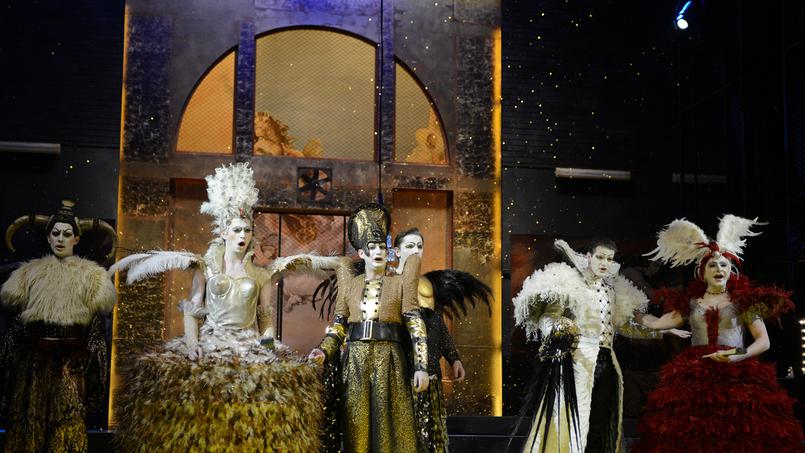
There is an attempt here to present Baroque costumes, though they seem to suddenly appear and disappear.  Now that Artaserse is king he appears in an incredible white wig with horns and a white outfit.  Then Artabano appears in the same outfit.  Jeroussky has the most beautiful voice, but there is much to admire here.  The most spectacular is probably Fagioli, but they're all pretty amazing.

Plot.  There is an offstage murder of the present king, Artaserse's brother.  This makes Artaserse king and causes a lot of accusations.  Artabano is probably to blame.  He and Megabise plot to marry Semira to Megabise instead of Artaserse.  Since the male characters all wear the same white outfit, it's very hard to keep track of who is who.  Some visual help would have been good.  Artabano tries to poison Artaserse, but when it appears that Arbace will drink the poison, Artabano confesses.  It has a happy ending, as do almost all opera seria.

What it is actually about is singing, of course.  If you are at all curious to know what Baroque opera was really like, this is probably your best opportunity.  This is the Italian Baroque opera and not the French version which had no castrati.  These guys belt it out in a way that is surprising.  It is a unique experience, unlike anything I have seen in all my years of going to the opera.


Jaroussky removes his hats and wigs as soon as possible, giving the impression that he doesn't much care for dressing up.  The tenor is banished.  All six characters return for a song at the end.  One of the "girls" brings out the conductor.  The music is spectacular, not just the singing.  Find a way to add this to your experience of opera.

#ad

Thursday, June 29, 2017

Macbeth rerun


I loved seeing Macbeth again and had pretty much the same reaction as last time.

Conductor: Fabio Luisi
Production: Adrian Noble

Macbeth: Željko Lučić (baritone)
Banquo: René Pape (bass)
Lady Macbeth: Anna Netrebko (soprano)
Duncan, King of Scotland: Raymond Renault
Malcolm, Duncan's son: Noah Baetge (tenor)
Macduff, Thane of Fife: Joseph Calleja (tenor)

The witches with their purses is fun.  This time I liked Željko Lučić more.  I went with a friend who had never seen this opera before.  We both had a wonderful time and are looking forward to Carmen and Otello next month.
 #ad

Sunday, April 23, 2017

Dido and Aeneas


Christopher Hogwood conductor
Wayne McGregor choreography, stage director

Lucy Crowe (Belinda)
Sarah Connolly (Dido)
Anita Watson (Second Woman)
Lucas Meachem (Aeneas)
Sara Fulgoni (Sorceress)
Eri Nakamura (First Witch)
Pumeza Matshikiza (Second Witch)
Iestyn Davies (Spirit)
Ji-Min Park (Sailor)

There is a film of Purcell's Dido and Aeneas on medici.tv which can be viewed through Amazon prime. I performed the spirit as a freshman in college and am always surprised by the level of detail I can remember.  Except now everyone does ornaments that are not in the score.  I doubt sincerely that they are extemporized.

Lucy Crowe and Sarah Connolly are worth the visit.  One of the odd features of this performance is that the First Witch and Second Witch are portrayed as Siamese twins joined at the side. 

Since I left college, I have only seen this opera staged by choreographers.  It would be nice to see it done as an opera.
 #ad

Wednesday, April 05, 2017

Orphée et Eurydice

👍🏻
My education with regard to Gluck's Orfeo ed Euridice is woefully inadequate.  In part to compensate for this I have purchased this DVD of Orphée et Eurydice starring Vesselina Kasarova.  The other reason was to see more of Kasarova.

This is the version created by Hector Berlioz in 1859 for Pauline Viardot, making it a legitimate vehicle for a star like Kasarova.  The role in Italian was written for a castrato, and in French it is often sung by a haute-contre (French high tenor).  Only since 1950 has the role been taken by a countertenor.  At Glimmerglass I saw Michael Maniaci who bills as a male soprano.

The curious feature of this production is the genderless costuming.  Whatever style is on display, it is worn by both males and females.  I've always wondered what this would be like.  At first everyone is dressed in men's tuxedos.  The fires of hell are tended by laborers in bakers' hats. Then we see Greek outfits which look a bit odd on the men.  Then back to tuxedos.

An annoyingly large amount of time in this not that long opera is consumed by ballet.  If you are French, this probably is not a problem.  The chorus mimes an orchestra.  Vesselina does not play her violin, but she sings and acts gloriously.  To fully understand why Berlioz would make such an arrangement for Viardot requires that you see such a towering performer in the role of Orphée.  It is a tour de force.

#ad

Sunday, March 12, 2017

The Salzburg La Bohème

Instead of going to the HD of La Traviata, I went to a party where the film of Puccini's La Bohème from Salzburg in 2012 was shown projected on the wall.  I liked very much seeing the faces up close.  Mimi isn't lighting her candle, she is lighting her cigarette.

Conductor: Daniele Gatti,
Production:  Damiano Michieletto

Anna Netrebko (Mimi)
Piotr Beczala (Rodolfo)
Nino Machaidze (Musetta)
Massimo Cavalletti (Marcello)
Alessio Arduini (Schaunard)

The production is supposed to make you think of Paris.  There are many reminders.  I love this wonderful cast and enjoyed seeing it again.

I have only enjoyed the Traviata red dress production when it was done with Netrebko.  Perhaps I will watch my DVD.
#ad