Showing posts with label Donald Runnicles. Show all posts

Sunday, March 28, 2021

San Francisco Ring -- Götterdämmerung


Conductor - Donald Runnicles 
Director - Francesca Zambello 

Brünnhilde - Iréne Theorin 
Siegfried - Daniel Brenna 
King Gunther - Brian Mulligan 
Hagen, Alberich's son - Andrea Silvestrelli 
Gutrune, sister of Gunther - Melissa Citro 
Waltraute - Jamie Barton 
Alberich - Falk Struckmann 

Götterdämmerung completes the Richard Wagner Ring cycle.  This is my first time for this production.

Act I

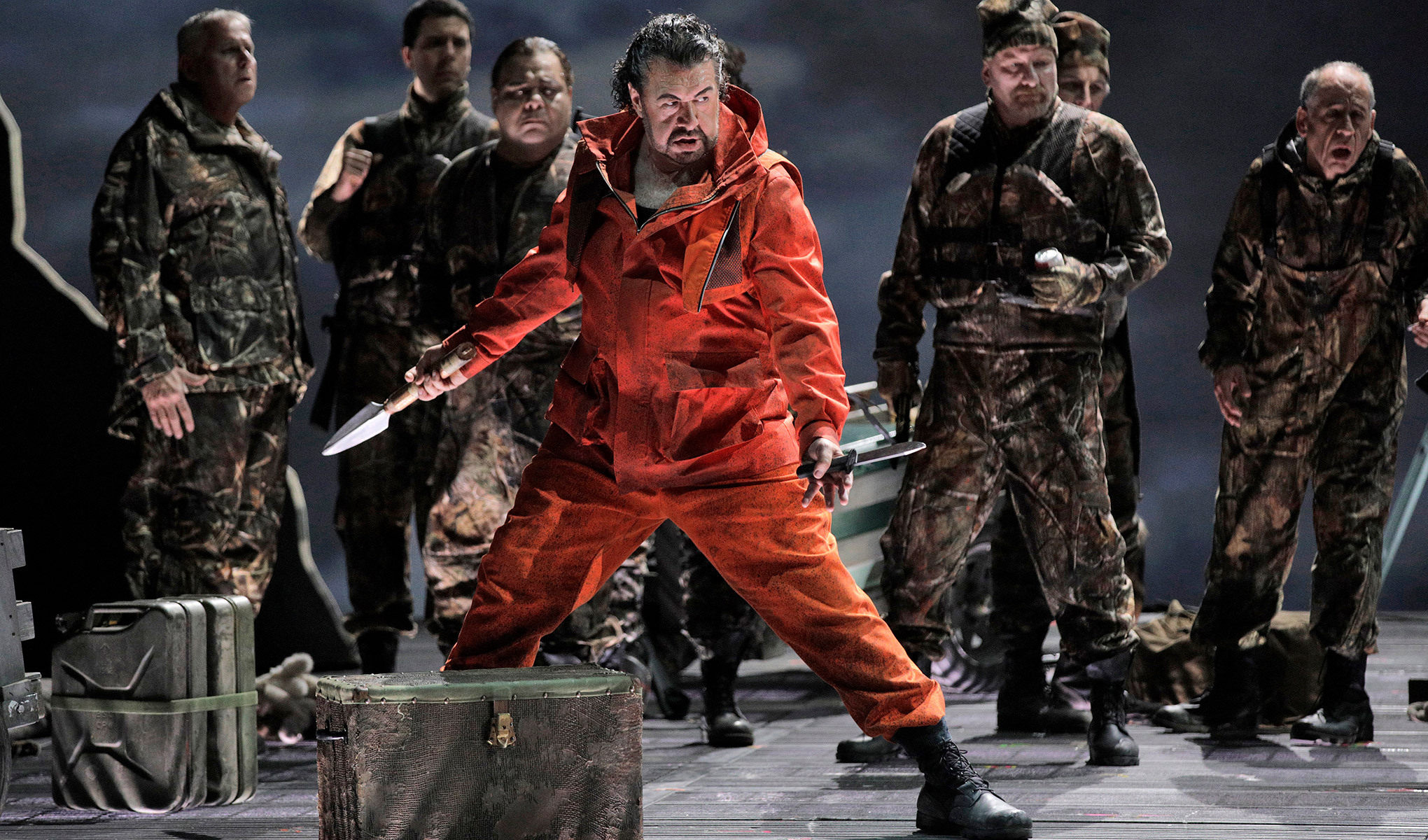
The balance between the orchestra and the three Norns is terrible. Why is this always such a problem?  Why don't properly placed microphones solve this?  Instead of threads, these strands of fate are fat electrical cables, and when one breaks, the Norms die.

We see Siegfried and Brünnhilde after their night together still blissfully in love.  He gives her the ring and goes off to explore.  The Rhein valley looks like a refinery.  

Siegfried ends up at the posh home of Gunther, Hagen and Gutrune.  He has taken the tarnhelm with him and tells them where he got it.  He drinks a potion, falls immediately for Gutrune and forgets all about Brünnhilde.  

Now we are back with Brünnhilde where she waits for Siegfried.  Her sister Waltraute arrives.  I like very much Iréne Theorin.  I remember that she was an emergency replacement.  I'm not sure I think Jamie Barton is a Wagnerian.  Waltraute tells Brünnhilde about how much Wotan has changed.  

After Waltraute leaves, Siegfried returns with the tarnhelm on his head.  The other three parts of the San Francisco Ring had subtitles, but this one does not.  It's hard.  He takes the ring from Brünnhilde and leads her off.

Act II

Alberich shows up to lecture his son Hagen.  If the ring is so powerful, why doesn't it work for anyone but Alberich?  I have always wondered about this.  I'm trying to make it all the way to the end, but it's pretty rough going.  Gunther drags Brünnhilde onto the stage in front of a crowd of his subjects.  Siegfried has eyes only for Gutrune, and she for him.  Siegfried swears he doesn't know Brünnhilde, and she swears things, too, only hers are true and his are not.  I enjoy very much how Theorin enthusiastically jumps about in her role.

Act III

All the fun parts of this opera are in this act.  The Rhein maidens are back, and they are covered in plastic bags full of garbage.  Siegfried enters and I'm booing. He's carrying a military style rifle which the maidens take from him.  Perhaps none of them can rule the world with the ring because they haven't renounced love.  It's harder than you think. The bad acoustics at the San Francisco Opera House are all too apparent in this recording.  They give him back his gun and he goes off.

One both hates and loves Daniel Brenna's Siegfried.  One loves the singer and hates the character.  One is no longer charmed by his egotism.  I'm shouting at the screen "You f**d up buddy."  Hagen, Gunther and Siegfried are together.  Hagen gives Siegfried a potion to reverse the other one, and he tells the story of Brünnhilde in the ring of fire.  That means he lied when he swore he didn't know her.  So Hagen kills him.  The big discovery of this Ring cycle was Andrea Silvestrelli as Hagen.  Magnificent.

For the ending we return to Gutrune with Siegfried's body.  When Hagen tries to steal the ring from Siegfried's dead hand, S raises it in the air and Brünnhilde appears.  It works out as it should.  My favorite thing is Brünnhilde gets to be Brünnhilde again.  Big finish.  I'm crying.  The sheet of gold is back where it belongs.  It's all about women now.  A great ending.

We loved Donald Runnicles, and it's great to see him again.

Saturday, March 20, 2021

San Francisco Ring -- Siegfried


Conductor: Donald Runnicles 
Director: Francesca Zambello 

Mime: David Cangelosi 
Siegfried: Daniel Brenna *
The Wanderer (Wotan): Greer Grimsley 
Alberich: Falk Struckmann 
Fafner: Raymond Aceto 
Forest Bird: Stacey Tappan 
Erda: Ronnita Miller 
Brünnhilde: Iréne Theorin 

I am enjoying that at the beginning of Siegfried Mime is banging in the rhythm of the score.  We are up to the part of the San Francisco Ring that I have not seen before.  The last time I simply was too tired to do four long operas in a row.  This is part of the caravan series.  Mime and Siegfried live in a busted up caravan.  We actually get a bear--not an actual bear.  

Wotan comes in to check on Siegfried.  I actually love Greer's harsh, growly voice as Wotan.  Mime and the The Wanderer are exchanging riddles and Mime recognizes that this is Wotan.  He is too dumb to figure out who it is who has never known fear.  We figure this out easily.  How about someone who brings a live bear home with him?  The reforging of the sword is very convincing.  In retrospect I suspect that Mime is pretending not to know.

This scene with Alberich and The Wanderer is reminding my of my rule of 3 baritones.  "Never go to an opera with three baritones."  This is a hell of a lot of snarling and growling.  Wotan by himself is fine.  Wotan wanders from place to place seemingly to provide Wagner with someone to explain what is going on.  I insist on my no explaining/all showing philosophy.  These operas are so long because someone is always explaining something.

The character of Siegfried in the person of Daniel Brenna is enjoyable.  The production seems to work in spite of the fact that the dragon is a machine.  Theoretically the machine should disappear when Siegfried takes the Tarnhelm from Fafner.

I like more and more the Wotan of Greer Grimsley.  However, he summons Erda and then doesn't really ask her anything.  He predicts the end of the gods, including her.  Then when Siegfried breaks Wotan's spear with Notung, all truly is over.

This is very cool.  "Mother, behold your fearless child."  He's terrified of a sleeping woman.  Herr Wagner, at last you have done it.  He kisses her awake like sleeping beauty.  We waited a very long time, but this is the best thing ever.  He thanks his mother for giving him life.  If it only ended here!


Sunday, March 14, 2021

San Francisco Ring -- Die Walküre


Conductor: Donald Runnicles 
Director: Francesca Zambello 

Sieglinde - Karita Mattila 
Siegmund - Brandon Jovanovich 
Hunding - Raymond Aceto 
Wotan - Greer Grimsley 
Brünnhilde - Iréne Theorin 
Fricka - Jamie Barton 

Die Walküre is of course the next installment in the San Francisco Ring.  Wotan lives in a skyscraper high over a relatively small city somewhat like San Francisco.

Act I is in Hunding's house which looks like an American house in the woods.  Inside is a cabinet full of sport trophies.  This Hunding is really a brute.  There's no question about whose side we are on.

Act II Scene 1.  is in the high rise built by the giants in Das Rheingold.  Jamie Barton is a truly magnificent Fricka.  She storms with great style.  He is clearly for Siegmund, but Fricka turns him to Hunding's side.  The goddess protects marriage no matter how bad it is.  There is lots of plot stuff in this act.  At the beginning Wotan orders Brünnhilde to defend Siegmund.  Then after Fricka's complaints, he reverses himself and tells her Siegmund must die.

Act II Scene 2.  In this scene Sieglinde and Siegmund are under a freeway, the latest symbol of urban wilderness.  Sieglinde has begun to feel guilt, both for staying with a husband who did not love her and for leaving him for Siegmund.  Brünnhilde enters and tells Siegmund he must come with her to Valhalla, thus at least attempting to fulfill Wotan's orders.  Siegmund says he will not go without Sieglinde.  This is all quite wonderful.  Brünnhilde changes her mind when Siegmund threatens to kill both himself and his twin even after Brünnhilde tells him Sieglinde is carrying his child.  The child must live.  I think we have here not at all the normal ending.  Hunding kills Siegmund, Wotan kills Hunding and Brünnhilde rescues Sieglinde.  Wotan just says to tell Fricka that he killed Siegmund, but he didn't actually.

Act III is the only part I remember vividly.  During the Ride of the Valkyries they enter on wires, which I see now are supposed to be parachutes.  I love this.  They are all wearing flying suits except Brünnhilde.

I just realized that Siegfried is a joining of the words for victory and peace.  One who brings peace in victory.  Forgive me Karita, but I long to hear Sieglinde in the voice of LD. Karita's performances always bring us her own personal intensity.

The Ring is very unliberated.  Where is Susan B Antony when you need her?  The gods can only imagine women belonging to men.  I enjoy Greer in many scenes, but he seems able to bring only anger into his voice.  And now I'm going to do what I criticize in others.  For me there is only one Wotan's Farewell and that is James Morris.  Greer has done well, but I want to hear the love bursting forth.  This is the only Wagner I truly love.  The ring of fire is perfect.


Saturday, March 06, 2021

San Francisco Ring -- Das Rheingold


Conductor: Donald Runnicles
Director: Francesca Zambello

Wotan, head god:  Greer Grimsley
Loge, god of fire:  Štefan Margita
Alberich, Nibelung: Falk Struckmann*
Fricka, Wotan's wife:  Jamie Barton
Erda, goddess of the earth, Ronnita Miller
Mime, Alberich's brother: David Cangelosi
Fasolt, giant: Andrea Silvestrelli
Fafner, giant: Raymond Aceto
Donner, god of thunder: Brian Mulligan
Froh, god:  Brandon Jovanovich
Freia, goddess of the apples;  Julie Adams
Woglinde, Rhinemaiden:  Stacey Tappan
Wellgunde, Rhinemaiden:  Lauren McNeese
Flosshilde, Rhinemaiden:  Renée Tatum

I've seen this San Francisco Opera production of Wagner's Das Rheingold twice before.  I don't remember the other times hardly at all.  I can read about them in this blog, of course, here and here. 

Runnicles still feels like the best Wagner conductor around.  I liked the production better than before and found that it clarified all plot points even to my fussy standards.

It is a surprise how much I like Greer Grimsley as Wotan.  I don't seem to be able to write a lot these days.  They are streaming the entire Ring throughout the month of March.  I am determined to make it through all four operas this time.


Tuesday, October 20, 2020

News

Donald Runnicles, formerly the musical director of the San Francisco Opera, is now officially Sir Donald Runnicles.  Congratulations.


Saturday, June 16, 2018

Die Walküre

👍🏻
Conductor Donald Runnicles
Director Francesca Zambello

Brünnhilde, Wotan's daughter:  Iréne Theorin
Wotan:  Greer Grimsley
Fricka: Jamie Barton
Sieglinde, Hunding's wife:  Karita Mattila
Siegmund, Sieglinde's lost brother:  Brandon Jovanovich
Hunding:  Raymond Aceto
Siegrune, Valkyrie:   Laura Krumm
Grimgerde, Valkyrie:  Renée Rapier
Ortlinde, Valkyrie:  Sarah Cambidge
Gerhilde, Valkyrie:  Julie Adams
Rossweisse, Valkyrie:  Lauren McNeese
Schwertleite, Valkyrie:  Nicole Birkland
Helmwige, Valkyrie:  Melissa Citro
Waltraute, Valkyrie:  Renée Tatum

I have always considered Die Walküre my favorite part of the Ring.  Some scenes are the best part of the Ring while others are just endless talking.  As the years have passed, I increasingly see Wotan's long winded explanation to Brünnhilde as a self serving excuse for his screw ups.

But the opening scene is a joyous occasion.  Karita Mattila and Brandon Jovanovich are marvelous as the twins reuniting after a long separation.  I think modern audiences feel that a woman who never wanted to marry in the first place is fully justified in running off with an attractive almost stranger.  "Du bist der Lenz" is a gorgeous love song well sung here by our Siegmund.  Ok, I'm happy with him as a heldentenor.  They made a great pair.  The staging for this scene is excellent.  Except one minute there's no tree and the next minute there it is.


I enjoyed very much Iréne Theorin's entrance in act II.  Her "toi-jo-to-hos" were impressive.  This was followed by the spectacular tantrum of Jamie Barton's Fricka.  She is very put off by the twins thing.  Wotan drones on but completely messes up.  What is his "will" supposed to make of the fact that first he tells her to make Siegmund win the battle, then completely reverses himself to please Fricka.  She knows what his true will is and does that.

Then we have a scene under a freeway like a modern homeless couple.  Or another opera seen recently.  Sieglinde is having difficulties.  Here occurs the scene where Brünnhilde fulfills the Valkyrie's main role--she offers him eternity in Valhalla.  He refuses because Sieglinde will not be there.

The battle between Siegmund and Hunding has Brünnhilde fighting for Siegmund and Wotan against him.  Wotan wins, but Brünnhilde spirits Sieglinde away to save her unborn child.

I thought all these scenes went very well.  The highlight of this production is the Valkyries flying in on a wire with their heroes.  This is a piece of fun.  Brünnhilde walks in like a sensible person but has no hero.  Then follows the greatest scene in all the Ring:  Wotan's farewell.  He makes her into a mere human as punishment.  The music is very beautiful and was well sung by Greer Grimsley.

The quality of the singing is very high.  The staging sometimes works and sometimes doesn't.

A small additional comment:  at every possible opportunity the audience gave the orchestra and maestro Runnicles a huge ovation.  He was very popular here.

Das Rheingold


Conductor Donald Runnicles
Director Francesca Zambello

Wotan, head god:  Greer Grimsley
Loge, god of fire:  Štefan Margita
Alberich, Nibelung: Falk Struckmann*
Fricka, Wotan's wife:  Jamie Barton
Erda, goddess of the earth, Ronnita Miller
Mime, Alberich's brother: David Cangelosi
Fasolt, giant: Andrea Silvestrelli
Fafner, giant: Raymond Aceto
Donner, god of thunder: Brian Mulligan
Froh, god:  Brandon Jovanovich
Freia, goddess of the apples;  Julie Adams
Woglinde, Rhinemaiden:  Stacey Tappan
Wellgunde, Rhinemaiden:  Lauren McNeese
Flosshilde, Rhinemaiden:  Renée Tatum

One wishes for Richard Wagner's Der Ring des Nibelungen to be significant.  The teeming Rhine surging in the orchestra in the orchestral intro to Das Rheingold signals something deep.

So tourists on a cruise ship was a bit disconcerting the last time I saw this.  But the lighting is transformed, the pastels are gone and every orchestral transition includes projections of water and landscapes.

As always, Donald Runnicles is the man you want for Wagner.  For the epic poem he is the one.  Remember he was great in Les Troyens as well.

And what an incredible cast.  Big Wagnerian voices are everywhere.  Falk Struckman, our Alberich, was the only SFO debut.  The force of his portrayal makes Alberich the main character here.  He convinced in his transition from lover to tycoon to reprobate.  We realize what he does not--his loss of the Ring only affects his self confidence, not his authority.

Štefan Margita's Loge was also outstanding.  He lords it over Wotan at every turn.  Only Wotan seems not to notice. 

My reaction to this whole opera is that when a voice dominates the ensemble, that character dominates the narrative.  That's why it comes out different each time.

Das Rheingold exists only to set the stage for the next three operas.  The Rhinemaidens have lost their gold and their charm; Alberich has lost his authority and love; Fafner has killed his brother but gained the ring, a trinket he has no idea how to use; and Wotan has his Walhalla and his Fricka.  Only Erda sees tragedy coming.

The changes to the production promise significant events to follow, not just fun on a cruise ship.

Friday, April 08, 2016

Elektra at the Deutsche Oper, Berlin

👍🏻
Conductor: Donald Runnicles
Production: Kirsten Harms

Klytämnestra, Elektra's mother: Doris Soffel (mezzo-soprano)
Elektra: Evelyn Herlitzius (soprano)
Chrysothemis, Elektra's sister: Manuela Uhl (soprano)
Aegisth, Klytämnestra's new husband: Clemens Bieber (tenor)
Orest, Elektra's brother: Tobias Kehrer (baritone)

It was a wonderful privilege to experience this production of Strauss's Elektra at the Deutsche Oper in Berlin.  I am very familiar with Donald Runnicles, of course, from his years at the San Francisco Opera.  He still comes to us on occasion to bring us wonderful things like the recent Les Troyens. Elektra is just his stuff.  It was beautiful and intensely dramatic throughout.  Runnicles is a great Wagnerian, and this is the most Wagnerian of Strauss's scores.

Elektra comes every day to a sacred place to mourn the death of her father Agamemnon.  In our production this is something like a dirt filled trash heap.  New trash falls from above during the opera.  The other women of the palace ridicule her.

Klytämnestra cannot sleep and comes to ask Elektra for advice.  She has been executing people and enters carrying an ax.  She imagines that if she kills the right person, her nightmares will stop.  Elektra explains that it is she who must die.  In the above picture Elektra holds the ax and Klytämnestra lies on the ground.

The cast was all excellent, but it was Evelyn Herlitzius with the guidance of Runnicles who brought the opera to a state of overwhelming intensity.  It would be difficult to imagine something more difficult.  Bravi.  It was very moving.

_________________________________
I have to add:  you will notice from the pictures that this is my second opera with an ax since arriving in Berlin.  In Der Vampyr the heroine wields her ax in an attempt to hit a vampire, but misses and hits her father instead.  In Elektra Klytämnestra wanders around the house using an ax rather like a cane.  In case there is a problem she has a weapon ready.  She leaves it behind when she leaves in a hurry.

Thursday, July 02, 2015

Why Do We Go to the Opera?

👍🏻
Conductor: Donald Runnicles
Production: David McVicar

Troy:
Cassandra: Anna Caterina Antonacci
Aeneas: Bryan Hymel *
Coroebus: Brian Mulligan

Carthage:
Dido: Susan Graham
Aeneas: Bryan Hymel
Anna: Sasha Cooke
Narbal: Christian Van Horn

For this, oh yes, for this.

Hector Berlioz' Les Troyens was a work of love.  Virgil's Aenead was one of his favorite things from childhood.  You can tell this because he composes everything.  He can't bear to leave anything out.  He didn't seem to care how hard it was to get such a long opera produced.

Thursday, February 14, 2013

Wagner


I am listening to my copy of Jonas Kaufmann's new album Wagner. I am immediately reminded of how often I praise Donald Runnicles for his Wagner conducting.  The combination of Runnicles and the Orchester der Deutschen Oper Berlin is beautiful and above all sensitive to the singer and this very personal interpretation he brings to the material.  There is an awesome lightness of tone and texture to accompany this proclaimer of the pianissimi of Wagner.  Runnicles doesn't leave out the big moments, but it must when the situation requires it be the most sweetly expressive Wagner I've ever heard.

Of course, the parts of the recording that are most familiar to me are the Wesendonck Lieder.  Jonas doesn't sing anything, really, the way everyone else sings it.  Right now, at this moment, he has to be the most creative musical artist in the classical world.  It probably helps that he's been listening to Wagner since he was 3.

I love the sound of his voice and think I prefer him in tenor mode.  Of all the Wagner I've heard him sing, I definitely prefer Lohengrin, the most truly tenor of Wagner's heroes.  I am reminded of the Munich Lohengrin where Elsa tries to cover Lohengrin's mouth with her hand at the moment where he is about to say his own name.  She has changed her mind, you see.  It is now my favorite Wagner.

My travels to see Jonas have been consistently a treat.  As usual, I digress.  I'm not a particularly gifted reviewer.  It is for the digressions I write.  He answers my wish.  He finds the music anew and recreates it in his own image.  The phrases never die too soon.

Kaufmann and Runnicles together are an unqualified joy.  Listen and be glad.

#ad

Wednesday, January 23, 2013

True Tales


I am currently reading Lotfi Mansouri's memoir, True Tales from the Mad, Mad, Mad World of Opera.  Mansouri is shown above laughing with Donald Runnicles, probably from the days when they were the tag team running the San Francisco Opera.

Let's just say he names names.  One anecdote about a soprano whose mother comes to the house to tell her daughter of the evils of opera singing, isn't named.  But that's about it.  Jon Vickers, we are told, could and did recite long passages from the Bible when he was supposed to be rehearsing.  Renata Scotto didn't want anyone to stand within 20 feet of her.  Pavarotti liked cash donations.  Stuff like that.

When he gets to his chapter on opening nights at the San Francisco opera, I start having questions. He remembers the night when Otello started over 3 hours late, and how much the opera board members liked the time spent getting drunk waiting for the opera to start.  I would have thought, in fact always have thought, that serving booze at the opera was a money making idea.  I would have kept track of how much money each intermission generated and whether or not the money increased with the length of the intermission.  So exactly why is it that the number of intermissions keeps getting smaller?  Don't they like money?  And if overtime kicks in at midnight, why is it that the intermissions aren't timed to end the opera just before that?  One isn't allowed to ask these questions.

It used to be that things that went on behind the scenes at the opera made it into the newspapers.  Why doesn't that happen any more?  It is a fun book with lots of insider information.  I tend to find books annoying these days because they don't have a like button.  (Like)

#ad

Monday, January 07, 2013

Announcement!!!


Jonas Kaufmann, Donald Runnicles and Orchester der Deutschen Oper Berlin.  How could you possibly top this for the Wagner year celebration.  And he's doing the Wesendonck Lieder, of all things.  This is available February 12.

Here is a nice film about the recording.


Brief comment:  the greatest singers listen to the greats.  Anna Netrebko listens to Callas, Freni and Scotto.  This is not a coincidence.

And if that isn't enough...


Also released on February 12.  Happy Wagner year.
#ad

Saturday, June 11, 2011

San Francisco Rheingold


After seeing the dress rehearsal of Das Rheingold last night at the San Francisco Opera, I am starting to wonder if it is possible to do anything with this opera that doesn't seem silly. At least in this version the screaming Nibelungs sounded like eerie, frightened children instead of the laughable operatic screams at the Met.

Does it make sense that the gods are from the lost generation, people dressed for a cruise like characters from Now Voyager?

Mark Delavan as Wotan looks very dashing in his high riding boots and nautical blue jacket. Fricka (Elizabeth Bishop) is just a jealous wife who would like her immortal husband to stay home more. In this version Freia (Melissa Citro) falls for the giant Fasolt and is heartbroken to see him killed.

Rheingold is useless without a great Loge, and we have him in Stefan Margita. Ronnita Miller is a wonderful Erda.

Donald Runnicles conducts. I always like his Wagner and did again, but the orchestra doesn't achieve the big tone of the Met orchestra.

But how do we make gods and heroes real to us? Do we dress them up in armor like Lord of the Rings or the Met Ring? Here they are like people in a Cary Grant movie, vapid but well-dressed.  An Affair to Remember perhaps? At the end the gangplank comes down and they leave for their vacation. Perhaps they are boarding the Titanic.

I want to add that I like Mark Delavan's Wotan very much.  His voice is right for the part.  He needs only to go deeper into the music than he has so far.

 [See Kinderkuchen History 1850-1870]

Friday, June 11, 2010

Die Walküre

👍🏻
I have to get this out of the way:  horse in Fanciulla, dogs in Die Walküre.  What are things coming to?

Die Walküre is the best Wagner.  It is wonderful almost beyond imagining because it's about relationships:  the self-named twins Siegmund and Sieglinde, and the father / daughter pair Wotan and Brünnhilde.  Both end tragically.

And Donald Runnicles is the best Wagner conductor.  Whatever cracks I may ever have made about him, I was only ever referring to his non-Wagner repertoire.  For Wagner he is the best.  It's ok to care almost exclusively about the orchestra if you are conducting Wagner.

 In the production at the San Francisco Opera, shared with the Washington National Opera, all the characters are American.  The places are American, the clothing, the trophy cases, the aviatrixes.  It's very important to mention the Valkyries as aviatrixes, with boots and goggles and parachute landings.  This is by far the loudest bunch of Valkyries I have ever heard.  These women can wail.


It's the most emotional Walküre I've seen.  Nina Stemme is a singer with a powerful voice who never forces anything, and who creates a wonderful character for Brünnhilde.  

# Brünnhilde: Nina Stemme
# Wotan: Mark Delavan
# Sieglinde: Eva-Maria Westbroek*
# Siegmund: Christopher Ventris
# Fricka: Janina Baechle*
# Hunding: Raymond Aceto
 

It is an excellent cast. Special mention goes to Eva-Maria Westbroek. Go.

 [See Kinderkuchen History 1850-1870]

Saturday, May 30, 2009

Farewell to Runnicles


As a farewell to music director Donald Runnicles, the Verdi Requiem was performed in the San Francisco Opera house last night.

It was OK, I guess, perhaps precisely suitable to represent and celebrate the tenure of Runnicles.

In the note in the program, he talks about his rapport with the San Francisco Opera orchestra, as if the orchestra was the main thing. In the Requiem he coddled and indulged them, brought out heretofore unheard details in the orchestration, while ignoring and even inhibiting the flow of the vocal line.

When do you have a great Verdi Requiem? When they really wail. The piece never hit its groove. Stephanie Blythe was disappointing. I got into bass Andrea Silvestrelli a bit--he came as close to wailing as anyone in the room.

Thursday, October 02, 2008

Die Tote Stadt


Erich Wolfgang Korngold (1897 – 1957) wrote Die Tote Stadt (1920) when he was very young. For my ears it is very neo-Wagnerian. I hear a lot more Wagner than Strauss. I saw it last night at the San Francisco Opera for the first time.

I was explaining to a friend while on the way to tote Stadt my "opera is a chick flick" theory (Bonesetter yes, Traviata yes, Manon definitely, there's even a bit of the chick flick in Simon Boccanegra), and he objected to the idea that Wagner operas were chick flicks. So the question is is Tote Stadt a chick flick? It's sort of a neo-Wagnerian horror movie chick flick. The music is a throwback but the plot is very twentieth century.

Man meets woman who looks just like dead spouse. Man dreams she is a low life theater person who sleeps around, including with him, and strangles her with dead wife's hair which he keeps in a box. Which appears in dream as a religious icon--perverse. The dream sequence is filled with religious imagery. In real life she is an ordinary woman, probably quite nice, who sings a song with him.


It's weird but has a sensible ending--he leaves Bruges, the city of the dead (In the Bay Area the city of the dead is Colma. All San Franciscans are buried there. They probably don't mean that, but what do they mean?) and goes back to wherever he came from. The production was from Vienna and was quite nice, though not always entirely visible from the balcony. Willi Decker directed--same guy who did Netrebko's Salzburg Traviata. The new screens in the balcony area help with visibility.

The orchestra with Donald Runnicles conducting played this music beautifully. They were the stars.

Paul: Torsten Kerl
Marie/Marietta: Emily Magee
Fritz, Frank: Lucas Meachem
Brigitta: Katharine Tier

All of these people were quite good. Torsten Kerl is a German Heldentenor and has recorded this work with Runnicles. Emily Magee trained in the United States and sings Wagner in the European houses. She has a big voice with excellent dynamic range.

Special mention must go to Katharine Tier, an Adler Fellow, as Brigitta. She sang very well and gets to be crucified in the second act.

_________________________________


I am finding this article about Die tote Stadt interesting. Not the stuff about the parallel to the Pre-Rafaelites which may or may not be valid. The period is sort of right, and it's true, the hair of the lady in the painting and the hair in the production go together. Is that hugely significant? No, my interest was in the idea that the happy ending weakens the opera. It isn't exactly happy, after all. He just decides he would rather not be an obsessed idiot. I have reached the age when I wish I had not been an obsessed idiot, and had paid more attention to what was going on around me. 

The idea is that our hero Paul needed a Liebestod to give the opera its proper force. He could still decide not to be an obsessed idiot, but he could do it with a lot more dramatic significance and operatic style. Such a Liebestod would have to be to the dead wife, not the living woman who looks like her. It would be sort of a "bye, sweetie--I loved you, but I have to go on living now" sort of thing. Not very significant or dignified or acceptably masculine. 

I think Korngold was attracted to the perverse parts of the story and deliberately emphasized them, particularly the anti-religious religious symbolism. In the twentieth century it is perversion that attracts us. Schoenberg had a grandiose scheme about the character of God in mind for Moses und Aron, but quickly lost interest once the perverse parts were over. Berg's widow tried to protect her dead husband's reputation by suppressing the more perverse parts of Lulu. These were the things people thought of as opera at that time. 

I think Korngold was a child of his era--the era of the early twentieth century, not the era of the Pre-Rafaelites--even if his music goes all the way back to the 1870's for its style. Once the hero realizes it was all a dream, he wants the end to come quickly. 

Would I travel out of town to see this opera? Probably not.

Thursday, September 18, 2008

Great Verdi


David Gockley has done the impossible--he has overcome the San Francisco Opera's Verdi curse. Traditionally they do better Verdi at the Palo Alto Opera than the San Francisco Opera. I have actually never heard such ghastly singing as in Verdi in San Francisco. Gockley has only been in SF for a couple of seasons so perhaps he's booking people based on how they sing now instead of how they will sound in 5 years.

I am talking about the current production of Simon Boccanegra starring Dmitri Hvorostovsky. I haven't forgotten the slogan I once made up about this opera--never go to an opera with 3 baritones. If you don't like a lot of low growling in your opera, you should avoid this one like the plague.

The plot is a little hard to follow. I will try to simplify. There is this girl named Amelia (soprano) and two guys are in love with her: Gabrieli (tenor) and Paolo (baritone). She likes Gabrieli and her guardian likes Paolo. So far par for an Italian opera. Paolo is an ally of the Doge of Genoa, Simon Boccanegra (baritone), and was primarily responsible for the fact that Simon, a commoner, was made doge. He thinks he deserves Amelia and intends to collect on his debt.

This is where the plot gets complicated. Amelia is adopted. She and Simon are together one day, and she begins talking about her memories of her childhood. These memories coincide with Simon's memories of his now dead wife and the old woman he left the child with. Amelia says she remembers a sailor, and this was Simon.

So Simon is her father and Jacopo Fiesco (bass) is her grandfather on the mother's side. One of the things that makes the plot so complicated is that Amelia is adopted as a Grimaldi and no one else in the plot is identified as a Grimaldi. Jacopo is her guardian, and he's named Fiesco. So what's that about?

Everyone makes up with everyone else, except for Paolo who poisons Simon. Who dies and is succeeded as the doge by Gabrieli who marries Amelia.

One or two of the small parts are also baritones. There are extended duets between baritone and bass and even between two baritones. For me this is tedious. Whether or not the opera is a success depends on the Simon character, here sung by Dmitri Hvorostovsky. Dmitri is a lovely lyric baritone who is required to sing sweetly and sentimentally with his daughter (sung beautifully by Barbara Frittoli making her San Francisco Opera debut), and still be sufficiently dramatic to support the heavy scenes with the other low voices. Dmitri is perfect for this kind of part. The beauty of his voice assuages the sense of growling.

Verdi was attracted to the subject matter, I'm sure, because of Simon's role as a uniter and peace maker in early Italy. He is seen trying to make peace with Venice while everyone else shouts for war. Verdi was an activist in the process of unifying Italy, and always has a purpose in his political operas.

Also excellent in their parts were the Ukranian bass Vitalij Kowaljow and the American tenor Marcus Haddock. I hope we hear more from Marcus.

Saturday, March 15, 2008

Peter Grimes in HD


Peter Grimes............Anthony Dean Griffey
Ellen Orford............Patricia Racette
Captain Balstrode.......Anthony Michaels-Moore
Mrs. Sedley.............Felicity Palmer
Auntie..................Jill Grove
Niece...................Leah Partridge
Niece...................Erin Morley
Hobson..................Dean Peterson
Swallow.................John Del Carlo
Bob Boles...............Greg Fedderly
Rev. Horace Adams.......Bernard Fitch
Ned Keene...............Teddy Tahu Rhodes
Conductor...............Donald Runnicles
Production..............John Doyle

Natalie Dessay, our hostess for the simulcast from the Metropolitan Opera, asked Anthony Dean Griffey to describe his preparation for the title role of Benjamin Britten's Peter Grimes. He replied that his whole life was preparation. "I was born to play Peter Grimes." I would have to say that I agree. His voice was if anything better in the part than Peter Pears, the singer the role was written for, and his large looming presence adds just the right note of fear and loathing. I've seen him before--last year in the LA Opera production of Mahagonny. He is a lyric tenor with power to back it up when he needs it. He is a man born to be Peter Grimes.

It is taught in school that this is Britten's masterpiece, but how is one to know when one has never seen it before?

The production was excellent. The set consisted of a floor to ceiling wall of doors which could be constantly repositioned to create different effects. The doors looming over the hero help to create his paranoia and sense of isolation from the crowds of villagers who never seem to leave him alone. It also helped to control the masses of people on the stage and prevent the chorus from confusing us about the characters. The essential choral work was massive.

Anthony Dean Griffey refused to answer Natalie's question about whether or not Grimes was guilty, preferring ambiguity. I suggest that unlike the law life is always ambiguous.

I particularly liked the first part of the second act where Grimes and Ellen talk while words from the Book of Common Prayer are recited in the background.

The always beautiful Patricia Racette was simultaneously gentle and powerful in the critical role of Ellen Orford. We aren't sure what she sees in Peter Grimes.

Everyone seemed perfect, including Jill Grove as Auntie the pub mistress, John Del Carlo as Swallow and Anthony Michaels-Moore as Balstrode.

Also born for Peter Grimes is the Scottish conductor Donald Runnicles. His work was full of love. In his brief interview he explained how Britten had composed for the movies, how the orchestra creates the feeling of the storms at sea that are crucial to the action.

I rarely come out of an opera feeling that there aren't here and there tiny bits that could be improved. Not so here. Benjamin Britten would feel proud of this wonderful production of his masterpiece. We believe now.
#ad

Monday, October 08, 2007

Tannhäuser

Conductor Donald Runnicles
Production: Paul Brown

Venus Petra Lang
Tannhäuser Peter Seiffert
Landgraf Hermann Eric Halfvarson
Walther von der Vogelweide Stefan Margita
Wolfram von Eschinbach: James Rutherford
Elisabeth Petra Maria Schnitzer

I went to see Tannhäuser at the San Francisco Opera yesterday afternoon. I sat in the front row of the balcony right by one of the new projection screens that hang down from the ceiling up there. I found that I looked at it and ignored the stage far below. I am pondering if this is a good thing. It was quite nice to watch the conductor during the overture.

I think it is primarily the religious kitsch that has always bothered me about Wagner. My favorites have always been Walküre and Meistersinger--one is myth and the other isn't religious at all. The kitschiest by far are Tannhäuser and Parsifal. I guess I have grown up enough to laugh at a world view that includes both the virgin Mary and the goddess Venus.

Tannhäuser, or Heinrich as he is called here, has achieved the ultimate fantasy and is having an affair with the goddess Venus. All this endless love making is starting to get on his nerves, and he wants to go back to his ordinary life.

Both of his women, Venus and Elisabeth, like him for his singing. k d lang once said that she became a singer because it was a great way to get laid. This may explain why the devoted Elisabeth, beautifully sung by Petra Maria Schnitzer, ignores the available Wolfram for the better singer Heinrich.

Wagner was an intuitive dramatist who recognized when the story required a musical gesture. He provides a beautiful male chorus for the returning penitents. The most beautiful musical gesture comes when Elisabeth has died (in this production she is strangled by Wolfram after she begs him to kill her) and Wolfram sings the beautiful aria "O du mein holder Abendstern," sung magnificently here by James Rutherford. He knew where to put an aria and he knew how to write one. "Evening star, greet an angel who now passes by." It is one of the great moments in opera.

I'm not sure Heinrich is worth saving, but the saintly Elisabeth intercedes on high, and he is saved. Perhaps God also likes a good singer.

The production was also filled with theatrical gestures. The single set is a large room (box set) with large windows along both sides and a dirt floor with a tree growing in the middle. The first theatrical gesture came when Heinrich, Peter Seiffert, first tells Venus, Petra Lang, he wishes to leave her. They are immediately surrounded by a ring of fire.

My problems with religious kitsch and the woman as angel/whore plot were very successfully overcome by the wonderful and restrained conducting of Donald Runnicles and the uniformly high quality of the singing. It was a treat.

Friday, June 29, 2007

Rosenkavalier fuer Kinder

Der Rosenkavalier is for love. It is amazing to me to think that there are people who don’t love it. I have seen it many times and have my favorites. My favorite Marschallin, of course, is Elisabeth Schwarzkopf in all three media: live, on recording, and on video. Other favorites are Renée Fleming believe it or not, and Kiri Te Kanawa. My unfavorite Marschallin: Felicity Lott. She did not happen for me.

My favorite Octavian remains Tatiana Troyanos. She is too mature by far, but I adore her anyway. Second is Susan Graham, especially with Renée Fleming. They were fabulous together. My unfavorite Octavian was Brigitte Fassbaender. I hated it. My friend D shares my opinion on this point, even if we disagree about the favorite. He likes Sena Jurinac. Fassbaender played him like a 12 year old. Disgusting.

Favorite conductor: Karajan, Sir Charles Mackerras, Jimmy Levine. Unfavorite: Donald Runnicles, apparently.

My favorite overall performance of Rosenkavalier: the Met version with Kiri, Tatiana, Judith, Jimmy et.al. And don’t forget Luciano. There must be contract conflicts that prevent a professional DVD from being issued. Go quickly because it’s now available from House of Opera.

It has to be exactly the same way each time. Mahomet must be black and wear a turban. The chocolate must arrive on a tiny table with a tiny tray and pot and an even tinier cup. In the second act there must be Louis XV chairs scattered around the stage. When Octavian and Sophie converse, they must sit on them. When Ochs is wounded, the chairs must be lined up in a row, and he must half lie on them. When he takes his wig off in Act III, he has to be bald. It isn’t allowed to vary anything except the decorations. I have seen a modernized production and didn’t mind it. But….

So how was last night’s version at the San Francisco Opera? Shall we obsess through each minute of the opera? I was very annoyed with the way Runnicles constantly cranked the volume of the orchestra up and down. He seems to have the idea that the orchestra should play as loud as it can any time no one is singing. Then any time the singers start, he can crank them back down again. Or not. Covering the singers is pretty common for him. This constant cranking up and down leaves a sense of seasickness. How nice to conceive it as a single piece and to think of the singers as part of the ensemble. Some time he should try it.

Joyce DiDonato made her debut as Octavian in this series. I think she has the idea. She was quite free and masculine in bed with the Marschallin. In her man clothes she seemed familiar with how to behave in the world of royalty. For me this is essential and is what Brigitte Fassbaender completely failed to do. Joyce was cute as Mariandel, too. I liked her portrayal very much and enjoyed her singing. But she is so tiny. This is the first time I have seen this boy of seventeen years and two months making love to an older woman and wondered if I were watching illegal activity. She is believable. He is very immature physically and his voice has not changed yet. I think she requires a very young looking Sophie, something not quite achieved by Miah Persson.

There were here and there unusual bits of business. In the last section of the first act the Marschallin actually pushes Octavian away. This was excessive and completely unnecessary.

Ours was the second string Marschallin, Martina Serafin. We felt that we had lucked out because the first stringer, Soile Isokoski, was said to be inadequate in her personification of the role. Martina fully possessed her Marschallin. She was passionate, pensive and in charge by turns as all Marschallins must be. She lacks only a proper awareness of Strauss phrasing to become a great Marschallin.

At the end Octavian and Sophie ran out laughing like the two children they obviously are.

________________

A friend has asked me to say more about Rosenkavalier.

I felt that the Swedish soprano Miah Persson was made up much too sophisticated and grown up in Rosenkavalier to be believable with the very young looking DiDonato. I saw Persson in London as Susanna, a role for which she is well suited. The same woman singing Susanna and Sophie? I guess it happens. Kathleen Battle did it. Susanna is almost a character part, a lyric soprano. Anna sings her and she is virtually dramatic, but she does it because Susanna gets all the sexy bits. Sophie is definitely a soubrette, the high voice in the ensemble, and I don't hear Persson in that Fach at all. Her Sophie came across as pretty sophisticated and arrogant. Sophie's arrogance must be perceived as charming and naive, and I didn't feel that.

The scenes are long. When they are familiar, as they certainly are with me, every note is part of a familiar dance where you know all the steps. The last act definitely goes on too long. Once Ochs says "Leopold, wir gaenge!" he should leave, but there's ten minutes more of music. Strauss just wants to compose more notes. It doesn't really work.

In her blog Joyce DiDonato comments about Kristinn Sigmundsson's portrayal of Ochs and his concern to make him seem more fully human. What is one to make of this upper class gentleman from the country? The Marschallin is polite to him while considering him beneath her. I think Strauss and Hofmannsthal are working against Sigmondsson. Sophie needs to feel like a victim so we will rejoice when she is rescued by Octavian, so Ochs must feel like a fate worse than death. We need to be appalled when he sings, "Keine Nacht wird zu lang." If Sophie is a bitch and Ochs is a nice guy, will we care at all? The entire opera is really from Octavian's perspective.

It is an opera of relationships between the four characters: Octavian, The Marschallin, Baron Ochs and Sophie. To everyone except the Marschallin Octavian must feel sophisticated and in charge, at least that's how I always feel it. He is already a popular public figure, or why else do the crowds cry out his name in the presentation of the rose scene?

The Marschallin is the deus ex machina who swoops in and rescues all from the chaos Octavian has created. It is a complex dance with a great many steps. It is pleasing even when it isn't perfect.