Showing posts with label Mezzo-sopranos. Show all posts

Sunday, April 29, 2018

Alice Coote: My Life as a Man

This is an article borrowed from the Guardian:

Ahead of her solo Brighton festival appearance showcasing Handel’s gender-bending operatic writing, mezzo-soprano Alice Coote reflects on the complexities of a creative life playing ‘breeches’ roles.

Alice Coote as Xerxes  in Xerxes by Handel, London Coliseum. An English National Opera production.

Alice Coote as King Xerxes

I get paid to flatten my breasts, dress up as a man, make love to other women, all the while singing athletically elaborate music without a microphone. This is my day job in rehearsals, and thousands of people around the world watch me do it in performance several nights a week.

I am an opera singer, and for those of us with the middle and lower range voices – mezzo-sopranos and contraltos – this is a normal part of the job.

Saturday, August 20, 2016

Prom


I am listening to BBC Proms orchestra The Hallé under Mark Elder in Mahler's Das Lied von der Erde with soloists Alice Coote and Gregory Kunde.  I may possibly love this piece more than any opera.  I remember sitting in my living room in Germany and playing it on the piano, even though I'm a terrible pianist.  There's been some work on the orchestration.   This performance is simply wonderful.  Thank you.  There is so much depth of understanding.

  Listen here.

Saturday, March 19, 2016

Lorraine

Around the internet today are people who are remembering the tenth anniversary of the death of Lorraine Hunt Lieberson. The actual date isn't until July 3.  The anniversary today is for her last performance.  Here is something I haven't heard before.


She was a transcendent performer who cannot be forgotten.

Tuesday, January 26, 2016

Coote does Mahler

This is Alice Coote singing Lieder eines fahrenden Gesellen by Mahler at the Royal Albert Hall.

I - "Wenn mein Schatz Hochzeit macht" ("When My Sweetheart is Married")


Thursday, October 08, 2015

Mezzo-soprano and Contralto Chapter

This is here to help you learn about the different types of operatic mezzo-sopranos and contraltos. It's intended to educate listeners rather than singers.

Lower voiced women in opera are usually mezzo-sopranos, but occasionally one hears a true contralto, the lowest female Fach.  Today I know of only two contraltos:  Ewa Podleś and Meredith Arwady.  Mezzos and contraltos will need notes well below middle C, and a mezzo should have a high B flat at least.  I'm not sure there is a sharp line separating mezzo-soprano from contralto, but I will try.  Here is a list of the sub-categories for mezzo-sopranos and contraltos.

Coloratura mezzo
Lyric mezzo
Dramatic mezzo
Coloratura contralto
Lyric contralto
Dramatic contralto

I am now going to describe the sub-categories, but please be aware that the same singer may show up in different sub-categories.  A role may also cross into more than one category.  I have tried in selecting these examples to make sure that the singer is actually of the suggested sub-category.

Coloratura Mezzo


The coloratura mezzo is primarily a phenomenon of the Baroque and bel canto.  Sometimes the male hero is in this Fach, but most of our examples are female roles.  Angelina in La Cenerentola (Rossini), Romeo in I Capuleti e i Montecchi (Bellini), Costanza in Griselda (Vivaldi) [Wikipedia lists Griselda as a coloratura mezzo when she is barely a singing role at all.  Costanza has all the good singing.], Rosina in The Barber of Seville (Rossini), etc.  This example is Cecilia Bartoli singing "Non piu mesta" from La Cenerentola.


And only La Bartoli runs to the top of the cake.

Monday, June 22, 2015

Semiramide CD

👍🏻
My first encounter with Anna Bonitatibus was in 2005 in Zurich where she sang Sesto in Giulio Cesare. From that day to this I have admired her work.

And now comes this amazing CD titled Semiramide.  Until the moment it appeared I had no idea this character appeared in so many operas.  She is a legendary Assyrian figure, sometimes an Amazon, sometimes a queen, perhaps real, perhaps only a legend.  The selection of pieces covers the history of Italian opera, from Caldara to Manuel Garcia the elder, all are masterfully presented by this great singer.  It is good enough to win the Opera Award for CD operatic recital.
#ad

Monday, April 27, 2015

Jamie Barton wins the Richard Tucker Prize


Jamie Barton wins the Richard Tucker Prize for 2015.  She's sort of the obvious choice, don't you think?  Congratulations.

So maybe a little journalism?  Jamie is the current holder of the Cardiff Singer of the World title.  I have referenced her work here, here, here, here, here and here. I'm sort of assuming that she is well known by now.


Tuesday, January 27, 2015

Three Mezzos


And they are Christa Ludwig, Joyce DiDonato and Susan Graham at the Opera News Awards 2014.  What a fabulous picture.

I imagine Joyce and Susan to be singing, "Reverenza!"

Thursday, September 25, 2014

Tara Erraught: The Rosenkavalierin

Soldiers, guns, bombs - and now the Munich Opera: an encounter with the Irish mezzo-soprano Tara Erraught. by Mirko Weber [Translated From Die Zeit, Sept 25,2014.  For background on this singer see here, here, and here. ]

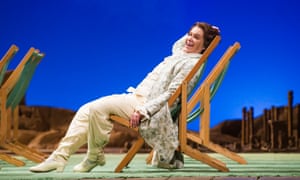
Too feminine for pants roles? Tara Erraught can only ignore a debate like this. © Christian Kaufmann

There are singers in Ireland - sometimes vocal cliches - almost as many as the sand on the sea. Truly successful, next to Gilbert O'Sullivan, Sinead O'Connor and Bono, in the first rung are really only three: John McCormack, Catherine Hayes and Ann Murray. McCormack, born in 1884 and a real competitor to Enrico Caruso, was a glittering figure. He owned countless race horses, had a dozen Rolls-Royces, and despite all the worldly fuss felt most comfortable with folk tunes. It was McCormack's "typical Irish ability, to tell a story in song," which make him unique, wrote entranced Henry Pleasants in the standard work The Great Singers.

Of all these Tara Erraught, now 28, knew absolutely nothing, when she began to sing at ten. Tara Erraught from Dundalk, from the little corner of northern Ireland where only the Atlantic and then long nothing comes, just knew, that you can win more people's hearts with one voice than with a violin. At least if one is a beginner on the violin, on which Tara Erraught then still tried though her parents advised her, "I should just let it go." Erraught sometimes talks like a squeaking string, and, yes, indeed, one can understand the parents.

While Tara Erraught with dark flowing Irish "Os " and "Us" tells in English of her beginnings, she has some of the buildings of the Bavarian State Opera in view. She loves the house. In the auditorium namely shines the Munich Opera, unlike other houses, almost like velvet. Tara Erraught can see if someone before her becomes drowsy. And then? "Then I sing him awake," says Erraught whose laugh can almost shake the walls. Now she sits between these walls in Munich, walls that she still cannot quite believe in.

During the teenage years in Dundalk the Erraughts went again and again to Northern Ireland, to concerts, rehearsals, performances. Mama drove well, in spite of the hazardous undertaking. In this way, says Tara Erraught, has she learned to deal with states of emergency: "Soldiers, guns, bomb threats - all not without." [?] However, Tara Erraught knew at age 13 just as well that it should be opera and only opera in her life. A trip on holiday led to the Arena di Verona: Aida, her first complete opera evening as listener. " And that was it."

This article is from the current issue of die Zeit, which you can purchase online or at a kiosk.

Everything great starts with a little kick. The rest is a lot of practice, talent and luck. And wait for the right moment. Through her teacher Veronica Dunne Tara Erraught came to the Royal Irish Academy of Music, but right in the lesson she went afterwards. In 2008 she auditioned in Munich, was taken and overnight was on her own, in a strange city in a foreign country and in a foreign language." That was a hard time," she says today and doesn't want to sugarcoat anything; but somehow it was also the best time. Because Tara Erraught, was included in the Opera Studio, the young blacksmith of the National Theatre, learned to know the operation by heart, as a mechanic his engines. At first she hardly left the opera at all, studied from the lower machinery up to the cloakroom attendant in the gallery everyone and everything. And heard alongside the profound education - "nowhere it can be better than here" - so much repertoire as she could get.

There was from the beginning something special in that voice, a youthful, almost always ready to smile and to convince as mezzo-soprano, with which Erraught five years ago first made her debut as Cherubino in Mozart's Figaro and began, as is the Irish way, a story to tell: What came from the heart, could easily go to the heart. Here spoke not the innocent from the country, but one that lived close to the origin of the music, as natural as it went. And no one slept.

Her breakthrough, however, Erraught had two years later, when she stepped in for Vesselina Kasarova in Bellini's I Capuleti ei Montecchi. Nikolaus Bachler, the chief, had asked, in dire need: Could she be trusted? Erraught learned the Romeo in five days, put honestly, at the premiere came "a little Italian filler from the imagination" - and made it through. Glorious, it must be said. She sang Kasarovas series to an end - and found herself catapulted into a world in which you say "Hi, Anna" (Netrebko) and "Hello, Jonas" (Kaufmann ). "Awesome", logically, but also a bit "strange, Erraught finds.

It was the time when many after the great early success make the first major, fatal mistake. Erraught, however, trusted the right agent, Jack Mastroianni, but above all herself and her giant Irish family who keep her "grounded, if that is necessary. She knocked out the big Bellini and Donizetti roles that were already within reach, and strengthened her voice with Mozart and Rossini: Rosina and Cenerentola, Sifare in Mithridates. Mozart's Zerlina and Elvira, that can also be sung by a mezzo, were desired roles.

Erraughts career has skyrocketed, while she still is working on the fundamentals. Also, this may contribute to a down to earth attitude, emphasizes this major talent. Who on one hand sings supporting roles (Hansel in Humperdinck, Sesto in Tito) and on the other with enthusiasm sings the kitchen boy in Rusalka, the Second Lady in The Magic Flute or the voice of the unborn child in Frau ohne Schatten, is simply less likely to crash.

On the other hand, she knows very well how disrespect works in her profession. As she made her debut this summer at Glyndebourne, not in Munich, with Octavian in Strauss' Rosenkavalier, she was met with a wave of contempt from many UK papers. She was accused of being too bulky for the role, which in turn drew a discussion about why the figure will always be made an issue of only with girl singers. The stupid result of a male-dominated music criticism? Tara Erraught has the debate, as she says, largely ignored. She knows that she is no elf and doesn't want to be one. In Glyndebourne she knew that she was obligated to Richard Strauss, Hugo von Hofmannsthal and the play. She sang, without fear. Fear on the stage is the worst adviser. But she sang very well.

Now she stands before the next fork. In the fall she debuts one after the other in Strauss’ Die schweigsame Frau und Janáčeks Die Sache Makropoulos, and at the Opera House in Washington, she is recognized as Angelina in La Cenerentola. At the same time Tara Erraught works - regularly with Brigitte Fassbaender now - on Lieder programs. Moreover, she remains, despite a Bavaria as a friend, Irin, she of course sings Danny Boy as an encore, "oh Danny boy, the pipes are calling", an ancient, ever new story. At Bayern Munich and Tara Erraught likes best, that on Sunday everything in the city is quiet and people meet for coffee and cake. "Fine," she says, that "nothing is happening". Break. "Except for opera in the evening!"

[I found this article charming and couldn't resist translating it.

The magazine Opera for August has a nice article about the Strauss year and an excellent viewpoint on the Erraught scandal.]
Monday, June 30, 2014

Kurt Weill


It's been too long since I've posted any Kurt Weill.  Here is Nannas Lied.  No apostrophes in German.

Wednesday, May 07, 2014

Always on the Lookout


I'm always on the lookout for the great performance, here of Tchaikovsky's "Nur wer die Sehnsucht kennt" with the original Goethe poem.

The Christa Ludwig version has gone now, so I replaced it with this one of Schwarzkopf. Ludwig is back.


Saturday, April 05, 2014

Sophie Koch in Opera News

I enjoyed very much reading the interview in Opera News before Sophie Koch's performance of Werther.  I was especially pleased to read her discussion of the Paris performance and the unusual and noteworthy conducting of Michel Plasson.  So it isn't just me.

I wonder what she would say now.

Monday, December 09, 2013

My Mahler Soul


I follow my musical loves wherever they may lead me, but despite whatever new loves I may acquire along the way, my deepest musical soul belongs only to the songs of Gustav Mahler.  This recording of Lieder eines fahrenden Gesellen IV by Anne Sofie von Otter is simply unbelievably beautiful.  She sings for me.

Wednesday, November 27, 2013

Proud Cross-dresser

This is Sarah Connolly at the Last Night of the Proms 2009 where she appears in the guise of Admiral Nelson.  Isn't it more fun to celebrate than to mourn?


She revives the original Arne arrangement.

Sunday, November 17, 2013

I cry when the pressure becomes too great


Interview with Elīna Garanča translated from Kurier.


"I cry when the pressure becomes too great," The opera star presents her autobiography "Really important are the shoes." In the interview she talks about the pressure to succeed, why she is shy and her farewell to trouser roles.

KURIER:  Ms. Garanča, tomorrow your first biography appears: "Really important are the shoes." Why do you already write your first biography when you are only 37 years old? 

Elīna Garanča:  Honestly?  Because I was persuaded to.  I myself would not have had the idea for this book, because I myself found that I am too young. But I am currently at a turning point in my life. I am about to turn 40, in a few weeks I will have my second baby - with this my family plan is completed. And in the next few years I want to sing new, more dramatic roles. So I thought, why shouldn't I after 15 years on the stage write a kind of interim result to be read in 20 years, as I then thought about my life and the world of opera.

In your biography you speak very openly about your childhood, your fears and your private life. This one does not even know of an Elīna Garanča ... 

It was not easy for me to unpack these thoughts and details about my life, because I'm actually a very reclusive and shy person. I have never told before how my husband and I got to know each other, and I never talked about my melancholy.

In what moments are you melancholy? 

My fans see me rather more like a "Wikingerweib" [female viking?], which nothing can shake. In fact, I'm the opposite, I am very vulnerable and there are rarely nights where I can sleep through the night without chasing the thousands of thoughts running through my head. I often look enviously at my colleagues, who brimming with confidence and often without knowing all the notes, stand on the stage - that would be a disgrace for me. My self-doubts usually start ten days before the premiere.

Then I argue if I can sing the role, if I understand what the conductor wants from me. To escape this misery I have several methods - go to the gym or I regain my peace of mind with gardening.  If all else fails, then it only helps to cry against the pressure. I listen to the saddest arias, drink a glass of wine and let my tears flow, and afterward fall exhausted into bed. This cleansing process works. The next day I have found my good mood, and self- doubts are gone.

Is that the way you deal with the pressure to succeed? 

Yes, of course. I try to protect myself from flops by choosing my parts very deliberately, often saying no to commitments when I'm not convinced. I prepare for every role very intensively. But nevertheless, the stage fright is getting bigger and the pressure grows. The older I get, the more my presence is ever more present. I become more and more aware that I need to protect my name. And I am on stage a completely different person than in private life. That's why it often bothers me how people think about me.

You want to make a repertoire change in the coming years. In which roles will one no longer see Elīna Garanča?  Will you continue to sing Carmen? 

Carmen is a role that can safely accompany a mezzo-soprano for a lifetime. It only changes which Don José is by my side. But what I definitely feel too old for at 40 are the trouser roles. I miss this youthful naivety, which is needed for the role of Sesto or Octavian. In these Bubenpartien [kid parts?] you will certainly not see me again. Besides that, routine bores me, I want to break new ground. In the next few years I want to sing a Santuzza, an Eboli and the highlight of my career Amneris in Aida.

You will have your second baby in a few weeks. What do you sing at the moment? 

At the moment I do not sing classical music, but with my daughter Winnie the Pooh (laughs). I know the top ten hits of Winnie the Pooh.

When do you want to return from maternity leave? 

I don't make any stress for myself. Fixed is the concert in Göttweig, but if I already appear before that will depend on my second daughter.   Even though I can imagine it going well, for the second child one has more routine.

How do you manage logistically - to bring two children, your career and the career of your husband under one hat? 

This is actually a logistical feat. My husband and I try never to be longer than two weeks separated from the children. We have our own nanny in Spain and a travel nanny.  In the future we will be traveling with two nannies.  And as hard as it may seem for some, we will also sometimes separate the children.  Say, the baby accompanies me to a gig and my older daughter Katie accompanies my husband to a concert.

Your husband is a conductor. You are the superstar. How does he deal with playing second fiddle? 

In trouser roles Elīna Garanča always excelled on the opera stage: 'But for these roles I now feel too old' My husband has never complained until now. He is not one who runs after the fame or the glory. Just like me, he is very down to earth and he got to know me when I was not long The Garanca. Sometimes he complains, because I've become very impatient in recent years. But we both try to realize our dreams. But between us there is no competition: Who got the better reviews, who received the greater applause. That would be the death of our relationship.

It is amazing that your mother when you were 17 dissuaded you from a career as a mezzo- soprano, because she saw too little talent. Has she already apologized for this miscarriage of justice? 

When I think back to my voice then I have to agree with my mother afterwards. My voice had then perhaps timbre, but there was too little volume with only one octave and too little power - these were not prerequisites for an international career. There existed a nature of the voice, but which had to be polished properly.

They repeatedly emphasize that the Garanča of the stage has nothing to do with private Elina. What is the real Garanča ? 

I am still the same natural person I was as a child. At the moment I'm winterizing my garden. Dirt is under my fingernails, I just put down rye seeds that I took from the earth in the spring. This is an ideal fertilizer for my vegetable garden. I can still milk cows or bake my own bread, which I learned from my grandmother. My friends always laugh when I describe myself as the best singing milkmaid.

Personal: Elīna Garanča World star without airs The native Latvian (37) wanted to be an actress. In the entrance examination for the Academy of Drama she fell through. When she expressed her desire to her mother, who was herself a mezzo-soprano, to become a singer, the mother said : "Nothing will come of your voice." But Garanča did not give up.  Her first engagement was Garanča in Thuringia. From then on it was uphill. Ioan Holender gave Garanča a fixed contract at the Vienna Opera. Since 2005 she is a freelance artist and has sung on all the major opera stages of the world from the Met in New York to Vienna to Covent Garden. She are currently considered the best "Carmen" in the world. In addition to the biography, a new CD "The best of Elīna Garanča" has been released. ( Kurier ) Created on 10.11.2013 , 11:21

'Really important are the shoes' : In this biography Elīna Garanča gives insight into her career, her personal life and her self-doubt. Released in Ecowin-Verlag at 21.90 Euros. 

[It is none of my business to second-guess the lady, but I disagree.  There is a world of difference between a Mozart trouser role and a Strauss trouser role.  You can feign youthfulness, but it is not possible to feign the mature voice required for Strauss.  I have no argument for her being bored with them.]

Wednesday, October 30, 2013

Guess Who

If you saw this on Facebook, don't give it away.

Clue:  mezzo.

Saturday, October 12, 2013

Point of Departure


I don't have a lot of musical regrets, but I do regret that I never sang Orlofsky.  At this point in life I begin to regret how long it's been since I saw Die Fledermaus.  Anyway, Brigitte Fassbaender is the best.

Sunday, June 23, 2013

Jamie Takes it All


At last there are films of Jamie's final at Cardiff Singer of the World.  This is so you can see what the fuss is about.

Jamie Barton has taken everything at Cardiff Singer of the World.  Listen here for a sample.  My entire acquaintance with her and enthusiasm for her singing came from her appearance at the Richard Tucker Gala.  I can't help being partial to mezzos because they always sing pieces I used to sing. Also, can it be a coincidence that she sings all this British music?  I think not.  Here is Purcell arranged by Britten.  These two clips are from her final competition performance.


In other news, we know from Norman Lebrecht that Jonas Kaufmann has switched labels from Decca to Sony and will soon release a Verdi album at Sony.