Showing posts with label Sarah Connolly. Show all posts

Monday, August 10, 2020

Giulio Cesare from Glyndebourne


Conductor William Christie
Director David McVicar

Giulio Cesare - Sarah Connolly, mezzo
Curio - Alexander Ashworth
Cornelia, Pompei's wife - Patricia Bardon
Sesto, Pompei's son - Angelika Kirchschlager, mezzo
Cleopatra - Danielle de Niese, soprano
Nireno - Rachid Ben Abdeslam, countertenor
Tolomeo, Cleopatra's brother - Christophe Dumaux, countertenor.
Achilla - Christopher Maltman, baritone

This performance of Handel's Giulio Cesare took place at Glyndebourne in 2005.  This is the David McVicar version that ran at the Met with David Daniels and Natalie Dessay in 2013.  I called it Julius Caesar the Musical.  I enjoy remembering that Natalie was ill for one of the performances, and Danielle de Niese was in town.  Naturally she took advantage of the opportunity and stood in for Natalie.  That would have been fun to see.

We are projected in time into the British Empire.  The Egyptian servants wear the Fez, and the Roman Army are dressed in the red uniforms of the British Army.  There is no evidence of Islam, I guess.  Cleopatra looks like a modern woman.  There are WWII ships and dirigibles.
In the real time of Julius Caesar the rulers of Egypt were descendants of one of the generals of Alexander the Great but still called themselves Pharoahs.  This is the original and in my opinion is better than the Met version.

I think I prefer this cast.  They are sincere in their change from Roman to British empire.  Angelika Kirchschlager is maybe the best trouser singer I have ever experienced.  It's worth it to see her alone. 
I'm never really wild about countertenors, so I am happy to see that Giulio Cesare is sung by the great Dame Sarah Connolly.  She even sort of looks like Caesar and carries herself like a great general.  This is Danielle de Niese's first big success, indeed this is her masterpiece.  She sings, she dances, she brings us joy.

I notice that the two dead guys, Tolomeo and Achilla, come back to life.  I also noticed this in Cecilia Bartoli's version.  The characters must have singing in the finale.  Here it is staged, but we're not sure what it should mean.

I loved it.  It runs for a little longer from Glyndebourne, so try to see it.


Saturday, June 20, 2020

Live from the Royal Opera


Today at 11:30 PDT we were treated to a live performance from the Royal Opera House in London.  The photo is of a rehearsal with David Butt Philip, tenor, and Dame Sarah Connolly, mezzo-soprano, preparing Mahler's Das Lied von der Erde.  This is one of my favorite things in the whole world and could simply not be missed. 

The ensemble orchestra was conducted by Antonio Pappano.  The chamber orchestra seemed to include only one instrument per part, including 2 violins, 1 viola, etc.  This seemed to work fine.  In the live performance there was also no audience.

Before the Mahler, Vadim Muntigarov performed a short piece representing the Royal Ballet.  There was a small fee to support the opera house.  I loved it.

Sunday, April 23, 2017

Dido and Aeneas


Christopher Hogwood conductor
Wayne McGregor choreography, stage director

Lucy Crowe (Belinda)
Sarah Connolly (Dido)
Anita Watson (Second Woman)
Lucas Meachem (Aeneas)
Sara Fulgoni (Sorceress)
Eri Nakamura (First Witch)
Pumeza Matshikiza (Second Witch)
Iestyn Davies (Spirit)
Ji-Min Park (Sailor)

There is a film of Purcell's Dido and Aeneas on medici.tv which can be viewed through Amazon prime. I performed the spirit as a freshman in college and am always surprised by the level of detail I can remember.  Except now everyone does ornaments that are not in the score.  I doubt sincerely that they are extemporized.

Lucy Crowe and Sarah Connolly are worth the visit.  One of the odd features of this performance is that the First Witch and Second Witch are portrayed as Siamese twins joined at the side. 

Since I left college, I have only seen this opera staged by choreographers.  It would be nice to see it done as an opera.
 #ad

Wednesday, November 27, 2013

Proud Cross-dresser

This is Sarah Connolly at the Last Night of the Proms 2009 where she appears in the guise of Admiral Nelson.  Isn't it more fun to celebrate than to mourn?


She revives the original Arne arrangement.

Friday, July 26, 2013

Hippolyte et Aricie from Glyndebourne


Jean-Philippe Rameau's opera Hippolyte et Aricie (1733) is basically the same plot as Phèdre by Jean Racine (1677), a play that was done at my college when I was an undergraduate. This is only my second experience of a Rameau opera--the first was Platée at Santa Fe, a comedy.


Hippolytus Ed Lyon, high tenor
Aricia Christiane Karg, soprano
Phaedre Sarah Connolly, mezzo
Theseus Stéphane Degout, bass
Diana Katherine Watson, soprano
Pluto/Jupiter/Neptune François Lis, baritone
Œnone Julie Pasturaud, soprano
Cupid/A female sailor Ana Quintans, same voice type as Hippolytus but sung by a mezzo
High Priestess/Huntress Emmanuelle de Negri, soprano

Conductor William Christie
Production Jonathan Kent

"It has an extraordinary quality of meandering."  Phaedre, wife of Theseus, falls in love with her step son Hippolytus who wishes to marry Aricia.  This is a serious opera, filled with gods and mortals.  Cupid and Diana vie for the souls of men, and Jove grants that one day a year Cupid will reign.  Racine is dark and very tragic, but we are now in the high Baroque which demands its happy ending. 

In this production the mortals are modern and the gods are Baroque.  In the beginning Diana's servants live inside a refrigerator and proceed to prepare broccoli and cauliflower.  Cupid pops out of one of the eggs.  Theseus and Phaedre live in an ordinary small apartment with a fishless fish tank.  Perhaps that's their fish poking their heads out of the radiator below.


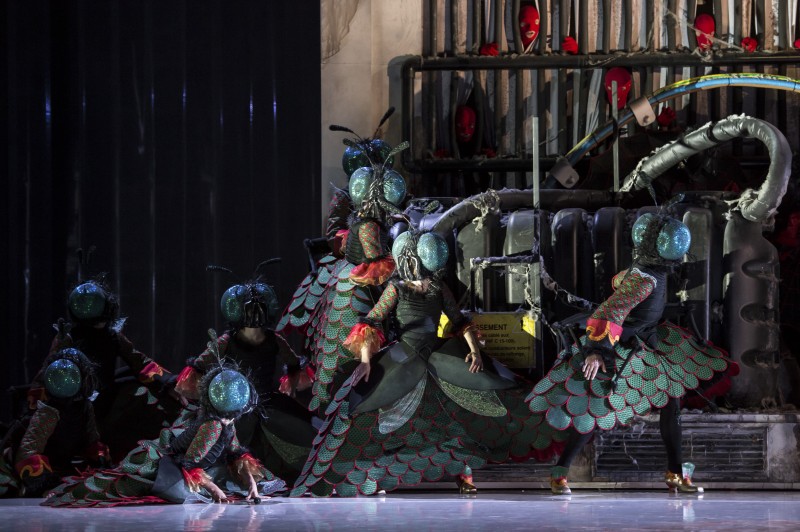
Hell is the most fun.  Pluto whose realm is pictured as a giant radiator is served by a variety of insects, include two spiders who perform a charming duet.  We aren't sure what Theseus is doing in hell, but the change of scene is welcome.

After Phaedre kills herself, the young lovers are reunited to happy rejoicing.

Though they are contemporaries, you will not hear the wondrous variety of Handel here.  If the tempo starts to pick up a bit, it must be a ballet.  There are, of course, no castrati in French opera and little of the intense display of coloratura that is present in Italian opera.  Perhaps we might even call this the Rococo.  It is graceful, elegant and formal above all else.  Rameau is pleasant but not particularly exciting.

This opera came to me via a live stream from Glyndebourne.  If it is considered a success, the opera and its production may start showing up other places. Between the scenes is the head of an old bald guy staring out at us.  If they make a DVD, they could think about leaving him out.
 

You may be curious to know that the version on YouTube with Emmanuelle Haim is traditional in its staging.  Diana descends from above just as she should.  The subtitles are in French.

Saturday, April 23, 2011

Capriccio in HD


Countess................Renée Fleming
Clairon.................Sarah Connolly
Flamand.................Joseph Kaiser
Monsieur Taupe..........Bernard Fitch
Count...................Morten Frank Larsen
Olivier.................Russell Braun
La Roche................Peter Rose
Major Domo..............Michael Devlin

Conductor...............Andrew Davis
Production..............John Cox

It is interesting to me that I have seen Strauss' Capriccio three times, and all have been in this set by Mauro Pagano. It's been decorated and painted differently, but always there are large doors going out to the garden stage right, and a harp ends up in the center of the stage. The other times were in the 90's with Kiri Te Kanawa. First Hanna Schwarz played Clarion, and all wore astounding black and white Versace. Then it was Tatiana Troyanos as Clarion in her last performance on any stage, but with period costumes. How could this set be improved upon?

Hanna Schwarz was the best Clarion because of her impeccable Bühnedeutsch, which means stage German. You believed completely that she was a professional stage actress when she spoke her German lines. Few if any foreigners achieve this. This time it was Sarah Connolly, and she was good, though a bit arrogant.

In the same performance as Hanna Schwarz Reri Grist as the Italian soprano ate an entire cake.

Kiri's countess was simply too fine for any mere mortal. Renée Fleming brings her to earth. She loves being vied for by two different men. Perhaps she loves it far more than she loves the men themselves. She alternately touches her cheeks as if to ask which cheek is the more beautiful. She pretends to play the harp very convincingly. For my money Renée is a great actress and brought the ending to a magnificent climax.

What we are seeing is real life transformed into an opera. Men, as is usual for them, are worrying over how to appropriately form themselves into a hierarchy.  Strauss and his theater friends have gathered for a party, and each claims that he is the most important all the way down to the prompter. All agree to praise Gluck and trash the Italians.

I give an advantage to Music, and not just because of my personal preference. Music does not feel humbled by the process of combining his art with words, but Words wishes to have nothing at all to do with Music. Generosity must surely lead to superiority, at least as husband material. Joseph Kaiser as the composer Flamand is also better looking and a better singer than his rival Olivier. The woman has to go to the tenor, though the opera does not tell us.

So Strauss and his friends argue over the issue until, just as in the opera, one suggests what a fine opera this would make. But does it? The Grafin's soliloquy rises to the level of the greatest Strauss, but the rest is not entirely pleasing. Just as it says in the dialog, the arias all sound too much like recitative.

I'm glad I went for Renée.

#ad