Showing posts with label Yannick Nézet-Séguin. Show all posts

Saturday, December 18, 2021

Eurydice in HD


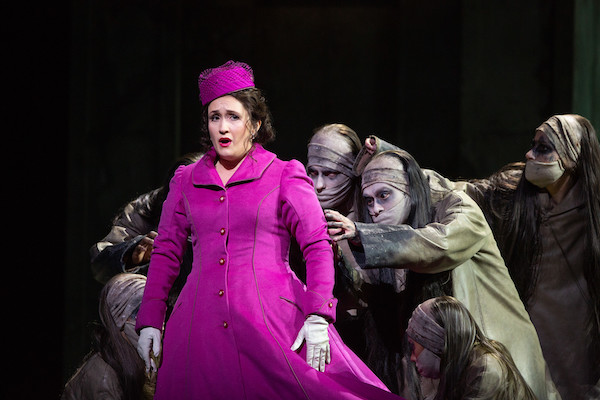
Eurydice................Erin Morley (soprano)
Orpheus.................Joshua Hopkins (baritone)
Orpheus’s Double....Jakub Józef Orlinski, countertenor 
Father.....................Nathan Berg (baritone)
Hades.....................Barry Banks (tenor)
Little Stone............Stacey Tappan (soprano)
Big Stone...............Ronnita Miller (mezzo)
Loud Stone............Chad Shelton (tenor)

Conductor............Yannick Nézet-Séguin 
Director................Mary Zimmerman 

The opera Eurydice by Matthew Aucoin on a libretto by Sarah Ruhl premiered in Los Angeles in 2020. It's based on a play by Sarah Ruhl and is in English. This is the Orpheus myth from the woman's point of view. It's a preferred topic for operas because it's about the power of music even over the gods. Orpheus can lure the gods into releasing Eurydice from hell. 

We are 20 minutes in and they have violated an important rule: there should be an aria, preferably for the soprano, in the first 10 minutes. So far just talky stuff. They tried all recitative operas at the beginning of opera, but it didn't work out. We go to hell and see Eurydice's father who still remembers life before death and how to read and write. He writes to Eurydice and sings about it. This is the closest we've come to an aria so far. 

Eurydice comes out in her bridal dress, and father watches her while he sinks back into the earth. Orpheus and Eurydice sing their vows, kiss and dance. Hades arrives and he has a conversation with Eurydice over the water cooler. He brings her the letter from her father. For me the lyrical bits don't go on nearly long enough. Eurydice goes off with Hades and Orpheus comes looking for her. 

I'm sorry. This just isn't happening for me.

Wednesday, July 07, 2021

Yannick Movie


I went to my local theater to see the movie from the Metropolitan Opera called Yannick: An Artist’s Journey, a new documentary from filmmaker Susan Froemke about Yannick Nézet-Séguin, the Met's new music director.  It shows his life in music throughout his whole life.  His childhood piano teacher is shown.  She's very proud.

I liked it very much.  They never forgot to show his love for music.  They showed a lot of rehearsal scenes, which for me is a joy.  They showed him rehearsing Diana Damrau in La Traviata and the whole cast in The Dialogues of the Carmelites.  This last was particularly enjoyable.  Try to see it.

Addendum.  It went by on the screen very quickly, but Yannick conducted as his Met debut the Carmen I loved so much.

Friday, April 03, 2020

Don Carlo


Conductor-Yannick Nézet-Séguin
Production-Nicholas Hytner

Don Carlo-Roberto Alagna
Elizabeth of Valois-Marina Poplavskaya
Princess Eboli-Anna Smirnova
Rodrigo-Simon Keenlyside
King Philip II-Ferruccio Furlanetto
Grand Inquisitor-Eric Halfvarson

The Metropolitan Opera is treating us in our hibernation to some streams of marvelous past performances.  It is interesting to see these films again.  I am having very different reactions, Don Carlo being no exception.  I feel no inclination to compare Marina Poplavskaya to anyone.  She had a brief but glorious career.  She crossed my path only between 2009 and 2011. I enjoy her today very much.  I think she became a real estate agent in Manhattan.

The peak of Ferruccio Furlanetto's career is the great scene here where he laments that his wife does not love him.  It is a great opera with a great cast.  They are mostly giving us traditional productions.

Smirnova isn't that interesting in the role of Eboli, but she gives a barn-burning "O don fatale."  Each character has a wonderful scene.

This is the era of the Inquisition, and Spain was at its center.  They ruled over a protestant land and killed many people.  As political operas go, this one is at the top of the heap, with glorious music, great characters, and here a beautiful performance.

Saturday, January 11, 2020

Wozzeck in HD


Conductor...............Yannick Nézet-Séguin
Production..............William Kentridge

Wozzeck.................Peter Mattei
Marie...................Elza van den Heever
Captain.................Gerhard Siegel
Drum Major..............Christopher Ventris
Doctor..................Christian Van Horn

This is my fifth time with Berg's Wozzeck--once in the 60's at San Francisco with Marilyn Horne, once in the 80's at San Francisco with Janis Martin, once in 2011 at Santa Fe with Nicola Beller Carbone, a German soprano, once streamed from Salzburg with Asmik Grigorian and now in HD from the Met with Elza van den Heever.  Marilyn Horne could have been singing Bellini.  Janis Martin could have been doing Wagner.  Since then it has become increasingly noticeable that there is a lot of Sprechstimme in this opera.  This means it often sounds like talking in rhythm against the large orchestra.

I saw this production streamed from Salzburg.  It looked even more jumbled and distracting this time.  It overwhelms the action and makes everything confusing.  I liked it even less this time.

Peter Mattei was just right as Wozzeck, mean and dark and nasty.  Elza may be too nice as Marie.  The puppet child never projects as a real child, never arouses any sympathy.  It must be under 3 years old, since that is how long Wozzeck and Marie have known each other.  When this opera works best for me it's when the child is seen wandering off after both his parents are dead.  A puppet doesn't arouse this reaction.

Musically it was quite well done.
 

Sunday, December 15, 2019

Winterreise


This recital by Joyce DiDonato, mezzo, and Yannick Nézet-Séguin, piano, of Schubert's Die Winterreise has a gimmick.  This is a long letter from her beloved which she reads as she sings.  This overcomes the masculine oriented text and allows her to read the text.  Interesting.  It also allows her to dramatize more than normally is done in a recital.  She begins seated and stands later on.  I think Joyce enjoys Lieder as theater.  Why not?

She is performing with the lid all the way up on the piano, something that doesn't often happen in a piano vocal recital.  This may be the explanation for my experience of poor balance between voice and piano.

I love this cycle and enjoyed Joyce singing it.  It won't pull me away from Jonas Kaufmann's version.


Saturday, October 12, 2019

Turandot in HD


Conductor...............Yannick Nézet-Séguin
Production..............Franco Zeffirelli

Turandot................Christine Goerke
Calàf...................Yusif Eyvazov
Liù.....................Eleonora Buratto
Timur...................James Morris

Today the season for the Metropolitan opera in HD began with a performance of Puccini's Turandot.   I think it was also Yannick Nézet-Séguin's first HD as the Musical Director of the Met.

The plot to this opera must be considered iffy.  It isn't exactly a MeToo opera (I'm thinking of making a list) because the abusive power figure is a woman.  She uses her position as heir to the Emperor of China to destroy as many men as possible for something that happened to one of her ancestors.  One isn't sure what the right response would be.  Becoming Emperor of China might be a greater temptation than the princess.  Calaf is an idiot, but he can hardly be blamed for the unfortunate results of his desire for Turandot.  The ending must be considered happy.

It was nice to spot James Morris under his very heavy makeup. This is going to sound strange, but I thought that the lead role sounded rather light in Ms Goerke's voice.  To me she seemed to be struggling with the role.  I thought the hit performance of the evening was the Calaf of Yusif Eyvazov.  He carried himself with dignity and confidence.  I have started to like him.

Yannick brought us a beautiful opera.  I hope to see more of him, but the only HD he is scheduled for is Wozzeck.  Sigh. They did curtain bows after all three acts.  I haven't seen that in a long time.

Saturday, May 11, 2019

Dialogues des Carmélites in HD

👍🏻
Conductor...............Yannick-Nézet-Séguin
Production..............John Dexter

Blanche de la Force.....Isabel Leonard
Madame de Croissy.....Karita Mattila
Madame Lidoine........Adrianne Pieczonka
Mother Marie.............Karen Cargill
Sister Constance........Erin Morley

Dialogues des Carmélites by Francis Poulenc brings the 2018-19 HD season to an end.  When I saw this opera in San Francisco long ago, it was in this same production, only in English.  This is my first time in French.  Poulenc, who lived before supertitles, wanted the opera performed in the language of the audience.  The production follows the historical context of the French Revolution while creating a context through abstractions.  The giant white cross will stay in memory forever.

The opera begins in the home of Blanche de la Force with her father and brother.  Her brother worries that she is always afraid while her father dismisses just about everything she says.  But when she tells him she wishes to join the Carmelite convent, he doesn't refuse.

The convent of Carmelite nuns is changing.  There are two novices, Blanche and Constance, and the mother superior is dying.  Isabel and Erin are charming in their relationship throughout the opera.  Karita Mattila plays her death scene to the ultimate extreme.  It is frightening to watch.  The opera is about death, so I suppose this is one extreme.


After she dies, a new mother superior is sent in from outside:  Madame Lidoine.  Adrianne Pieczonka played her very low key.

Blanche provides the story.  She loves the private life and prayer, but news of the outside world seeps into the seclusion of the convent.  The nuns agree to commit to becoming martyrs.  Even Constance agrees.  All but Blanche agree.

Her brother comes to warn her she is in danger.  The priest is removed from his position and tries to escape.  Finally they are all arrested and forced to give up their nun clothing for "normal" clothes.  At this point Blanche escapes and finds her brother.  She learns that her father has gone to the guillotine.  She rejoins them right at the end.  We hear the sound of the guillotine falling.

Isabel is such a spectacular performer.  She gives us beauty, emotional connection, great singing and her own personal magnetism.  She keeps the stream of emotion going.

This opera is deeper than opera usually is.  Altogether it was a great performance with emotional and musical intensity and exceptional theatrical clarity.

Saturday, December 15, 2018

La Traviata in HD


Conductor.................Yannick Nézet-Séguin
Production................Michael Mayer

Violetta.....................Diana Damrau
Alfredo.....................Juan Diego Flórez
Germont...................Quinn Kelsey

Hostess .................Anita Rachvelishvili

We were treated to the new production by Michael Mayer of Verdi's La Traviata live in HD from the Met.  I could not find a picture that looked just like the single set production.  The actual set had the piano upstage right instead of downstage left as shown here.  Throughout the opera Violetta's bed was downstage center.  It was simply integrated into the staging.  A dance in Act I successfully used this bed.

This versatile set looked remarkably different in each scene.  The busyness of the design, elaborate deco figures and costumes, was successfully offset by dressing Violetta in white, Alfredo in a dark military uniform and Germont in a brown suit.  They each easily stood out from the background.   Another unusual feature of the production was the appearance of Alfredo's sister in a mime role.  I am counting this as a successful production.

There seemed to be unusual unanimity of purpose here.  Much complaining appeared concerning Juan Diego's light voice, but my impression was that he fit impressively into the overall concept.  From beginning to end Violetta is a woman with a very serious disease who is dying.  We see this emphasized first through her lying on her death bed during the prelude.  Diana in particular played and sang her fragility.  This was a particularly beautiful performance which stayed close to the story.

Juan Diego's role was more varied, but was also acted extremely well.  And Quinn Kelsey has followed his line of great Verdi successes with a beautiful Germont performance.

This series is the debut of  Yannick Nézet-Séguin in his new role as music director.  Welcome, Yannick.  Singers love him.  We were shown in intermission a coaching session between Yannick and Diana, who said he was like a brother to her.  They were together in this beautiful, delicate concept of La Traviata.

I liked very much Anita as hostess.

Friday, November 30, 2018

Barbara Hannigan

The career of Barbara Hannigan is endlessly surprising. The secret seems to be complete fearlessness.


Thursday, February 15, 2018

News


The big news is that Yannick Nézet-Séguin will be music director beginning in the 2018-19 season.  This is very good news and two seasons earlier than planned.


Thursday, June 02, 2016

It's Yannick


According to the New York Times, Yannick Nézet-Séguin will succeed James Levine as musical director of the Metropolitan Opera.  Important sentence in this article:  "Beginning in the 2017-18 season, when he takes on the title of music director designate, he will conduct two operas a season; in 2020-21, when he officially becomes music director, he will conduct five."  I am assuming he will begin the administrative parts of his job asap. 

He conducted the amazing Carmen at the Met starring Elina Garanča and Roberto Alagna.  His most recent appearance in HD was last fall in Otello.  The artists all love him.  Congratulations.

Sunday, October 18, 2015

Otello in HD


Conductor: Yannick Nézet-Séguin
Production:  Bartlett Sher

Montano:  Jeff Mattsey (bass)
Cassio: Dimitri Pittas (tenor)
Iago: Željko Lučić (baritone)
Roderigo:  Chad Shelton (tenor)
Otello: Aleksandrs Antonenko (tenor)
Desdemona:  Sonya Yoncheva (soprano)
Emilia: Jennifer Johnson Cano (mezzo-soprano)

Saturday's Met Live in HD featured Verdi's Otello.  Many consider this Verdi's greatest opera.  I think it requires perfection to achieve that.  There is no sense of transition from recitative to aria, which leads to people calling it Wagnerian.  Bah humbug.

Otello has been the subject of a lot of talk since it opened in September.  People who don't know anything about opera are pitching for casting a black singer to play Otello.  Those of us who know things know that there are probably about 5 people who can sing Otello today and none of them are black.  Russell Thomas may develop into a great Otello, but he has already gone on record that he wants to keep his repertoire varied.

So we have Aleksandrs Antonenko, a Russian tenor with a huge voice who brought a lot of angry intensity to his portrayal.  I need an Otello who covers both ends of the emotional range and shows the transition from love to anger.  Željko Lučić as Iago was theatrically quite wonderful.  I would call him a lyric baritone who is stretching a bit to do Iago, but on the HD screen this was irrelevant.

My biggest complaint about both of these men is the complete absence of any Italian phrasing.  Each slid about 3 times in the whole opera.  Netrebko goes to great lengths to learn how to phrase her Italian repertoire, and you guys could do the same.  I wasn't sure if possibly Yannick Nézet-Séguin wasn't encouraging them in this direction.  A brief rehearsal was shown on the movie screen.  Dimitri Pittas shows a much more natural Verdi style, but the conductor was constantly trying to get him to square off the phrasing.  This is incorrect.  It is also the likely cause of the fact that Antonenko did not project as romantic in the early scenes.  It's less important for Iago who is always nasty.

Sonya Yoncheva sang with absolute perfection in her Italian style.  Never too much, never too little.  She was wonderful.  In the intermission she said that she had decided to portray Desdemona as a strong Italian woman.  It was a thing of beauty.  I wasn't sure I would like her, but I was completely won over.  The death scene did make me think of the issue, "Please remember that Otello kills Desdemona, but Antonenko does not kill Yoncheva."  Very important.  In the bows she tried to choke him jokingly.

I didn't mind the movable glass buildings though they did not project any sense of geographical location.  The plot was easy to follow.  This Otello was generally very pleasing.
#ad

Saturday, February 08, 2014

Rusalka


Conductor: Yannick Nézet-Séguin
Production:  Otto Schenk
Set Designer:   Günther Schneider-Siemssen

Cast

Rusalka:  Renée Fleming
Prince:   Piotr Beczala
Princess:  Emily Magee
Jezibaba:  Dolora Zajick
Gnome:  John Relyea
Kitchen Boy:  Julie Boulianne
Gamekeeper:  Vladimir Chmelo
First Sprite:  Jihee Kim
Second Sprite:  Renée Tatum
Third Sprite:  Maya Lahyani
Hunter:  Alexey Lavrov

Yes.  I looked it up and the only live performance of Dvorák's Rusalka I've ever seen, San Francisco Opera 1995, was also in a set designed by Günther Schneider-Siemssen.  It also starred Renée Fleming, she also sang the aria from the top of a tree, and she walked on water in the last act.  I see in the archives that this opera had its first Metropolitan Opera performance in 1993 and was revived with Renée Fleming in 1997.  The Met revived it in 2004, but it hasn't been revived in San Francisco.  So I shouldn't have been surprised when everyone around me said they hadn't seen it.

This cast was incredible, and the traditional production gave a vivid idea of what the opera was about.  This is probably the best you are going to get from Rusalka.

The role of Rusalka fits Renée Fleming's voice like a glove, and Piotr Beczala is the perfect Prince Usually Charming.  As the foreign princess, Emily Magee stole all the scenes she was in.  Dolora Zajick is just the sort of wacko witch you might just believe in.  Perhaps she could turn you into a human being.

But then why would you want to?  The music, guided by Yannick Nézet-Séguin, is gorgeously romantic.  It's not hard to understand why Renée Fleming loves this opera.  The only weakness lies in the plot.  What makes a human in the witch's description is that they can die and have a soul that lives on after them.  Rusalka doesn't care--she just wants to experience love.  We will assign the resulting foolishness to youth, perhaps.  It's a Czech fairy tale, and fairy tales frequently come out badly.

#ad

Saturday, December 10, 2011

Faust in HD


Faust: Jonas Kaufmann
Marguerite:  Marina Poplavskaya
Méphistophélès:  René Pape
Valentin:  Russell Braun
Siebel:  Michèle Losier
Marthe:  Wendy White
Wagner:  Jonathan Beyer

Conductor:  Yannick Nézet-Séguin
Production:  Des McAnuff

Today in Faust Live from the Metropolitan Opera in HD we had the privilege of hearing loud boos from the audience for the production designer Des McAnuff.  The production is a bit Eurotrashy, but after the bizarre production in Santa Fe--Marguerite on roller-skates--it didn't really seem too boo worthy.  One of the advantages of being in the house over being in a movie theater is that one can participate in the post production audience antics.  I "bravo" at the movies, but it does seem a bit silly.

Faust in this production is an aging bomb maker between the two world wars.  The current trend is to explain the opera as a dream or hallucination between the poison and dying.  Faust flashes back to his own youth, and the costumes change.  Faust and Mephistopheles always dress alike.  Perhaps Satan is his alter ego. The sets are spare, abstract and gray.

The goal is to cast the sincerity of the medieval religious fable into the cynical frame of the present.  The sincerity of the music plays against this cynicism.  I was prepared for the production to be confusing, but I did not find this to be the case.


In case there was any doubt about who the opera is really about, our Marguerite Marina Poplavskaya's face was projected on the curtain for extended periods throughout the opera.  These were films.  Her facial expression would change gradually, but she never blinked.  When Faust is still in his laboratory, Marina enters and sits down at one of the work stations.  He is hallucinating about a real woman.  I enjoyed her performance, but her expression in the Jewel Song was rather textbook for my taste.  In her interview with Joyce DiDonato she worked on her sewing the entire time.  Perhaps she has never sewn anything before.
 
As an old man, Jonas Kaufmann's hair will apparently go straight.  His problem in this role is that it is hard to think of him as a cad.  He was irresistible.  That is the idea, isn't it? 

Musically this Faust was somewhere between the extremely somber San Francisco Opera version and the really quite gay Santa Fe Opera version.  (Remember I am an old woman who has lived in a time when "gay" had a variety of meanings.) 

René Pape was explaining to the very elegantly dressed Joyce DiDonato that he had no desire to be a tenor.  Why, in fact, would he wish to be anyone but René Pape?  He was simply awe inspiring.  In his interview he greeted his mother who was supposed to be watching from a movie theater in Nuremberg, not too far north in Bavaria from Munich where Jonas is from. 

I enjoyed the calming effect of the modern context.  I cried anyway.

#ad

Saturday, December 11, 2010

Don Carlo in HD

Today's simulcast of Verdi's Don Carlo didn't sound anything like this:


Marina Poplavskaya sings it like this:


Rather astoundingly different.


Don Carlo-Roberto Alagna
Elizabeth of Valois-Marina Poplavskaya
Princess Eboli-Anna Smirnova
Rodrigo-Simon Keenlyside
King Philip II-Ferruccio Furlanetto
Grand Inquisitor-Eric Halfvarson

Conductor-Yannick Nézet-Séguin
Production-Nicholas Hytner

The version is all five acts.

Act I. a wonderful black and white abstraction of the forest at Fontainebleau where Elisabeth de Valois and Don Carlo fall in love begins the opera. Then it is announced that as part of the treaty with Spain Elisabeth is to marry King Philip II of Spain, not his son Carlo, destroying their hopes for a beautiful life. I swear I have never seen it with this scene included. It is utterly charming and for me completely changes the character of the opera. The beauty of opera lies in the personal.

There is very little color throughout the opera. Most of the costumes are black or white. Red and gold are the only other colors. Each setting emphasized the meaning of each scene. This made the drama very vivid and easy to follow.

Ferruccio Furlanetto played the King in LA, too. He's still quite wonderful. Simon Keenlyside was up to the lyricism of Rodrigo, though I continue to have doubts about him as a Verdi singer.

But perhaps the Met is trying something different here. Except for our wild Inquisitor, and perhaps Eboli, the entire cast is exhibiting a sweeter, more lyrical approach to Verdi. I thought it worked. One grows tired of being punched all the time. And perhaps the sweet tempered French Canadian conductor, Yannick Nézet-Séguin helped to lead the production in this direction.

Roberto Alagna was very strong in this part. If the other characters don't overwhelm him, then Carlo becomes truly the center of his opera. His singing was strong and sensitive throughout. I loved him.

One of the high points was when the host, Deborah Voigt, was interviewing her tenor for Fanciulla, Marcello Giordani, and asked him what was his favorite part of the opera? He responded by kissing her. Very funny. Maybe I would like Fanciulla more as a comedy.

Saturday, January 16, 2010

Carmen in HD


👍🏻
Carmen:  Elina Garanča
Don José:  Roberto Alagna
Micaëla:  Barbara Frittoli
Escamillo:  Teddy Tahu Rhodes

Conductor:  Yannick Nézet-Séguin
Production:  Richard Eyre

Well, maybe, just maybe I never have to see another Carmen again. I think my search for the perfect Carmen is over. My favorite thing was when Renée Fleming as our announcer for the HD broadcast from the Metropolitan Opera said, "Brace yourself." It's nice to be warned.

Elina Garanča has an inner coolness, and before I saw this performance I wondered how it would play against the character of Carmen.  Angiolina, the heroine of La Cenerentola, has a hidden heat at her core which for me didn't mesh with Elina. But Carmen is as hard as nails. She is very beautiful, very sexy and very interested in men, but inside is cool, powerful detachment. Don José never stands a chance. How does the character of Carmen play against the specific gifts of Elina Garanča? The answer is spectacularly well. And she is also the best danced Carmen I've seen. Renée couldn't say enough about her dancing. She also has one of the most beautiful voices around today and sang an extremely beautiful mezzo soprano Carmen. I know a lot of sopranos sing this, but I'm not sure why. If you still want more from your Carmen, I can't begin to imagine where you would find it.


Teddy Tahu Rhodes stood in for ailing Mariusz Kwiecien as Escamillo on three hours notice. He was lovely and looked ready to fight bulls.

Roberto Alagna was her Don José. I suppose I should thank him for driving his wife so mad that she would drop out of the production. Roberto was the perfect heat for this cool Carmen. He is the good boy who fondles his crucifix passionately just before stabbing Carmen. The part is good for his voice, and he did some gorgeous high pianissimos.

The instrumental numbers were often accompanied by some lovely dancing. In the bar scene they even attempted a bit of Flamenco. For a rare change it fit seamlessly with the drama.

There should be special kudos for the coaching staff of the Metropolitan Opera, for both music and acting. If you look at the films available on YouTube, you would not have seen this coming.  More kudos for the conducting of Yannick Nézet-Séguin.

I was thankful for being warned. If this was your first experience of opera, you might spend your life searching for something this good. I am in awe.

#ad