Showing posts with label Walküre. Show all posts

Sunday, March 14, 2021

San Francisco Ring -- Die Walküre


Conductor: Donald Runnicles 
Director: Francesca Zambello 

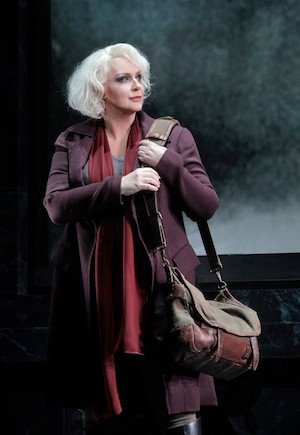
Sieglinde - Karita Mattila 
Siegmund - Brandon Jovanovich 
Hunding - Raymond Aceto 
Wotan - Greer Grimsley 
Brünnhilde - Iréne Theorin 
Fricka - Jamie Barton 

Die Walküre is of course the next installment in the San Francisco Ring.  Wotan lives in a skyscraper high over a relatively small city somewhat like San Francisco.

Act I is in Hunding's house which looks like an American house in the woods.  Inside is a cabinet full of sport trophies.  This Hunding is really a brute.  There's no question about whose side we are on.

Act II Scene 1.  is in the high rise built by the giants in Das Rheingold.  Jamie Barton is a truly magnificent Fricka.  She storms with great style.  He is clearly for Siegmund, but Fricka turns him to Hunding's side.  The goddess protects marriage no matter how bad it is.  There is lots of plot stuff in this act.  At the beginning Wotan orders Brünnhilde to defend Siegmund.  Then after Fricka's complaints, he reverses himself and tells her Siegmund must die.

Act II Scene 2.  In this scene Sieglinde and Siegmund are under a freeway, the latest symbol of urban wilderness.  Sieglinde has begun to feel guilt, both for staying with a husband who did not love her and for leaving him for Siegmund.  Brünnhilde enters and tells Siegmund he must come with her to Valhalla, thus at least attempting to fulfill Wotan's orders.  Siegmund says he will not go without Sieglinde.  This is all quite wonderful.  Brünnhilde changes her mind when Siegmund threatens to kill both himself and his twin even after Brünnhilde tells him Sieglinde is carrying his child.  The child must live.  I think we have here not at all the normal ending.  Hunding kills Siegmund, Wotan kills Hunding and Brünnhilde rescues Sieglinde.  Wotan just says to tell Fricka that he killed Siegmund, but he didn't actually.

Act III is the only part I remember vividly.  During the Ride of the Valkyries they enter on wires, which I see now are supposed to be parachutes.  I love this.  They are all wearing flying suits except Brünnhilde.

I just realized that Siegfried is a joining of the words for victory and peace.  One who brings peace in victory.  Forgive me Karita, but I long to hear Sieglinde in the voice of LD. Karita's performances always bring us her own personal intensity.

The Ring is very unliberated.  Where is Susan B Antony when you need her?  The gods can only imagine women belonging to men.  I enjoy Greer in many scenes, but he seems able to bring only anger into his voice.  And now I'm going to do what I criticize in others.  For me there is only one Wotan's Farewell and that is James Morris.  Greer has done well, but I want to hear the love bursting forth.  This is the only Wagner I truly love.  The ring of fire is perfect.


Sunday, July 05, 2020

Die Walküre with James Morris


 👍🏻
Conductor...............James Levine
Production..............Otto Schenk

Brünnhilde..............Hildegard Behrens
Siegmund, brother.....Gary Lakes
Sieglinde, sister.........Jessye Norman
Wotan......................James Morris
Fricka, Wotan's wife.....Christa Ludwig
Hunding.................Kurt Moll

This performance of Wagner's Die Walküre streamed today from the Metropolitan Opera, played at the Met on April 8, 1989.  One forgets.  James Morris is the most intensely emotional Wotan that ever existed.  Everyone is wonderful.  Hildegard Behrens indeed seems like a goddess.  Gary Lakes has that true Heldentenor sound and pairs well with the ever great Jessye Norman.  Who could top Christa Ludwig, and I actually recognized Kurt Moll under all that makeup.

I liked the set for not distracting from these magnificent singing actors.  All was as it should be.

One forgets.  One forgets that in his prime James Levine was truly a great conductor.  Why he wanted to go on past even merely competent we will never know.

One forgets that this is the greatest Wagner performance ever assembled, that James Morris towers over Wotan like a true god.  Thank you for the reminder.


Thursday, April 04, 2019

Die Walküre in HD

Conductor...............Philippe Jordan
Production..............Robert Lepage
Hostess..............Deborah Voigt

Brünnhilde..............Christine Goerke
Siegmund, brother.....Stuart Skelton
Sieglinde, sister.........Eva-Maria Westbroek
Wotan...................Greer Grimsley
Fricka, Wotan's wife.........Jamie Barton
Hunding.................Günther Groissböck

Opera is the greatest of all art forms because it centers on so many great female characters.  The opera is almost always about them.  Men tried to keep it all to themselves for as long as they could, but as soon as opera became commercial, that was over.

Wednesday I saw Wagner's Die Walküre delayed from last Saturday. I have seen this work many times, but this was very romantic for some reason.  I followed the story of Wotan better than ever.  In the previous opera, Das Rheingold, he is Fricka's husband, and they are happy but have no children.  He gains power by trading away the gold for Valhalla.  He is all powerful and uses his power to do whatever he wants.  By Walkure he is the father of everyone else in the story except Fricka and maybe Hunding.  He's been busy and Fricka is pissed.  All of the 9 Valkyries are his daughters by Erda.  Siegmund and Sieglinde are his children by a she wolf.

They did act bows to avoid making people stay in costume all the way to the end.  Act I is Siegmund, Sieglinde and Hunding.  The twins have not seen one another since the day their house burned down, killing their mother.  Siegmund has wandered alone while Sieglinde was forced to marry Hunding.  The singing in this act was beautiful.. Eva-Maria created the role in the original mounting of this production.  Her partner at that time was Jonas Kaufmann.  They truly looked like brother and sister.  Stuart sang well this time, but Eva has grown in the role.  She was wonderful, with great dramatic presence.

The staging was slightly different.  The planks at the front of the stage didn't stick up in front of the singers this time which looked much better.  When he sings, "du bist der Lenz" I want something spectacular to happen.  I want to feel that in that moment spring has arrived. 

In Act II Wotan, Fricka and Brünnhilde arrive.  Christine is very saucy at this point.  Her Brünnhilde has truly spectacular emotional range.  She shows us joy, love, pride, sympathy, sorrow.  It is the greatness of this performance that makes this production of Die Walküre the best that I have seen.  Wotan asks to see the joy again, and she justly refuses.

I have seen Jamie Barton's Fricka before and loved it again here.  I have also seen Greer Grimsley's Wotan before and found him very much improved.

Act III starts with Valkyries waving.  A bit too silly for me.  However, the act ended well.

Philippe Jordan brought us the emotional range that appeared in the interpretations of all the actors.  I truly loved this.  The Met seems to have realized that Christine Goerke would be something we would all want to see.  Thank you.

Saturday, June 16, 2018

Die Walküre

👍🏻
Conductor Donald Runnicles
Director Francesca Zambello

Brünnhilde, Wotan's daughter:  Iréne Theorin
Wotan:  Greer Grimsley
Fricka: Jamie Barton
Sieglinde, Hunding's wife:  Karita Mattila
Siegmund, Sieglinde's lost brother:  Brandon Jovanovich
Hunding:  Raymond Aceto
Siegrune, Valkyrie:   Laura Krumm
Grimgerde, Valkyrie:  Renée Rapier
Ortlinde, Valkyrie:  Sarah Cambidge
Gerhilde, Valkyrie:  Julie Adams
Rossweisse, Valkyrie:  Lauren McNeese
Schwertleite, Valkyrie:  Nicole Birkland
Helmwige, Valkyrie:  Melissa Citro
Waltraute, Valkyrie:  Renée Tatum

I have always considered Die Walküre my favorite part of the Ring.  Some scenes are the best part of the Ring while others are just endless talking.  As the years have passed, I increasingly see Wotan's long winded explanation to Brünnhilde as a self serving excuse for his screw ups.

But the opening scene is a joyous occasion.  Karita Mattila and Brandon Jovanovich are marvelous as the twins reuniting after a long separation.  I think modern audiences feel that a woman who never wanted to marry in the first place is fully justified in running off with an attractive almost stranger.  "Du bist der Lenz" is a gorgeous love song well sung here by our Siegmund.  Ok, I'm happy with him as a heldentenor.  They made a great pair.  The staging for this scene is excellent.  Except one minute there's no tree and the next minute there it is.


I enjoyed very much Iréne Theorin's entrance in act II.  Her "toi-jo-to-hos" were impressive.  This was followed by the spectacular tantrum of Jamie Barton's Fricka.  She is very put off by the twins thing.  Wotan drones on but completely messes up.  What is his "will" supposed to make of the fact that first he tells her to make Siegmund win the battle, then completely reverses himself to please Fricka.  She knows what his true will is and does that.

Then we have a scene under a freeway like a modern homeless couple.  Or another opera seen recently.  Sieglinde is having difficulties.  Here occurs the scene where Brünnhilde fulfills the Valkyrie's main role--she offers him eternity in Valhalla.  He refuses because Sieglinde will not be there.

The battle between Siegmund and Hunding has Brünnhilde fighting for Siegmund and Wotan against him.  Wotan wins, but Brünnhilde spirits Sieglinde away to save her unborn child.

I thought all these scenes went very well.  The highlight of this production is the Valkyries flying in on a wire with their heroes.  This is a piece of fun.  Brünnhilde walks in like a sensible person but has no hero.  Then follows the greatest scene in all the Ring:  Wotan's farewell.  He makes her into a mere human as punishment.  The music is very beautiful and was well sung by Greer Grimsley.

The quality of the singing is very high.  The staging sometimes works and sometimes doesn't.

A small additional comment:  at every possible opportunity the audience gave the orchestra and maestro Runnicles a huge ovation.  He was very popular here.

Monday, January 22, 2018

Die Walküre


Conductor:  Kirill Petrenko
Production:  Andreas Kriegenburg

Siegmund:  Simon O'Neill
Hunding:  Ain Anger [Ain Anger is bae. I stole this]
Wotan:  John Lundgren
Sieglinde:  Anja Kampe
Brünnhilde:  Nina Stemme
Fricka:  Ekaterina Gubanova

Die Walküre streamed from the Bayerische Staatsoper today.  Somehow I thought it was tomorrow and missed the first part.  I'm watching it on demand.  This is my favorite Wagner.

The first thing we notice is the stage is full of thin young women from the ballet.  They seem to be mostly set dressing.  When the sword theme plays, they shine small palm lights on the sword in the tree.  The director says they represent a context.

The second thing we notice is that while Ain Anger is beautiful to hear and see, in his role as Hunding he is a pig.  He dries his hands on his wife's dress.

I would describe this production as rural minimalism.  Without the ballet women it might get too dull.  Above you see the dead who are brought to Valhalla hanging on poles.  Perhaps that's who the girls are--the paradise maidens.  This production is making me smile.

I love this opera, more than any other Wagner.  The singing from Munich is glorious.  I love that the story is about love.  I like Tristan, but this grabs me more.  Kirill Petrenko wins again with the most applause.  Perhaps my operatic soul is German.

There is lots of shouting.  This is as it should be.

Post Script.  I always love Nina Stemme best, but it is curious to see her drinking from a plastic bottle of water and then rolling it into the wings.  Anja Kampe was outstanding as Sieglinde.

John Lundgren as Wotan was powerful and godlike with a wonderful low register.

Friday, July 07, 2017

Die Walküre


Harteros and Kampe at the Salzburg Easter Festival 2017. Anja does it just right. See 5:10.  Oh wait.  They're both named Anja.  That would be Harteros.

Tuesday, May 15, 2012

Die Walküre rerun


Die Walküre in HD ran last night as part of a complete Ring cycle that finishes on Saturday.  Philistine that I am, I have not been exactly thrilled.  For me Wagner soars often enough to keep me in the game, but he also gives me gigantic extended scenes that bore me to tears.  One of my fellow bloggers says she has seen 9 complete Ring cycles in the last year.  Ugh.  I think I would give up opera.  My favorite Wagner has always been the Wesendonck Lieder.  Soaring and terse all at the same time.

Eva and Jonas were still wonderful--beautiful AND passionate.  I think I'm used to the machine.  I remember that in the house you can see the black-clad gremlins that lurk behind the set, but not in the movie theater.  I rather like that it doesn't really translate into an "interpretation," if you know what I mean.

James Levine has done a complete Ring before, which included Jessye Norman as Sieglinda.  I guess we should not feel too sorry for him.

I sincerely hoped that I would like Bryn more this time, but I didn't.  He's all talky and melodramatic when I only want that wonderful, soaring Wagner line.  Do I care what they're talking about?  Not really. 

I made it through 4 hours and went home.

Tuesday, May 10, 2011

Die Walküre in New York

👍🏻
One of the joys of live opera comes from comparing the different perspectives many productions of the same work can bring to great works of art? Die Walküre last night at the Metropolitan Opera is more your old fashioned Wagner.

Working from story boards can lead you to see the work as a series of pictures. Deborah Voigt in particular was the perfect image of Brünnhilde. The log machine creates pictures which I begin to think look better in the house than on the big screen. In act 1, though, everyone was cut off at the knees. I especially liked the forest in act 2.

Or maybe it was just Eva-Maria Westbroek and Jonas Kaufmann as the fated twins I liked. They were a great pair, even looking a bit alike, and acting with style. I wish they had set a standard for the whole opera. There were no cute moving set bits in their scenes, and nothing to trip over, which may have helped.

Jonas was perfect--warm, romantic, gorgeous. I feel smug telling what an astounding Siegmund he turned out to be. In the house his singing sounded full and perfect for the tessitura of Siegmund. Sigh.


This is the first time I have believed the hype for Stephanie Blythe. In the role of Fricka her voice achieves the highest standards for a Wagner mezzo. This time her contract said not only no wire walking, but no walking at all. She sits in a chair, and all movement is by the machine.

The Hunding of Hans-Peter König was also outstanding.

Deborah Voigt looked wonderful, and the brightness of her voice cut easily through the orchestra. She flubbed the first high note. I wouldn't want to have to walk out on stage and throw off a high C first thing. No thank you.

Bryn Terfel. Let's just say he livened up a whole lot from Das Rheingold. He also lost his Veronika Lake hairdo. I liked him a lot more this time.

The staging of Wotan putting Brünnhilde on her rock was ridiculous. The drama is in the characters, and it is a great loss to sacrifice that to pretty, sometimes absurd pictures.

The biggest ovation was for James Levine. Every appearance these days seems like a miracle. I remember when we took his smiling face for granted.

 [See Kinderkuchen History 1850-1870]

Die Walküre in New York

Sunday, April 24, 2011

Siegmund


He's right, of course. He should not move into this repertoire at his age, and maybe even 5 years is too soon. It's too low. But hear how he feels the phrase rise. Wagnerians will lose patience.

You might enjoy reading this review. He hates the set as much as I do and for the same reasons.

Thursday, April 14, 2011

Jonas as Siegmund


Here's an AP article about Jonas Kaufmann's appearance at the Metropolitan Opera as Siegmund:

NEW YORK (AP) — Jonas Kaufmann knew he was taking a risk when he agreed five years ago to sing the role of Siegmund, the doomed hero of Wagner's "Die Walkuere," in the Metropolitan Opera's new production that opens next week.

Five years is about how far in advance top opera singers like the German tenor get booked by leading houses. The offer for Siegmund came from Peter Gelb, the Met's general manager, after he heard Kaufmann sing another Wagner role, Parsifal, in Zurich, Switzerland.

"It's an insanely long time," Kaufmann exclaimed in a recent interview before the start of the day's rehearsals. "It's a contradiction to art, because what an artist usually does, he follows his instincts, and the more he goes into what he is keen on doing at that moment, the more enthusiasm or passion is in it.

"If you would ask a painter to choose the colors now that he's going to paint in five years, I mean of course he would refuse. What is that idea? It's so weird. But we are forced to do that, to think over where we'd like to go, what we guess our voice is capable of doing in this amount of time."

Meanwhile, with the "Walkuere" contract tucked away, Kaufmann continued building a career that now, at age 41, has made him perhaps the most sought-after tenor in the world. With a sturdy sound that can handle melting pianissimos or full-voiced high Cs with equal ease, leading-man good looks and fluency in multiple languages, he has been able to triumph in a wide range of roles.

There was Cavaradossi in Puccini's "Tosca" in London; Des Grieux in Massenet's "Manon" in Chicago; Wagner's "Lohengrin" in Munich and Bayreuth; Massenet's "Werther" in Paris. He's also an accomplished performer of German songs, giving recitals and recording one of the touchstone works in that repertory, Schubert's "Die Schoene Muellerin."

Now here he is, preparing to make another high-profile role debut in the second installment of Robert Lepage's new staging of the "Ring" cycle, a production filled with operatic stars but dominated by the set, a 45-ton metal structure run by a computer.

"We just have to keep our fingers crossed that the machine is doing its job," Kaufmann said of the Lepage contraption. "Unfortunately, there's this little worry that's around because it has happened that it hasn't worked perfectly."

Siegmund, son of the god Wotan, has an unusual story line for an operatic hero: He enters into an incestuous relationship with his twin sister, Sieglinde.

"Obviously, it's forbidden, but it's not our fault," Kaufmann joked during a recent panel discussion about the production. "We've been separated, we didn't know who we are, we met that night in this hut in the middle of nowhere. And there we are!"

Siegmund dies at the end of the second of the opera's three acts. But Kaufmann said that even though the role is not particularly long, learning it was harder than he had expected.

"Especially at the beginning of Act 1, it's always bits and pieces, two or three phrases at a time. I don't want to say it was frustrating, but it was close to it. For a while I thought, 'Am I getting old or something?'"

But he trusted his usual procedure for learning new parts. "There's a natural process with me," Kaufmann said. "Once you've sung it through, with the score in your hand, three, four times maybe, the whole thing starts ringing in your head.

"And obviously you have tons of rehearsals to double check if that was correct. Because it's so much easier to fix it for eternity when you learn it combined with staging. The text, the singing and the visual — that puts it into a different place of the brain." 


The finale to Act 1, an extended love scene for the twins, is one of the most rhapsodic passages in all of Wagner. Kaufmann said he and soprano Eva-Maria Westbroek, making her Met debut as Sieglinde, are aiming for what conductor Herbert von Karajan called "controlled ecstasy."

"We have to convince the audience, and even ourselves, that we are out of control, that we are driven away by all those emotions," he said. "But still deep inside there is something that controls it and can unplug it if it's too much.

"To always be at this edge, this borderline, that's really the interesting bit. And that gives you also the possibility to fill up the words and the singing with your real emotions, because you're feeling exactly what you're saying at this very moment. That makes it credible. Without going over this edge, without really falling in love with your partner, without really being in tears, and no longer under control of your breath," Kaufmann said.

The role of Siegmund sits low for a tenor, something that Kaufmann said colleagues warned him about.

"They said, 'Oh you have to wait until you lose your high C,'" he recalled with a chuckle, "'because otherwise you're going to ruin your high notes.' And I said, well, in my theory this would be never, because it's not that I'm estimating in the next three years to get rid of my high C."

To illustrate how low the vocal line descends, he sings the phrase that concludes Siegmund's soliloquy midway through Act 1: "Tief in des Busens Berge glimmt nur noch lichtlose glut." ("Deep in the recesses of my heart only a flameless fire still smolders.") The final word "glut" is sung a full octave below middle C.

"You have to trust your voice," he said. "If you try to sing like a bass, if you squeeze it and try to project it, it actually won't carry."

Early in Kaufmann's career, Siegmund wouldn't even have been a possibility. He started out in 1990's sounding "like a typical young German tenor with a very light, white voice."

As for his lower register, he said, "I had none at all. I think F or F sharp (below middle C) was the lowest note I had. Under that it was only hot air."

He also found that when he tried to sing out to express emotion, "I lost control. My voice just wasn't reliable."

That led him in 1995 to a teacher, American baritone Michael Rhodes, who had moved to Germany after World War II.

Rhodes said in an email reply to questions that he instructed Kaufmann in the use of a technique he calls "sbadigliare," from the Italian for yawning, which he himself had learned from the great baritone Giuseppe De Luca.

"Sbadigliare requires one to relax the whole body and really yawn — an involuntary reaction," Rhodes said. "In this state of relaxation, the voice is completely free, as Jonas's is."

Kaufmann said that after he had studied with Rhodes, many colleagues who knew him from before predicted he would quickly come to ruin. "They said, 'Maybe another two to three years, maybe five, but then it's over.' Because everyone expected me to overdo, to artificially darken the sound. It was impossible to believe that this would be my own voice."

Instead, his career started to take off. Kaufmann's relationship with the Met began in 2000, when he auditioned for music director James Levine in Munich. The following year he was offered contracts for his debut season in 2006 (that five-year lag time again), as Alfredo in Verdi's "La Traviata" and Tamino in Mozart's The Magic Flute."

"I was very happy," he said. "I came, I sang, and they said, 'Well, what's next? Why didn't we book you more?'"

Eager to have Kaufmann return, Gelb arranged for the next couple of seasons for him to fit in a few performances in between his other engagements.

"I didn't have enough time to learn a production," he said, "so we always scheduled "Traviata," because that was the thing I knew. They could just throw me in."

Finally, after 14 Alfredos, last spring Met audiences got to hear him as Cavaradossi and as Don Jose in Bizet's "Carmen." Now, after Siegmund, there are other roles lined up: Gounod's "Faust" next season, and after that reportedly a new "Parsifal" and a "Werther."

Elsewhere, he'll add Aeneas in Berlioz's "Les Troyens" for Covent Garden next season, and plans to expand his Verdi repertory, working toward "Otello" through Manrico in "Il Trovatore" and Don Alvaro in "La Forza del Destino."

One thing Kaufmann won't be tackling for now is more Wagner. The roles he hasn't yet sung — Tristan, Tannhaeuser and Siegfried — are widely regarded as ultimate voice killers.

"As soon as you put one step into this repertory, all the theater managers immediately try to offer you everything up to Tristan, because there's this desperate need.

"If I have the chance to be able to sing for a long time, then hopefully I'll be able to do those things later," Kaufmann said.

"But I don't want to get into the hit books of history as one of the youngest Tristans ever, and who lost his voice right after."

[Dr.B He always says exactly the right things.]

Friday, June 11, 2010

Die Walküre

👍🏻
I have to get this out of the way:  horse in Fanciulla, dogs in Die Walküre.  What are things coming to?

Die Walküre is the best Wagner.  It is wonderful almost beyond imagining because it's about relationships:  the self-named twins Siegmund and Sieglinde, and the father / daughter pair Wotan and Brünnhilde.  Both end tragically.

And Donald Runnicles is the best Wagner conductor.  Whatever cracks I may ever have made about him, I was only ever referring to his non-Wagner repertoire.  For Wagner he is the best.  It's ok to care almost exclusively about the orchestra if you are conducting Wagner.

 In the production at the San Francisco Opera, shared with the Washington National Opera, all the characters are American.  The places are American, the clothing, the trophy cases, the aviatrixes.  It's very important to mention the Valkyries as aviatrixes, with boots and goggles and parachute landings.  This is by far the loudest bunch of Valkyries I have ever heard.  These women can wail.


It's the most emotional Walküre I've seen.  Nina Stemme is a singer with a powerful voice who never forces anything, and who creates a wonderful character for Brünnhilde.  

# Brünnhilde: Nina Stemme
# Wotan: Mark Delavan
# Sieglinde: Eva-Maria Westbroek*
# Siegmund: Christopher Ventris
# Fricka: Janina Baechle*
# Hunding: Raymond Aceto
 

It is an excellent cast. Special mention goes to Eva-Maria Westbroek. Go.

 [See Kinderkuchen History 1850-1870]