Showing posts with label Eva-Maria Westbroek. Show all posts

Thursday, April 04, 2019

Die Walküre in HD

Conductor...............Philippe Jordan
Production..............Robert Lepage
Hostess..............Deborah Voigt

Brünnhilde..............Christine Goerke
Siegmund, brother.....Stuart Skelton
Sieglinde, sister.........Eva-Maria Westbroek
Wotan...................Greer Grimsley
Fricka, Wotan's wife.........Jamie Barton
Hunding.................Günther Groissböck

Opera is the greatest of all art forms because it centers on so many great female characters.  The opera is almost always about them.  Men tried to keep it all to themselves for as long as they could, but as soon as opera became commercial, that was over.

Wednesday I saw Wagner's Die Walküre delayed from last Saturday. I have seen this work many times, but this was very romantic for some reason.  I followed the story of Wotan better than ever.  In the previous opera, Das Rheingold, he is Fricka's husband, and they are happy but have no children.  He gains power by trading away the gold for Valhalla.  He is all powerful and uses his power to do whatever he wants.  By Walkure he is the father of everyone else in the story except Fricka and maybe Hunding.  He's been busy and Fricka is pissed.  All of the 9 Valkyries are his daughters by Erda.  Siegmund and Sieglinde are his children by a she wolf.

They did act bows to avoid making people stay in costume all the way to the end.  Act I is Siegmund, Sieglinde and Hunding.  The twins have not seen one another since the day their house burned down, killing their mother.  Siegmund has wandered alone while Sieglinde was forced to marry Hunding.  The singing in this act was beautiful.. Eva-Maria created the role in the original mounting of this production.  Her partner at that time was Jonas Kaufmann.  They truly looked like brother and sister.  Stuart sang well this time, but Eva has grown in the role.  She was wonderful, with great dramatic presence.

The staging was slightly different.  The planks at the front of the stage didn't stick up in front of the singers this time which looked much better.  When he sings, "du bist der Lenz" I want something spectacular to happen.  I want to feel that in that moment spring has arrived. 

In Act II Wotan, Fricka and Brünnhilde arrive.  Christine is very saucy at this point.  Her Brünnhilde has truly spectacular emotional range.  She shows us joy, love, pride, sympathy, sorrow.  It is the greatness of this performance that makes this production of Die Walküre the best that I have seen.  Wotan asks to see the joy again, and she justly refuses.

I have seen Jamie Barton's Fricka before and loved it again here.  I have also seen Greer Grimsley's Wotan before and found him very much improved.

Act III starts with Valkyries waving.  A bit too silly for me.  However, the act ended well.

Philippe Jordan brought us the emotional range that appeared in the interpretations of all the actors.  I truly loved this.  The Met seems to have realized that Christine Goerke would be something we would all want to see.  Thank you.

Saturday, October 27, 2018

La Fanciulla del West in HD


Conductor...............Marco Armiliato
Production..............Giancarlo Del Monaco

Minnie..................Eva-Maria Westbroek
Dick Johnson........Jonas Kaufmann
Jack Rance............Željko Lučić

Saturday, November 12, 2016

Singer List -- Those who have Thrilled me most 👍🏻

Lists are the order of the day.  This singer selection is based on certain specific performances experienced in about the last four years, and not on a generic idea of who is best.  I am strongly influenced by theatrical performance in addition to great singing. 

These have been my favorite soprano performances.  The order is alphabetical

Sopranos

These are towering performances with a strong drift toward dramatic sopranos.

Mezzos

These are all complete performances where the mezzo leads the way.

Tenors

We trend in the direction of ham actors, but it can't be helped.

Baritones and basses.

The list comes out a little different this way.  If you want on this list, wow me in something.  I apologize if your favorite is missing.  Finley was outside the time frame.


Saturday, October 31, 2015

Tannhäuser in HD

Michelle DeYoung as Venus

👍🏻
Conductor.............James Levine
Production............Otto Schenk

Tannhäuser...........Johan Botha (tenor)
Elisabeth...............Eva-Maria Westbroek (soprano)
Wolfram...............Peter Mattei (baritone)
Venus...................Michelle DeYoung (mezzo-soprano)

This production of Wagner's Tannhäuser premiered in 1977 with the same conductor, James Levine.  He is looking very fragile these days.  I am certain that a man carries him to his chair on the podium, but this is not filmed.  We only see the man going back into the wings.  Nevertheless, musically it was an excellent Tannhäuser.

Wolfram von Eschenbach and Heinrich von Ofterdingen, called Tannhäuser, were real people, Minnesingers from the 13th century, though not precisely contemporary. The opera is based on the legend that Tannhäuser spent a year in the grotto of Venus before returning to normal life.  Wagner is interested in the idea of the true meaning of love, especially as described in German literature.

It could be argued that Wagner thought of this as being about himself.  He had throughout his life complex and stormy relationships with women, though none of them seem at all like Elisabeth.  To me she is the anomaly and not Venus.  When this opera was written, Mathilde Wesendonck and Cosima von Bülow lay in the future.

I felt that the production conveyed clearly the meaning of the opera while at the same time giving it a medieval quality.  We begin in the cave of Venus with a ballet and what is called the Venusberg music.  For Wagner this music was intensely erotic.  Our version was sedately erotic, though I found Michelle DeYoung very sexy.  After the dancing, Tannhäuser tells Venus that he has dreamt of the sound of bells and wishes to return to the surface where he will be able to see the sun and the seasons.  He has tired of constant love making.  He tells her he is leaving to follow the virgin Mary.  We will consider this a low blow.


In the next scene he is found lying on the ground with his harp next to a roadside shrine to Mary.  Pilgrims pass by on their way to Rome.  Then a group of minstrels pass by and recognize him.  Wolfram convinces Tannhäuser to return with him to bring comfort to Elisabeth who loves him.


Elisabeth enters the hall of the singing competitions and knowing that Tannhäuser has returned, joyfully sings "Dich teure Halle" (treasured hall), the place where she fell in love with a singer.  This scene includes a singing competition where each contestant is to describe the true meaning of love.  Wolfram begins and describes an abstract and idealistic kind of love.  Everyone praises this except Tannhäuser who leaps up to sing that no one can know about love who has not been with Venus.  Everyone is shocked, especially Elisabeth.  Since this whole scene was arranged for the sake of Elisabeth, he realises he has messed up.  She pleads for them not to kill him, and he agrees to go to Rome with the pilgrims.

In this intermission Susan Graham interviewed the harpist Emmanuel Ceysson who is just beginning his career in the Metropolitan Opera orchestra.  In this opera he accompanies all of the many songs heard through the opera.  He started to speak in French, and Susan reminded him, "You have to speak English now."

Finally we return to the road seen in the second scene.  Elisabeth is there waiting for the pilgrims to return from Rome.  We hear the famous pilgrim's chorus while she searches for Tannhäuser.  If he is there, it means the Pope has forgiven him.  He is not, and she goes off and dies.  Wolfram sings the very beautiful "O du mein holder Abendstern" to the evening star, which curiously is Venus.  "Greet her as her soul passes by."  Peter Mattei sang this especially beautifully.

Tannhäuser returns complaining bitterly and wanting to return to Venusberg.  The Pope has refused him.  We see Venus pleading in the distance, but when Elisabeth's body is brought in, he dies, too.  Too late they realize that the staff has bloomed, indicating that he is forgiven.

May this production live forever.  It can be wonderful to have the story told with so much straight forward simplicity.  I want to praise all the singers for their emotional depth.  This includes the magnificent chorus.  The chorus master told us his favorite HD choral moments.  In four languages they were Prince Igor (Russian), Il Trovatore (Italian), Sayagraha (Sanskrit) and Die Meistersinger (German).

It is argued that we today do not care much about someone's soul, but I can propose the idea that we might care for someone who did.  Elisabeth, especially as beautifully played by Eva-Maria Westbroek, might be such a person.  She went transcendently from joy to shock to sorrow to death.  Botha sang wonderfully, and conveyed Tannhäuser's wild emotional swings.  Michelle DeYoung convinced us that she was Venus.

Thank you for an excellent Tannhäuser.

Saturday, April 25, 2015

Cavalleria Rusticana and I Pagliacci in HD


CONDUCTOR: Fabio Luisi
PRODUCTION: Sir David McVicar

Cavalleria Rusticana

Turiddu: Marcelo Álvarez (tenor)
Santuzza: Eva-Maria Westbroek (soprano)
Mamma Lucia: Jane Bunnell (contralto)
Alfio: George Gagnidze (baritone)
Lola: Ginger Costa-Jackson (mezzo-soprano)

The final HD from the Metropolitan Opera for this season was a new production of Pietro Mascagni's Cavalleria Rusticana and Ruggero Leoncavallo's I Pagliacci.

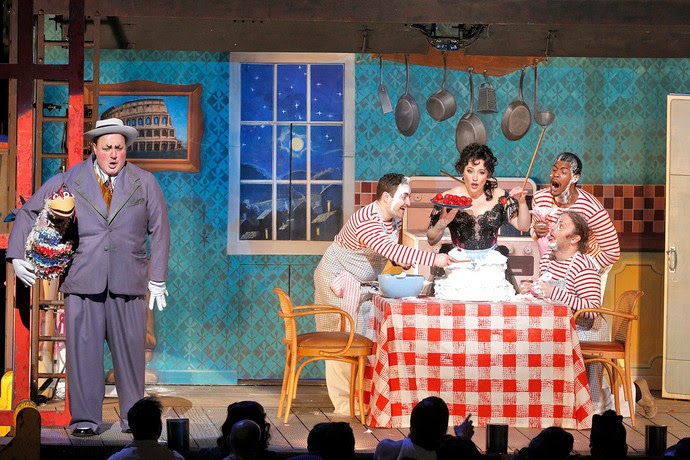
It might probably have been a good idea for me to wait to watch the Salzburg film until after this one.  Though in black and white, the Salzburg production was far more visually interesting.  I chose the above picture as the most colorful from the Met's Cavalleria.

I seldom say this so here goes:  The Met Orchestra was absolutely fabulous in both operas.  I know they are supposed to be... but I don't generally have this reaction.  Luisi must get a big piece of the credit. This is a very beautiful opera, and Luisi brought exactly the right feeling to it,  This cannot be said of Thielemann in Salzburg who could have been conducting Strauss.

It is impossible not to compare the two performances.  And there is much to contrast.  The Salzburg performance was beautiful and dignified.  Everyone is dressed for Easter.  Santuzza and Turiddu have a child who is an altar boy.  Mamma Lucia is the most northern Italian mother I've ever seen.  It was unbelievably restrained.

The Met performance despite its extreme low-stimulus production was the right one for Marcelo Alvarez.  His mother is very much the warm Italian mother.  Lola's husband is a tough.  I'm not sure about Eva-Maria Westbroek.  Sing something a bit lighter.


I Pagliacci

VAUDEVILLE CONSULTANT: Emil Wolk

Tonio: George Gagnidze (baritone)
Canio: Marcelo Álvarez (tenor)
Beppe: Andrew Stenson (tenor)
Nedda: Patricia Racette (soprano)
Silvio: Lucas Meachem (baritone)

Pet peeve out of the way--venti-tre ore means twenty-three oclock or 11 pm, not sunset or whatever other goofy times appear in the translations for this.  They have siesta in these places.

I enjoyed very much Susan Graham's interview with Patricia Racette in the intermission.  Racette informed us that Nedda is much closer to her real personality than the parts she generally plays.  She bragged about riding in on a horse with no hands, but she forgot to mention she was side-saddle with no hands.  She was by far the funniest Nedda I have ever seen.  We already knew she could do anything, but now we know that anything includes riding horses, dancing, doing slapstick comedy, and covering the emotional gamut in a single opera.

Tonio in the picture above is using the chicken (duck?) as a ventriloquist dummy.  He sang an excellent prolog.

This is the perfect opera for Marcelo Álvarez whom I sincerely doubt is as serious as his character here.  When he needs the big emotions, he rises to the occasion.

I hope you enjoyed this as much as I did.

Footnote.  Some one in our audience asked me what "toi" was, and I said it is "toi, toi, toi," means nothing in particular and is said instead of "break a leg" for good luck.  At this point in life I treasure the first time it was said to me.

Tuesday, February 03, 2015

Andrea Chénier

I always have to be a bit nostalgic.  My first Andrea Chénier was in 1965 at the San Francisco opera and starred Richard Tucker and Renata Tebaldi.  I recall she entered from upstage to great applause.  The stage director was Lotfi Mansouri who knew that the great star required an entrance.

I have watched the link on the comment of Andrea Chénier from the ROH.  I didn't mind at all the absence of titles.  They have all made an excellent case for this opera.  This is not a story like Tosca and Butterfly.  They are real people who lived and died in a way much like this.  They have honored the story with real costumes such as they might truly have worn.  I even liked the two Madame Defarge characters knitting in the front row of the tribunal scene.

And for this most real opera they have hired two wonderful singers, Jonas Kaufmann and Eva-Maria Westbroek, who just may be the two most sincere singers today.  For only absolute sincerity will carry the last scene, one of the greatest in all opera.  Lučić was remarkable, too, showing a very wide range of emotions.

For love, for poetry, for art.  Bravi tutti. 

Andrea Chénier, a poet tenor Jonas Kaufmann
Carlo Gérard, a servant baritone Željko Lučić
Maddalena de Coigny soprano Eva-Maria Westbroek
Bersi, her maid mezzo-soprano Denyce Graves
La comtesse di Coigny mezzo-soprano Rosalind Plowright
Pietro Fléville, a novelist bass Peter Coleman-Wright
Mathieu, a sans-culotte buffo or baritone Adrian Clarke
The Abbé, a poet tenor Peter Hoare
The Incredible, a spy tenor Carlo Bosi
Roucher, a friend of Chénier bass or baritone Roland Wood
Schmidt, a jailer at St. Lazare bass or baritone Jeremy White
Madelon, an old woman mezzo-soprano Elena Zilio
Fouquier-Tinville, the Public Prosecutor bass or baritone Eddie Wade
Dumas, Master of the Household bass Yuriy Yurchuk
#ad

Monday, December 29, 2014

News

I said here that I thought Eva-Maria Westbroek was ready for something bigger, but after years as the designated Isolde at Bayreuth 2015, she has decided not to try it.  Perhaps something not quite that big would be right.  Anja Kampe will replace her.

Saturday, August 31, 2013

Misc

There are now at least five women in the Wiener Philharmoniker.

Riccardo Chailly and the Gewandhausorchester Leipzig played Mahler 9 on Saturday to great effect. The maestro was very pleased.

I got back to my hotel after in time to see the final credits roll on Don Carlo on the ORF.

The seats in both houses of the Salzburger Festspiele are very uncomfortable, especially in long works like Meistersinger. 

Tried Kaiserschmarrn today and liked it. When in Austria, do as the Austrians do.

Lotfi Mansouri has died. He was formerly head of the San Francisco Opera.  His obituaries are saying he invented supertitles.  I didn't know that.

I no sooner said that Eva-Maria Westbroek was ready for something bigger than I found she is scheduled to do Isolde in Bayreuth in 2015.

Friday, August 30, 2013

All Wagner Concert


Matti Salminen - Hunding
Eva-Maria Westbroek - Sieglinda
Peter Seiffert - Siegmund

Sometimes the stars align. Sometimes the musical phrasing is so strong that everyone is swept up in the experience. Sometimes perfection is achieved. Yesterday's concert was such a time. The Wiener Philharmoniker with Lorin Maazel was on the program.

I enjoyed the sweet playing of the Siegfried Idyll which began the concert, but it's not really one of my favorites. The joy for me came in the second half with a performance of Act I of Die Walküre.  I did not mind the absence of surtitles because by now I am very familiar with this act and recognize just enough German.

I saw Eva-Maria in this role in New York and San Francisco, but was unprepared for how truly wonderful she was here. The voice was big and glorious and for my ears ready to take on something more. She was the only one who did not use a score and attempted to act her part as she would on the stage.

Peter Seiffert, the true Heldentenor, perhaps the Heldentenor of our time, was completely on form. I saw him before in Tannhäuser in San Francisco, and he was very passionate and warm here.

Matti Salminen is a force of nature. He provided just the right amount of terror in the awkward situation that is the beginning of Walküre.

Such musical synchronicity among the three singers was met and exceeded by the synchronicity with this great orchestra and the musical leadership of Lorin Maazel. They started quietly and built steadily over the long act. Everyone was ready when the big finish came.

Great singing, great playing, great music. Keep your heart open and something wonderful will come your way.

Saturday, March 16, 2013

Francesca da Rimini


Today's simulcast from the Metropolitan Opera, Zandonai's Francesca da Rimini, 1914, was just the production for those who like their opera to be pretty.  Every frame will remind you of Dante Gabriel Rossetti.


Francesca da Rimini:  Eva-Maria Westbroek
Paolo:  Marcello Giordani
Giovanni:  Mark Delavan
Malatestino:  Robert Brubaker
Samaritana:  Dina Kuznetsova
Smaragdi:  Ginger Costa-Jackson
Garsenda:  Dísella Làrusdóttir [Debut]


Conductor:  Marco Armiliato
Production:  Piero Faggioni

At least a bit.  Eva-Maria Westbroek in the title role has to be the most Pre-Raphaelite opera singer you've ever seen.  This was my fourth role for her after Jenůfa in Munich, three different performances of Sieglinde and her wonderful outing as Anna Nicole. Her work in this opera was intensely passionate.

This opera is also about the Guelphs and Ghibellines, it turns out. The Malatesta family, Paolo the beautiful, sung by Marcello Giordani, Gianciotto the deformed, sung brilliantly by Mark Delevan, and Malatestino the one-eyed, sung by Robert Brubaker, are Guelphs.  What a sorry lot they are.

The plot is not complicated.  Originally Francesca is just a reference in The Inferno.  Francesca is tricked into marrying Gianciotto.  She thinks she is marrying Paolo, but all the men know she is not.  In spite of the fact that he knows she is married to Gianciotto, Paolo falls in love with her.  Everything turns out badly.

Ginger Costa-Jackson is our gorgeous contralto Smaragdi.  

The music is for a plush, romantic orchestra, perhaps after Mascagni and Boito.  I don't really hear Puccini in it.  The opera is a bit long, but not really long enough to justify starting an hour early.  We were out by 1:00.  Every once in a while one should see it.
#ad

Tuesday, October 11, 2011

New Candidates for Sexiest

Ailyn Pérez
Ildebrando D'Arcangelo

Sarah Coburn
Noah Stewart
Danielle de Niese

Philippe Jaroussky


Eva-Maria Westbroek
Aleksandra Kurzak
Stephen Costello


Saturday, October 08, 2011

Anna Nicole, the Opera

Curiosity has killed the cat.  It is completely dead.  I could not overcome my desire to see Mark-Anthony Turnage's opera Anna Nicole. I can't decide. Does it help or hinder appreciation of it that I know virtually nothing about her? For instance, I didn't know she was from Texas.  It kind of explains a lot. 

I am pondering this opera in light of things I always say composers should do.  This opera is definitely a chick flick.  In the classic plot the heroine starts high and ends low.  Then there's the Traviata plot where she begins low, goes high and then dies.  It's hard to see any highs in the life of Anna Nicole Smith.  In the opera her mother calls her an embarrassment.

I asked for interesting music.  I find the style of the music suitable to the subject matter and reasonably entertaining.  I asked for the composer to love singing and to write something that shows off the voice.  I didn't get it.  These singers are very fine, but they have not much to work with.

The whole thing would not be possible without the glorious work of Eva-Maria Westbroek. She looks disturbingly like the woman she is portraying and projects her essence. She carries the opera. She would have to. Alan Oke and Gerald Finley are wonderful.  Pappano conducts.

I don't know what to think.  It is a lot of fun through to the place where husband #2 dies.  It gets gloomier from that point until it just peters out.  This is the trajectory of her real life. It's a comedy until it isn't.  As a comedy I liked it very much.  How often do you hear the words "Yoko Ono" as a gag line?

I want to thank the librettist for making husband #2 seem lively and entertaining.  It made that part of her life seem less grotesque.  It is just as trashy as you would have imagined.
#ad

Tuesday, May 10, 2011

Die Walküre in New York

👍🏻
One of the joys of live opera comes from comparing the different perspectives many productions of the same work can bring to great works of art? Die Walküre last night at the Metropolitan Opera is more your old fashioned Wagner.

Working from story boards can lead you to see the work as a series of pictures. Deborah Voigt in particular was the perfect image of Brünnhilde. The log machine creates pictures which I begin to think look better in the house than on the big screen. In act 1, though, everyone was cut off at the knees. I especially liked the forest in act 2.

Or maybe it was just Eva-Maria Westbroek and Jonas Kaufmann as the fated twins I liked. They were a great pair, even looking a bit alike, and acting with style. I wish they had set a standard for the whole opera. There were no cute moving set bits in their scenes, and nothing to trip over, which may have helped.

Jonas was perfect--warm, romantic, gorgeous. I feel smug telling what an astounding Siegmund he turned out to be. In the house his singing sounded full and perfect for the tessitura of Siegmund. Sigh.


This is the first time I have believed the hype for Stephanie Blythe. In the role of Fricka her voice achieves the highest standards for a Wagner mezzo. This time her contract said not only no wire walking, but no walking at all. She sits in a chair, and all movement is by the machine.

The Hunding of Hans-Peter König was also outstanding.

Deborah Voigt looked wonderful, and the brightness of her voice cut easily through the orchestra. She flubbed the first high note. I wouldn't want to have to walk out on stage and throw off a high C first thing. No thank you.

Bryn Terfel. Let's just say he livened up a whole lot from Das Rheingold. He also lost his Veronika Lake hairdo. I liked him a lot more this time.

The staging of Wotan putting Brünnhilde on her rock was ridiculous. The drama is in the characters, and it is a great loss to sacrifice that to pretty, sometimes absurd pictures.

The biggest ovation was for James Levine. Every appearance these days seems like a miracle. I remember when we took his smiling face for granted.

 [See Kinderkuchen History 1850-1870]

Die Walküre in New York

Thursday, April 14, 2011

Jonas as Siegmund


Here's an AP article about Jonas Kaufmann's appearance at the Metropolitan Opera as Siegmund:

NEW YORK (AP) — Jonas Kaufmann knew he was taking a risk when he agreed five years ago to sing the role of Siegmund, the doomed hero of Wagner's "Die Walkuere," in the Metropolitan Opera's new production that opens next week.

Five years is about how far in advance top opera singers like the German tenor get booked by leading houses. The offer for Siegmund came from Peter Gelb, the Met's general manager, after he heard Kaufmann sing another Wagner role, Parsifal, in Zurich, Switzerland.

"It's an insanely long time," Kaufmann exclaimed in a recent interview before the start of the day's rehearsals. "It's a contradiction to art, because what an artist usually does, he follows his instincts, and the more he goes into what he is keen on doing at that moment, the more enthusiasm or passion is in it.

"If you would ask a painter to choose the colors now that he's going to paint in five years, I mean of course he would refuse. What is that idea? It's so weird. But we are forced to do that, to think over where we'd like to go, what we guess our voice is capable of doing in this amount of time."

Meanwhile, with the "Walkuere" contract tucked away, Kaufmann continued building a career that now, at age 41, has made him perhaps the most sought-after tenor in the world. With a sturdy sound that can handle melting pianissimos or full-voiced high Cs with equal ease, leading-man good looks and fluency in multiple languages, he has been able to triumph in a wide range of roles.

There was Cavaradossi in Puccini's "Tosca" in London; Des Grieux in Massenet's "Manon" in Chicago; Wagner's "Lohengrin" in Munich and Bayreuth; Massenet's "Werther" in Paris. He's also an accomplished performer of German songs, giving recitals and recording one of the touchstone works in that repertory, Schubert's "Die Schoene Muellerin."

Now here he is, preparing to make another high-profile role debut in the second installment of Robert Lepage's new staging of the "Ring" cycle, a production filled with operatic stars but dominated by the set, a 45-ton metal structure run by a computer.

"We just have to keep our fingers crossed that the machine is doing its job," Kaufmann said of the Lepage contraption. "Unfortunately, there's this little worry that's around because it has happened that it hasn't worked perfectly."

Siegmund, son of the god Wotan, has an unusual story line for an operatic hero: He enters into an incestuous relationship with his twin sister, Sieglinde.

"Obviously, it's forbidden, but it's not our fault," Kaufmann joked during a recent panel discussion about the production. "We've been separated, we didn't know who we are, we met that night in this hut in the middle of nowhere. And there we are!"

Siegmund dies at the end of the second of the opera's three acts. But Kaufmann said that even though the role is not particularly long, learning it was harder than he had expected.

"Especially at the beginning of Act 1, it's always bits and pieces, two or three phrases at a time. I don't want to say it was frustrating, but it was close to it. For a while I thought, 'Am I getting old or something?'"

But he trusted his usual procedure for learning new parts. "There's a natural process with me," Kaufmann said. "Once you've sung it through, with the score in your hand, three, four times maybe, the whole thing starts ringing in your head.

"And obviously you have tons of rehearsals to double check if that was correct. Because it's so much easier to fix it for eternity when you learn it combined with staging. The text, the singing and the visual — that puts it into a different place of the brain." 


The finale to Act 1, an extended love scene for the twins, is one of the most rhapsodic passages in all of Wagner. Kaufmann said he and soprano Eva-Maria Westbroek, making her Met debut as Sieglinde, are aiming for what conductor Herbert von Karajan called "controlled ecstasy."

"We have to convince the audience, and even ourselves, that we are out of control, that we are driven away by all those emotions," he said. "But still deep inside there is something that controls it and can unplug it if it's too much.

"To always be at this edge, this borderline, that's really the interesting bit. And that gives you also the possibility to fill up the words and the singing with your real emotions, because you're feeling exactly what you're saying at this very moment. That makes it credible. Without going over this edge, without really falling in love with your partner, without really being in tears, and no longer under control of your breath," Kaufmann said.

The role of Siegmund sits low for a tenor, something that Kaufmann said colleagues warned him about.

"They said, 'Oh you have to wait until you lose your high C,'" he recalled with a chuckle, "'because otherwise you're going to ruin your high notes.' And I said, well, in my theory this would be never, because it's not that I'm estimating in the next three years to get rid of my high C."

To illustrate how low the vocal line descends, he sings the phrase that concludes Siegmund's soliloquy midway through Act 1: "Tief in des Busens Berge glimmt nur noch lichtlose glut." ("Deep in the recesses of my heart only a flameless fire still smolders.") The final word "glut" is sung a full octave below middle C.

"You have to trust your voice," he said. "If you try to sing like a bass, if you squeeze it and try to project it, it actually won't carry."

Early in Kaufmann's career, Siegmund wouldn't even have been a possibility. He started out in 1990's sounding "like a typical young German tenor with a very light, white voice."

As for his lower register, he said, "I had none at all. I think F or F sharp (below middle C) was the lowest note I had. Under that it was only hot air."

He also found that when he tried to sing out to express emotion, "I lost control. My voice just wasn't reliable."

That led him in 1995 to a teacher, American baritone Michael Rhodes, who had moved to Germany after World War II.

Rhodes said in an email reply to questions that he instructed Kaufmann in the use of a technique he calls "sbadigliare," from the Italian for yawning, which he himself had learned from the great baritone Giuseppe De Luca.

"Sbadigliare requires one to relax the whole body and really yawn — an involuntary reaction," Rhodes said. "In this state of relaxation, the voice is completely free, as Jonas's is."

Kaufmann said that after he had studied with Rhodes, many colleagues who knew him from before predicted he would quickly come to ruin. "They said, 'Maybe another two to three years, maybe five, but then it's over.' Because everyone expected me to overdo, to artificially darken the sound. It was impossible to believe that this would be my own voice."

Instead, his career started to take off. Kaufmann's relationship with the Met began in 2000, when he auditioned for music director James Levine in Munich. The following year he was offered contracts for his debut season in 2006 (that five-year lag time again), as Alfredo in Verdi's "La Traviata" and Tamino in Mozart's The Magic Flute."

"I was very happy," he said. "I came, I sang, and they said, 'Well, what's next? Why didn't we book you more?'"

Eager to have Kaufmann return, Gelb arranged for the next couple of seasons for him to fit in a few performances in between his other engagements.

"I didn't have enough time to learn a production," he said, "so we always scheduled "Traviata," because that was the thing I knew. They could just throw me in."

Finally, after 14 Alfredos, last spring Met audiences got to hear him as Cavaradossi and as Don Jose in Bizet's "Carmen." Now, after Siegmund, there are other roles lined up: Gounod's "Faust" next season, and after that reportedly a new "Parsifal" and a "Werther."

Elsewhere, he'll add Aeneas in Berlioz's "Les Troyens" for Covent Garden next season, and plans to expand his Verdi repertory, working toward "Otello" through Manrico in "Il Trovatore" and Don Alvaro in "La Forza del Destino."

One thing Kaufmann won't be tackling for now is more Wagner. The roles he hasn't yet sung — Tristan, Tannhaeuser and Siegfried — are widely regarded as ultimate voice killers.

"As soon as you put one step into this repertory, all the theater managers immediately try to offer you everything up to Tristan, because there's this desperate need.

"If I have the chance to be able to sing for a long time, then hopefully I'll be able to do those things later," Kaufmann said.

"But I don't want to get into the hit books of history as one of the youngest Tristans ever, and who lost his voice right after."

[Dr.B He always says exactly the right things.]

Friday, June 11, 2010

Die Walküre

👍🏻
I have to get this out of the way:  horse in Fanciulla, dogs in Die Walküre.  What are things coming to?

Die Walküre is the best Wagner.  It is wonderful almost beyond imagining because it's about relationships:  the self-named twins Siegmund and Sieglinde, and the father / daughter pair Wotan and Brünnhilde.  Both end tragically.

And Donald Runnicles is the best Wagner conductor.  Whatever cracks I may ever have made about him, I was only ever referring to his non-Wagner repertoire.  For Wagner he is the best.  It's ok to care almost exclusively about the orchestra if you are conducting Wagner.

 In the production at the San Francisco Opera, shared with the Washington National Opera, all the characters are American.  The places are American, the clothing, the trophy cases, the aviatrixes.  It's very important to mention the Valkyries as aviatrixes, with boots and goggles and parachute landings.  This is by far the loudest bunch of Valkyries I have ever heard.  These women can wail.


It's the most emotional Walküre I've seen.  Nina Stemme is a singer with a powerful voice who never forces anything, and who creates a wonderful character for Brünnhilde.  

# Brünnhilde: Nina Stemme
# Wotan: Mark Delavan
# Sieglinde: Eva-Maria Westbroek*
# Siegmund: Christopher Ventris
# Fricka: Janina Baechle*
# Hunding: Raymond Aceto
 

It is an excellent cast. Special mention goes to Eva-Maria Westbroek. Go.

 [See Kinderkuchen History 1850-1870]

Sunday, October 18, 2009

Jenůfa

Die alte Buryja:  Helga Dernesch
Laca Klemen:  Jorma Silvasti
Števa Buryja:  Brandon Jovanovich
Die Küsterin Buryja:  Deborah Polaski
Jenůfa:  Eva-Maria Westbroek
Altgesell:  Christian Rieger
Dorfrichter: Christoph Stephinger
Frau des Dorfrichters:  Heike Grötzinger
Karolka:  Laura Tatulescu
Schäferin:  Angela Brower
Barena: Tara Erraught
Jano:  Laura Nicoresc

Conductor: Tomáš Hanus
Production: Barbara Frey

Went to Jenůfa at the Bayerische Staatsoper last night. It stopped raining for a few seconds. The opera was sung in Czech with German supertitles.

If you have been wondering what happened to Deborah Polaski, wonder no longer. She sang Kostelnička Buryjovka. Very nice. Another surprise name is Helga Dernesch as Grandmother Buryjovka. So she has gone from soprano to mezzo to contralto. Love her.

I didn't know Eva-Maria Westbroek who sang Jenůfa, but she was very good. They do quality opera, though everything is reset into a roughly contemporary time period. There is nothing period related about Jenůfa, so why not?

The evening's biggest curiosity came in the interlude. I was in the 1 Rang where there are several rooms facing the front of the opera house. These six rooms form into a circle, and everyone made a parade going counter-clockwise around the rooms. I thought why not and circled with everyone else holding my glass of Sekt.

People still studying in America sing roles here. The youthfulness of the casts is a big plus. They clap a lot louder and longer than we do.