👍🏻
Conductor:
Mikhail Tatarnikov
Production Designer:
Frank Philipp Schlössmann
Emilia Marty, formerly Elina Makropulos, a celebrated singer:
Nadja Michael
Albert Gregor, Dr Kolenatý's client:
Charles Workman
*
Dr. Kolenatý, a lawyer:
Dale Travis
Vítek, Kolenatý's clerk:
Joel Sorensen
Kristina, his daughter, a young singer:
Julie Adams
Baron Jaroslav Prus, the other party to the case:
Stephen Powell
Janek, his son and Kristina's sweetheart:
Brenton Ryan
*
Count Hauk-Šendorf, Emilia's old lover:
Matthew O'Neill
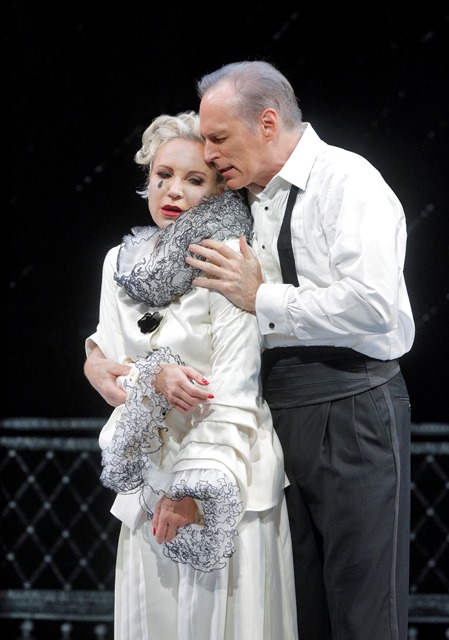
The Makropulos Case by Leoš Janáček was presented last night at the San Francisco Opera. It is interesting to note that this opera made its American premier in 1966 in San Francisco. I think this opera doesn't quite work. Perhaps it works when you are seeing it for the first time and don't know what will happen.
For most of the opera it seems to be about a lawsuit between Albert Gregor and Baron Jaroslav Prus over the estate of "Pepi" Prus, a lawsuit that has been going on for at least 100 years. It sounds like a Dickens novel. One side of the lawsuit, Albert, has a rumor saying Pepi promised the estate to his ancestor, while the other side, Baron Prus, is a distant relative of Pepi.
The opera is actually about a glamorous young woman who appears in the law office with information that may resolve the case in Albert Gregor's favor. She knows where the will is to be found. The woman is Emilia Marty, a famous singer. I'm not sure I want to explain the entire plot. Emilia was born Elina Makropulos in 1585 in Greece. At 15 her father gave her a potion that made her virtually immortal. She has lived in various countries under various assumed names, including Ellian MacGregor, making her Albert Gregor's ancestor. This is also the reason she knows so much.
The opera has an astounding role for a dramatic soprano. I'm sure our Emilia, Nadja Michael, could hold her own against any of the others. It is staged in a very physical way. She climbs on the furniture and shows off her swimmer's physique. I have previously seen her here as Salome and live in HD from the Met in Bluebeard's Castle. She brings to the stage a huge voice and thrilling intensity. She is what you would want here.
Over the course of the opera Emilia realizes that she has lost her lust for living and explains to the other characters that it is death that gives life its meaning. She allows herself to die. The opera ends well, except we never hear how the case came out.
Showing posts with label Czech. Show all posts
Thursday, October 27, 2016
Sunday, July 31, 2016
The Cunning Little Vixen
Gold-Spur, Sharp-Ears. Photo by Cory Weaver.
👍🏻The story of The Cunning Little Vixen by Leoš Janáček, composed 1921-23, is from a serial that ran in a Czech newspaper. West Edge Opera presented it in the Oakland abandoned train station as a series of titled vignets.
Conductor: Jonothan Khuner
Director: Pat Diamond
Sharp-Ears, the Vixen: Amy Foote, soprano
Gold-Spur, the Fox: Nikola Printz, mezzo-soprano
Forester: Philip Skinner, baritone
Forester's wife: Rachel Rush, contralto
Schoolmaster: Joseph Raymond Meyers, tenor
Young Vixen: Hannah Guyer
There are a number of anthropomorphized animals in this story, sometimes recognized, sometimes not. My favorite recognition was seeing a group of women dressed in white and thinking "Chickens. Those are chickens." The chickens come with a rooster. The humans understand what he's there for, but the hens don't really seem to. Vixen escapes her captor after killing the rooster because he lords it over the hens.
It was visually delightful, and musically fun. It is possible to stage this opera from either extreme of delightful children's story or tragedy, or anywhere in between. I think our production has certain adult features but is otherwise on the fairy tale side. Vixen dies and is replaced by one of her children.
My favorite performers were Amy Foote as Sharp-Ears and Philip Skinner, a favorite at West Edge.
The orchestra included what appeared to be an electronic marimba. This I've never seen before. West Edge has recently established a very high standard of performance, and they have met it here. Go if you can.
Thursday, June 23, 2016
Jenůfa in SF 👍🏻
Laca, Kostelnička, Jenůfa
👍🏻Conductor: Jiří Bělohlávek
Director: Olivier Tambosi
Production: Frank Philipp Schlössmann
Jenůfa, Kostelnička's stepdaughter: Malin Byström*, soprano
Kostelnička Buryjovka: Karita Mattila, soprano
Laca Klemeň, cousin of Jenůfa: William Burden, tenor
Steva Buryja, cousin of Jenůfa: Scott Quinn*, tenor
Grandmother Buryjovka, Kostelnička's mother: Jill Grove, contralto
Jenůfa (yeh-NEW-fuh) by Leoš Janáček currently running at the San Francisco Opera will never be the same for me. There are like rocks in this production. We decided this must be symbolism, but I don't really do symbolism.
Jenůfa is about the lives of women as seen from the perspective of those who love them. Because Kostelnička married a leader in the church, when he died she retained her position of leadership in the community. After Jenůfa's baby is born, Kostelnička mentions that she has christened him. That means she has that authority. Grandmother Buryjovka had two sons, both of whom were married twice, and Kostelnička is the only one from the second generation who remains alive and the only one without a child of her own. Though she is only her stepmother, Kostelnička loves Jenůfa and wishes her to have a good life, one as good as hers has been. All that happens arises out of this motive.
Jenůfa is a cheerful, beautiful young woman who is loved by both Laca and Steva. Steva is a drunk and a layabout who has gotten Jenůfa pregnant, but who also inherits the mill from grandmother when she dies. Laca is lonely and rejected. Crucial to the plot is the fact that Laca accidentally cuts Jenůfa in the face. In our production this was made to look particularly ugly.
When Kostelnička finds out that Jenůfa is pregnant, she knows that she must act to save this situation. She tells Steva that he must marry Jenůfa, and he responds that he is engaged to the mayor's daughter. He won't marry Jenůfa because she is now disfigured. Steva knows that he is the father of Jenůfa's baby and still rejects her.
Kostelnička in the dead of winter takes the baby out and shoves it down through a hole in the ice. She feels that without a baby Jenůfa has a better chance in life. Instead Jenůfa is saved by the almost miraculous transformation of Laca who truly loves her.
I enjoyed the voices, including the two wonderful tenors. These two men, Laca and Steva, look and sound close enough alike to actually be brothers.
But it is the women that give this particular performance its great power. Important is the contrast in power between the characters of the sweet but weak Jenůfa and the strong and controlling Kostelnička. Malin Byström acts and sings beautifully, but it is the astounding strength of Karita Mattila that carries the opera to its great heights. She has always been one of the great singing actresses of opera, but here she has topped herself. It is these moments when the art form of opera shows itself to us to be the greatest of all, that it towers over the emotional heights and depths of everything else without presenting the material in a sordid way.
The tension built all the way to the end due to the masterful conducting of Jiří Bělohlávek. There was some unusual orchestration.
In my heart David Gockley retires with this wonderful performance. I don't know what the rocks mean, and I don't care, but my heart has been penetrated. Thank you.
Labels:
+500,
Czech,
Czech Music,
David Gockley,
FavOpera,
Janáček,
Karita Mattila,
Northern California,
Opera Only,
OperaUS,
Reader Favorites,
Regie,
Review Performance,
San Francisco Opera,
SF Bay Area,
United States
Thursday, November 11, 2010
The Makropulos Case
Conductor: Jiří Bělohlávek
Production: Frank Philipp Schlössmann
Vítek: Thomas Glenn
Albert Gregor: Miro Dvorsky
Kristina: Susannah Biller*
Dr. Kolenatý: Dale Travis*
Emilia Marty: Karita Mattila*
Baron Jaroslav Prus: Gerd Grochowski
A Cleaning Woman: Maya Lahyani*
A Stagehand Austin Kness*
Janek: Brian Jagde*
Count Hauk-Šendor: Matthew O'Neill*
A Chambermaid: Maya Lahyani
*Role Debut
This was my fifth Janáček opera after Katya Kabanova, Jenůfa and The Cunning Little Vixen in San Francisco and From the House of the Dead on DVD. The music never makes me think of Wagner. He eschews Romantic tonality without even seeming to notice it exists. I'm going to say something outrageous now so please duck: to me he almost reminds me of Mussorgsky. Almost. Am I too far out on a limb yet? Wikipedia says he was influenced by Puccini. I can see that in the vocal writing. It's sort of verismo without the Italian soul.
The act I set is shown in the picture above. The other two scenes are equally simple. There was a giant clock in two acts that showed the actual time.
We begin with a court case that has been going on for almost 100 years. Count Prus died intestate, and the members of the Prus family possess the estate. One Albert Gregor claims that Count Prus named his ancestor Ferdinand Gregor as the intended heir. The case drags on rather like Bleak House.
Then one day Emilia Marty is in town in her guise as a famous opera singer and drops by the law office to ask about the case. Though none of them have ever seen her before, except possibly across the footlights, she seems to know all about the case. She describes an existing will and tells them exactly where to find it.
Characters speculate about Emilia's age. She must be at least 30, they say. She is very beautiful and all the men fall in love with her. It would be better to see it without knowing what's going on, perhaps. She knows where the will is because she was present when it was placed there almost 100 years before. Emilia has had many names and is over 300 years old. She began her life in Crete as Elina Makropulos and has returned because she feels herself to be dying and wants another dose of the life-sustaining drug.
Isn't this fun! Five of the smaller parts were played by Adler Fellows, and another was played by Thomas Glenn, a former fellow. If there is a Janáček style, no one knows what it is, so don't worry. Susannah Biller as Kristina was especially nice.
The star of the show, singing the virtually immortal Elina, is Karita Mattila. She is towering, intense, gorgeous, outrageous, and utterly fabulous. There was lots of audience screaming. They closed the curtain before we were finished screaming, seemed not to know what to do with sustained applause.
Maybe I would like to see this with the closeup screens.
Thursday, November 12, 2009
From the House of the Dead

From the House of the Dead by Leoš Janáček was virtually completed in 1928 when the composer died. It turns out I don't have to go to New York. I think this film from 2007 from Aix-en-Provence is the same production. Yes.
The film reunites Patrice Chereau and Pierre Boulez who did the centennial Ring together in 1976. At the Met it is Salonen conducting. New for the Met are Peter Mattei as Shishkov and Willard White as Gorianchikov. Many of the rest of the cast are the same as the DVD. It uses the edition prepared by Sir Charles Mackerras, the father of all modern Janáček, and John Tyrrell.
Enough journalism. No one tops Dostoevsky, the source of the plot, for unrelenting grimness. I used to read a lot of Russian literature when I was much younger, and loved it. Now this opera is simply too dark, though there is a brief turn toward the light at the end.
We are in a men's prison, and the opera consists almost entirely of prisoners telling their grim stories of violence.
The music is wonderful, just the right balance of dissonance and consonance to please. But there are no sopranos to thrill us and charm us as there are in Jenufa.
It definitely violates the three baritones rule. [Never go to an opera where three of the characters are baritones.] In fact they all seem like baritones, even when they're not.
The captured eagle is freed and flies away. Thank God.
#ad
Labels:
#ad,
+30,
Czech,
Czech Music,
France,
Janáček,
ONew2Me,
Opera Only,
Peter Mattei,
Regie,
Rev Video,
Willard White
Sunday, October 18, 2009
Jenůfa
Die alte Buryja:
Helga Dernesch
Laca Klemen: Jorma Silvasti
Števa Buryja: Brandon Jovanovich
Die Küsterin Buryja: Deborah Polaski
Jenůfa: Eva-Maria Westbroek
Altgesell: Christian Rieger
Dorfrichter: Christoph Stephinger
Frau des Dorfrichters: Heike Grötzinger
Karolka: Laura Tatulescu
Schäferin: Angela Brower
Barena: Tara Erraught
Jano: Laura Nicoresc
Conductor: Tomáš Hanus
Production: Barbara Frey
Went to Jenůfa at the Bayerische Staatsoper last night. It stopped raining for a few seconds. The opera was sung in Czech with German supertitles.
If you have been wondering what happened to Deborah Polaski, wonder no longer. She sang Kostelnička Buryjovka. Very nice. Another surprise name is Helga Dernesch as Grandmother Buryjovka. So she has gone from soprano to mezzo to contralto. Love her.
I didn't know Eva-Maria Westbroek who sang Jenůfa, but she was very good. They do quality opera, though everything is reset into a roughly contemporary time period. There is nothing period related about Jenůfa, so why not?
The evening's biggest curiosity came in the interlude. I was in the 1 Rang where there are several rooms facing the front of the opera house. These six rooms form into a circle, and everyone made a parade going counter-clockwise around the rooms. I thought why not and circled with everyone else holding my glass of Sekt.
People still studying in America sing roles here. The youthfulness of the casts is a big plus. They clap a lot louder and longer than we do.
Laca Klemen: Jorma Silvasti
Števa Buryja: Brandon Jovanovich
Die Küsterin Buryja: Deborah Polaski
Jenůfa: Eva-Maria Westbroek
Altgesell: Christian Rieger
Dorfrichter: Christoph Stephinger
Frau des Dorfrichters: Heike Grötzinger
Karolka: Laura Tatulescu
Schäferin: Angela Brower
Barena: Tara Erraught
Jano: Laura Nicoresc
Conductor: Tomáš Hanus
Production: Barbara Frey
Went to Jenůfa at the Bayerische Staatsoper last night. It stopped raining for a few seconds. The opera was sung in Czech with German supertitles.
If you have been wondering what happened to Deborah Polaski, wonder no longer. She sang Kostelnička Buryjovka. Very nice. Another surprise name is Helga Dernesch as Grandmother Buryjovka. So she has gone from soprano to mezzo to contralto. Love her.
I didn't know Eva-Maria Westbroek who sang Jenůfa, but she was very good. They do quality opera, though everything is reset into a roughly contemporary time period. There is nothing period related about Jenůfa, so why not?
The evening's biggest curiosity came in the interlude. I was in the 1 Rang where there are several rooms facing the front of the opera house. These six rooms form into a circle, and everyone made a parade going counter-clockwise around the rooms. I thought why not and circled with everyone else holding my glass of Sekt.
People still studying in America sing roles here. The youthfulness of the casts is a big plus. They clap a lot louder and longer than we do.
Tuesday, September 05, 2006
Rusalka
This should come as no surprise, but productions from Paris seem to focus on sex. That's fine for Alcina with Renée Fleming, Susan Graham and Natalie Dessay, since that's what Alcina is about--sex, not love. Men enchanted in various stages of undress seems quite sensible as well as entertaining. Incidentally, the cast of the House of Opera nude man Alcina is the same as the CD recommended in the New York Times Essential Library--Opera book. The singing on the video is excellent.
This DVD of Dvorak's Rusalka is also from Paris, and recasts the fairy tale into sexual terms. Instead of nude men, we have beds in every scene. As a water sprite Rusalka, it seems, doesn't long for the Prince so much as his bedroom, seen perched at the top of the set.
When the rival appears, the Prince alternates between two identical bedrooms. The story isn't very attractive when told this way. It effectively showcases Renée Fleming in her favorite role.
#ad
This DVD of Dvorak's Rusalka is also from Paris, and recasts the fairy tale into sexual terms. Instead of nude men, we have beds in every scene. As a water sprite Rusalka, it seems, doesn't long for the Prince so much as his bedroom, seen perched at the top of the set.
When the rival appears, the Prince alternates between two identical bedrooms. The story isn't very attractive when told this way. It effectively showcases Renée Fleming in her favorite role.
#ad
Labels:
#ad,
+30,
Czech,
Czech Music,
Dvorák,
Natalie Dessay,
Opera Only,
Regie,
Renée Fleming,
Rev Video,
Robert Carsen,
Rusalka
Wednesday, August 02, 2006
Jenůfa

I have checked out a DVD from Glyndebourne of Leoš Janáček's Jenufa. This is a restoration to the original score of 1904, very much the preferred version now. It is an opera with two great roles for soprano, one Jenufa, a spinto soprano and the other her step mother, called the Kostelnicka , a true Wagnerian. The men are relatively unimportant.
The story is everywoman's story. Jenůfa has had a baby and been abandoned by her lover who wishes to marry the mayor's daughter. Mother sees her daughter's future and her own as one of shame and isolation, and kills the baby.
We are used to modern and don't hear Wagner, Puccini or Debussy in this original music. It is post-romantic and fresh all at once. The melodies and rhythms are quaint and attractive while still operatic.
This video is very beautiful. Video is more intimate than anything experienced in the opera house.
Tip number 43 on how to write a hit opera: be sure someone has a mad scene. This works for Jenůfa quite as well as it does for Lucia or La Sonnambula. I am thinking "One flew over the Cuckoo's Nest" would make a fine opera--instead of a mad scene, we would have an entirely mad opera.
I digress. The mother holds a religious office and performs christenings [female sacristan, so called because she tended the village church--thank you internet]. The minister in the wedding scene is also a woman. Just as Laca and Jenůfa are married the dead baby is found.
Roberta Alexander is Jenůfa. Anja Silja is mother. The singing is wonderful. Anja Silja has here a harsh edge to her tone, but she is so wonderfully intense that the entire performance is fabulous, majestic and deeply emotional. Roberta Alexander rises to meet her. Philip Langridge is a beautiful Laca.
Highly recommended.
#ad
Subscribe to:
Posts (Atom)


