Showing posts with label Dawn Upshaw. Show all posts

Sunday, June 03, 2018

Peter Sellars --- Extended


Over the life of this blog I have been trying to figure out the director Peter Sellars, and after all these years I want to try to do a full essay on him.  It turns out there are two of him:  Peter Sellars the opera director and Peter Sellars the librettist.  He has directed other things not opera, but this discussion will limit itself to Peter Sellars in the classical music world.  He is America's foremost representative of the Regietheater movement.

To briefly review, the principles of Regietheater involve:
  • moving the action to another time period, including costumes which usually look modern
  • more sex than strictly necessary
  • creating an interpretation that emphasizes modern day issues.

Peter Sellars the Regisseur of other people's operas

I am attempting to reconstruct my own experience of his work and find this hard going for the operas staged before the beginning of this blog.  I now believe that my experience of his stagings began with the 1987 PBS presentation of John Adams' Nixon in China with Alice Goodman as the librettist.  I especially enjoyed the comic Henry Kissinger.  Who knew Nixon was funny?  I liked Madame Mao's aria, the play within a play and the portrayal of Pat Nixon.  I enjoyed its proximity to real life.  The time frame is not changed because it's already modern.   (film)

It might be important to remember that as an undergraduate he did a puppet version of The Ring.

My next experience with the work of Peter Sellars the opera director probably dated from his 1990 filming of the Mozart-Da Ponte trilogy which played on PBS.  In the Sellars' Don Giovanni we are among the American urban lower class in the 60s.  People shoot drugs and sniff cocaine.  You may and probably should view this here, here, and here.  I should probably watch it again myself for Lorraine Hunt Lieberson as Donna Elvira if nothing else.  Leporello and the Don are played by twin brothers.  At the time it was very shocking and caused an enormous stink.  But isn't that the problem with Don Giovanni?  That it just isn't shocking enough.  The other two operas in the trilogy were not nearly this shocking.  

So I did.  You should too.  Lorraine is fabulous, but what else could she be?  The filming is a bit heavy on the close ups but otherwise completely brilliant.  When these guys act like they will kill one another, you believe them.  Every scene rings true.  How often does that happen?  There is a lot of kissing and snuggling but no fake sex.  The hero strips down to his briefs a couple of times.  At the end, after the Don has descended to hell, it appears that the sun has begun to rise.  This is actually more timely today than when it was originally done.  (film)

I attended a performance of Adams' The Death of Klinghoffer, libretto by Alice Goodman at San Francisco Opera in 1992, shortly after its premier.  When the opera was withdrawn from the HD season in 2014 for political reasons, I discussed it in the blog.  It was trying to be even handed about a terrorist attack, which I found difficult.  One side are terrorists, the other tourists.  What's even about that?  The direction by Sellars was not remarkable. (live)

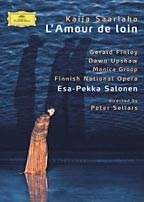
L'Amour de Loin ("Love from afar,") (2000) Music by Kaija Saariaho, seen later in 2005 on a DVD from Finland, was also directed by Sellars with a kind of mysterious simplicity.  I simply wanted to see and hear this work.  A shallow pond of water representing the Mediterranean Sea covered the stage, and on each side was a winding metal staircase.  On the left staircase was Dawn Upshaw in France, and on the right was Gerald Finley in Lebanon.  A messenger in a boat brings their communications back and forth.  I found everything about this fascinating, including the music and the fabulous singing stars.  The story comes from the mythical past, but everything here seems modern.  It was a deep and wonderful experience.  (film)

In 2011 the Metropolitan Opera revived Adams' Nixon in China and kept the original director, Peter Sellars, making his Met debut.  This new Met version ended with enhancements bordering on pornography.  I didn't see the point.  The Met also used some of the same singers who were then older.  I still prefer the Houston version.  (HD)

My next encounter with Sellars wearing only his director hat was Vivaldi's Griselda at Santa Fe.  I also attended his lecture here and agreed with him that Griselda is a terrible opera.  The most notable thing here was that the always smiling Isabel Leonard never smiled once.  They look rather like people from the 60s.  I don't know if this opera could be saved.  How about staging it like Platée with a man in the title character?  (live)

After all these years of hearing about but always missing it, I came upon Peter Sellars direction of  Bach's Saint Matthew Passion from Berlin.  A religious work became a ritual, an aspect of religion that cannot be disparaged, at least not by me.  I was deeply moved by this enhancement to a long loved work.  The wonderful musical performance also helped.  A glimmer of light began to appear. (film)

Then in 2017 came Mozart's La Clemenza di Tito from Salzburg.  This story about ancient Rome became a modern racial encounter.  The encounter was emphasized through the use of cast members who belonged to the suggested races.  Sellars added some other music (which he also did in Griselda) from a mass by Mozart to enhance the sad parts.  I found this entire production profoundly beautiful.  Two home runs in a row.  How was I to explain this?  It made me think that he is actually capable of the truly profound and should work harder.  As usual, the costumes are modern.  I saw as never before that this was an opera about forgiveness and reconciliation.  It may possibly be Mozart's greatest opera.  (film)

I followed my curiosity over to an easily available film of Handel's Theodora from Glyndebourne in 1996.  Lorraine Hunt Lieberson and Dawn Upshaw are also in this.  It turned out to be a much earlier example of his true gift:  the portrayal of large, significant issues.  This is an oratorio with a story rather than an opera, and consists of a lot of very beautiful music suitably staged in modern settings.  I recommend it.  (film)

Can I write about stagings I have not seen?  After his wildly popular, at least in Europe, Mozart-da Ponte trilogy, he staged Saint François d'Assise by Olivier Messiaen at Salzburg in 1992.  There's a film about this but not of it.  He says,  "Anything that finally matters doesn't appear in the plot synopsis.  So this history of staging the plot synopsis is one of the things that has made opera so intellectually inert and dull and expressively limited.  And opera becomes incredibly expressive just as soon as you forget about the story and try and stage the music."  I would go with a statement that said:  what does this opera express?  Stage that.

Don Giovanni expresses exploitative sexuality; Nixon is just people out of their context; Klinghoffer expresses that terrorists are people, too; L'Amour is about love conquering all; Griselda is about men treating women badly, or maybe it's just about singing; Matthew Passion is about the life and death of Jesus; Clemenza is about forgiveness; Theodora is about the life and death of a Christian; Saint François is basically the same with vastly more complex music.  Clearly the staging works best where the message is clearest.  You may feel free to hate my simplified summaries.

This vision statement I quoted above may explain everything.  I think if you are staging an existing opera, you need to focus on enhancing its musical expression within the delineated characters.  But generally when you are composing an opera, the libretto is usually slightly ahead of the music.  There must be a vision of the opera before the composer can write it.  That's my idea anyway.

Score card:

Great things:  Mozart La Clemenza di Tito, Handel Theodora, Bach Matthew Passion, Iolanta / Perséphone
Hits:  Saariaho L'Amour de Loin, Mozart Don Giovanni, Nixon (1st)
So so: Mozart Figaro, Giulio Cesare
Misses:Vivaldi Griselda, Adams The Death of Klinghoffer, Nixon (2nd)

This is an excellent record for any director.  I will add to this list where I can.  Next is Giulio Cesare.  Clearly he follows the first rule of Regietheater:  everyone will wear post WWII clothing.  Stuff you can buy in a department store or thrift store.  They will look like people you know.  This is key.

There is one thing that he does that I can think of no one else who does.  Claus Guth took all the spoken dialog out of Fidelio and replaced it with groans and sound effects, but he left the music alone.  We are living in the era of reconstructing old scores to accurately represent their eras and original condition.  Doctor Gossett called this a critical edition.  Peter Sellars consistently changes the score, sometimes adding from somewhere else, sometimes cutting sections, in order to reflect his vision.  Academicians will object to this, especially the adding part.

Peter Sellars the Librettist and regisseur of his own operas

Which brings us to the other Peter Sellars, the librettist.  After the stink that surrounded The Death of Klinghoffer, Alice Goodman abandoned her career as an opera librettist, or it abandoned her.  Her libretto for Nixon in China was very successful, but no one was willing to forgive Klinghoffer.  She began working on Doctor Atomic with Adams, but withdrew after a while.  Adams was used to working with Peter Sellars by then, and he took over the task of librettist.

As a librettist, it is not possible to add or subtract from the score or the original theatrical concept because one is the person creating it.  One may do what one wishes.

The John Adams/Peter Sellars operas are El Nino (2000), Doctor Atomic (2005), and Girls of the Golden West (2017).

I began blogging about his direction with the premier of John Adams' Doctor Atomic at the San Francisco Opera in 2005 where Sellars wore both librettist and director hats.  Some of the work was done by Alice Goodman, but she bailed somewhere around mid way.  Perhaps around the beginning of Act II.  Added to this trio of collaborators was the boss Pamela Rosenberg who thought of it as a Faust play.  I think it is this mish mash of influences that muddies the plot here.

Other people's ideas about Faust seem to be different from my own.  It's true that Faust was an intellectual, a scientist, but his soul was clearly not threatened by this fact.  It was threatened by the fact that in old age he began to regret wasting his life with serious efforts instead of having fun.  The devil immediately pops in to offer other activities that might attract his attention.  In short:  science is the good path, seducing women and debauchery is the path to hell.  Please, Faust, take one of these and love it.  Wearing lab coats is irrelevant.  But this is a side issue.  Apparently Rosenberg did not win the argument.

For me the production was a bomb hanging in the air, a bomb which looked nothing like the photos of the bombs that were dropped on Japan.  Contrary to my comments, the bomb used in the production looked just like the experimental version of the bomb that was exploded in New Mexico.  I ranted, "I attended Peter Sellars' lecture before Doctor Atomic where he enthusiastically raved over what a great opera it is and what a great production he had invented. I don't care if the opera sells when you're talking about it. I don't care if part of it came from John Donne. I only care if it plays while I'm watching it. Do the characters matter? Does the drama draw me in?  Or is it all BS?"  I got carried away.   (live)

In the first half people came out and spoke to the air.  The first part of the opera was OK if somewhat static, but the entire second half was empty.  We waited and waited, and there wasn’t even an explosion at the end.  This was supposed to represent time moving slower and faster, but remember I am the person who never reads the program before.  If that's what it means, show me.

My next encounter was with a film of another John Adams work:  El Nino (2000), also with Lorraine Hunt Lieberson and Dawn Upshaw, which I reviewed in 2006.  I couldn't stand how the film switched constantly from filming the performers and showing still pictures of other people.  I rejected it for its film direction, but it is also a work where Peter Sellars wears both librettist and director hats.  I really wanted to see this but could not stand looking at it.  A live performance would probably have been easier to deal with.  Even a split screen would have been better.  I offer no opinion of the work itself. (film)

Doctor Atomic was significantly changed when it played at the Metropolitan Opera in 2008.  This version was directed by Penny Woodcock.  The empty act II was filled out with action.  So here Sellars wore only the librettist hat.  I am still unclear about the meaning of this opera.  What does it mean that a man reads John Donne who searches for God while simultaneously developing the largest bomb ever seen on earth, a bomb destined to kill thousands in Japan.  This is the story I wanted to see and did not.  I wanted to see the conflict of good and evil.

This season I saw in San Francisco Girls of the Golden West .  The text is yet again assembled around a structure provided by letters of Louise Clappe with the pen name Dame Shirley.  There are many other sources.  I was again missing a sense of clear narrative, though this doesn't seem to have been fatal.  Dame Shirley is telling stories about her experiences during the gold rush, which is a kind of narrative.

If there are other operas by John Adams on librettos by Peter Sellars, I have not seen or reviewed them.  I didn't get the impression from anything I have read or heard about these works that Peter Sellars actually wrote any of the words sung from the stage.  I believe he only selects and assembles them.  So if you get the impression that no one is speaking to anyone else, it's because the words came from something written down by people not named Peter Sellars and never attempts to simulate conversation.  Glass successfully writes operas in Sanskrit and ancient Egyptian and still does not make you feel lost without a sense of narrative.

What does this opera express?  Then include structures and text that accomplish that.

You may also have noticed that the narrative never quite gels.  An Oratorio like Messiah can be assembled, but no staging is implied.  Assembling a text in English, generally the language of the audience, made up of literary texts never intended to represent conversation or action is a problem.  No amount of moving people around is going to make up for the fact that the words were never intended to be theater.  For me this requires that the action be absolutely clear.

Clearly Mr. Sellars' operas haven't given me the sense of genius that his work on other people's operas have.
#ad

Friday, March 16, 2018

Dawn Upshaw in Sacramento


Dawn Upshaw came to Sacramento for a recital at CSUS as part of the New Millennium concert series.  Her accompanist was Gilbert Kalish.  I last saw her in San Francisco in 2010.  After a rather spectacular career, this lyric soprano seems more like the single mom she is.  Die Zeit, sie ist ein sonderbar Ding.

The theme of the recital was love.

She performed two groups by female composers.  The first was "On Loving," three songs by Sheila Silver.  These songs can be found on YouTube.  I believe these songs were composed in memory of Gilbert Kalish's wife.

The second group by a female composer was four songs by Rebecca Clarke who mostly composed for her instrument, the viola.  From this group I most enjoyed "Infant Joy."  It also can be found on YouTube.

The rest of the program was wide ranging and began with familiar songs by Franz Schubert.  "Gretchen am Spinnrade" was my favorite.  I do also love "Nur wer die Sehnsucht kennt."

Mr Kalish played a movement from Charles Ives' Piano Sonata No.2, which was followed by three of Ives' songs.

My favorite group of the concert was five songs by Béla Bartók.  In school one is taught that Bartók was an ethnomusicologist.  This means he went around his native Hungary with a recorder taping every song he heard.  There are supposed to be hundreds of these, but this is the first time I have heard them on a concert.  They were fascinating.

The program ended with three songs by William Bolcom.  There are also YouTube films of these.

There was an encore:  Ives' "Two little flowers", a song I love madly which I must surely have sung at one time or another.

Curiously, Gilbert Kalish can be found accompanying many of these songs on YouTube.

______________________
Highlights of the career of Dawn Upshaw as seen from this blog.

  • CDs of works by Oswaldo Golijov including Ayre, 2005,  and Oceana.
  • A live performance of Ayre in Berkeley.  This did not seem possible since so much of it is electronic.

Friday, August 25, 2017

Theodora from Glyndebourne

 👍🏻
Conductor:  William Christie
Director:  Peter Sellars

Theodora, a Christian of noble birth, soprano: Dawn Upshaw
Didymus, a Roman Officer, converted by and in love with Theodora, originally alto castrato, here countertenor:  David Daniels
Septimius, Roman soldier and friend to Didymus, tenor:  Richard Croft
Valens, President of Antioch, bass:  Frode Olsen
Irene, a Christian and friend of Theodora, mezzo-soprano:  Lorraine Hunt
Messenger, tenor:  Michael Hart-Davis

Someone said that Peter Sellars' production of Handel's Theodora was even better than his La Clemenza di Tito, so I thought I would give it a try.  He seems best in things that have religious themes.  This is one of Handel's oratorios and is in English.  This film is from 1996.

Hmmm.  There are soldiers and they wear American flags on their sleeves.  It's politics and religion rolled into one.  Christians are ordered to bow to idols to show loyalty to Caesar.  This is a  joy.  And then there is Lorraine Hunt.  It would be hard to ask for more.  He stages the first Christian scene like a prayer meeting, except women speak.  Lorraine sings of prosperity and people put money on the floor.  Many are in white and kneel on the floor to pray.  The chorus always present in any Handel oratorio represents the congregation.


Soldiers enter and warn the Christians that they are tempting fate.  "Dread the fruits of Christian folly."  This is not the usual oratorio libretto.   I understand it was not popular at its premier.  Oratorios usually draw their plots from either scripture or mythology.  Theodora is an historical Christian martyr.

I begin to grasp Peter Sellars' world view.  He sometimes strays too far from it.  He is THE outstanding American leader in the world of Regietheater, and this is one of his greatest works.  Among his productions, this one makes no alterations to the original text.

Apparently, honoring the Emperor consists of getting falling down drunk. So far I don't find this staging to be at all a distortion of the original.  People just look like people today instead of ancient Romans.  If this bothers you, you should get over it.

Christians are serious people while pagans are drunks seems to be the general idea.  One remembers this primarily for the work of Lorraine Hunt, but I am enjoying also Dawn Upshaw and David Daniels.  Theodora is in prison and Didymus visits her.  She asks him to kill her, but instead they exchange clothing and she escapes.

This is an extraordinary piece, deeply emotional.  One needs exposure to a wider range of Handel's works.  Here we still hear the Italian coloratura along side the more English lyricism and Handel's great choral music.

The picture above depicts the application of the death penalty.  The ending is sad and strange.  Christians wave their arms rather more than is strictly tolerable.   My experience of the Baroque does not include anything like this.  I came for Peter Sellars and Lorraine Hunt but ended with the joy of some of the most beautiful music of Handel I have ever heard.
#ad 

Sunday, January 26, 2014

2014 Classical Grammy Nominations

Classical Field

Best Orchestral Performance

Atterberg: Orchestral Works Vol. 1 - Neeme Järvi, conductor (Gothenburg Symphony Orchestra)

Lutoslawski: Symphony No. 1 - Esa-Pekka Salonen, conductor (Los Angeles Philharmonic)

Schumann: Symphony No. 2; Overtures Manfred & Genoveva - Claudio Abbado, conductor (Orchestra Mozart)

Winner:  Sibelius: Symphonies Nos. 1 & 4 - Osmo Vänskä, conductor (Minnesota Orchestra)  This is the disappearing Minnesota Orchestra.

Stravinsky: Le Sacre Du Printemps - Simon Rattle, conductor (Berliner Philharmoniker)

Thursday, December 06, 2012

Górecki's Birthday

In honor of the birthday of Henryk Górecki (1933 - 2010) we post the complete Symphony 3. 


Monday, September 05, 2011

Golijov Deadline Controversy

Here from Wikipedia is the explanation for the Dawn Upshaw concert:

Golijov came under scrutiny in 2011 for a series of high-profile commissions that were either delayed or cancelled. A violin concerto written for the LA Phil was not completed in time, and had to be replaced on the program. This followed a similar cancellation in 2010, when a song cycle that was scheduled had to be removed from the program when it was not complete in time.  The March, 2011 premiere of a new string quartet for the St. Lawrence Quartet was also delayed due to a missed deadline.

Sunday, March 21, 2010

Composer Missing

I went to San Francisco to hear Dawn Upshaw and Emanuel Ax at Davies Hall. The main attraction for me was the announced debut of a new piece by Oswaldo Golijov. Well.... I ran into Stephanie Friedman, and she said that the piece by Golijov was not ready. Now that he's so famous maybe he's having composer's block.

On the program instead was a song cycle by Stephen Prutsman called Piano Lessons. It is possible to hear in these pieces a connection to such American composers as Bernstein, Copland and Barber. The poems are charming, the music is nice, blah, blah, blah. But don't you think maybe pieces about practicing scales should have here and there a few scales? Perhaps he is avoiding the obvious. I like to hear a specific character for each song and instead got a lot of sameness. To be completely unobvious the singer would have to sing the scales.

This year is the 200th anniversary of the births of Frédéric François Chopin and Robert Schumann, and this concert may be regarded as a celebration of that. The Chopin songs were sung in Polish--Dawn Upshaw does that--and were accompanied by a Polish pianist. They were pleasant.

The highlight of the evening was the playing of Emanuel Ax. Between the songs he played four mazurkas and two nocturnes by Chopin.

The encore was by Hugo Wolf who is having his 150th anniversary this year. It was all fine, but I went for Golijov. It was known but not announced that his songs would not appear by the time I bought my ticket.

Sunday, November 02, 2008

Discoveries

Since I started blogging, I have discovered Lorraine Hunt Lieberson. Sadly, this amazing singer first appeared in this blog as an obituary. I was also quite a gloomy singer with a taste for the "Dead Kid Songs" of Gustav Mahler, so I was fully prepared for her profundity, far deeper than my own. Most astounding, perhaps, is her Marc-Antoine Charpentier's Médée, available from House of Opera. She puts Peter Lieberson on the map with his Neruda Songs . She reaches to depths rarely reached before.

Another discovery since I started blogging is the composer Osvaldo Golijov, composer of the St. Mark Passion, Ainadamar, Oceana, Ayre, etc. The main component of his work is fun. Often the best performances of his works are by people not classically trained, leading to the possible conclusion that it isn't really classical music at all. He loves Dawn Upshaw because she is able to let go, to release her preconceptions and find the music as he has conceived it.

And, of course, there is Jonas Kaufmann, discovered by accident in a Zurich performance of Fidelio while on a trip to to see Cecilia Bartoli. I have even gone so far as to travel to see him in Zurich. He is fascinating at every level: he's cute and sexy, has a gorgeous voice, is apparently a fabulous actor and a great musician. This last is a qualification I am personally unable to ignore. They must arouse my musical instincts, and not just my libido.

Netrebko, Bartoli, Fleming and Florez are old loves, not discoveries. Renée is continuing to develop, something I did not really expect. One looks for and wishes for this--that the artist will grow in their repertoire as they mature.

Tristan and Isolde isn't exactly a love, but it does qualify as a discovery. Who knew I could enjoy this?

I am in the process of discovering Joyce DiDonato. Her Handel mad scene on YouTube is very impressive. I wasn't wild about her Octavian, probably because she is so small and not because of anything about her performance. She has a lot to offer.

Thursday, June 19, 2008

Wikipedia

I see that Wikipedia in the article on tenors correctly lists Villazon as a lyric tenor and Domingo as a dramatic tenor. Some of the role classifications seem a tiny bit iffy to me, but in general it's a reliable article.

I used the term leggiero in my technique book to describe a less than fully legato style rather than a voice classification. Interesting. They are leggiero tenors because they sing in a leggiero style, presumably. Leggiero, if I understand it correctly, means midway between legato and staccato.

Here is something interesting from the soubrette article:

Here are four different voice types singing the same soubrette role, Susanna, in The Marriage of Figaro by Mozart arranged in ascending amount of weight.

* To hear soubrette Dawn Upshaw as Susanna click on:


For soubrette to lyric Kathleen Battle, click on


* To hear light lyric soprano Lucia Popp as Susanna click on


* To hear full lyric soprano Anna Netrebko as Susanna click on


To hear a dramatic soprano Margaret Price as Susanna, click on

Sunday, March 02, 2008

The Voice of Now


I attended a Cal Performances concert last night at Zellerbach Hall in Berkeley that featured three pieces performed by Orquesta Los Pelegrinos, orchestra of pilgrims, one with Dawn Upshaw. All three were fascinating, probably in ascending order. Ms Upshaw and the orchestra are touring these pieces around the country.

All three works involve electronic music in one form or another. The audience experienced the electronics through the auditorium's sound system, but the musicians were aided by speakers that pointed back toward them. Clearly we are in the realm of today.

There are unusual features galore. The first two works featured a prepared Steinway grand piano, an idea invented / popularized by John Cage that involves making physical changes to the piano that alters the sound. In Meanwhile the sound was muffled by padding the hammers. The prepared piano in the second piece was a more traditional mixture of distorted sounds and strumming on the strings. Imagine--John Cage now represents a tradition. This is a sign that one has lived too long. The player was a young woman named Lisa Kaplan who came attired in jeans, a black blouse and high heel boots.

First is Meanwhile (2007) by Stephen Hartke.

Is there anything else I can say about Meanwhile besides that it used prepared piano? The piece is described as incidental music to imaginary puppet plays. Imagine any play you like. The viola is tuned a half step lower than normal.

Percussion is vital to this sound scape work. The flautist and clarinetist eventually turned into percussionists by the end. The percussion ensemble included a lot of wood tones and an invented electronic instrument. The sound ideal seems derived from gamelan. It was fun.

Second is Vox Balaenae (Voice of the Whale, 1971) by George Crumb.

Have you heard whale songs? Judy Collins once had a song that included them. They are eerie and mysterious. When you were listening to them, did you imagine these sounds could be produced by electronic flute, cello and prepared piano? In the presentation of the theme the flautist, Timothy Munro, played and sang through his flute to produce some pretty bizarre sounds. The tunes clearly come from the whales themselves, but it is the phrasing that makes you actually feel whale songs. I would not have thought this possible. There were no recordings of whales included in the performance.

This piece was played with the lights dimmed and the players blindfolded. One is to imagine oneself deep in the ocean. They walked off with their blindfolds still on, though I think the pianist may have been cheating. The masks and dim lighting are suggested by the composer. Nothing is said about any possible role for extemporization, so I assume they memorized their parts.

The most curious sentence in the program says that "George Crumb is one of the most famous composers of out time." I am even more out of the loop than I thought.

Last is Ayre (2004) by Osvaldo Golijov.

If they'd said Osvaldo Golijov is one of the most famous composers of our time, I would have believed it.

The orchestra expands to eleven players, including Jeremy Flower on laptop computer who adds recorded elements when they become necessary. This is a very tricky job which he pulled off expertly. His part included Dawn Upshaw singing with herself. Percussion is also vital to Ayre, and it is curious that the percussionist hid on the floor behind the double-bass player. Was this to prevent us from knowing how much of the rhythm came from him and how much came from the laptop?

Ayre is deeply middle-eastern, fundamentally monophonic with several players providing the same melody, rather like Turkish music with a much more high tempo, driving rhythm. In my CD review of this piece I compared it to Klezmer, and this still feels right.

It was wonderful to see and hear Dawn Upshaw. She stands in the middle and leads her ensemble in a way that can only remind one of La Bartoli. I'm glad she figured out a way to present this cycle to the public. It's very exciting. It is her ability to immerse herself in the style that makes this work. All is done without compromising classical vocal technique. Best wishes.

I'm going on and on. And I haven't said anything about the hyper-accordion. The entire concert was completely fascinating. I have a feeling that this is what passes as classical music in the twenty-first century. There are apparent connections to whales, klezmer and gamelan, but connections to classical music as we know it were not there.

Saturday, February 16, 2008

Thursday, October 18, 2007

Other recordings


I have been buying a lot of CD's lately, including Dawn Upshaw's Canteloube: Chants d'Auvergne. This is a collection of folk songs from Auvergne, a region in central France with its own dialect, called Auvergnat. Cantaloube's songs are in this dialect, though the liner notes show only French and English. This makes it more difficult to match the singing with the translation.

Joseph Cantaloube is known primarily for these songs which were composed over a long period from 1923 to 1955. The orchestral accompaniment seems to answer the question, "What if these songs were in a movie?" We're hearing post-impressionism. Alternate question, "If these songs were a movie, what would the plot be?"

Dawn Upshaw's main talent is her ability to bring a sense of ecstasy into unusual music, a talent strongly in evidence here. It's not a new recording.

I also bought:
Elīna Garanča Aria Cantilena
Angela Gheorghiu Live from La Scala
Measha Bruggergosman Surprise
Vivica Genaux Handel & Hasse Opera Arias
Netrebko and Villazon duets
Natalie Dessay French Opera Arias
Lotte Lenya Kurt Weill
Matthias Goerne Schumann

In the mail is Jonas Kaufmann's Strauss Lieder. I'll let you know if I think of anything to say about them.

Florez' Arias for Rubini is out in Europe, but I can't find it here.
#ad

Tuesday, September 25, 2007

Oceana

I am a fan of Osvaldo Golijov and enjoyed very much his St Mark's Passion when I heard it in London. The difference between the passion and Oceana, which is supposed to be a preparation for the passion, or at least a stylistically related piece, may lie in the performance. In London the players and chorus were primitives from South America who sang in a raw style that very much attracted me. Oceana is performed here by the Atlanta Symphony Orchestra and Chorus, conducted by Robert Spano, and the severe, almost monotonous classical style of the chorus is distancing. Maybe you would prefer it that way, but I didn't. It doesn't put me all the way off. Like all of his music, it's fascinating.

The pieces Tenebrae I and II, played by the Kronos Quartet, and Three Songs with his muse, Dawn Upshaw, are gorgeous and quite somber.

Golijov achieves something that not many modern composers achieve: he makes you want to hear more.
#ad

Thursday, July 27, 2006

Blogging

I am pleased to read that Anna Netrebko has gone ahead with her Austrian citizenship. It is also pleasing to realize that Austria still values music so much that it grants citizenship so easily.

Though I said opera is not a newsreel, I am aware that this is something of a goal for the minimalists. I think stories can come from reality, even present day reality, but I think the story has to stand alone.

My own ideas are evolving. I'm trying to decide what the path forward for opera is, and I feel very concerned that the powerful people in this field are generally misguided when it comes to new operas. Read the Cambridge companion to twentieth-century opera and notice how few of these operas you have actually seen or are ever likely to see.

I'm convinced that the singer plays a much larger role in determining what operas become standard than is ever realized. Golijov writes for Dawn Upshaw. This is a very smooth move. Find a singer you love and write an opera that will make her a star. It will work.

Sunday, July 16, 2006

El Niño


My local public library has a few opera dvds, and among them I found a film of John Adams El Niño. I was interested in this because it is the Adams opera that immediately preceded Doctor Atomic. The presentation was in 2000 in Paris with Kent Nagano as the conductor. El Niño means the boy in Spanish.

The cast consists of the ubiquitous Dawn Upshaw (does anyone try to do a modern opera these days without Dawn Upshaw?), Willard White (Saint Francis in my memory) and Lorraine Hunt Lieberson (my other reason for checking it out.)

It is called an opera in this video. Elsewhere it has been called a nativity oratorio. Everyone is dressed casually. Ms Upshaw is wearing a plaid shirt, for instance. It is simply a retelling of the nativity from Mary's viewpoint with texts from the Bible, carols, something called the Gospel of James, Luther's Christmas sermon, Hildegard von Bingen, etc.

Don't buy this video. It's completely unwatchable. I am not a member of the MTV generation, and I don't care to have tiny fragments of video which are flashed on the screen and replaced by other tiny fragments of video. This is crap. I think in the theater the performers were in the foreground while a film played simultaneously in the background, but here they just cut back and forth. It's horrible. In fact the whole gimmick is wearing thin for me. I liked the human parts of the annunciation and would have liked them even more if they would just stay on the screen.

The music is supposed to be good for Adams. I don't know. Maybe if I play it without looking, it would be ok. Am I the only one who is getting tired of Peter Sellars, the aging wunderkind of opera? The very stark and abstract La Traviata I liked so much was blessed with a complete lack of distractions. We have a clock face that generally does nothing, a man that just stands around doing nothing and a white stage. No films. No gimmicks. Just people singing and acting. It doesn't get better than this. I want the opera to be about the opera.

Every opera stage isn't populated with the marvelous actors in the Traviata video. Too bad. Nevertheless, I'm never sitting there thinking we should switch away to a film. We're working up the theory that people staging operas today don't really like opera. Have you ever seen any work by Peter Sellars where he wasn't the main thing going on? No, thank you.
#ad

Monday, February 20, 2006

Golijov

Osvaldo Golijov, composer of the St. Mark Passion, Ainadamar, Ayre, and other works, is so hot right now! Dawn Upshaw's recording of Ayre --highly recommended-- has put him on the map. I'm going to hear his St. Mark Passion at the Barbican on Friday and will report. If his other stuff is anything like this interesting, it puts him well ahead of a long list of composers.

I am puzzled about why this is "classical music" and songs about people in WWII is not. Classical music is often a puzzling topic. A symphony is something that is played by a symphony orchestra. Opera is something sung by opera singers. Or what exactly is the definition?

I keep listening to Susan Graham's recording of Ned Rorem songs, but it simply never comes to life for me. Perhaps something interesting could be made of his songs, but I sure haven't heard it.
#ad

Monday, January 02, 2006

Shopping

I can't think when I have had a more successful trip to a record store than yesterday. I like all of it very much, including:

Rosa Ponselle arias and songs. The digital remastering of old 78's is really good now. It is fascinating to hear her "Casta Diva." We lose awareness of the icons in our past, but this version does not know of Maria Callas, and rushes forward where Maria would have held back, achieves an equally interesting but completely different interpretion. No contemporary singer would think of doing anything this different.

Ewa Podleś. Ach! A true contralto, that rarest of all voices. The recording is just called "Ewa Podleś, Garrick Ohlsson, Live." You have to hear this to believe it, especially the Mussorgsky "Songs and Dances of Death," done in Russian. Ewa is Polish, and the recording was made in Poland. If you haven't heard her, I guarantee you have never heard anything like the sound of her voice. Her style is also quite interesting, somewhat rough, like her voice.

Dawn Upshaw singing Ayre, a song cycle with a sound that isn't at all like classical music. Klesmer is what I would have called it. It is ethnic in language and style, and Dawn Upshaw achieves this. I have read on the internet people complaining about Dawn Upshaw, wondering why she is there when others have more beautiful voices. There are two things: voice and style. There is nothing wrong with her voice, but that isn't why she's here. Apparently nothing is too hard for her. She achieved cult status with her performance of Gorecki's Third symphony, a musically awesome performance. She was unbelievable in L'Amour de loin, a work with virtually no toe holds, no musical landmarks to orient yourself to, nothing but the ever flowing ocean below you. Everything turns to music in her hands.

Gramophone Issue 1000. Their list of the 100 greatest recordings of all time includes a few of my favorites, including the Bjoerling and de los Angeles La Boheme I recommended everyone should buy. Elisabeth Schwarzkopf is in the list for Der Rosenkavalier and the Four Last Songs of Strauss. These choices are called controversial. The author says yes, I know this is controversial, but I still like it. It isn't told why they are controversial. Somebody somewhere doesn't like Schwarzkopf. I wouldn't doubt that you could find fuller voices to sing these notes, but she is the point of departure, the standard for performance of these works for her grace, for her emotional presence in the moment.

The list hasn't nearly enough opera, contains nothing by Bellini or Donizetti. I grew up on De Los Angeles' "Les Nuits d'Été" and not Regine Crespin's. I have always preferred Janet Baker's Das Lied von der Erde and not the more historical version by Bruno Walter, considered the definitive interpreter of Mahler. If you learn to love a particular recording, you are not likely ever to change.
 #ad

Sunday, January 01, 2006

Blogging

I notice that the New York Times has a long article today about the effects of microphones in the opera house. They got this idea from me, you know. There is a nice bit about Thomas Glenn, an Adler Fellow, who wore a body mike in Doctor Atomic, and no, that didn't come from me. When I heard Glenn in his Schwabacher Debut Recital, I recommended that he take up coloratura singing, since that was the only use I knew for such a light tenor voice. I didn't think of amplified opera. That's the problem, you see. If you can just crank up the volume as high as you want, there is no need to develop the proper heavy technique, the true operatic technique.

The same newspaper has a short list of the hits of crossover, starting with the Three Tenors. This list also includes Dawn Upshaw's recording of Gorecki's Third Symphony.

I hope everyone has a happy new year.

Friday, December 30, 2005

Favorites by Year 2005 👍🏻


I was still working when I began blogging.  It was a present from my son. I traveled from the DC area where I lived to Zurich and San Francisco.  I watched and blogged a lot about DVDs since the nearest opera company was in Washington.  I reviewed 35 performances which included 27 DVDs and only 9 live performances in 4 different houses.

Favorite Performances

  • (CB) Zurich Giulio Cesare    I traveled to Zurich on one of my many trips to see Cecilia Bartoli.  This time she was doing Handel's Giulio Cesare in a relatively sedate production.  The Egyptians wore blue and white striped outfits.  Cecilia was incredible.  By this time I had been a fanatical fan of Cecilia for over 10 years.  I still love her best.  Travel **
  • Licitra's Tosca in Washington   Salvatore Licitra performed Tosca at the Washington National Opera.  I have a soft place in my heart for tenors.  Local **

  • The Pearl Fishers in San Francisco  Bizet's Pearl Fishers appeared at the San Francisco Opera (SFO) long before it came to the Met.  What I appear to have enjoyed most were the very sexy Charles Castronovo and Norah Amsellem.  Travel **
  • (CB) Opera Proibita, both live and on CD.  Berkeley  This is the long ago time when Cecilia Bartoli still came to Berkeley virtually every year.  I was the only one who noticed that she wasn't just waving her arms randomly but was instead conducting the orchestra.  Travel **


Singer of the Year


Cecilia Bartoli was singer of the year for her wonderful Cleopatra and her Opera Proibita album.

Didn't like


People say I like everything, but actually that's not true.  This year I didn't much like:  The Rape of Lucretia because of the disturbing mixture of pagan history and Christian commentary; The Dangerous Liaisons by Susa is just musically boring; Doctor Atomic where the characters never seem to be talking to one another.

New to Me Opera


New operas this year came almost exclusively from DVD or video.  There are a lot of wonderful performances in this list, but only Doctor Atomic is actually new.


  1. Adams' Doctor Atomic was live at SFO.  This is new to everyone. **
  2. Barber's Vanessa was on DVD and starred Kiri te Kanawa.
  3. Bernstein's Candide was on DVD.
  4. Britten's The Rape of Lucretia (live in San Francisco) **
  5. Donizetti's Roberto Devereux was a DVD with Montserrat Caballe. 
  6. Giordano's Fedora was on DVD.
  7. Halévy’s La Juive was on DVD.
  8. Larson's Rent was on DVD.
  9. Mozart's Mitridate Re di Ponto was on DVD.
  10. Monteverdi’s L’Incoronazione di Poppea with Maria Ewing was on DVD..
  11. Rossini's Il Viaggio a Reims was on DVD.
  12. Saariaho's L'Amour de Loin was on DVD.
  13. Susa's The Dangerous Liaisons was on Video.
  14. Verdi’s Stiffelio was on Video.

##20 top 20 all time
** live, live stream or live in HD

Things recommended to buy


#ad

Friday, October 28, 2005

L'amour

👍🏻

When I wrote that opera was about love, it was just an observation. I made a list from a few opera plot books and picked out the ones that form the basis for opera theater repertoire throughout the world. And there it was. They are all about love with not one single exception.


With L'Amour de Loin ("Love from afar," Music by Kaija Saariaho and Libretto (in French) by Amin Maalouf) we have a new opera about love, and in its five years of existence it has already been presented in Salzburg, Santa Fe and Finland. The subject is longing, longing for someone else, for somewhere else, for an existence outside oneself. This is the opera for me.

It is a DVD from 2005 at the Finnish National Opera, so I am not required to see it all at once as I would in the opera house.

The opera has three characters:

  • Jaufré Rudel, a troubadour living in a tower in Aquitaine has had many lovers and longs for love at a distance, for the far away, unattainable lover of ideals and dreams. He is sung by Gerald Finley, baritone.
  • Clémence, countess of Tripoli, living in a tower in Lebanon, left Toulouse when she was five and has longed to return ever since. She is sung by Dawn Upshaw, soprano.
  • The pilgrim longs to see the east, especially the holy land; sung by Monica Groop, mezzo-soprano.

There is also a chorus who take on the character of Rudel’s friends, his dubious friends, and other characters in the drama. The chorus is also part of the orchestration, much as it would have been in the writing of Debussy. There are two harps, also like Debussy.

All long for what they do not have. The pilgrim travels back and forth between them and is the cause of all that happens. Without the pilgrim they would sit in their towers alone and discontented.

This production is simple. The towers are represented by metal winding staircases. The pilgrim’s boat is small and white in the center. The stage is covered with a thin layer of water in which the boat sails and the pilgrim walks.

Rudel expresses his desire for a distant love, and he is overheard by the pilgrim, who relates a brief story about a woman in Tripoli that he saw one day. She was, “beautiful without the arrogance of beauty, noble without the arrogance of nobility, pious without the arrogance of piety." The hero is fatally fascinated and describes a complete imaginary woman.

Oh my.

Part II

The camera shows briefly the orchestra pit, and it contains what appears to be a standard opera orchestra. Modern pits allow for the possibility of players sitting under the stage.

This cryptic sentence:
4(2pic,afl).3(ca).3(bcl).3(cbn)/4231/timp.4perc/pf(kbd)/str
describes the instrumentation.
woodwinds/brass/percussion/piano/strings

kbd next to pf means it is an electronic keyboard, perhaps a synthesizer. All we see is strings, two harps and maybe some woodwinds on the other side. It could be a piece by Berlioz or Debussy they are about to play. The list above from G. Schirmer seems to have missed the harps.

I am worrying about this because this ordinary, only somewhat large orchestra, these ordinary opera singers and the hidden chorus are making music with no obvious link to the music of Papa Haydn who first formalized the makeup of an orchestra. Once the ordinary looking conductor with his ordinary baton gives the downbeat, we don't see the orchestra any more. The singing is relatively ordinary, too, without too much irrational leaping about, a common feature of modern opera. There are even occasional trills and small ornaments such as an opera singer might do.

There is throughout the work no apparent meter. Instruments, themes, melodies sneak mysteriously into the stream of sound, play for a while and just as mysteriously depart. It is a sea of sound rather more like the ocean than Haydn. Or perhaps more like the Mediterranean Sea where the action takes place.

Part III

We come to opera for the ecstasy. Now I begin to fear that our hero who has stepped into the boat and is making his crossing to Tripoli will find at the other side that the love from afar is the only one that will sustain the ecstasy forever, that the reality of a real lover will pale beside it.

What is opera without passion? Has the fear of annihilation any chance beside it?

L'amour de loin is uncompromisingly modern and in spite of that may well be a masterpiece. Only its extreme difficulty would prevent it from becoming standard repertoire.

The visual images in this dvd are haunting. Perhaps I will buy it after all.
#ad