Showing posts with label Anja Harteros. Show all posts

Friday, December 24, 2021

2021 Opera Year in Review KK Awards

I'm not sure 2021 was any better than 2020.  I am counting only performances that took place this year or films I had never seen before this year.  This was another year aggravated by both COVID and my advancing age.  I still saw some very nice stuff.

Here is the all too short list of operas new to me this year.

  • BEST NEW OPERA AWARD   It's hard to choose one.  I enjoyed most Heggie's Three Decembers from the San Jose Opera, but this was probably because the lead role was played by the always amazing Susan Graham.  The two modern operas from the Metropolitan Opera did not grab me.  I require musical interest, and not just theater.  Donizetti is famous mostly for his comic operas L’Elisir d’Amore and Don Pasquale, plus Lucia, of course.  Linda di Chamounix is very beautiful, but perhaps the plot is too dated.  It is opera seria with a happy ending, a genre we don't follow that much.  The award seems to go to Three Decembers. 
  • BEST OF MOZART, BEETHOVEN, AND WEBER AWARD     My only Mozart was Cosi fan Tutte, November 28, from San Francisco in a lovely modern production, part 2 of their Da Ponte trilogy.  I saw two new versions of Beethoven's Fidelio this year:   Fidelio, Jan 29, from Birmingham England and some years old, and Fidelio, October 15, from San Francisco.  Weber Der Freischütz, Feb 16, from Munich. All four of these operas might be regarded as regie.  The Birmingham Fidelio features a row of washing machines.  Der Freischütz, which we see all too seldom, is in a sky scraper.  Modernizing it loses some of the mystery.  Cosi is in a Country Club which people join to play golf and tennis.  I dearly love Fidelio, but I think the most successful of this group has to be the San Francisco Cosi fan Tutte, and I award to it.
 

  • BEST OF WAGNER AWARD  This turned out to be a big year for Wagner for me.  I saw two new Wagner productions:  Tristan und Isolde, August 12, from the Bayerische Staatsoper with Jonas Kaufmann and Anja Harteros and Der fliegende Holländer, Sept 37, from Bayreuth with Asmik Grigorian, who does not touch my heart.  She's quite celebrated, but these are my opinions.   Both were regie productions.  I also finally saw the full Ring cycle from the San Francisco Opera:  Das Rheingold, Die Walküre, Siegfried and Die Götterdämmerung.  The last two were new for me.  
The concert version of act I of Die Walküre, July 17, also from the Bayerische Staatsoper with Jonas Kaufmann and Lise Davidsen is the final entry.  This last was quite wonderful, but I find it not quite as wonderful as the amazing and surprising Tristan und Isolde, also from Munich.  It is hard to top the combination of Jonas and Anja.  Musically and theatrically they are completely in tune.  I award to that.  Lise may be turning me into a Wagnerian.
 
 
  • BEST OF VERDI, MUSSORGSKY AND R. STRAUSS AWARD  The pickings in the late Romantics are pretty slim.  Lise Davidsen makes her only staged opera appearance in a rather odd Strauss Ariadne auf Naxos, Feb 4, from Aix en Province.  I say odd because in this regie production Ariadne doesn't await a god to rescue her; instead she awaits a baby because she is pregnant.  Lise frowned almost constantly.  The singing was wonderful.  Other performances in the running are Verdi Aida, February 18, from Paris and Mussorgsky's Boris Godunov, October 9, from the Met in a shortened version.  The Aida with Jonas Kaufmann and Sondra Radvanovsky has puppets.  None of these are anything I would want to see again, but I award to Aida.
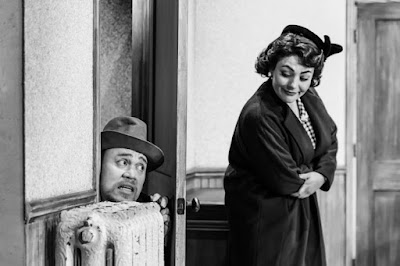
  • BEST VERISMO AWARD  The Verismo operas for this year were Korngold Die Tote Stadt, June 20, from the Bayerische Staatsoper, Janáček's Káťa Kabanová, August 2, from West Edge, and Leoncavallo's Pagliacci, August 20, from Chicago.  West Edge was in a poor venue and can't really compete with the other companies.  Verismo operas are modern enough to allow for regie productions with no complaining, at least from me.  The Korngold starred Jonas Kaufmann who is hard to beat in anything.  Pagliacci starred our boy Quinn Kelsen who gave us a marvelous prologue.  The pictured performance was a television show, The Honeymooners, which I am old enough to have seen.  If you hadn't seen it, you would not get the back story.  I award to Pagliacci, for fun.
  • SINGER OF THE YEAR   This has to go to Jonas Kaufmann, who managed to find a way onto the stage and our screens in spite of everything.  I especially loved him in the reopening of the Bayerische Staatsoper in Act I of Die Walküre with Lise Davidsen, who was glorious.  This is the most I have become emotionally involved with this scene. His fully staged operas were Aida with Sondra Radvanovsky, Die Tote Stadt with Marlis Peterson, Tosca with Anna Netrebko in Salzburg and with Sondra Radvanovsky in Spain, and the triumph that puts him above all others:  Tristan und Isolde with Anja Harteros.  I loved every bit in spite of the fact that it was very much regie.  With such great artists it doesn't seem to matter.

 It was a pretty strange year.  Let's hope for better things in the future.

Thursday, August 12, 2021

Tristan und Isolde from Munich 👍🏻


Conductor -  Kirill Petrenko 
Production - Krzysztof Warlikowski 

Tristan - Jonas Kaufmann 
Isolde - Anja Harteros 
King Mark - Mika Kares 
Kurwenal - Wolfgang Koch 
Brangäne - Okka von der Damerau

This is Wagner's Tristan und Isolde from the Bayerische Staatsoper.  It's a regie production, naturally.  Almost everything from there is.  I'm not sure it provides a context.  They all wear modern clothing, and we don't seem to be on a ship.

Act I.

Tristan has traveled to Ireland to bring back the future bride of King Mark of Cornwall.  He is there in his official capacity as representative of Cornwall.  Actually Tristan and Princess Isolde have an already existing relationship.  In a war between the two kingdoms, Tristan has killed Isolde's fiance and been seriously wounded in the process.  Isolde with the help of Brangäne nursed him back to health.  

On the journey she tries to order him around.  He remains distant and sends his assistant, Kurwenal.  This bit is not precisely clear.  Brangäne prepares a potion that Tristan and Isolde are to share.  Tristan drinks half, and then Isolde drinks the rest.  They seem to think it will kill them, but instead they fall hopelessly in love.  I thought the sudden falling in love was well handled.  We appear to be doing social distancing in this production.  No one touches in this part.

Act II

Isolde keeps turning the lights on and off.  I'm not sure what that's about.  I've never seen this character portrayed as perverse.  A feature of this production is that we see the characters live on the stage and projected on the wall in the form of a film at the same time.  Brangäne blames herself for administering the potion, but Isolde blames the Love Spirit who spreads love all around.  Isolde sees herself without love as destined for death.

I am an hour and a half in and did not ever before realize what a bear of a part Isolde is.  Other characters make brief appearances.  Finally Tristan enters and they talk about their time traveling to Cornwall.  She feels that she loved him then, but he was there in the role of foe.  Now they cannot simply forget that they love one another.  There is much discussion of which is better:  day or night?  Night is chosen.  Tristan wants to die.  The picture above comes from this section.

In the real world they sit in chairs and sing, but in the film behind they meet in the bedroom.  I don't know why I like this, but I do.

They sing for a long time about death, then suddenly they take needles from a bowl on the table and give themselves shots.  Death?  The bed in the background is suddenly surrounded by water.  Then people begin to enter.  They are discovered.  King Mark tells his story, that it was Tristan who thought he should marry.  Isolde is hearing this story for the first time.

This hardly seems like the same opera.  We want these two singers together in this opera because they are together emotionally.

Isolde says that she will follow Tristan to his home.  Melot, the betrayer, complains and the two men draw swords.  The bald person reappears.  Melot stabs Tristan.

Act III

Bald people in uniforms drinking coffee?  This part of the production I don't get.  Tristan sits with them and drinks coffee.  Next to him they look like children.  All but one appear to be puppets. A return to childhood?  An English horn plays on the stage.  

Kurvenal sings to the puppet Tristan while Jonas sings.  Then they exchange places. The puppet in the yellow blouse is Isolde herself.  I don't think I realized before how little time Tristan and Isolde spend on stage together.  I feel like I have never seen this opera before.  Opera's greatest singing actors have brought it to life as never before.  Absolutely stunning.

Old age advice.  Do not mourn that your love cannot be fulfilled.  Rejoice that passion can come to you.

Wednesday, January 01, 2020

Favorites of the Decade 2010-19 👍🏻

We have turned over a new decade, so I have decided to follow the trend and do a list of favorites of my own.  I will group them by favorite artists.

Jonas Kaufmann and Anja Harteros


I am feeling a bit sad that the Bayerische Staatsoper doesn't seem to cast them opposite one another any more.  I hope I'm wrong because together they have brought me some of my favorite Verdi performances.

  • My first experience of this pairing was in Wagner's Lohengrin on DVD (2010).  I saw this production live in Munich but with a different soprano.  This is the much maligned blue t-shirt production.  For me it worked and continues to be very watchable.  They are two great artists with magnificent charisma who are musically and theatrically on the same page.  The look may be odd, but it doesn't damage the story.  This is available on DVD.
  • Next they appeared together in Verdi's Don Carlo from the ROH (2013).  Thomas Hampson was Rodrigo.  In this wonderful opera they reign supreme.  It is a traditional production.  This is available on DVD.
  • That same year brought me my favorite ever of Verdi's La Forza del Destino (2013) from Munich. The villain brother is played by Ludovic Tézier.   Forza is very hard to stage, and I felt this version was successful by keeping the villain evil.  This is available on DVD.
  • And finally Verdi's Otello (2018) from Munich.  This is a lot of two Germans performing the essential Italian, but I loved all of it.  Unfortunately the DVD of Kaufmann's Otello is for a different performance from London, but I very much prefer this one for its tilt toward Desdemona and his relationship to her.  It goes very deep.
#ad

Anna Netrebko


This is the decade when Anna Netrebko moved from a lyric soprano to a Verdi spinto.  This change was not to everyone's taste, but I was surprised to find that I liked her Verdi almost as much as I had liked her Donizetti. The red dress Traviata I loved so much is from the previous decade.

  • Cilèa's Adriana Lecouvreur in HD from the Met (2019) with Anita Rachvelishvili.  Piotr Beczala is a wonderful added bonus.  This performance brings us a whole new generation of wailing.  It is appropriate that Anna end the decade with a new female voice at her side.  They were together in Aida at the Met, but the tenor spoiled the performance.
     

Elīna Garanča


Elīna's performances are beautifully sung and magnificently acted

 
#ad


Cecilia Bartoli


Cecilia began the decade with a Grammy for Sacrificium.  Shortly after that she became the manager of the Salzburg Whitsun Festival.  Of her triumphs I enjoyed these most.  Her contract in Salzburg continues to 2026 while she has added Opera de Monte Carlo to her future management duties.

  • Handel's Giulio Cesare at Salzburg (2012) in a regie production.  This production made it to DVD, and the DVD was nominated for a Grammy.  For some reason not known to me this opera is often regarded as a comedy with silly action.  In spite of that the musical elements are spectacularly beautiful.  Cecilia singing with a bag over her head may be going too far.
  • Handel's Ariodante (2017) from Salzburg.  This is Cecilia having fun with gender issues.  She begins with a beard and wearing a suit of armor.  She takes off her armor, dances, changes into a dress, and eventually removes her beard.  She blows smoke rings, or at least mimes blowing smoke rings since we see no smoke.  The singing is lovely.  The beard idea has found its way onto her latest album.
  • Rossini's L'Italiana in Algeri (2018) from Salzburg.  Of the bunch, this is my favorite.  Cecilia rides a camel, takes a bath, rejects the baritone and talks the tenor into returning to Italy, all in great comic style.  Cecilia sings wonderfully, acts as only she can and looks gorgeous.


#ad


Nina Stemme


Nina Stemme is an almost incidental singer, but nevertheless there are a few performances by her that have completely charmed me.  [That sounds worse than I meant it.]


Everyone Else


Here are some favorites from the past decade which did not make the previous list because no big name appeared in the performance.


I saw Rossini's Maometto II at the Santa Fe Opera in the new critical edition in 2012. It starred Luca Pisaroni and Leah Crocetto.  Leah sang the role originally written for Isabella Colbran.  I found this a magnificent opera and have been disappointed that I haven't seen it revived elsewhere.


That same year I saw Heggie's Moby-Dick at the San Francisco Opera.  I declared it to be a masterpiece, but haven't seen much of it lately.  Dead Man Walking seems to be everyone's favorite Heggie opera.  Stephen Costello and Jay Hunter Morris were the stars.


For a triple threat year I also saw a touring company present in its original production Einstein on the Beach by Philip Glass.  It was an historic event, even if I don't remember much about it.


Opera Parallèle brought me Golijov's Ainadamar in 2013.  This was already a favorite from recording.  There is time travel in the story which was easily solved by posting the current year in the titles.  The confusing story was well presented here.  It's about a play by Federico Garcia Lorca, done as a trouser role.  There was Flamenco dancing.  What more could you ask for?


Bay Area wonders continued with West Edge Opera's presentation of Berg's Lulu in 2015.  It starred Emma McNairy, so far my favorite Lulu ever.  She played her for sex, an entirely not irrelevant part of the story.  I see her name pop up in Europe now.


I visited Berlin in 2016 to see five Strauss Operas but ended up liking best Marschner's Der Vampyr at the Komische Oper.  No one I'd heard of before or since was in it, but it was enormous fun.


2017 was a notable year primarily for two different and very interesting productions of Mozart's  La Clemenza di Tito by two of the more notorious regisseurs in opera:  Claus Guth at Glyndebourne and Peter Sellars at Salzburg. Sellars focused on creating a racial context for the drama with racial casting while Guth moved the story from Rome to a river bank.  Sellars featured Golda Schultz and Russell Thomas while Guth had Alice Coote.  I dearly loved both of these performances and have come to regard this as Mozart's greatest opera.


Glyndebourne brought us in 2018 Barber's Vanessa. It was wonderfully mysterious and charming, and made me wonder why it never plays here.


2019 topped everything with the Metropolitan Opera's presentation of Glass's Akhnaten in an astounding production by Phelim McDermott.  We didn't know an opera could be about juggling.  Much of this success is due to the brilliant performance of Anthony Roth Costanzo.


Oh.  I award the decade to Jonas Kaufmann.  I liked him in more things than the performances with Anja Harteros. 


Sunday, December 02, 2018

Otello is Here

👍🏻
Conductor: Kirill Petrenko
Production Amélie Niermeyer

Otello Jonas Kaufmann
Jago Gerald Finley
Cassio Evan Leroy Johnson
Roderigo Galeano Salas
Lodovico Bálint Szabó
Montano Milan Siljanov
Ein Herold Markus Suihkonen
Desdemona Anja Harteros
Emilia Rachael Wilson

This performance of Verdi's Otello from Munich is unquestionably a masterpiece. We have here the ultimate domestic violence story.  It was a simple regie production in modern dress with many pictures to be seen here.  There are a few plot alterations.  Normally Otello and Desdemona are married before the opera starts, but here they marry shortly after he returns from war, after the love duet.  People enter and cover their bed with flowers.

In the past I have doubted that this opera was exactly right for Jonas Kaufmann, but now I may have to reconsider.  He refrained from pushing, as do many tenors here, and won me over.  This Otello is not black but he is also not beautiful.  This is why it is so easy for him to believe that this particular woman doesn't love him.  He believes in himself as a warrior but not as a lover.  Jonas has created this character in the manner of the great performer he certainly is.  We are lucky to live in his time.

The sets and staging focus on the couple and their relationship, and who better to play this couple than the great opera stage couple of our own era:  Jonas Kaufmann and Anja Harteros.  Anja is a stage creature.  To come to her greatest triumphs requires the stage where she can show voice, movement, beauty, expression and I think perhaps most of all acting.  In my mind I think of Desdemona as a light, relatively insignificant role.  With Anja we have the greatest depths of tragedy.  We have love and fear together in abundance.  Like many others before and after, she prepares for her own death and does not think of escaping.  It was a triumph.

And as if that were not enough we have the dream Iago of Gerald Finley, one of the greatest singing actors in opera.  You need to overlook the outfit where he wears baggy pants and Adidas.  He approaches Otello rather more intimately than one would generally expect, creating a new dimension to the opera.  Our imaginations immediately leap to lovers.  Could it be jealousy that motivates all this mayhem?

Petrenko was marvelous, as usual.  In my group people complained that he is seen rather more during the drama than they would prefer.  At the start they jumped immediately to film of Anja, which meant no shots of Petrenko.

This was a genuinely great thing.  I'm going to watch it again tomorrow.

P.S.  I did.  It was wonderful the second time, too.

Monday, August 06, 2018

Lohengrin from Bayreuth -- the Blue Lohengrin


Conductor:  Christian Thielemann
Production:  Yuval Sharon

King Heinrich:  Georg Zeppenfeld
Lohengrin:  Piotr Beczala
Elsa von Brabant:  Anja Harteros
Friedrich von Telramund:  Tomasz Konieczny
Ortrud:  Waltraud Meier
Heerrufer:  Egils Silins

The complete Lohengrin from Bayreuth has been posted on YouTube.  Piotr replaced Roberto Alagna in the title role, probably because Christian Thielemann had worked with him in his debut in the role in Dresden.  Piotr is quite successful in this role.  Lohengrin doesn't take on the Heldentenor tone seen in later Wagner.  Anja Harteros is making her Bayreuth debut here.  In her interview she says that Thielemann never does anything the same way twice.

At the beginning of the opera Elsa is already bound as a prisoner.  You will note please that the wings some of the characters wear only appear on the ruling classes.  King Heinrich has them, as do Friedrich and Ortrud, and of course Elsa.  This makes them symbols of position?  When the duel begins, the fighters fly up into the air, which makes the ropes defining the fighting ring irrelevant.  Lohengrin steals Friedrich's wings and is awarded his own set to adorn his costume when he wins the battle.

Tuesday, July 17, 2018

News


Anja Harteros has announced that she will no longer perform outside of Europe.  She likes to sleep in her own bed.  She was already performing in Europe most of the time.  If I want to see her live, I will have to travel.  She makes a great impression over the internet.


In other important news baritone Philippe Sly is doing a Klezmer version of Schubert's Winterreise.  I don't make this stuff up.

Sunday, March 25, 2018

Alcina on Medici.tv


Marc Minkowski | Conductor 
Adrian Noble | Stage director

Anja Harteros | Alcina
Verónica Cangemi | Morgana
Vesselina Kasarova | Ruggiero
Kristina Hammarström | Bradamante
Alois Mühlbacher | Oberto
Benjamin Bruns | Oronte
Adam Plachetka | Melisso

I have been subscribing to medici.tv without actually watching much of anything.  I notice that there are films from San Francisco on here.  All are highly recommended.

So I decided I should watch Handel's Alcina from the Vienna State Opera, 2011, with Harteros and Kasarova.   This is a typical opera seria with a traditional staging.  The best part is at the beginning where Alcina and Ruggiero are flirting.

You would want this for the singing which is very high class.  Anja in giant fro gets the most applause.  Why isn't Alcina played scarier?  This is hard to understand about this opera.  Here she seems genuinely in love and hugs everyone at the end.

Alois Mühlbacher is elsewhere called a countertenor who sounds like the boy soprano he is supposed to be according to Wikipedia.  This is a significant role, and Minkowski makes a fuss over him at the end.

This is for the Handel lover.  The camera makes a quick flash over to the audience, and I thought it might be Donna Leon, a known Handel lover.
#ad

Friday, August 04, 2017

Jonas and Anja together


This is Andrea Chenier from the Bayerische Staatsoper.  For love, for poetry, for art. 


And this is Don Carlo.


The love duet from Otello.


Lohengrin from the Bayerische Staatsoper. 

 
La Forza del Destino.  They sing together quite a lot, but not enough for me.  How about Tristan und Isolde?

Sunday, July 09, 2017

Tannhäuser 👍🏻

👍🏻
Conductor:  Kirill Petrenko
Production:  Romeo Castellucci

Hermann, Landgraf von Thüringen: Georg Zeppenfeld
Tannhäuser: Klaus Florian Vogt
Wolfram von Eschenbach: Christian Gerhaher
Walther von der Vogelweide: Dean Power
Biterolf:  Peter Lobert
Heinrich der Schreiber: Ulrich Reß
Reinmar von Zweter: Ralf Lukas
Elisabeth, Nichte des Landgrafen: Anja Harteros
Venus: Elena Pankratova

There appears to be some nudity in this production of Wagner's Tannhäuser from the Bayerische Staatsoper.  Or maybe we are seeing body stockings.  Or some of each.  I'm imagining the casting call for the set of archers shown who are clearly topless.  Their boobs are too uniform to be ballet.  [Research indicates that the archers are members of the ballet.  I'm still not sure I believe it.]  Later in the opera are people lying on the floor who are wearing body stockings.

The archers are very carefully blocked so that when they are actually shooting, they are always facing up stage.  The cocked arrows are never pointed anywhere else. It is interesting to notice that none of the arrows fell to the floor.  Later in the opera one of the characters pulled back an arrow and pointed it in the general direction of Elisabeth.  I did not like this at all.

I did not hallucinate that the Dresden Amen appears in Act III.  I'll have to learn to sublimate my reaction to this showing up in Wagner.


The most reaction in my group was to these feet.  Feet!  I won't bother to try to explain this production and have probably already shown the most interesting parts.

The orchestra, chorus, conductor and soloists were glorious.  I especially liked Anja Harteros, but then I generally do.  It was entirely beyond ones very high expectations.


Anja looks down on her dead self.  Please note:  the tombstones are named after the singers and not the characters they portray.  The talking heads said that this was to show that an opera staging is just pretend.  No attempt is made to explain her death, except we are told that an hour has elapsed.

The production is a cross between Star Wars and The Hunger Games, and instead of Venusberg we have Venusfleischberg [mountain of flesh].

Again the greatest applause is for Petrenko whose contract has been extended to 2021.


Sign back stage during this performance.  Attention Life Danger!!!  Bow and arrow action.  It is forbidden to enter the stage when the doors are locked by staff.

Friday, July 07, 2017

Die Walküre


Harteros and Kampe at the Salzburg Easter Festival 2017. Anja does it just right. See 5:10.  Oh wait.  They're both named Anja.  That would be Harteros.

Tuesday, June 20, 2017

Tosca from Vienna


There's a film currently on YT of Tosca from the Wiener Staatsoper with Anja Harteros & Jorge de León. It doesn't tell who the Scarpia is. I wasn't particularly wild about the tenor but very much enjoyed Anja's idea of Tosca. She is the first Tosca I've seen that made you feel you were watching a famous opera singer. It's as though she herself murdered Scarpia. She behaves as though she expected people to be constantly watching her. She is ever self-consciously melodramatic. She moves like an actress. And in act III when she instructs Mario how to die, she demonstrates like a director with a very theatrical fall to the floor. This is the Tosca of imagination.
#ad

Saturday, March 18, 2017

Andrea Chénier from Munich

👍🏻
Conductor: Omer Meir Wellber
Production: Philipp Stölzl

Andrea Chénier, a poet tenor: Jonas Kaufmann
Carlo Gérard, a servant baritone: Luca Salsi
Maddalena di Coigny, soprano: Anja Harteros
Bersi, Mulattin, her maid mezzo-soprano: J'Nai Bridges
La comtesse di Coigny mezzo-soprano : Doris Soffel

They layered every nuance for us to see at the Bayerische Staatsoper for Giordano's Andrea Chénier.  Above is how we generally viewed the sets.  Below is closer to what the audience saw.


The production made frequent use of split  pictures.  In the opening party scene we see the household staff laboring below stairs while the party goes on upstairs.  When the revolutionaries arrive, we see people from the below stairs staff among them.  When Andrea and Maddalena are preparing to die, we see the guillotine just above them.  The last thing shown is the blade falling.  In the task of explaining the action this production was excellent.

This is a play about patriotism and class resentment.  It started to sound familiar.  The central character is actually Carlo Gérard who tries to stand on both sides of the conflict.  He is for the revolution and overthrowing the aristocracy, but he also loves the family he served.  He is the truly honorable but conflicted man.  Each speaks of how he loves his country.

The artistry of the performers set fire to this opera.  It is an opera about one of the most violent periods in western history.  But somehow before today it has never had a sufficient effect. From "La mamma morta" to "Vicino a te" it blazed to ever more emotional intensity.  Opera should set fire to your heart, and this one did.  Bravi.

Saturday, November 12, 2016

Singer List -- Those who have Thrilled me most 👍🏻

Lists are the order of the day.  This singer selection is based on certain specific performances experienced in about the last four years, and not on a generic idea of who is best.  I am strongly influenced by theatrical performance in addition to great singing. 

These have been my favorite soprano performances.  The order is alphabetical

Sopranos

These are towering performances with a strong drift toward dramatic sopranos.

Mezzos

These are all complete performances where the mezzo leads the way.

Tenors

We trend in the direction of ham actors, but it can't be helped.

Baritones and basses.

The list comes out a little different this way.  If you want on this list, wow me in something.  I apologize if your favorite is missing.  Finley was outside the time frame.


Friday, October 21, 2016

Vissi d'arte


Gradually this has become my favorite version of this aria. Anja's version is the inner Tosca, the real woman who has lived for art and love and does not understand why the Madonna has turned against her.  Armiliato is with her in every note.

The film I posted before is gone.  This one is more recent.

Saturday, September 10, 2016

La Forza del Destino on DVD

Papa, Don Carlo, Leonora, Curra, priest, servant

Conductor Asher Fisch
Production Martin Kušej

Il Marchese di Calatrava / Padre Guardiano: Vitalij Kowaljow
Donna Leonora: Anja Harteros
Don Carlo di Vargas: Ludovic Tézier
Don Alvaro: Jonas Kaufmann
Preziosilla: Nadia Krasteva
Fra Melitone: Renato Girolami
Curra: Heike Grötzinger
Un alcade: Christian Rieger
Mastro Trabuco: Francesco Petrozzi
Un chirurgo: Rafał Pawnuk

I saw this streamed from the Bayerische Staatsoper in 2013, and now it has come out on DVD.   I am trying to decide if it makes more sense the second time around.

Forza is a problematic opera.  The music is some of Verdi's best.  I think when I was young it was far more popular than Don Carlo.  I can't say if this is due to the fact that it was one of Leontyne Price's more prominent operas, is in fact the only currently available DVD of a full length opera film of her in Amazon.  The plot centers around the evil brother who is simply nasty for little apparent reason.

Act I.  Don Alvaro has apparently been invited to dinner.  The family along with their priest wait around the table, but he doesn't arrive.  His empty chair can be seen above.  Ultimately he comes, and he has a gun.


And somewhat more obviously he has hair.  Papa doesn't like him, and we know why.  He's a hippie, and fathers of girlfriends never like hippies.  There's probably another back story somewhere.  He tries to cool off papa and ends up throwing the gun on the ground.  It goes off and shoots papa.  This was very well staged.  An open space separates papa from Alvaro, and he throws the gun out into the open space.  One sees the flash.  Usually this part of the plot is completely botched, and the audience has no idea what happened without reading it in the program.  Here it is very clear.  Papa curses daughter and dies.

Act II.  Separated from Alvaro, Leonora is at an inn where she sees her brother still dressed in his green sweater, though now he looks like Ludovic Tézier.  This both works and doesn't work.  It works because it tells us he is the brother from the previous scene.  It doesn't work because the child in the previous scene is too young.  He needs to be at least 16.  Or why is he still wearing the same sweater after so many years?

It's very dark and hard to see much of anything.  The table is still there, and papa still lies dead on the floor.  Leonora is still in her black dress, but seeing brother she slips into this mysterious disguise which she finds on the floor under the table in a case.  Does this make any sense at all?  The disguise may be the best part of the production, along with Jonas's hair.


Preziosilla sings for the customers.  She's recruiting for the army.

Leonora arrives at the monastery and asks for entry.  The table is still there, but papa no longer lies dead on the floor.  Only a couple of chairs plus the cross from the table remain.  The main priest at the monastery is the same singer as papa.  They dicker, but eventually he gives in and lets her stay.

They let her inside where there is a huge basin of water and a bunch of rag tag men in white suits.  They submerge her in the water as in an immersion baptism, three times fast and then one time slowly.  They perform the "La vergine degli Angeli."  It isn't exactly Catholic, so perhaps a cult of some kind.  This is one of the more gorgeous things Verdi ever wrote.

Act III.  This is the war act.  When Don Carlo and Don Alvaro meet, they pledge eternal friendship because Alvaro has saved Carlo's life.  When Carlo discovers who Alvaro is, he tries to kill him.  Alvaro decides to go into a monastery, the same one Leonora is in.


Act IV.  The greatest aria of this opera is in this act:  "Pace pace."  Alvaro is hiding, but Carlo finds him anyway.  Alvaro mortally wounds Carlo who manages to kill Leonora before he dies.  These three great singers do beautiful justice to this opera, but it still leaves a nasty taste in ones mouth.

#ad

Tuesday, September 06, 2016

Sexiest Opera Singers

The selection is based primarily on photographs.  I try to use pictures I haven't used before.

Vittorio Grigolo

Pavol Breslik
There are so many choices for Pavol that it is impossible to pick.  Man with gun always works.

Anna Netrebko

Philippe Sly

Susan Graham


Nadine Sierra -- Photo: Dario Acosta

Jonas Kaufmann

René Pape with gun

Anja Harteros
Nothing with gun

Saturday, March 19, 2016

Un Ballo in Maschera from Munich


Conductor:  Zubin Mehta
Production:  Johannes Erath

Riccardo:  Piotr Beczala (tenor)
Renato, Riccardo's best friend:  George Petean (baritone)
Amelia, wife of Renato:  Anja Harteros (soprano)
Ulrica:  Okka von der Damerau (contralto)
Oscar, Riccardo's page:  Sofia Fomina (coloratura soprano)

The Bayerische Staatsoper brought us Verdi's Un Ballo in Maschera in a manner we might have expected.  The whole thing takes place in Riccardo's bedroom.  This must surely indicate that it's all a dream.  The It's all a Dream staging is certainly one of the more annoying.  My most recent one of these was Falstaff from Florence.  Interestingly, that was also conducted by Mehta.  Everything is in black and white, and the stage is a bit dark for a stream.

I watched this out of order, middle first, followed by beginning, so I noticed that the woman with long blond hair that appears mysteriously at the beginning is Ulrica the witch.  Throughout this opera a lot is going on.  The male chorus is divided into two groups:  those friendly to Riccardo and those who are conspiring to kill him.  For the first time in my experience they are both labeled and translated in the subtitles.  If you watched without text, you wouldn't guess this.

I didn't realize before this that Riccardo so dominates the action.  No excuse.  He appears in various guises:  as himself, as a dead body uncovered by Ulrica lying on his own bed, and as a ventriloquist dummy, sometimes operated by Oscar and sometimes by Riccardo himself.  Piotr sings, dummy's mouth moves.  If this means something, I didn't guess it.  I thought ventriloquists were completely out of style.  I'm surprised by what a wonderful role this is for Piotr.

Now we wake up in Renato's bedroom where he is in bed with Amelia.  Ulrica is here, too.  We're supposed to be in a field with a gallows.  Anja sings her aria.  I didn't realize Oscar actually has a bigger part.  Riccardo appears, which is fine if we're in a field but iffy when we're in Renato's bedroom.  He sleeps through the whole thing.  Renato wakes up during the love duet.  The lovers spot him, and Amelia gets back in bed and covers up.  This is rather spectacularly silly, but the plot is actually more plausible if Renato is a lot more boring than Dmitri.

I have loved the music.  Harteros may be by now my favorite current Verdi singer, though this is not the best role for her.

Ulrica is still with us at the end.
#ad

Thursday, September 03, 2015

New Releases

New releases from the Metropolitan Opera can be ordered from Amazon in the US, such as this wonderful Falstaff and Renée Fleming's definitive Rusalka.  This is a very distinguished Falstaff, both musically and theatrically. 


Everyone loves Jonas, and his new CD can be preordered here.


This one you can buy from the Met shop but not from Amazon.


At amazon.de [that's Amazon in Germany] you can preorder Jonas's new Aida.  There's no sign of it here.


And look what else I found on amazon.de now in preorder.


I loved the Fanciulla but am waiting to see the Manon Lescaut from the simulcast.

P.S.  Everything can be ordered from Amazon now.
 #ad