Showing posts with label Cross-dressing. Show all posts

Sunday, April 29, 2018

Alice Coote: My Life as a Man

This is an article borrowed from the Guardian:

Ahead of her solo Brighton festival appearance showcasing Handel’s gender-bending operatic writing, mezzo-soprano Alice Coote reflects on the complexities of a creative life playing ‘breeches’ roles.

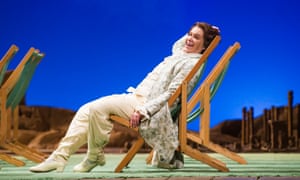
Alice Coote as Xerxes  in Xerxes by Handel, London Coliseum. An English National Opera production.

Alice Coote as King Xerxes

I get paid to flatten my breasts, dress up as a man, make love to other women, all the while singing athletically elaborate music without a microphone. This is my day job in rehearsals, and thousands of people around the world watch me do it in performance several nights a week.

I am an opera singer, and for those of us with the middle and lower range voices – mezzo-sopranos and contraltos – this is a normal part of the job.

Sunday, December 11, 2016

Trouser Roles Ranked


Thursday, October 13, 2016

Eliogabalo


Conductor:  Leonardo García Alarcón
Production:  Thomas Jolly

Eliogabalo (Roman Emperor): Franco Fagioli (countertenor)
Alessandro Cesare (Eliogabalo's cousin): Paul Groves (tenor)
Flavia Gemmira (Alessandro's girlfriend): Nadine Sierra (soprano)
Giuliano Gordio (Flavia's brother): Valer Sabadus (countertenor)
Anicia Eritea (Giuliano's girlfriend): Elin Rombo (soprano)
Atilia Macrina: Mariana Flores (soprano)
Zotico: Matthew Newlin (tenor)
Lenia (old female servant): Emiliano Gonzalez Toro (tenor)
Nerbulone, Tiferne: Scott Conner (bass)

This performance from the Paris Opera of Eliogabalo by Cavalli in Italian with French subtitles is rather more cold than even I can tolerate.  I tried watching it without knowing anything, and this didn't work out for me.  For an excellent discussion of this production see The Idle Woman. It was composed for a Venetian carnival performance in 1668 which did not take place.  Many speculate why this would happen.  Cavalli was the most important Venetian opera composer but was coming to the end of his life.  It may also have been censors.  One writer suggests that it may have been too serious for carnival.  It's first performance was in 1999, then René Jacobs revived it in 2004, and it's played in several locations since.  A description of the plot can be found here.  View the stream here.

The music is clearly still in the style of the late operas of the great Monteverdi.  I am no longer "cold" in this aspect of the performance and enjoy it very much.

Act I

Campidoglio (the square on the capitol in Rome)
Emperor Eliogabalo has returned to Rome.  A rebellion by the Praetorian Guard has been put down.  The plot concerns itself primarily with his sexual interests.  He's no longer interested in Eretea and needs new women to harass.  There are frequent appearances of young men wearing only loin cloths, such as our Amor above.

I find the arias, especially by Nadine Sierra and Paul Groves, particularly beautiful.

Hall in the Senate
I've been in the Senate and there are no halls.  Women in tall hats are entering.  Eliogabalo has replaced the male Senate with an all female one.  Eliogabalo himself is dressed as a woman and sings their praises.  We can say already that this opera is about cross-dressing, mostly men dressing as women, such as Lenia who is a tenor.

The women cover their faces and are told to embrace one another.  The one who guesses who is touching them wins.  Atilia guesses and becomes a proconsul.  Flavia cannot guess when it is Eliogabalo and goes off embarrassed.

Act II

If you are tired of the impossible to stage da capo arias of Neapolitan opera, this may be just what you want.  This is from the era when the composers wrote their own recitative and regarded it as an important part of the work.  This opera is strangely relevant.  Who would have thought our own country would become something like this.

Nadine suddenly sings a very high note.  Fun.

The most shocking thing about this production is how not shocking it is.  Obviously Eliogabalo is a scandal.  How can such a dark and low key production express this scandal?

Eliogabalo prepares a banquet with two prominent pitchers.  Zotico and Lenia taint the pitchers--one is sleeping potion and the other poison.  Nerbulone drinks the sleeping potion.  Large black owls descend on the table, and the banquet is cancelled.  The owls dance.  Franco Fagioli is enjoying a peak in his career.  His countertenor is very robust.

Act III

I am a fan of Nadine Sierra and am happy to see her performance here.  Eliogabalo is the only character who gets interesting costumes.  He sticks his arms and feet into a bath and they come out covered in gold.  He gets in.  One of the people dressed in a loin cloth appears to be a girl.  He thinks about Flavia while everyone else thinks about killing him.  Eventually they succeed.

One would choose an opera about this particular Emperor for the debauchery, surely.  It was probably rejected for the seriousness.  I personally would have liked a less serious production.  The music is glorious but just a little long.

Circo Massimo
Everyone is at the games, but Eliogabalo does not arrive. Then it is reported that he is dead.  Flavia brings in his head and explains that the guards killed him when he broke into her room.  Alessandro becomes emperor, marries Flavia and everyone lives happily ever after.  This music is very beautiful, but I imagine the Venetians wanted more bang for their buck.

Wednesday, May 21, 2014

Blogging

There is currently a row going on in the opera world, dubbed Taragate, about the attacks by male critics on Tara Erraught currently cast as Octavian at Glyndebourne.  See Opera Fresh, Telegraph, Elle, Telegraphagain, etc.  It's all over Twitter, too.  It live streams on June 8 if you want to make up your own mind.

Glyndebourne responds:  "Tara Erraught is an outstandingly talented artist whom we are thrilled to have as part of the cast of Der Rosenkavalier."

Should I feel guilty about this?  After all, I have posted a sexiest opera singers list every year since the beginning of this blog.  I even complained about Anna Netrebko post baby, something that I have reconsidered.  I am used to the way she looks now and still think she is gorgeous.

In the case of the Glyndebourne incident, I still insist that the designer of a production can make his performers look any way he wants.  If you don't like the way Ms. Erraught looks, you should complain about the production.  These people who sing Octavian are women.  That is part of the fun.  If you successfully completely disguise that fact, isn't that a mistake?  If you don't like cross-dressing, stop going to Rosenkavalier or any of the other operas where this goes on.  See extensive discussion of cross-dressing elsewhere in this blog.

I know of at least two young singers who do long distance running to keep their weight down.  Whoever you are, you have seen at least one of them and will probably soon see the other one. 

To Tara herself I would like to remind her there is no bad publicity. 

Tara is singing La Cenerentola next season at the Washington National Opera.

FYI:  Dame Kiri agrees with me.

Thursday, January 23, 2014

Cross-Dressing in the Movies

Often in the movies a character of one gender dresses up as the other, such as here where we see Marlene Dietrich in Morocco.  Her character in the movie is female.  In this disguise she kisses one of the women in the audience.


In Some Like it Hot two guys, played by Tony Curtis and Jack Lemmon, are pretending to be women.  Everyone in the audience knows they are not really women, and part of the joke is deciding how well or badly they have managed it.

In Tootsie Dustin Hoffman pretends to be a woman.  We know that he is actually a man.  A common motive for cross-dressing is to get a job.  The general consensus was that he was badly disguised.


That is also Julie Andrews' motive in Victor Victoria.  We didn't buy her either.

Tom Hanks did it in Bosom Buddies to get a room in a women only hotel.  For some reason we believed this.


But if you didn't read about it in advance, you might not have known that the male character Billy Kwan in The Year of Living Dangerously was played by a woman, Linda Hunt, currently of NCIS Los Angeles.  I suppose this is the only case I can think of that parallels operatic cross-dressing.  The singer in an opera is supposed to be the other gender and not just pretending to be.

I especially loved this movie because of the scene where the older man (Linda) introduces the younger man (Mel Gibson) to the joys of the Strauss Four Last Songs.  I believe if memory serves, that the version was Kiri te Kanawa.


The Crying Game was a special case.   Everyone I knew did a fabulous job of keeping the secret that Dil was actually a guy.  If you knew, it spoiled the joke.  He takes a man home with him and we get to find out together with the man on the screen that his plumbing is not really female.

This is based on an item in Entertainment Weekly.  I used different pictures, but the idea is the same.  No one thinks anything of cross-dressing when it's a joke.

Sunday, December 15, 2013

Cross-dressing Research

A brief chronological list of male opera roles sung from the beginning by women.  The purpose of this seems to be to make the character seem youthful.  Since I first posted this, it has acquired a few roles where the character is female but the singer is a man.


role opera composer  Fach
Lenia Eliogabalo Cavalli tenor
Ottone Agrippina Handel contralto
Sesto Giulio Cesare Handel soprano
L'Amour Les Indes Galantes Rameau soprano
Bellone Les Indes Galantes Rameau baritone
Platée Platée Rameau haute-contre
Sesto La clemenza di Tito Gluck mezzo-soprano
Amore Orfeo ed Euridice Gluck soprano
Cherubino Nozze di Figaro Mozart mezzo-soprano
Annio La clemenza di Tito Mozart mezzo-soprano
Tancredi Tancredi Rossini mezzo-soprano
Roggiero Tancredi Rossini mezzo-soprano
Ottone Adelaide di Borgogna Rossini contralto
Malcolm La Donna del Lago Rossini mezzo-soprano
Arsace Semiramide Rossini contralto
Puck Oberon Weber contralto
Isolier Le comte Ory Rossini mezzo-soprano
Jemmy William Tell Rossini soprano
Romeo I Capuletti e I Montecchi Bellini mezzo-soprano
Smeton Anna Bolena Donizetti mezzo-soprano
Maffio Orsini Lucrezia Borgia Donizetti contralto
Vanya A Life for the Tsar Glinka contralto
Urbain Les Huguenots Meyerbeer mezzo-soprano
Ascanio Benvenuto Cellini Berlioz mezzo-soprano
Pierroto (?) Linda di Chamounix Donizetti contralto
Ratmir Russlan and Ludmilla Glinka contralto
Adriano Rienzi Wagner mezzo-soprano
The Shepherd Tannhäuser Wagner soprano
Siebel Faust Gounod mezzo-soprano
Oscar Ballo in Maschera Verdi soprano
Stephano Romeo and Juliet Gounod soprano
Tibaldo Don Carlo Verdi soprano
Fyodor Boris Godunov Mussorgsky mezzo-soprano
Orlofsky Fledermaus Strauss, J mezzo-soprano
Nicklausse Tales of Hoffmann Offenbach mezzo-soprano
Walter La Wally Catalani soprano
Hansel Hänsel und Gretel Humperdinck mezzo-soprano
The Sand-Man Hänsel und Gretel Humperdinck soprano
The Dew-Man Hänsel und Gretel Humperdinck soprano
Cricket Cricket on the Hearth Goldmark soprano
Le Prince Charmant Cendrillon Massenet soprano/tenor
The Kitchen Boy Rusalka Dvořák soprano
Yniold Pelleas et Melisande Debussy soprano
Page Salome Strauss contralto
Chérubin Chérubin Massenet mezzo-soprano
Octavian Rosenkavalier Strauss mezzo-soprano
The Composer Ariadne auf Naxos Strauss mezzo-soprano
Aljeja, a young Tartar From the House of the Dead Janáček mezzo-soprano
Cherubino Ghosts of Versailles Corigliano mezzo-soprano
Ariel The Tempest Ades soprano
Pilgrim L'Amour de Loin Saariaho mezzo-soprano
Pip Moby Dick Heggie soprano

The list isn't intended to be complete but instead tries to show how this spans all eras and nationalities of opera.  Nicklausse in Conte d'Hoffmann is a special case, since the character represents both Hoffmann's female muse and male friend.  There is another list at least this long of roles originally sung by castrati, but the date range is earlier.

Wednesday, November 27, 2013

Proud Cross-dresser

This is Sarah Connolly at the Last Night of the Proms 2009 where she appears in the guise of Admiral Nelson.  Isn't it more fun to celebrate than to mourn?


She revives the original Arne arrangement.

Monday, November 25, 2013

Brief History of Cross-dressing in Opera


Please forgive me. This is written out of my head and involves no research. Usually I research things, but it can ruin my train of thought.

In the beginning (Greece, Shakespeare, etc.) theater was a masculine activity.  Often society decided that all public appearances by females were immoral. The world was pretty much the same as it now is in Saudi Arabia. Men did things and women stayed home and had babies and cleaned house. If you're my age, you can remember this. Don't go around asking yourself why there were no women composers or painters. Composing and painting are jobs, and women were not allowed to have jobs. Except prostitution, of course. Women were angels or devils with no in between statuses that allowed for holding jobs. Opera singing is also a job.

In the early era of opera the situation was somewhat confusing to follow. In Venice and Mantua women appeared on the stage in female roles.  In Rome and the Papal States all roles were played by men with the high voices sung by castrati (men surgically altered to retain their child voices). There were plenty of castrati around to serve in this capacity. Women singing in church was still forbidden in most places. This means lots of cross-dressing in opera, all by men, such as would have occurred in Shakespeare. High voices were preferred, and castrati sang both male and female roles.

The French were violently opposed to the idea of castrating men to provide high singers. Their female roles were always sung by women. Then Napoleon conquered Italy and put a stop to castration there, apparently imparting the French horror over the practice to the Italians. Over the next 100 years the practice died out until eventually there were no living castrati.

But it is important to remember in the French tradition that Rameau's Platee includes a cross-dressing frog tenor in the title role--the character is female and composed for a tenor. There are no legitimate female operatic tenors, so the role would be sung by a man.

By the time of Mozart, who in his person embodied all the musical practices of all the musical centers of Europe of his time, an additional cross-dressing tradition arose: roles for teenage boys were sung in their pre-pubescent high voices and were portrayed by women. The most famous example of this is Cherubino in Le Nozze di Figaro.


Summary--opera seria included roles for castrati, opera buffa did not. There is a very nice role in an opera by Cavalli (Venetian school, heir to Monteverdi, lived before the seria/buffa split--La Calisto--looked the name up) where Jove pretends to be a woman. As Jove he is a baritone, as the female he is a falsetto soprano. Very funny. This is cross-dressing outside the traditional stereotypes, and as far as I know is the only early opera role intended to be sung falsetto.


Rossini came after the invasion by Napoleon. He composed both for castrati and women singing men, with the preponderance being the latter. Women began to replace castrati during this time in the portrayal of heroes in serious opera.  It is surprising how few castrato parts there are in Rossini. Women singing male roles is far more frequent.


One wishes to hear the sound of two high voices singing together: I Capuletti e i Montecchi, still always sung by two women; Semiramide. The plot makes one of them a man, the music makes both of them women. DiDonato and Kasarova have kept Capuletti alive, but Semiramide is now very rare now that Marilyn Horne has retired. Women sing these bel canto roles and have since the beginning. Countertenors were not known in Italian opera in any period.

The only part of the cross-dressing tradition that survived into operas composed in the twentieth century is the tradition that teenage boys should be sung by women: Octavian and The Composer.

My sense of the cross-dressing tradition of opera is that it comes from two causes--the original reluctance to allow respectable women to appear in theater, which morphed into the later realization that seeing people portray the other gender was itself a distinct pleasure, a pleasure that works in both directions.
__________________________

In modern times certain traditions are followed when reviving older operas.


In my youth Handel and Vivaldi revivals involved Marilyn Horne donning masculine attire, including very tall helmets to compensate for her short stature. Alfred Deller was the only known practicing countertenor, and I don't think he sang very much staged opera. This would require research.

I am reminded that Sarah Bernhardt, a French stage actress, portrayed Hamlet.  And there is a movie of The Tempest where Helen Mirren plays Prospero.

Then came the countertenor explosion. If there were an opera composed for 6 countertenors (don't worry, there isn't), casting this would no longer be a problem. Some of them are actually good. No woman could achieve the heroic intensity of David Daniels' Giulio Cesare. The new tradition says that if a male role was written for a castrato, it should be sung by a countertenor, but so far the countertenors have not completely displaced the female mezzo-sopranos. It has so far not become a tradition for teenage boys with high voices to be sung by countertenors. The main objective of this revolution seems to be to reduce the amount of cross-dressing in opera.
______________________

Which brings us to the problem: society wishes to look down on cross-dressers of either gender in or out of opera, accusing them of doing it on purpose I suppose.

Alice Coote, a spectacularly gifted operatic cross-dresser, complains out loud that she actually is a woman. She also sings Charlotte and Carmen.


Susan Graham has a song written for her where she complains similarly. She also sings La Grande Duchesse, Iphigenie and Dido to great acclaim. (I almost looked this up. Caught myself in time.) Susan has the additional disadvantage of being tall.


The most spectacular of all operatic cross-dressers is Vesselina Kasarova who I am pleased to say has not complained, at least not in my hearing.  She sings Carmen.
________________________


And now Elīna Garanča (cannot display her correct name without looking it up) has announced that she is retiring from trouser roles, as they are usually called. She wants to become a Verdi mezzo. My official opinion on this subject is that while Netrebko can truly say that her voice has transitioned to Verdi, Garanča is premature. She has a dark but not a particularly heavy voice. People don't seem to be able to differentiate between the two--a distinction that is vital to the vocal health of the singer. What matters is the actual physical heaviness of the voice, not how heavy you can fake it. This is the same reason Jonas is not ready for Tristan. Elīna Garanča so far has always cancelled on the west coast, so I have not been in the room with her.

After her Cenerentola, Garanča announced a similar retirement from bel canto. She wants to sing only Carmen forever. Perhaps she simply doesn't want to dress up like a boy any more. Sesto in Clemenza could be any age.  She mentioned specifically only Cherubino and Octavian.  One would prefer to think that major career decisions were not made for reasons of social bigotry.

The Strauss trouser roles, and perhaps others from Romantic repertoire, are not vocally similar to Mozart. Kasarova warns that it is dangerous to sing Octavian too soon. If you're 18 and can sing him, it isn't too soon for Cherubino.

I have friends who don't like to see cross-dressing in opera. I explain that only in England do countertenors have a long tradition. Italian operas were not composed for the male falsetto and don't sound right in their voices. They are establishing turf in the Baroque era, and even I am beginning to like it. I respond well to people reinventing a musical genre.

So for some people everyone should appear in public, and that includes on the stage, in their gender assigned costume. There is even a Google (I googled this, I confess) question that explains that being a countertenor doesn't necessarily have to do with being gay. The thing it most likely relates to is that the particular singer sounds better in his falsetto voice than he does in his natural voice. You can see films on YouTube of Philippe Jaroussky singing in his normal crooner baritone voice. You would never have heard of him singing like this.

Apparently Jaroussky has announced that he does not wish to appear in a female role. I think it is correct to lump this together with Garanča's announcement. The type of vocal issues that arise for Garanča are not relevant to Jaroussky, since there is no established tradition for countertenors and no roles composed for them until Britten.  (Footnote:  all of Bach's high voice music would have been written for falsettists or boys, but this is not opera.  Still not from research.)

Opera is by now an ancient tradition. I attended the 400 years of Orfeo performance. I don't want to get into the sociological ramifications of this issue, but I feel firmly that looking down on the honored cross-dressing tradition of opera is disrespectful of the genre. It's fun. Relax and enjoy it.

The picture at the top is Erwin Schrott in Les Vepres Siciliennes at ROH.  For a list of roles that involve cross-dressing see here.
Sunday, November 17, 2013

I cry when the pressure becomes too great


Interview with Elīna Garanča translated from Kurier.


"I cry when the pressure becomes too great," The opera star presents her autobiography "Really important are the shoes." In the interview she talks about the pressure to succeed, why she is shy and her farewell to trouser roles.

KURIER:  Ms. Garanča, tomorrow your first biography appears: "Really important are the shoes." Why do you already write your first biography when you are only 37 years old? 

Elīna Garanča:  Honestly?  Because I was persuaded to.  I myself would not have had the idea for this book, because I myself found that I am too young. But I am currently at a turning point in my life. I am about to turn 40, in a few weeks I will have my second baby - with this my family plan is completed. And in the next few years I want to sing new, more dramatic roles. So I thought, why shouldn't I after 15 years on the stage write a kind of interim result to be read in 20 years, as I then thought about my life and the world of opera.

In your biography you speak very openly about your childhood, your fears and your private life. This one does not even know of an Elīna Garanča ... 

It was not easy for me to unpack these thoughts and details about my life, because I'm actually a very reclusive and shy person. I have never told before how my husband and I got to know each other, and I never talked about my melancholy.

In what moments are you melancholy? 

My fans see me rather more like a "Wikingerweib" [female viking?], which nothing can shake. In fact, I'm the opposite, I am very vulnerable and there are rarely nights where I can sleep through the night without chasing the thousands of thoughts running through my head. I often look enviously at my colleagues, who brimming with confidence and often without knowing all the notes, stand on the stage - that would be a disgrace for me. My self-doubts usually start ten days before the premiere.

Then I argue if I can sing the role, if I understand what the conductor wants from me. To escape this misery I have several methods - go to the gym or I regain my peace of mind with gardening.  If all else fails, then it only helps to cry against the pressure. I listen to the saddest arias, drink a glass of wine and let my tears flow, and afterward fall exhausted into bed. This cleansing process works. The next day I have found my good mood, and self- doubts are gone.

Is that the way you deal with the pressure to succeed? 

Yes, of course. I try to protect myself from flops by choosing my parts very deliberately, often saying no to commitments when I'm not convinced. I prepare for every role very intensively. But nevertheless, the stage fright is getting bigger and the pressure grows. The older I get, the more my presence is ever more present. I become more and more aware that I need to protect my name. And I am on stage a completely different person than in private life. That's why it often bothers me how people think about me.

You want to make a repertoire change in the coming years. In which roles will one no longer see Elīna Garanča?  Will you continue to sing Carmen? 

Carmen is a role that can safely accompany a mezzo-soprano for a lifetime. It only changes which Don José is by my side. But what I definitely feel too old for at 40 are the trouser roles. I miss this youthful naivety, which is needed for the role of Sesto or Octavian. In these Bubenpartien [kid parts?] you will certainly not see me again. Besides that, routine bores me, I want to break new ground. In the next few years I want to sing a Santuzza, an Eboli and the highlight of my career Amneris in Aida.

You will have your second baby in a few weeks. What do you sing at the moment? 

At the moment I do not sing classical music, but with my daughter Winnie the Pooh (laughs). I know the top ten hits of Winnie the Pooh.

When do you want to return from maternity leave? 

I don't make any stress for myself. Fixed is the concert in Göttweig, but if I already appear before that will depend on my second daughter.   Even though I can imagine it going well, for the second child one has more routine.

How do you manage logistically - to bring two children, your career and the career of your husband under one hat? 

This is actually a logistical feat. My husband and I try never to be longer than two weeks separated from the children. We have our own nanny in Spain and a travel nanny.  In the future we will be traveling with two nannies.  And as hard as it may seem for some, we will also sometimes separate the children.  Say, the baby accompanies me to a gig and my older daughter Katie accompanies my husband to a concert.

Your husband is a conductor. You are the superstar. How does he deal with playing second fiddle? 

In trouser roles Elīna Garanča always excelled on the opera stage: 'But for these roles I now feel too old' My husband has never complained until now. He is not one who runs after the fame or the glory. Just like me, he is very down to earth and he got to know me when I was not long The Garanca. Sometimes he complains, because I've become very impatient in recent years. But we both try to realize our dreams. But between us there is no competition: Who got the better reviews, who received the greater applause. That would be the death of our relationship.

It is amazing that your mother when you were 17 dissuaded you from a career as a mezzo- soprano, because she saw too little talent. Has she already apologized for this miscarriage of justice? 

When I think back to my voice then I have to agree with my mother afterwards. My voice had then perhaps timbre, but there was too little volume with only one octave and too little power - these were not prerequisites for an international career. There existed a nature of the voice, but which had to be polished properly.

They repeatedly emphasize that the Garanča of the stage has nothing to do with private Elina. What is the real Garanča ? 

I am still the same natural person I was as a child. At the moment I'm winterizing my garden. Dirt is under my fingernails, I just put down rye seeds that I took from the earth in the spring. This is an ideal fertilizer for my vegetable garden. I can still milk cows or bake my own bread, which I learned from my grandmother. My friends always laugh when I describe myself as the best singing milkmaid.

Personal: Elīna Garanča World star without airs The native Latvian (37) wanted to be an actress. In the entrance examination for the Academy of Drama she fell through. When she expressed her desire to her mother, who was herself a mezzo-soprano, to become a singer, the mother said : "Nothing will come of your voice." But Garanča did not give up.  Her first engagement was Garanča in Thuringia. From then on it was uphill. Ioan Holender gave Garanča a fixed contract at the Vienna Opera. Since 2005 she is a freelance artist and has sung on all the major opera stages of the world from the Met in New York to Vienna to Covent Garden. She are currently considered the best "Carmen" in the world. In addition to the biography, a new CD "The best of Elīna Garanča" has been released. ( Kurier ) Created on 10.11.2013 , 11:21

'Really important are the shoes' : In this biography Elīna Garanča gives insight into her career, her personal life and her self-doubt. Released in Ecowin-Verlag at 21.90 Euros. 

[It is none of my business to second-guess the lady, but I disagree.  There is a world of difference between a Mozart trouser role and a Strauss trouser role.  You can feign youthfulness, but it is not possible to feign the mature voice required for Strauss.  I have no argument for her being bored with them.]

Monday, April 26, 2010

Which Trouser Role Are You?

I haven't taken this quiz in a while so I thought I would do it again. This time I came out...

You're Countess Geschwitz! You're not a trouser role -- just a garden variety dyke. You do wear 'male costume', though, so it's all right that you slipped in somehow. You're decent, honest, brilliant, loyal, and apparently the only principled human being on the continent. Then why are you so miserable? Because you fell in love with a heartless skank-ho, dummy! "Mein Engel" mein ass! A word of advice: when they call it "serial music", they aren't kidding -- watch out for Jack the Ripper.

Oh to be young again and play this Countess. This time I didn't lie.

Thursday, July 03, 2008

Rinaldo


Photo caption left to right: Ruben Drole, Liliana Nikiteanu, Malin Hartelius, Juliette Galstian and Ann Helen Moen.

How I love this Eurotrash Handel--especially the kind they do at the Zurich Opera! Our war isn't between Christians and Saracens--it's between two large corporations, one headed by the heroic CEO Rinaldo and the other by the evil sorceress Armida.

One especially nice thing is the fact that there are no countertenors--just lovely girls having fun in their drag outfits--sometimes in business suits and sometimes in urban guerilla outfits.

There is ballet work but no dancing. It's amazing how much more I like ballet without the dancing. There is an escalator which doesn't move, but the ballet go up and down on it like it did, creating the illusion of an escalator. There is kissing--anyone kisses anyone. There is pantomime kicking in usually imaginary balls.

Ruben Drole, baritone, the one lone male, is Argante, Armida's lover / flunky--we're not sure which. Or perhaps both.

All of this works because of the fabulous, gorgeous, bitchy, glorious Malin Hartelius as Armida. The singing was incredible, starting from the top with Juliette Galstian as Rinaldo and Ann Helen Moen as his girlfriend Almireno. I also like Liliana Nikiteanu who was having a lot of fun with her part.


I loved it.

Here is the official trailer.


In the past I have bitched about La Scintilla, the natural instruments orchestra at the Zurich Opera. The first time I heard them was in Giulio Cesare a few years ago, and I found them seriously out of tune and inaccurate. Things have improved a lot. I noticed Ada Pesch went twice around the orchestra helping some players tune their instruments.

In Rinaldo there was a lovely aria where a flute imitates a bird that was quite charming on the soprano recorder.

Wednesday, February 06, 2008

Sexiest in Drag


I was scanning for pictures of Elīna Garanča in drag and came upon this nice picture. We would nominate the other woman, too, but we don't know who she is.

In the same search we found this:

My own picture, shown on the right, also appeared in this search. I am happy to be mistaken for the gorgeous Elina.

Lately every opera picture looks like a candidate for the Regie game. What opera includes a satyr?

Wednesday, December 14, 2005

Castrati

Opera from Monteverdi to Rossini contains a dirty little secret: the castrato. Dramatic presentations in Rome in this period, whether operas or oratorios, used all male casts, because of the church’s complete oppression of women. For some reason not clear to modern minds it was felt better to castrate men than to allow women to appear in public performances. The Roman opera from its origin in the 1620’s performed with all male casts, with castrated men playing the female roles.

In my discussion of the unknown opera composers I left out Landi, Mazzocchi, Marazzoli and the two Rossis, the composers of the Roman school, from my list. My apologies.

Cecilia Bartoli’s Sacrificium goes into detail about when, how and how frequently the castration took place. The sources for this data seem a bit sketchy.