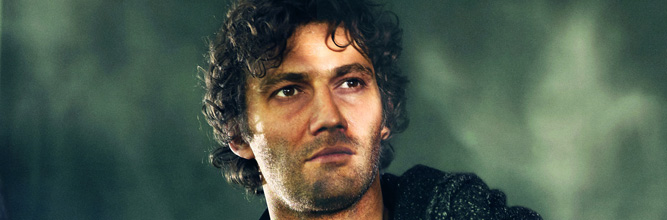
Showing posts with label Peter Mattei. Show all posts

Tuesday, March 31, 2020

Il Barbiere di Siviglia

👍🏻

Conductor...............Maurizio Benini
Production..............Bartlett Sher 

Figaro..................Peter Mattei
Rosina..................Joyce DiDonato
Count Almaviva....Juan Diego FlĂłrez
Dr. Bartolo.............John Del Carlo
Don Basilio.............John Relyea

The Met is streaming Rossini's Il Barbiere di Siviglia that originally played in 2007 while I was driving across the country.  I don't seem to have had much enthusiasm for it, but seeing it now I like it a lot.  This is such a marvelous cast.  Every one is among the best in their class.  At this point in my life Mattei may be my favorite Figaro.  He plays the role with great vigor.  There is a strange, ghost-like man who wanders the stage.  The main trio are young and lively, great singers, actors, musicians.

This opera was originally called Almaviva and ended with the big aria usually heard as the finale to La Cenerantola, here sung by the tenor.  Later Rossini removed it from this opera and assigned it to Angiolina, a coloratura mezzo.  In modern times it is only rarely heard in Il Barbiere di Siviglia, and only when a company wishes to particularly honor a tenor.  Juan Diego's performance is excellent.

I find this is highly recommended.


Saturday, January 11, 2020

Wozzeck in HD


Conductor...............Yannick Nézet-Séguin
Production..............William Kentridge

Wozzeck.................Peter Mattei
Marie...................Elza van den Heever
Captain.................Gerhard Siegel
Drum Major..............Christopher Ventris
Doctor..................Christian Van Horn

This is my fifth time with Berg's Wozzeck--once in the 60's at San Francisco with Marilyn Horne, once in the 80's at San Francisco with Janis Martin, once in 2011 at Santa Fe with Nicola Beller Carbone, a German soprano, once streamed from Salzburg with Asmik Grigorian and now in HD from the Met with Elza van den Heever.  Marilyn Horne could have been singing Bellini.  Janis Martin could have been doing Wagner.  Since then it has become increasingly noticeable that there is a lot of Sprechstimme in this opera.  This means it often sounds like talking in rhythm against the large orchestra.

I saw this production streamed from Salzburg.  It looked even more jumbled and distracting this time.  It overwhelms the action and makes everything confusing.  I liked it even less this time.

Peter Mattei was just right as Wozzeck, mean and dark and nasty.  Elza may be too nice as Marie.  The puppet child never projects as a real child, never arouses any sympathy.  It must be under 3 years old, since that is how long Wozzeck and Marie have known each other.  When this opera works best for me it's when the child is seen wandering off after both his parents are dead.  A puppet doesn't arouse this reaction.

Musically it was quite well done.
 

Saturday, April 22, 2017

Eugene Onegin from the Metropolitan Opera

The Prince and Princess Gremin
👍🏻
Conductor...............Robin Ticciati
Production..............Deborah Warner

Eugene Onegin...... Peter Mattei
Tatiana.................Anna Netrebko
Lensky..................Alexey Dolgov
Olga....................Elena Maximova
Prince Gremin......Stefan Kocán
Larina..................Elena Zaremba
Filippyevna, nanny....Larissa Diadkova
Triquet.................Tony Stevenson

Today was the Metropolitan Opera Live in HD presentation of Tchaikovsky's Eugene Onegin starring Mattei and Netrebko.  This was the third HD presentation of this opera and the second of this production.  I had no sense that I was seeing a repeat.

This time the production seemed perfect.  The first two acts are clearly in a country villa with villagers and land owners.  Larina, Lensky, Olga, Tatiana and Onegin represent the latter.

Every role was cast to perfection.  Tony Stevenson did a star turn singing the couplets at Tatiana's birthday party.  Larissa Diadkova is very attentive as Tatiana's nanny.  Olga and her mother were wonderfully sung by the two Elenas.  Alexey Dolgov as Lensky was perfection as the too immature man who simply assumes Olga is his forever and does not know what to do when Onegin flirts with her.  We will have to read the novel if we want to know what happens to Olga.  Stefan Kocán seems a little young for Gremin but sang beautifully.

But it is the amazing acting of Anna Netrebko and Peter Mattei that brings this opera thrillingly to life.  Anna has gone deeper into the character this time with astounding results.  Peter portrays arrogance and ennui better than any of his predecessors, and then caps his performance with an intense finish.


Here he appears at a party in St. Petersburg in the third act.

It is an opera about love.  I often think that I am happier in my old age because I no longer feel inclined to fall in love.  It is far better to watch others suffer at the opera.  This performance was a level of theatrical and musical achievement that comes only rarely.  Bravi.

RenĂ©e Fleming was our hostess.  In two weeks we will see her in Der Rosenkavalier.  We hope that isn't the last time we see her.

________________________________________

Comment from Stefan Kocán on Facebook:

"Dear my facebook friends ,
I just like to say one thing about Gremin.
He is NOT old!
At the end of opera is Onegin 26, [this is in the dialog.] Tatyana let's say 20-22 (?) and Gremin is around/after 30.
Gremin in his aria only refers to an old man and to a young boy in the bloom of youth...
That means the staging of the MET didn't felt short! ...but totally in accordance with Pushkin and Tchaikovsky potrayed Gremin as an adult ( not anymore boy) man with an war experience."

Saturday, October 31, 2015

Tannhäuser in HD

Michelle DeYoung as Venus

👍🏻
Conductor.............James Levine
Production............Otto Schenk

Tannhäuser...........Johan Botha (tenor)
Elisabeth...............Eva-Maria Westbroek (soprano)
Wolfram...............Peter Mattei (baritone)
Venus...................Michelle DeYoung (mezzo-soprano)

This production of Wagner's Tannhäuser premiered in 1977 with the same conductor, James Levine.  He is looking very fragile these days.  I am certain that a man carries him to his chair on the podium, but this is not filmed.  We only see the man going back into the wings.  Nevertheless, musically it was an excellent Tannhäuser.

Wolfram von Eschenbach and Heinrich von Ofterdingen, called Tannhäuser, were real people, Minnesingers from the 13th century, though not precisely contemporary. The opera is based on the legend that Tannhäuser spent a year in the grotto of Venus before returning to normal life.  Wagner is interested in the idea of the true meaning of love, especially as described in German literature.

It could be argued that Wagner thought of this as being about himself.  He had throughout his life complex and stormy relationships with women, though none of them seem at all like Elisabeth.  To me she is the anomaly and not Venus.  When this opera was written, Mathilde Wesendonck and Cosima von BĂĽlow lay in the future.

I felt that the production conveyed clearly the meaning of the opera while at the same time giving it a medieval quality.  We begin in the cave of Venus with a ballet and what is called the Venusberg music.  For Wagner this music was intensely erotic.  Our version was sedately erotic, though I found Michelle DeYoung very sexy.  After the dancing, Tannhäuser tells Venus that he has dreamt of the sound of bells and wishes to return to the surface where he will be able to see the sun and the seasons.  He has tired of constant love making.  He tells her he is leaving to follow the virgin Mary.  We will consider this a low blow.


In the next scene he is found lying on the ground with his harp next to a roadside shrine to Mary.  Pilgrims pass by on their way to Rome.  Then a group of minstrels pass by and recognize him.  Wolfram convinces Tannhäuser to return with him to bring comfort to Elisabeth who loves him.


Elisabeth enters the hall of the singing competitions and knowing that Tannhäuser has returned, joyfully sings "Dich teure Halle" (treasured hall), the place where she fell in love with a singer.  This scene includes a singing competition where each contestant is to describe the true meaning of love.  Wolfram begins and describes an abstract and idealistic kind of love.  Everyone praises this except Tannhäuser who leaps up to sing that no one can know about love who has not been with Venus.  Everyone is shocked, especially Elisabeth.  Since this whole scene was arranged for the sake of Elisabeth, he realises he has messed up.  She pleads for them not to kill him, and he agrees to go to Rome with the pilgrims.

In this intermission Susan Graham interviewed the harpist Emmanuel Ceysson who is just beginning his career in the Metropolitan Opera orchestra.  In this opera he accompanies all of the many songs heard through the opera.  He started to speak in French, and Susan reminded him, "You have to speak English now."

Finally we return to the road seen in the second scene.  Elisabeth is there waiting for the pilgrims to return from Rome.  We hear the famous pilgrim's chorus while she searches for Tannhäuser.  If he is there, it means the Pope has forgiven him.  He is not, and she goes off and dies.  Wolfram sings the very beautiful "O du mein holder Abendstern" to the evening star, which curiously is Venus.  "Greet her as her soul passes by."  Peter Mattei sang this especially beautifully.

Tannhäuser returns complaining bitterly and wanting to return to Venusberg.  The Pope has refused him.  We see Venus pleading in the distance, but when Elisabeth's body is brought in, he dies, too.  Too late they realize that the staff has bloomed, indicating that he is forgiven.

May this production live forever.  It can be wonderful to have the story told with so much straight forward simplicity.  I want to praise all the singers for their emotional depth.  This includes the magnificent chorus.  The chorus master told us his favorite HD choral moments.  In four languages they were Prince Igor (Russian), Il Trovatore (Italian), Sayagraha (Sanskrit) and Die Meistersinger (German).

It is argued that we today do not care much about someone's soul, but I can propose the idea that we might care for someone who did.  Elisabeth, especially as beautifully played by Eva-Maria Westbroek, might be such a person.  She went transcendently from joy to shock to sorrow to death.  Botha sang wonderfully, and conveyed Tannhäuser's wild emotional swings.  Michelle DeYoung convinced us that she was Venus.

Thank you for an excellent Tannhäuser.

Saturday, October 18, 2014

Figaro #75


Conductor:  James Levine
Production:  Sir Richard Eyre
Host:  RenĂ©e Fleming

CAST
Figaro:  Ildar Abdrazakov (bass)
Susanna:  Marlis Petersen (soprano)
Doctor Bartolo:  John Del Carlo (bass)
Marcellina:  Susanne Mentzer (soprano)
Cherubino:  Isabel Leonard (soprano)
Count Almaviva:  Peter Mattei (bass)
Don Basilio:  Greg Fedderly (tenor)
Countess Almaviva:  Amanda Majeski (soprano)
Antonio:  Philip Cokorinos (bass)
Barbarina:  Ying Fang (soprano)

Today was James Levine's 75th time conducting Mozart's Le Nozze di Figaro at the Metropolitan Opera.  There aren't enough superlatives to describe this.

This was also the best staged Figaro I've seen.  The countess stays in her disguise until the end, and for me this works much better than when she changes back into the countess before surprising her husband.

Thank the opera gods for allowing Isabel Leonard to get over her cold so we could see her marvelous Cherubino.  How many mezzos can do pushups?  She was the best Cherubino I've seen.  They have her take a leak on the stage.  Hmmm. 

Here is a surprise for me:  both Isabel Leonard and Amanda Majeski were in Griselda in Santa Fe.

Saturday, March 02, 2013

Parsifal


You're not going to believe this.  I hardly believe it myself.  I loved it.  I am speaking of the simulcast of Parsifal from the Metropolitan Opera.

Conductor:   Daniele Gatti
Production:   François Girard

Parsifal:   Jonas Kaufmann
Gurnemanz:   RenĂ© Pape
Amfortas:   Peter Mattei
Kundry:   Katarina Dalayman
Klingsor:   Evgeny Nikitin

Daniele Gatti was the key.  He has been conducting Parsifal all around the globe for the last 5 years and has managed to sublimate the annoying passage [this refers to my personal annoyance with the use of the Dresden Amen as a leitmotiv--see here] into the overall texture of the opera, making it the key to understanding it all.  You see, Wagner's Parsifal is so corny as to completely transcend corniness.  Gatti conducted without a score and was simply magnificent.  I was very surprised to hear hints of impressionism in the score.  One can't help wondering.

All the tempos were painfully slow.  By the time I made it out to the parking lot it had been over 6 hours since the opera started.

The story arc of Kundry is interesting.  In Act I she is the messenger of the Knights, a person who seems always to do what she is told while facilitating their destruction.  She is a kind of eternal woman like Emilia Marty.  As Herodias she laughed at Jesus and was punished with a curse that she would never die.  During the time of the opera she is a slave of Klingsor.  In the second act she tries to seduce Parsifal.  The harder he resists, the harder she tries.  Parsifal defeats Klingsor and releases Kundry from her curse.  In the third act she washes his feet and he baptizes her.  In our production she takes the grail from its shrine, holds it aloft and dies.  Katarina Dalayman was our Kundry.  Describing her part, she said, "It has no real tessitura."  This means it doesn't emphasize any particular part of the range and instead covers the whole voice.  Her concept of Kundry's character was impressive and very enjoyable.

I moved Gurnemanz up in the cast list because he is the narrator and sings more than anyone else.  RenĂ© Pape could do this part in his sleep.

Parsifal means pure fool.  He is raised alone, like Siegfried, and knows nothing of life.  He doesn't know he isn't supposed to shoot a swan and makes his entrance having done just that.  He is suddenly enlightened just as Kundry kisses him.  This is Jonas Kaufmann who clearly loves this opera a very great deal.  This is only his second time singing it, but it lies deep in his soul.

The style of the production reminded me of the latest super hero movies like Avengers.  They are the people of great strength of character who go around in drab costumes on dark sets.  Parsifal is a great super hero who performs feats of mystical power.

Both our Germans, Jonas Kaufmann and RenĂ© Pape, wanted to greet their relatives watching in Germany. 

It was all deeply emotional throughout, a marvelous cast with great commitment.  Is it possible to have a spiritual quest without following any particular religion?

Perhaps this was the Parsifal for me.  Congratulations to all.
#ad

Thursday, November 12, 2009

From the House of the Dead


From the House of the Dead by Leoš Janáček was virtually completed in 1928 when the composer died. It turns out I don't have to go to New York. I think this film from 2007 from Aix-en-Provence is the same production. Yes.

The film reunites Patrice Chereau and Pierre Boulez who did the centennial Ring together in 1976. At the Met it is Salonen conducting. New for the Met are Peter Mattei as Shishkov and Willard White as Gorianchikov. Many of the rest of the cast are the same as the DVD. It uses the edition prepared by Sir Charles Mackerras, the father of all modern Janáček, and John Tyrrell.

Enough journalism. No one tops Dostoevsky, the source of the plot, for unrelenting grimness. I used to read a lot of Russian literature when I was much younger, and loved it. Now this opera is simply too dark, though there is a brief turn toward the light at the end.

We are in a men's prison, and the opera consists almost entirely of prisoners telling their grim stories of violence.

The music is wonderful, just the right balance of dissonance and consonance to please. But there are no sopranos to thrill us and charm us as there are in Jenufa.

It definitely violates the three baritones rule. [Never go to an opera where three of the characters are baritones.] In fact they all seem like baritones, even when they're not.

The captured eagle is freed and flies away. Thank God.
#ad

Saturday, March 24, 2007

Barber of Seville in HD

I saw the simulcast of Rossini's Il Barbiere di Siviglia from the Metropolitan Opera in Albuquerque. It was very fine. The sound was a little loud, but the quality was excellent.

Figaro..................Peter Mattei
Rosina..................Joyce DiDonato
Count Almaviva....Juan Diego FlĂłrez
Dr. Bartolo.............John Del Carlo
Don Basilio.............John Relyea

Conductor...............Maurizio Benini
Production..............Bartlett Sher

 I hardly know where to start. The acting and general theatrical business was especially well done. Maurizio Benini, the conductor, understood the special qualities of Rossini and got his tempos right.

So I'll start where I want to start. I know John Del Carlo. We were in the same Julius Caesar at Pocket Opera many years ago. He decided on a career as a buffo bass, and has appeared in these types of parts in San Francisco, parts like Don Pasquale and the man in the Marschallin's morning visits. I thought he was good, maybe just OK. For a buffo he has grown in his Fach beyond what I would have imagined. His Dr. Bartolo was very fine indeed. It helped that he actually is the age for a Bartolo. He kept pace in the coloratura with the greatest coloratura tenor I have certainly ever seen. He was wonderfully funny. Adorable even. Bravo.

What could one think to say about Juan Diego Florez? He is king. At the end of the opera they revived the aria "Cessa di piu resistere" just for him. This aria is familiar as the finale of La Cenerentola, but sounds wonderfully different in his voice. He was funny, beautiful, stunning.

Joyce DiDonato, a girl from Kansas, had her hands full competing with the men. My heart did not beat for her. Perhaps I am not destined to love another coloratura mezzo. Don't get the wrong idea. I liked her.

Peter Mattei was good. Juan Diego upstaged him too often.

The big aria brought into Barber for Florez was created for this opera and later cut because the soprano didn't want it, didn't want the tenor competing with her. Later it was inserted into La Cenerentola. Perhaps this is why Angiolina is a mezzo.

Opera, beautiful opera, heart stopping, thrilling, wonderful opera. Gelb is starting at the top.