Showing posts with label Piotr Beczala. Show all posts

Friday, December 11, 2020

Werther from Vienna


Bertrand de Billy (conductor)
Andrei Serban (stage director), 

Piotr Beczała | Werther 
Clemens Unterreiner | Albert 
Gaëlle Arquez | Charlotte 
Daniela Fally | Sophie 

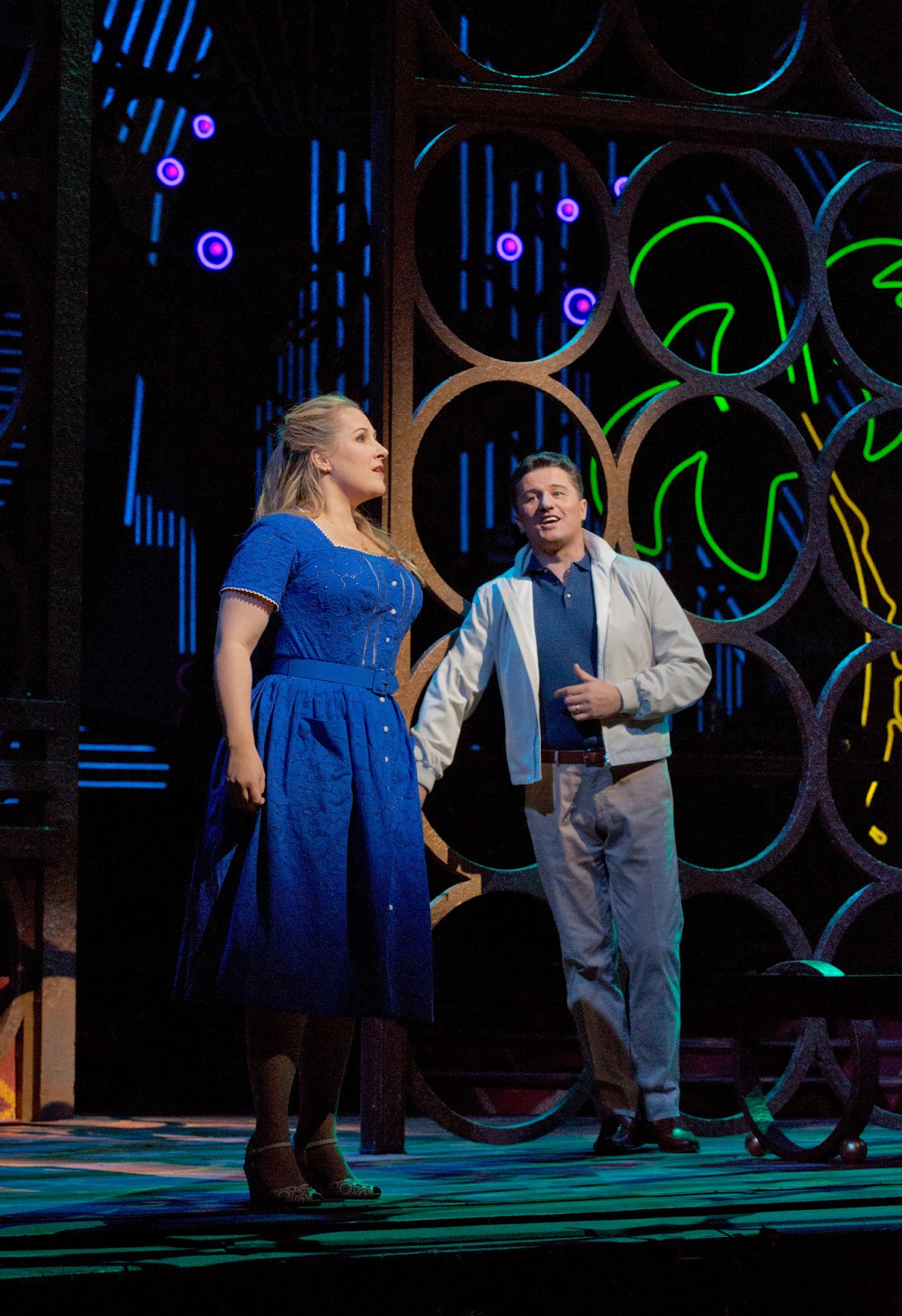
The Wiener Staatsoper has live streamed Werther with Piotr Beczala.  I have only really liked this opera with Jonas Kaufmann, but Piotr seems like the right type to carry it off.  We have soccer balls and hula hoops, so it must be at least the 1950s.  The stage is filled with a gigantic tree which stays through all the scenes.  Do they live in a tree house?  I am pleased to see a piano in Charlotte's bedroom. 

Charlotte seems to be seriously leading him on while telling him she has to marry Albert.  She blows him kisses.  Hmmm.  We are ambiguous about Charlotte.  Werther loves her for her responsible, motherly qualities.  She has married Albert because she promised her mother, but now she seems not to like him.  This Albert is nasty.  She is serious and sad.  Werther has ruined her life.  When one loves someone who cannot love you in the same way, one is obligated to pretend that all is well.  Piotr is excellent in this role but one does not love his Werther.  It is nevertheless a great role for him. 

I have not pictured Charlotte as the mature woman that she is here.  I prefer her as simply the older sister of her mother's many children.  It's too sad.  The emotional dynamic is very strong here.  In life this is too hard.  In opera it is perfect.  They are messing up everything.  

If you want a serious, intense Werther, this is for you.

Tuesday, November 10, 2020

Tosca from Wien


Director:  Marco Armeliato
Production:  Margarethe Wallmann

Tosca  Sondra Radvanovsky
Mario  Piotr Beczala
Scarpia  Thomas Hampson

This production of Puccini's Tosca at the Vienna State Opera is very popular.  I can see why.  In Act I the church shows members of the Swiss Guard.  I was going to question this when I remembered we are in period, the time of Napoleon, when Rome was ruled by Naples.  I associate the Swiss Guard only with Vatican City.  Perhaps the Bishop of Rome is attending.

This performance is from last year.  I love Sondra in this.  She dominates her male partners.  She sings and acts with such wonderful intensity.  Tosca is a diva of the greatest quality, and should seem so.  

There is a lot to like here.  Unless I am hallucinating, Piotr gets a bis for "E lucevan le stelle."  Cool.  I don't seem to tire of Tosca as long as it's new people each time.


Saturday, January 12, 2019

Adriana Lecouvreur in HD

👍🏻
Conductor:  Gianandrea Noseda
Production:  David McVicar

Adriana Lecouvreur, an actress:  Anna Netrebko
Maurizio, the Count of Saxony:  Piotr Beczala
Princess di Bouillon, also in love with Maruizio:  Anita Rachvelishvili
Prince di Bouillon, her husband:  Maurizio Muraro
Michonnet, stage manager:  Ambrogio Maestri

Today the metropolitan Opera brought us Francesco Cilèa's Adriana Lecouvreur in HD.  Our host was Matthew Polenzani.  The opera is from 1902 in the era of verismo.

It was a single set production with a raised stage area in the center.  This was useful in portraying an opera about an historical figure who was an actress.  Most of the scenes have some kind of performance, including a ballet.  I enjoyed when the stage was shown from the angle of the wings, always my favorite perspective.

Gianandrea Noseda shaped the music in the most beautiful way.  Today was my best reaction to his conducting.  In his interview he expressed his respect for the vocal performers.

At the beginning we see that Adriana has not heard from her lover whom she believes to be a soldier away at battle.  She is preparing for her entrance where she plays Roxane, the heroine of Cyrano de Bergerac, I believe.  He comes in, woos her ardently and arranges to meet her after the play.  Adriana's most beautiful arias "Io son l'umile ancella" comes in this act. The plot is a bit hard to follow here.  Who exactly is Duclos?  Her name is not listed in the cast. Maurizio receives a letter and cancels on Adriana.  He is obviously a cad whatever his feelings might be.  Michonnet wants Adriana to marry him.

Not to be outdone, the Princess sings "Acerba voluttà, dolce tortura" while anxiously awaiting the arrival of Maurizio.  Again more plot complexities.  Maurizio arrives, Adriana arrives and figures out who Maurizio actually is, the Princess's husband arrives and they sneak her out of the meeting place without Adriana discovering who she is.  By the end of the opera everyone has discovered the identity of everyone else, Adriana is angry with the Princess and insults her, and finally Adriana is poisoned with flowers, aria "Poveri fiori".  The person who deserves the anger, the Count of Saxony, gets off.

The plot confusion interferes with ones overall pleasure.  It's rather like a murder mystery.  The music is sweet and not at all murder-mystery-like.  The cast is spectacular.  Ambrogio Maestri is very sweet as the stage manager in love with Adriana.  I have only seen him as Falstaff.

Anita rose to her angry bitch character to make the perfect foil for Anna  Piotr convincingly wooed both women, demonstrating his skills at seduction.

But this performance belonged to Anna Netrebko, intense in every scene, the diva incarnate.  All hail Anna.  Perhaps I will go again on Wednesday.
______________________________

P.S  A commenter left this on Facebook:

Roxane here is a character of "Bajazet" which is a tragedy by Racine. That is why at some point Adriana is called Gran Sultana. This is about the character she was portraying in first act. (Cyrano de Bergerac was written at very end of 19th Century. Therefore Lecouvreur could not have played it).

Monday, August 06, 2018

Lohengrin from Bayreuth -- the Blue Lohengrin


Conductor:  Christian Thielemann
Production:  Yuval Sharon

King Heinrich:  Georg Zeppenfeld
Lohengrin:  Piotr Beczala
Elsa von Brabant:  Anja Harteros
Friedrich von Telramund:  Tomasz Konieczny
Ortrud:  Waltraud Meier
Heerrufer:  Egils Silins

The complete Lohengrin from Bayreuth has been posted on YouTube.  Piotr replaced Roberto Alagna in the title role, probably because Christian Thielemann had worked with him in his debut in the role in Dresden.  Piotr is quite successful in this role.  Lohengrin doesn't take on the Heldentenor tone seen in later Wagner.  Anja Harteros is making her Bayreuth debut here.  In her interview she says that Thielemann never does anything the same way twice.

At the beginning of the opera Elsa is already bound as a prisoner.  You will note please that the wings some of the characters wear only appear on the ruling classes.  King Heinrich has them, as do Friedrich and Ortrud, and of course Elsa.  This makes them symbols of position?  When the duel begins, the fighters fly up into the air, which makes the ropes defining the fighting ring irrelevant.  Lohengrin steals Friedrich's wings and is awarded his own set to adorn his costume when he wins the battle.

Sunday, April 15, 2018

Luisa Miller in HD


Conductor...............Betrand de Billy
Production..............Elijah Moshinsky

Luisa...................Sonya Yoncheva, soprano
Rodolfo...............Piotr Beczala, tenor
Miller..................Plácido Domingo, baritone
Count Walter.......Alexander Vinogradov, bass
Wurm..................Dmitry Belosselskiy, bass
Federica..............Olesya Petrova, contralto  


Yesterday the Metropolitan Opera presented Verdi's Luisa Miller in HD.  I liked it better this time than I did in 2015 in San Francisco.  This is a very fine cast, but perhaps it is Placido Domingo, a man born to musical theater, who makes the difference.  In the other staging everyone seemed like a bad guy, but here we are clear that Miller deeply cares about his daughter and will give up everything for her.  Rodolfo on the other hand thinks only of himself and commits a murder/suicide, something we generally hear about from the newspaper.  His excuse is only a tiny bit better than Otello's.

All over the internet are people wondering why Placido keeps singing.  His scenes with Yoncheva were by far the most spectacularly beautiful of anything seen here today.  He definitely still has it, and this performance is one of his better outings as a baritone.

Plot--young nobleman goes wandering around the countryside in disguise looking for girls, very much like the Duke in Rigoletto or the King in La Donna del Lago.  He knows that makes him a shit, but does it anyway.  It turns out badly for everyone.  It was like a magic trick, but this cast made it work.

Wednesday, April 11, 2018

2018 International Opera Awards Winners Announced

See all the winners below!

CHORUS MusicAeterna
CONDUCTOR Vladimir Jurowski (He conducted Wozzeck at Salzburg)
DESIGNER Paul Steinberg
DIRECTOR Mariusz Treliński
EDUCATION AND OUTREACH Opera Holland Park
FEMALE SINGER Malin Byström


FESTIVAL Festival Verdi Parma
LEADERSHIP IN OPERA Bernd Loebe
LIFETIME ACHIEVEMENT Teresa Berganza


MALE SINGER Piotr Beczala


NEW PRODUCTION Britten: Billy Budd, d. Deborah Warner (Teatro Real, Madrid)


NEWCOMER Barbora Horáková Joly (Director)
OPERA COMPANY Bayerische Staatsoper [every year]
OPERA ORCHESTRA Teatro alla Scala, Milan
PHILANTHROPY Annette Campbell-White
READERS' AWARD Pretty Yende


RECORDING (COMPLETE OPERA) Berlioz: Les Troyens (Erato) [with Joyce DiDonato]
RECORDING (SOLO RECITAL) Veronique Gens: Visions (Alpha)
REDISCOVERED WORK Krenek: Drei Opern (Oper Frankfurt)
WORLD PREMIERE Brett Dean: Hamlet (Glyndebourne)
YOUNG SINGER Wallis Giunta

Sunday, March 12, 2017

The Salzburg La Bohème

Instead of going to the HD of La Traviata, I went to a party where the film of Puccini's La Bohème from Salzburg in 2012 was shown projected on the wall.  I liked very much seeing the faces up close.  Mimi isn't lighting her candle, she is lighting her cigarette.

Conductor: Daniele Gatti,
Production:  Damiano Michieletto

Anna Netrebko (Mimi)
Piotr Beczala (Rodolfo)
Nino Machaidze (Musetta)
Massimo Cavalletti (Marcello)
Alessio Arduini (Schaunard)

The production is supposed to make you think of Paris.  There are many reminders.  I love this wonderful cast and enjoyed seeing it again.

I have only enjoyed the Traviata red dress production when it was done with Netrebko.  Perhaps I will watch my DVD.
#ad

Sunday, February 05, 2017

Dresden Lohengrin

Conductor: Christian Thielemann
Production:  Christine Mielitz

Lohengrin:  Piotr Beczala 
Elsa von Brabant:  Anna Netrebko 
Heinrich der Vogler, King: Georg Zeppenfeld
Friedrich von Telramund:  Tomasz Konieczny
Ortrud, Friedrich's wife: Evelyn Herlitzius
Der Heerrufer des Königs:  Derek Welton

Tuesday, August 23, 2016

Faust from Salzburg


Alejo Pérez conductor
Reinhard von der Thannen stage director, stage sets and costumes

Piotr Beczala (Faust)
Ildar Abdrazakov (Méphistophélès)
Maria Agresta (Marguerite)
Alexey Markov (Valentin)
Tara Erraught (Siébel)
Marie-Ange Todorovitch (Marthe)

Gounod's Faust from the Salzburg Festival streamed today on medicitv.  It came in a regie production, as you can see in the picture above.  There were many images to choose from, but I have chosen the Rien neon which began and ended the opera.  One puzzles briefly at the start, and then Faust opens his mouth and sings "Rien,"  French for nothing.  Of course.  I have reached Faust's age and listen to his complaining with now more sympathetic ears.  He effectively transforms from a bald old man to a young man with hair.

The white daisies Siebel gives as a bouquet in act III are called Marguerites.

Everything is symbolic.  I have no idea of what.  Abstract shapes that look like nothing at all seem preferable to people in a laboratory for no apparent reason.  Half of the tunes are hit tunes.  I can listen to Pique Dame and recognize very little of the music, while Faust is ever familiar.  The music is intensely nostalgic, a style that grows old for us.  Perhaps a meaningless modernist staging takes away from the nostalgia and makes the music tolerable again.  I actually enjoyed this, an excellent concert with pictures.  The pictures were sometimes odd, but the story line stayed in tact.  Except maybe the baby as a box wrapped as a present.

Maria Agresta gave us a strong Marguerite capable of soaring over the orchestra and chorus.  Ildar was perfection as Méphistophélès, growly and nasty.  Piotr was pleasing.  They could only have cast Tara because they wanted her soft sweetness to contrast with the angry brother and the evil Méphistophélès.

It is a Faust for today. 

___________
P.S.  I was reading a review of this production today which covered each of the usual subjects one by one--conducting, orchestra playing, each singer's performance and the production.  Then it suddenly turned into a religious commentary.  Faust is a Christian morality tale.  The lesson is that the devil can do nothing to prevent your salvation.  From a Christian perspective Faust is the essential opera.  We were scolded for our lack of interest in it.

Beginning in 1862 it became the most frequently performed opera in the repertoire for a long period.  Since its premier at the Met in 1883, it has played hundreds of performances, but recently has declined in popularity.  My sense of this is that while people seem never to grow tired of Puccini, Gounod is another matter entirely.  The music begins to sound corny to us.

It is my understanding that this opera didn't sell well in Salzburg.  I don't think lecturing us about Christian themes will save it.

Saturday, March 19, 2016

Un Ballo in Maschera from Munich


Conductor:  Zubin Mehta
Production:  Johannes Erath

Riccardo:  Piotr Beczala (tenor)
Renato, Riccardo's best friend:  George Petean (baritone)
Amelia, wife of Renato:  Anja Harteros (soprano)
Ulrica:  Okka von der Damerau (contralto)
Oscar, Riccardo's page:  Sofia Fomina (coloratura soprano)

The Bayerische Staatsoper brought us Verdi's Un Ballo in Maschera in a manner we might have expected.  The whole thing takes place in Riccardo's bedroom.  This must surely indicate that it's all a dream.  The It's all a Dream staging is certainly one of the more annoying.  My most recent one of these was Falstaff from Florence.  Interestingly, that was also conducted by Mehta.  Everything is in black and white, and the stage is a bit dark for a stream.

I watched this out of order, middle first, followed by beginning, so I noticed that the woman with long blond hair that appears mysteriously at the beginning is Ulrica the witch.  Throughout this opera a lot is going on.  The male chorus is divided into two groups:  those friendly to Riccardo and those who are conspiring to kill him.  For the first time in my experience they are both labeled and translated in the subtitles.  If you watched without text, you wouldn't guess this.

I didn't realize before this that Riccardo so dominates the action.  No excuse.  He appears in various guises:  as himself, as a dead body uncovered by Ulrica lying on his own bed, and as a ventriloquist dummy, sometimes operated by Oscar and sometimes by Riccardo himself.  Piotr sings, dummy's mouth moves.  If this means something, I didn't guess it.  I thought ventriloquists were completely out of style.  I'm surprised by what a wonderful role this is for Piotr.

Now we wake up in Renato's bedroom where he is in bed with Amelia.  Ulrica is here, too.  We're supposed to be in a field with a gallows.  Anja sings her aria.  I didn't realize Oscar actually has a bigger part.  Riccardo appears, which is fine if we're in a field but iffy when we're in Renato's bedroom.  He sleeps through the whole thing.  Renato wakes up during the love duet.  The lovers spot him, and Amelia gets back in bed and covers up.  This is rather spectacularly silly, but the plot is actually more plausible if Renato is a lot more boring than Dmitri.

I have loved the music.  Harteros may be by now my favorite current Verdi singer, though this is not the best role for her.

Ulrica is still with us at the end.
#ad

Wednesday, February 10, 2016

Richard Tucker Gala 2016


I'm a little slow on this one, but I want to write about this year's wonderful Richard Tucker.  Here is a link.  It should be up for a year.  We start off with the current award holder Jamie Barton who sings "Acerba Volluta" from Cilea's Adriana Lecouvreur.  This is a barn burner and she does an excellent job.  She is very talented.

Each singer has to talk after they exit.  Then Piotr Beczala sings Puccini's "Nessun Dorma."  There is chorus with this.  If you want to know how it's going, just look at the faces of the singers in the chorus.  His voice is showing some stress.

Renée Fleming is shown briefly singing with Luciano Pavarotti.  Then she comes out and sings "Io son l'umile ancella" from Cilea's Adriana Lecouvreur.  The Renée, she always sounds so good.  She recommends that you know your own voice.  Can't argue with that.  I complain constantly about people selecting repertoire outside their physical gifts, but Renée knows what is best for her.  She was gorgeous here.

Then Nadine Sierra comes out and performs a duet with Andrea Bocelli, the special guest of the evening.  They sing the "Sulla tomba, Verrano a te sull'aure" duet from Lucia di Lammermoor.  They actually look well together.  He is beginning to both look and sound old.  Sorry.  There was a lot of complaining on line about him.  Nadine genuinely seems to like him and they do well together.

Cilea is having a big night.  Stephen Costello then sings "E la storia solita del pastore" from Cilea's L'Arlesiana.  This is very beautiful.  Stephen's voice is developing nicely.

"In quelle trine morbide" from Manon Lescaut is sung by Angela Gheorghiu.  It's always nice to see Angela.

The repertoire is all of a piece here, like something from the 30's.  "Ebben, nel andro lontano" from Catalani's La Wally comes next, also sung by Angela.  Perhaps she is the other guest star.  This is just her stuff and she is in form.

And now for something completely different.  Isabel Leonard sings"Nacqui all' affano...Non piu mesta" from Rossini's La Cenerentola.  Instead of sweetness, we have some spectacular vocal gymnastics with wonderful, original fiorature.  I think this concert is designed to warm up as it goes along.  Her ornaments are very original.  I've seen her in Griselda so I know what she can do.  This is excellent.

Jamie, "You got all my friends.  Thank you for that."  Tucker person, "We tried to get your enemies,  but you don't have any."

Back to the concert.  Jamie and Christine Goerke appear for a duet from Ponchielli's La Gioconda, "E un anatemal."  We are back to singing big which is what the Tucker is all about.  Goerke is the queen of big singing, and Gioconda isn't done nearly enough.  Their voices are well matched.  You won't hear it better than this.

They come off the stage and do this incredible chest bump, as it they were the Bryan brothers (tennis).

Lawrence Brownlee talks about lifelong learning.  Gee I love him.  That's why I can't really ever be a critic because I love them all too much.  He sings "Terra amica" from Rossini's Zelmira.  I don't understand the public's desire to trash people in places like YouTube comments.  I'm only good for love.  This one also has chorus.  Larry tears into it.  Rossini tenors are one of the wonders of the world.

Nadine Sierra sings another duet, this time with Stephen Costello, this time "Va, je t'ai pardonee" from Gounod's Romeo et Juliette.  She's singing 3 different roles at the Paris Opera next season.  She knows her Gounod from her Donizetti.

The great Christine Goerke sings Eboli's aria "O don fatale" from Verdi's Don Carlo.  I don't know what she's doing singing something I used to sing.  Perhaps a Verdi dramatic mezzo is coming.  She completely aces this and has a much easier time with it than the average mezzo.  The drama and the notes all come easily.

Boccelli returns to sing "M'appari tutt' amor" from Flowtow's Martha.  This song plays in my head in German, but in concerts it always appears in Italian.  Perhaps that's why he is here.  He sees the Richard Tucker foundation as a promoter of Italian music.  I see it like that, too.  We're almost finished and there has been only Italian and French singing.

Renée Fleming and Piotr Beczala sing the love duet from Gounod's Faust, "Il so fait tard."  Renée is outstanding in this, too.  The audience is amazing and cheers for everything.

The concert closes with Jamie Barton, she is really showcased here, singing "Adieu fiere cite" from Berlioz' Les Troyens.  Is this something we should thank Susan Graham for?  Perhaps.  I am so glad to see the growth of interest in Berlioz' vocal music.  Jamie is a singer to love.  IMHO.

All Italian and French, nothing before Rossini, nothing after Puccini.  This is all classic Richard Tucker.  A wonderful concert with several former winners and guests.  It will be available on the PBS website for 3 years.


Monday, October 12, 2015

Lucia in San Francisco


Conductor:  Nicola Luisotti
Director:  Michael Cavanagh

Enrico Ashton, Lucia's brother:  Brian Mulligan (baritone)
Lucia Ashton:  Nadine Sierra (coloratura soprano)
Riamondo Bidebent, Lucia's tutor:  Nicolas Teste (bass)
Edgardo, Lucia's fiance:  Piotr Beczala (tenor)
Arturo Bucklaw, man Lucia is forced to marry:  Chong Wang (tenor)

The San Francisco Opera presented a new production of Donizetti's Lucia di Lammermoor before I was tired of the old one.  There were some interesting features.  The female ghost appeared.  I believe this feature was introduced by Mary Zimmerman in her production, but now it is treated as an ancient tradition.  When Lucia sings about the woman killed in the fountain, her ghost appears.  Nothing else resembled Zimmerman who evoked the Scottish moors and retained the traditional giant staircase.  Here everything either resembled an interior or moved to something like outer space.


This picture is the scene of Edgardo and Enrico quarreling in the clouds.

The mad scene in Act 3 was the creepiest ever.  Everything is covered with blood.  Then Lucia pulls her blood-stained train toward us, revealing Arturo lying dead on the bed.  I was sitting next to someone who was once a super, and we agreed that this was perhaps the great super role.  He must lie there quietly with his pants pulled down halfway and his butt sticking out while Lucia sings her heart out.  Very impressive.  There was an entertaining interplay between the soprano and the flute here that we enjoyed very much.

Nadine Sierra performed this role previously in Zurich and seems to have benefited beautifully from the coaching there.  I felt that both her singing and her facial expressions were a treat.  I liked this Lucia, though her voice is somewhat small for the War Memorial. 

Brian Mulligan, our Sweeney Todd, successfully made the transition to serious opera.  He was if anything even scarier here than his previous outing.  I love Piotr, but his voice may also be a bit small for our acoustically challenged opera house.

There are basically 3 ways to establish a costuming period for an opera.  First is the stated period, here the 17th century; second is the period of the first performance of the opera, here 1835, and last is something vaguely modern.  Curiously, our program says "TIME AND PLACE:  Scotland in the near-future."  This means category 3 and anything goes.  Most of the time Lucia wears a big dress like you see in the era of the American Civil War.  The men wear modern looking suits, sometimes uniforms.  Occasional kilts were seen, always in dark colors.  In the wedding scene the women all wore giant hats such as one might see at a British royal wedding.  People like to think they can pick a fashion period, but that seemed impossible here.

Luisotti was great.  This is the first opera I have actually liked this season.

At the end as Edgardo kills himself, Lucia appears as the ghost to escort him to heaven.  If this is a new tradition, I think I like it.  If it turns out to be an old one, let me know.

Saturday, February 14, 2015

Iolanta in HD


CONDUCTOR:  Valery Gergiev
PRODUCTION:  Mariusz Treliński
DRAMATURG: Piotr Gruszczyński

IOLANTA: Anna Netrebko (soprano)
COUNT VAUDÉMONT, friend of the Duke:  Piotr Beczala (tenor)
DUKE ROBERT, Iolanta's Fiance: Aleksei Markov (baritone)
KING RENÉ, Iolanta's father: Ilya Bannik (bass)
IBN-HAKIA, Moorish Doctor: Elchin Azizov (baritone)

Tchaikovsky's Iolanta is based on a Danish play which is in turn based on the real life of Yolande, Duchess of Lorraine. For the simulcast from the Metropolitan Opera the story is moved in time to the twentieth century.

People around me expressed confusion about the production, but I didn't experience this.  There is a naturalistic looking set with a single room representing Iolanta's imprisonment that is turned to various positions throughout the opera, surrounded by a few trees and a stack of wood.  Between the stage and the audience is a scrim on which various things are projected, probably the source of the confusion.  The projections begin with a deer running through the woods.  It was immediately clear to me that this was to create the idea that we are in the middle of the woods, far from human civilization.  The projections changed to ominous looking branches when the desired atmosphere was dark and mysterious.  Why is this confusing?

Because the women who surround Iolanta are dressed in uniforms, we assume that she is being kept in some kind of institution.  She talks to Marta, the head nurse, and tells her she is sad.  She then asks Marta why Marta is sad, and though Marta does not tell her, Iolanta concludes that this is due to the tears flowing from her own eyes.  She tells us that eyes must be for tears.  This is the plot, you see.  She does not know what they are truly for because she is blind and has not been told.

A doctor arrives to treat her, and he insists that Iolanta must be told everything.  Father refuses.  Young men arrive with skiing equipment, one of whom is her fiance.  This is the most farfetched piece of the story.  No, not the skiing part--the fiance part.  He has never met Iolanta and talks about how much he is in love with someone else.  He rejects Iolanta without ever having seen her.  He leaves.

Piotr Beczala is left behind to meet and fall in love with Iolanta.  She can't tell the difference between the white and the red roses, giving away the fact that she is blind.  He tells her this and explains about light and seeing.  This is the most beautiful part of the opera.  Light was the first act of creation, he explains.  There is a poetical beauty that is rare in opera.

All live happily ever after.  Iolanta is cured, the fiance and father agree that Iolanta will not marry him, God is thanked, and joy abounds.  A large chorus appears and Iolanta asks what this is.  People, father explains.  Netrebko then comes backstage to tell us it's Valentine's Day, and we should go home and enjoy ourselves.  These are not appropriate Valentine's Day operas.  We knew that.

This was very beautifully done, very emotionally done, with beautiful playing from the orchestra which is exactly perfect for this music.  (You know I don't always think this.)  Gergiev knows his repertoire.  The singers were all gorgeous with wonderful solos for all 5 of the listed characters.  Anna Netrebko sings Russian music like she was born for this. For me she successfully suggested blindness.

I couldn't help thinking about Queen of Spades, an opera that is very familiar to me, and how I have never heard the perfect one.  Anna.  Please.

P.S.  The New York Times has informed me that this opera has been very popular in Russia, that to make it acceptable in the Soviet Union the libretto was altered to omit all references to the deity.  The communists praised nature and not God.  That Netrebko and others of the Russian artists insisted on singing the version they had learned, that is the religiously cleansed version.  The motivation was undoubtedly the lack of desire to learn a different Russian text.  The surtitles translated the original libretto and not the one the singers were actually singing.  Curious.

Others have pointed out that this version of Bluebeard is actually interesting.  I left early on, but perhaps I will go on Wednesday.

Tuesday, May 13, 2014

The Year of the Tenor

With the Metropolitan Opera season now closed Broadway World has called this the Year of the Tenor.  Here is their list.  How can you argue?


Jonas Kaufmann. What is there to say? He's #1 these days, whether in Wagner, Massenet or Verdi. He also excited in his recital debut at Carnegie with German lieder. But his schedule looks a little sparse next year at the Met, other than a few Don Joses. Do whatever he wants, please.  [I'm definitely not arguing with this.]


Juan Diego Florez. The Met's first "King of the High Cs" since Pavarotti, Florez is an utterly winning and boyish performer, whether in LA FILLE DU REGIMENT, LE COMTE ORY or DON PASQUALE. His high notes were wonderful in LA CENERENTOLA, though one wonders what lots of RIGOLETTOs will wreak on them, as he moves away from bel canto.


Piotr Beczala. He thrilled as the Duke in the Met's "Ratpack" RIGOLETTO, Lenski in EUGENE ONEGIN and RUSALKA's fickle Prince. A cautious artist, he's moving into heavier roles, with UN BALLO IN MASCHERA next season, as well as IOLANTA with Netrebko.


Lawrence Brownlee. Brownlee was an audience favorite in I PURITANI and the opera's high F held no fear for him. Yet he seems a little placid when more ardor would do better. Still, the notes were there and that means a great deal.


Javier Camarena. Tenor Camarena had a great spring at the Met, as Elvino in Bellini's LA SONNAMBULA then stepping in for Florez in the first three performances of Rossini's LA CENERENTOLA. It took the Met way too long to bring him back after his notable debut in IL BARBIERE DI SIVIGLIA--let's see what they come up with as a follow up (and sooner rather than later, SVP).

Dr. B:  These are the guys, all fabulous artists.  There can never be too much tenor.  As almost an afterthought they add Matthew Polenzani, Roberto Alagna, Vittorio Grigolo, Michael Fabiano, Stephen Costello, Yonghoon Lee.  They put in David Daniels, but we know he is a countertenor and doesn't count.  We might add Bryan Hymel.

Saturday, February 08, 2014

Rusalka


Conductor: Yannick Nézet-Séguin
Production:  Otto Schenk
Set Designer:   Günther Schneider-Siemssen

Cast

Rusalka:  Renée Fleming
Prince:   Piotr Beczala
Princess:  Emily Magee
Jezibaba:  Dolora Zajick
Gnome:  John Relyea
Kitchen Boy:  Julie Boulianne
Gamekeeper:  Vladimir Chmelo
First Sprite:  Jihee Kim
Second Sprite:  Renée Tatum
Third Sprite:  Maya Lahyani
Hunter:  Alexey Lavrov

Yes.  I looked it up and the only live performance of Dvorák's Rusalka I've ever seen, San Francisco Opera 1995, was also in a set designed by Günther Schneider-Siemssen.  It also starred Renée Fleming, she also sang the aria from the top of a tree, and she walked on water in the last act.  I see in the archives that this opera had its first Metropolitan Opera performance in 1993 and was revived with Renée Fleming in 1997.  The Met revived it in 2004, but it hasn't been revived in San Francisco.  So I shouldn't have been surprised when everyone around me said they hadn't seen it.

This cast was incredible, and the traditional production gave a vivid idea of what the opera was about.  This is probably the best you are going to get from Rusalka.

The role of Rusalka fits Renée Fleming's voice like a glove, and Piotr Beczala is the perfect Prince Usually Charming.  As the foreign princess, Emily Magee stole all the scenes she was in.  Dolora Zajick is just the sort of wacko witch you might just believe in.  Perhaps she could turn you into a human being.

But then why would you want to?  The music, guided by Yannick Nézet-Séguin, is gorgeously romantic.  It's not hard to understand why Renée Fleming loves this opera.  The only weakness lies in the plot.  What makes a human in the witch's description is that they can die and have a soul that lives on after them.  Rusalka doesn't care--she just wants to experience love.  We will assign the resulting foolishness to youth, perhaps.  It's a Czech fairy tale, and fairy tales frequently come out badly.

#ad

Sunday, October 06, 2013

Eugene Onegin in HD

Onegin and Tatiana in the city

I have long been an admirer of Chekhov, the Russian writer of plays and short stories, so when Peter Gelb compared his new Metropolitan Opera production of Tchaikovsky's Eugene Onegin to a play by Chekhov, I was prepared to enjoy it.

Conductor:  Valery Gergiev
Production:  Deborah Warner

Tatiana: Anna Netrebko
Olga: Oksana Volkova
Madame Larina, their mother:  Elena Zaremba
Tatiana's Nurse:  Larissa Diadkova
Lenski: Piotr Beczala
Onegin: Mariusz Kwiecien
Gremin: Alexei Tanovitski

I liked enormously the sets for the house in the country.  It created an atmosphere of reality and strengthened the sense of the relationships between the characters.  There was too much contrast in the last act with the bare stage and huge columns.  There was no sense of artistic unity for the opera as a whole.


Lensky and Olga in the country

The beginning and ending had a new symmetry.  As Onegin rejects and coldly dismisses Tatiana, he looks at her face and kisses her before walking away.  Netrebko's Tatiana rises to equal Onegin's coldness and arrogance in the final act.  She tells him she loves him but will not sacrifice her life for him.  She stares him down coldly and then kisses him before she walks away in the snow.  There was a kind of perfection to this.  Perhaps Mariusz is the right singer for this conception after all.

Netrebko sang extremely well, giving the letter scene a special intensity.  Alright.  I'll say it.  She looked terrible in the girl's dress.  But the mature Tatiana's outfits made her look beautiful.  Few singing actresses could bring so much strength to a character. 

I couldn't help wondering how this would all play in the house.  Chekhov is not for the huge theater.  Could the softness of the singing be heard in the house?  Could such an intimate and interior conception be seen, heard and indeed felt in the huge expanse of the Met?  Chekhov's sense of humor seemed to be missing.

Beczala was the best Lensky ever.  My favorite was the Nurse, a wonderful actress.  The sense of it all being truly Russian was very powerful.  I would like very much to see this kind of treatment of Pique Dame which somehow just misses for me.

P.S.  Netrebko seemed to be in the mood to argue with Debbie in her interview.  I wonder what that was about?

PPS.   The plot of Onegin is from Pushkin (1799-1837). I know that. What was being discussed was the PRODUCTION which was moved to the time of Tchaikovsky (1840-1893) which it just so happens overlaps with the time of Chekhov (1860-1904). My remarks referred to the production and not to the opera.   Gelb is the one who brought up Chekhov.  I liked this and went with it.  The production comes from British theater people who are undoubtedly far more familiar with Chekhov than with either Pushkin or Tchaikovsky.

A truly Chekhovian ending would require much more ambiguity.  Instead of perfect symmetry we would need to be left wondering if perhaps they might get together on occasion, just as we are left wondering in the story "The Lady with the Little Dog."  If she is not required to sacrifice her life and her husband, would Tatiana occasionally meet with Onegin in secret?
#ad
 

Friday, May 03, 2013

Sexy Pictures

I'm always on the lookout for new sexy pictures of opera singers.  Here are a few.


This one is called René Pape Easy Rider.  I'm not too young to remember this movie.


This is Noah Stewart in The Pearl Fishers. He works out.


Every picture of Vittorio Grigolo is sexy.


The same could be said of Dmitri Hvorostovsky.  This picture is by Pavel Antonov.


And I'm not exactly sure why I find this picture of  Piotr Beczala sexy.  It's sort of the Thin Man syndrome.  Or just exactly why is Die Fledermaus so sexy?

Clearly I need a new sexy picture of Jonas.  The girls don't seem to be keeping up.

I use a lot of pictures from around the internet uncredited, but many of them are in costume.  I always assume these are freely available as publicity.

Wednesday, February 20, 2013

International Opera Awards

These are the singer contestants for the International Opera Awards competition being held somewhere in Great Britain.  My acquaintance with these singers is spotty. 

Jonas Kaufmann Germany, tenor.  He needs no introduction, surely.  He has never sung at the San Francisco Opera but is fast becoming a regular at the Met.  Just to be annoying, I'll post him singing "La donna e mobile."


Aleksandrs Antonenko  Latvia spinto tenor.  He has never sung at the San Francisco Opera.  There are quite a few films of him, but most of them come with terrible sound.  Here he is in Carmen.  He has a bright tone and a huge voice.  It turns out I have seen him--in René Pape's Boris Godunov from the Met.  He shows 20 Met performances.  He has sung Otello in London, Paris, Riga, Wien, Salzburg, Rome and Dresden.


Piotr Beczala  Poland lyric tenor.  He has sung at the San Francisco Opera in Eugene Onegin, Die Zauberflöte, and I reviewed him in La Bohème in 2008.  He shows 62 Met performances.  I've already posted him several times, but here he is in the "Questa o quella" I missed.


Joseph Calleja  Malta, lyric tenor.  He has never sung at the San Francisco Opera but shows 43 Met performances.  For my taste his vibrato is a bit odd.  This performance is from last summer.


Luca Pisaroni  Italy, bass-baritone.  He has never sung at the San Francisco Opera but shows 37 Met performances.  Here he sings the catalog aria and keeps his list on his smart phone. 


Bryn Terfel  Wales, bass-baritone.  At the San Francisco Opera he's sung Nozze di Figaro and Rake's Progress (2000).  He shows 105 Met performances, including the famous Figaro with Bartoli.   Next season he will do Falstaff in San Francisco.  In the clip he's singing Dulcamara.  Forgive the Dutch subtitles.  We have both male and female bimbos.


Sarah Connolly English mezzo-soprano.  She appeared in Semele at the San Francisco Opera and sang the Komponist at the Met.  In general her career is concentrated in her native country.


Joyce Didonato  American mezzo-soprano.  She has sung Il Barbiere di Siviglia, Der Rosenkavalier, and I Capuleti e i Montecchi (2010) at the San Francisco Opera.  She shows 55 Met performances.  We will hear her sing "Tanti affetti" this summer at Santa Fe.


Evelyn Herlitzius German dramatic soprano.  She has never sung at the San Francisco Opera or at the Met.  Her career is concentrated primarily in Germany.  I have posted her before in a clip from Erwartung.  Here she sings the immolation scene from The Ring.


Catherine Naglestad American soprano. At the San Francisco Opera she has sung Alcina, Pagliacci, Norma, and Rodelinda (2005).  She has never sung at the Met.  Lately she sings primarily in Germany.  When I knew her, she sang Handel, but here is something much more recent where she sings Wagner.  Isn't the leggy blond mezzo a hoot.


Nina Stemme  Sweden soprano.  She has sung only 11 times at the Met and has a magnificent international career.  I have seen all of her Die Walküre Brünnhilde, and it was a profound experience.  Here is "Siegmund! Sieh auf mich!"   When he sings, "Gruesse mir Valhal," it is one of the most moving things in all opera.


Beatrice Uria Monzon France, mezzo-soprano.  She has never sung at the San Francisco Opera but shows 18 performances for the Met.  She prefers to sing in her native country.  This is rather an old film of her singing Donizetti.  This aria exists in French, but she's singing in New York where it's best known in Italian.  Remember, Philip Gossett prefers the French version of this opera.


There is very much a preference for big, heavy voices. Joyce is the only one that currently specializes in bel canto.

Sunday, February 17, 2013

Neon Rigoletto


Poor Renée.  She worked so hard during the intermissions for the Metropolitan Opera's simulcast of Rigoletto trying to get the singers to comment on the production, but mostly they didn't really want to.  They were happy to tell which member of the rat pack they were supposed to be, but that was about it.

Rat Pack:

Rigoletto (Don Rickles):  Željko Lučić (baritone)
Duke of Mantua (Frank Sinatra):  Piotr Beczala (tenor)
Marullo (Dean Martin):   Jeff Mattsey (baritone)
Count Ceprano (Sam Giancana):   David Crawford (bass)

The rest of the cast:

Gilda:  Diana Damrau (soprano)
Maddalena:  Oksana Volkova (contralto)
Sparafucile:  Stefan Kocán (bass)
Monterone:  Robert Pomakov (baritone)

Conductor:  Michele Mariotti
Production:  Michael Mayer

I guessed Don Rickles before Lučić said it.  If you are unfamiliar with Mr. Rickles' work, here is a sample.    I can actually see a certain similarity.


The best neon was in the last scene where it was used spectacularly to illustrate the sound of lightning flashes found in Verdi's score.  I could see this in every Rigoletto.  Amazing.

The man who issues the curse, Monterone, was costumed as an Arab.  Your average American might shoot the Duke, but would not really think of cursing him.  I wonder if this is a scandal.

Hidden in all this glitz was the regular Rigoletto we all know.   Lučić and Diana Damrau, our Gilda, are part of the ensemble of the Frankfurt Opera and well acquainted.  They have even played Rigoletto and Gilda together before and maintained their already highly developed conceptions.  She commented that Gilda wasn't nearly so hard as Fille de Regiment, referring to the San Francisco production, I assume.  She was carried off inside an Egyptian sarcophagus and died in the trunk of a car.  She also skipped her high note at the end of "Caro nome."


The only character who seemed to really shine in this production, to take on the aura of his environment, was Piotr Beczala as the Duke.  Above we see him looking very young in his disguise as a student.  He seemed completely at home in his white dinner jacket and bow tie.  He relaxed into the character and had a wonderful time.

I've never had any real complaints about Renée Fleming's interviews before, but I must say it was foolish for her to ask Piotr about his up coming high note in "La donna e mobile."  He told her he tries not to think about it, but just asking the question jinxed it.  He came very close to blowing it completely.  So.  Never ask a tenor if he is worrying about an up coming high note.  You can ask him after if you want.  Just never before.  You'd think this was obvious. It's in a category with asking a horn player to do his solo standing on the stage.

This is a Rigoletto for an American audience.  Many of the cultural references meant nothing to the international artists playing them.  It worked fine for me.  A father's love for his daughter transcends time and place.  The rat pack image falls apart when you consider that it assumes that Frank Sinatra would ever have dared to fool around with Sam Giancana's wife.
#ad