Showing posts with label Erin Morley. Show all posts

Saturday, December 18, 2021

Eurydice in HD


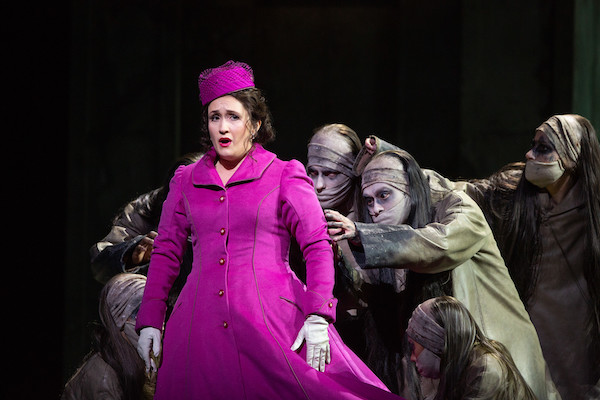
Eurydice................Erin Morley (soprano)
Orpheus.................Joshua Hopkins (baritone)
Orpheus’s Double....Jakub Józef Orlinski, countertenor 
Father.....................Nathan Berg (baritone)
Hades.....................Barry Banks (tenor)
Little Stone............Stacey Tappan (soprano)
Big Stone...............Ronnita Miller (mezzo)
Loud Stone............Chad Shelton (tenor)

Conductor............Yannick Nézet-Séguin 
Director................Mary Zimmerman 

The opera Eurydice by Matthew Aucoin on a libretto by Sarah Ruhl premiered in Los Angeles in 2020. It's based on a play by Sarah Ruhl and is in English. This is the Orpheus myth from the woman's point of view. It's a preferred topic for operas because it's about the power of music even over the gods. Orpheus can lure the gods into releasing Eurydice from hell. 

We are 20 minutes in and they have violated an important rule: there should be an aria, preferably for the soprano, in the first 10 minutes. So far just talky stuff. They tried all recitative operas at the beginning of opera, but it didn't work out. We go to hell and see Eurydice's father who still remembers life before death and how to read and write. He writes to Eurydice and sings about it. This is the closest we've come to an aria so far. 

Eurydice comes out in her bridal dress, and father watches her while he sinks back into the earth. Orpheus and Eurydice sing their vows, kiss and dance. Hades arrives and he has a conversation with Eurydice over the water cooler. He brings her the letter from her father. For me the lyrical bits don't go on nearly long enough. Eurydice goes off with Hades and Orpheus comes looking for her. 

I'm sorry. This just isn't happening for me.

Wednesday, September 02, 2020

Ariadne auf Naxos from Vienna 👍🏻


Conductor Peter Schneider
Director Sven-Eric Bechtolf

Ein Musiklehrer Markus Eiche
Der Komponist Rachel Frenkel
Der Tenor (Bacchus) Stephen Gould
Zerbinetta Erin Morley
Die Primadonna (Ariadne) Lise Davidsen

This has popped into my awareness just at the right moment.  It is Richard Strauss' Ariadne auf Naxos from the Wienerstaatsoper, 2017, and can be found on Opera on Video.  My copy has no subtitles.  We begin with this wonderful view of the rich man's garden and progress to the artists' dressing room.  Everyone does their own makeup.

I'm here for Lise Davidsen, of course.  In the opening scene Rachel Frenkel earns a mention.  She is an excellent Komponist, who appears only at the beginning.  Originally this opera consisted of only the second act which appeared after a play by Moliere.  In our production she appears around the set in the second half.  She accompanies Zerbinetta on the piano for her big aria and composes a cadenza for her while she sings.  This is a logical addition to the staging.

Complaining.  The voice/orchestra balance is terrible.  In the second half the purported audience is shown at the rear of the stage.  This would be the rich man and his guests.  The singers all turn towards us, of course, which seems rude.  The set for the second half is grand pianos thrown all around.  One realizes that if everything was changed at the last minute, it would all be exactly as chaotic as this staging.

I have not come in vain.  While Lise sings “Es gibt ein Reich,” Der Komponist walks slowly as though in a trance down from the onstage audience.  He cannot believe what he hears.  Such a glorious legato which moves effortlessly from low to high, from soft to loud we have never heard before. The upper register is gorgeous.  The clowns come out before she finishes, so there is no opportunity to clap.  This is a great lady.  It's always wonderful to have someone new to love.  Lise owns this role.

You might also want Erin Morley for your Zerbinetta.  At the very end the Komponist kisses Zerbinetta.

This is one of Strauss's more significant tenor roles, and it very well suits the Heldentenor we have here. 

Saturday, May 11, 2019

Dialogues des Carmélites in HD

👍🏻
Conductor...............Yannick-Nézet-Séguin
Production..............John Dexter

Blanche de la Force.....Isabel Leonard
Madame de Croissy.....Karita Mattila
Madame Lidoine........Adrianne Pieczonka
Mother Marie.............Karen Cargill
Sister Constance........Erin Morley

Dialogues des Carmélites by Francis Poulenc brings the 2018-19 HD season to an end.  When I saw this opera in San Francisco long ago, it was in this same production, only in English.  This is my first time in French.  Poulenc, who lived before supertitles, wanted the opera performed in the language of the audience.  The production follows the historical context of the French Revolution while creating a context through abstractions.  The giant white cross will stay in memory forever.

The opera begins in the home of Blanche de la Force with her father and brother.  Her brother worries that she is always afraid while her father dismisses just about everything she says.  But when she tells him she wishes to join the Carmelite convent, he doesn't refuse.

The convent of Carmelite nuns is changing.  There are two novices, Blanche and Constance, and the mother superior is dying.  Isabel and Erin are charming in their relationship throughout the opera.  Karita Mattila plays her death scene to the ultimate extreme.  It is frightening to watch.  The opera is about death, so I suppose this is one extreme.


After she dies, a new mother superior is sent in from outside:  Madame Lidoine.  Adrianne Pieczonka played her very low key.

Blanche provides the story.  She loves the private life and prayer, but news of the outside world seeps into the seclusion of the convent.  The nuns agree to commit to becoming martyrs.  Even Constance agrees.  All but Blanche agree.

Her brother comes to warn her she is in danger.  The priest is removed from his position and tries to escape.  Finally they are all arrested and forced to give up their nun clothing for "normal" clothes.  At this point Blanche escapes and finds her brother.  She learns that her father has gone to the guillotine.  She rejoins them right at the end.  We hear the sound of the guillotine falling.

Isabel is such a spectacular performer.  She gives us beauty, emotional connection, great singing and her own personal magnetism.  She keeps the stream of emotion going.

This opera is deeper than opera usually is.  Altogether it was a great performance with emotional and musical intensity and exceptional theatrical clarity.

Saturday, May 13, 2017

Thank You

👍🏻
This is the moment in Richard Strauss's Der Rosenkavalier, live in HD from the Metropolitan Opera, at the end of Act I when Renée Fleming looks out into the auditorium and thinks this is perhaps the last time.  The look of this scene resembles Blenheim Palace, the home of the Duke of Marlborough. 

Conductor....................Sebastian Weigle
Production...................Robert Carsen

Count Octavian Rofrano.....Elīna Garanča
Princess von Werdenberg...Renée Fleming
Baron Ochs...................Günther Groissböck
Sophie.......................Erin Morley
Faninal......................Markus Brück
Annina.......................Helene Schneiderman
Valzacchi...................Alan Oke
Italian Singer.............Matthew Polenzani


The time has been moved to 1912 when the opera was first performed, just before WWI.  All the men are soldiers.  There were many special moments in this Rosenkavalier, but I especially liked when the Marschallin sings "Wenn ich auch an ein Maedel errinnern, die frisch aus dem Kloster bis in die heiligen..." and she goes over to the chest containing the rose, takes it out and remembers that once the rose arrived for her.  I have never seen this business before.  I saw my first Renée Fleming Marschallin in 2000 in San Francisco and find her characterization was deeper and more serious than before.  I also loved that at the end she takes the arm of the police sergeant, moving on to her next lover it would seem.  I can only describe her as magnificent.

Most of the details of the staging are acceptable if not always traditional, but at the end is a surprise.  In Act I a large, odd looking green hat appears.  Then at the very end of the opera when everyone has left the stage, an army rises up with someone in the center wearing the green hat.  We must assume this is the otherwise not seen Feldmarschall being mowed down in battle.  Curious.  This could easily be done without.

I didn't agree with every detail, but the richness of texture of this production filled my heart to overflowing.  Der Rosenkavalier holds a special place in my heart, and this one has risen to the top. 


Our Ochs, Günther Groissböck, was Ochs in Salzburg in 2014.  He adds many layers of depth to this character.


And our Italian singer was none other than Enrico Caruso.


This moment in the second act was also perfection, though of the more traditional sort.  Octavian leans over to smell the Persian attar of roses, looks up at Sophie and instantly falls in love.  I first heard Erin Morley in King Roger in Santa Fe where she was wonderful.  Her Sophie is much more than a mere soubrette and adds soaring lines.  Her acting is also more complex than usual.

When I saw her in duets with Anna Netrebko, I did not imagine that our Latvian mezzo Elīna Garanča would turn out to be such a wonderful actress.  She was simply spectacular.  I'm having a hard time finding the words for something that exceeded my wildest imaginings.  She threw herself so gleefully into Mariandel.

We finished with a spectacularly glorious trio.  Thank you, Peter Gelb, Metropolitan Opera, Günther Groissböck, Erin Morley, Renée Fleming, and most of all Elīna Garanča for a wonderful memory.

#ad

Saturday, October 01, 2016

Rosenkavalier on the radio

Thank you Renée Fleming, soprano (Marschallin) Erin Morley, soprano (Sophie) Susan Graham, mezzo-soprano (Octavian) Franz Hawlata, bass (Baron Ochs) and Andris Nelsons and WCRB.  There can never be too much Rosenkavalier.

Saturday, January 31, 2015

Tales of Hoffmann in HD


Conductor: Yves Abel (excellent)
Production: Bartlett Sher

Olympia: Erin Morley (absolutely fabulous)
Antonia/Stella: Hibla Gerzmava
Giulietta: Christine Rice
Nicklausse: Kate Lindsey  (wonderful)
Hoffmann: Vittorio Grigolo  (best ever)
Four Villains: Thomas Hampson

Today was the second simulcast from the Metropolitan Opera of Offenbach's The Tales of Hoffmann. Bartlett Sher told Debbie Voigt that the inspiration for his staging was Kafka.  I think in this version the production was somewhat darkened and toned down.  Nothing looked too shocking.  In another context the production was called surreal.  I think this is a correct use of the term.

I notice they have put the order of the scenes back to the traditional order:  Antonia before Giulietta.

Yves Abel from his official biography:   "A Franco-Canadian, he has a particular affinity with the French repertoire and has won significant critical acclaim for his achievements as founder and Music Director of L'Opéra Francais de New York, with whom he has regenerated rare French operas and also performed the world premiere of Dusapin’s To be Sung. Since 1994, the company has performed regularly to capacity audiences at the Lincoln Center."  This is included because I panned the conducting for Merry Widow.  He was great, but if he wants on my sexiest conductors list, he needs a better picture taken while conducting.  Just saying.


I wanted to see Grigolo in this role.  He was perfect beyond my imagining, wildly romantic, exactly what you want in a Hoffmann.

Huge complaint:  no separate bow for the ballet.  Boo.

This worked extremely well for me.  I hoped others liked it as much as I did.


Wednesday, August 15, 2012

Roger


I have now listened to three different people try to explain Karol Szymanowsky's [Shim-on-OFF-sky] King Roger (composed 1918-1924) to no avail.

I'm going to give it a shot.  First off there is what you see.

Byzantine
We begin in a church service with beautiful choral singing and bright royal costumes.  The Shepherd arrives talking about his non-Christian god and the priests and congregation want to kill him.  Only Queen Roxana speaks on his behalf.  The three characters visible in the above picture are Shepherd (sung by tenor William Burden), King Roger (sung by baritone Mariusz Kwiecien), and Roxana (sung by soprano Erin Morley).

Arab
We are in King Roger's royal chambers.  The Shepherd continues to preach his gospel of Dionysus and everyone seems to be coming over to his side.  There is an orgy.  Roger tries to chain the Shepherd, but he easily breaks free.

Greek
The scene takes place in a ruined Greek temple.  The Shepherd appears in fuzzy pants and looks a bit like a satyr, the servants of Dionysus.  Roger has a spiritual awakening and rises to greet the rising sun.

Got that?  No, I thought not.  I'm not sure it is possible to understand this opera at all.

So here's my theory:  Szymanowsky wrote an opera about things he liked.  He liked Sicily and went there often.  At some point he heard about the medieval King Roger II of Sicily with his uncharacteristic religious tolerance.  He liked Nietsche's The Birth of Tragedy which is about counterbalancing influences of Apollo and Dionysus in Greek tragedy.

He ignored time and space and mixed all this together in an incomprehensible libretto with the help of one of his relatives.  They didn't mind that it made little sense.  Each person can make his own interpretation.  An explanation that focused strictly on Roger might be more comprehensible, but ambiguity is not altogether unpleasing.

Szymanowsky was a composer and may be regarded as more successful in that area.  We discussed the composers who may have influenced him and mentioned Debussy, Ravel and Stravinsky.  For my ears I definitely heard what I lovingly call Movie Music.  The combination of a world-wide depression and the beginning of talkies brought a lot of European composers to America and American films.  Alfano, Korngold, guys like that.  The specific details would vary from composer to composer, but the general style is very similar.  I call the style Movie Music because it is seldom heard today outside that medium.  King Roger will never make the 100 most performed operas list.

The performance was marvelous.  Szymanowsky could hardly have asked for more.  Kwiecien was fabulous as King Roger, and Erin Morley was simply incredible as Roxana with her soaring, mysterious singing.  The orchestra played this difficult score brilliantly.  It's all atmosphere and is over in 90 minutes.  This was the last performance, so everyone did their best.

Saturday, March 15, 2008

Peter Grimes in HD


Peter Grimes............Anthony Dean Griffey
Ellen Orford............Patricia Racette
Captain Balstrode.......Anthony Michaels-Moore
Mrs. Sedley.............Felicity Palmer
Auntie..................Jill Grove
Niece...................Leah Partridge
Niece...................Erin Morley
Hobson..................Dean Peterson
Swallow.................John Del Carlo
Bob Boles...............Greg Fedderly
Rev. Horace Adams.......Bernard Fitch
Ned Keene...............Teddy Tahu Rhodes
Conductor...............Donald Runnicles
Production..............John Doyle

Natalie Dessay, our hostess for the simulcast from the Metropolitan Opera, asked Anthony Dean Griffey to describe his preparation for the title role of Benjamin Britten's Peter Grimes. He replied that his whole life was preparation. "I was born to play Peter Grimes." I would have to say that I agree. His voice was if anything better in the part than Peter Pears, the singer the role was written for, and his large looming presence adds just the right note of fear and loathing. I've seen him before--last year in the LA Opera production of Mahagonny. He is a lyric tenor with power to back it up when he needs it. He is a man born to be Peter Grimes.

It is taught in school that this is Britten's masterpiece, but how is one to know when one has never seen it before?

The production was excellent. The set consisted of a floor to ceiling wall of doors which could be constantly repositioned to create different effects. The doors looming over the hero help to create his paranoia and sense of isolation from the crowds of villagers who never seem to leave him alone. It also helped to control the masses of people on the stage and prevent the chorus from confusing us about the characters. The essential choral work was massive.

Anthony Dean Griffey refused to answer Natalie's question about whether or not Grimes was guilty, preferring ambiguity. I suggest that unlike the law life is always ambiguous.

I particularly liked the first part of the second act where Grimes and Ellen talk while words from the Book of Common Prayer are recited in the background.

The always beautiful Patricia Racette was simultaneously gentle and powerful in the critical role of Ellen Orford. We aren't sure what she sees in Peter Grimes.

Everyone seemed perfect, including Jill Grove as Auntie the pub mistress, John Del Carlo as Swallow and Anthony Michaels-Moore as Balstrode.

Also born for Peter Grimes is the Scottish conductor Donald Runnicles. His work was full of love. In his brief interview he explained how Britten had composed for the movies, how the orchestra creates the feeling of the storms at sea that are crucial to the action.

I rarely come out of an opera feeling that there aren't here and there tiny bits that could be improved. Not so here. Benjamin Britten would feel proud of this wonderful production of his masterpiece. We believe now.
#ad