Showing posts with label Stéphanie d'Oustrac. Show all posts

Tuesday, April 21, 2020

Les Contes d'Hoffmann

 Hoffmann, Nicklausse

Conductor : Philippe Jordan
Director : Robert Carsen

Olympia : Nadine Koutcher
Giulietta : Kate Aldrich
Antonia : Ermonela Jaho
La muse, Nicklausse : Stéphanie d'Oustrac
La mère d'Antonia : Doris Soffel
Hoffmann : Ramón Vargas
Spalanzani : Rodolphe Briand
Nathanaël : Cyrille Lovighi
Luther, Crespel : Paul Gay
Andrès, Cochenille, Pitichinaccio, Frantz : Yann Beuron
Lindorf, Coppélius, Dapertutto, Miracle : Roberto Tagliavini

Les Contes d'Hoffmann from Paris, 2016. I'm watching this because I'm a huge fan of Stéphanie d'Oustrac. She's doing the male-Nicklausse/female-Muse thing with great expertise.

Our Olympia treats us to a bit of pseudo-nudity before being shockingly disassembled.  She is fun.

There are no titles.  This is what going to the opera used to be like.  Perhaps this is why opera has shifted its values toward the theatrical.  They used to just stand around singing.  Nobody really knew more than just vaguely what was going on.  Now everyone acts.

In the Antonia act we are in a theater orchestra pit, where she steals the conductor's score.  Her aria is my favorite part of the opera.  Her mother appears on the stage above, Antonia runs about trying to get up on the stage, and finally she succeeds.  This segment of the story is confusing.  In opera everyone sings all the time.  So Antonia is told if she sings she will die.  She sings.  She dies.  But how do we tell which singing is the singing that kills her?   The orchestra appears in the pit and the act ends.

Now we are in the audience of the same theater?  Nicklausse and Giulietta sing the barcarole from the seats.  The audience files in and begins making out with one other.  This is Paris where there seems always to be hanky-panky on the stage.  Being in the chorus there is a whole different thing.  We're supposed to be in Venice.

When all Hoffmann's loves are gone, the muse returns.  I loved only the one I came to see.  For the bows she changes quickly back into her Nicklausse outfit.  Enjoyable if not very romantic.

Thursday, February 28, 2019

Les Troyens from the Paris Opera


I am viewing a film of Berlioz' Les Troyens from the Paris opera.

Conductor:  Philippe Jordan
Production: Dmitri Tcherniakov

The Trojans at Troy

Aeneas: Brandon Jovanovich
Cassandra: Stéphanie d'Oustrac
Coroebus, Cassandra's fiance: Stéphane Degout, bass

Something like a movie marquee announces in French and English that the Greeks have abandoned their positions around Troy, and the war is over.  The streets fill with celebrators.  This is a regie production of Berlioz' Les Troyens from the Paris opera.  The characters are introduced with text at the top of the screen.  Priam looks a lot like Generalissimo Franco.  The billboard clarifies the action as perhaps never before.

I found Act I very coherent.  We don't see a horse, but the death of Laocoon is vividly described.  Cassandra warns and laments, but no one listens.

Where Act II should begin, we see soldiers with automatic rifles enter and shake hands with Aeneas.  Hmm.  So are we to believe he is a traitor?  His wife is dead and sends him a note explaining she is ashamed by his betrayal.  This is unclear.  Perhaps I have completely misunderstood.  His own people still seem to honor him.

Priam and his wife are shown dead.  Stéphanie d'Oustrac is wonderfully intense.  The men all head off and leave the women to die or be taken into slavery.  They choose death, and Cassandra goes up in flames.  I seem to remember a play by Euripides called The Trojan Women which describes a somewhat different fate for them.

This part of the opera is well presented.


The Trojans at Carthage

Dido: Ekaterina Semenchuk
Aeneas: Brandon Jovanovich
Anna: Aude Extremo
Narbal: Christian Van Horn

A title announces that we are in a Psychological Center for Victims of the War.  The set looks a bit like a hotel lobby.  This is my third insane asylum opera after Carmen (also Tcherniakov) and Oberon.  This part of the staging has nothing to do with either Berlioz's opera or the staging of the first half.  Yes, people in war are often in need of psychiatric care, but the opera is about the triumph of Rome, not mental illness.  Perhaps it is better to just listen.  The audio is gorgeous.  This staging is definitely boo worthy.

I may never have realized before what a great opera for chorus this is.  Dido enters and the chorus holds up a homemade sign saying "Tu es notre Reine." [You are our queen.]  Aeneas's son holds up his cell phone to show pictures of Troy to Dido.  Ach!  One is interested in the translation because nothing in the visuals is giving you a clue.  I missed before that these people of Carthage are from the eastern Mediterranean, just like the Trojans.  That explains a lot.

A black guy comes in and Aeneas tries to beat him up.  Weird.  The essential feature of an insane asylum is the keepers who now enter in red vests and lead everyone out.  It is hard to imagine any other tenor besides Jovanovich playing this scene.  I'm determined to watch it to the end, but it gets goofier and goofier.

In Act IV the patients are in a circle, and enact a story.  They hold up signs to indicate where they are and what is going on.  The title of the story is "La Chasse Royale."  Perhaps you will recall that Dido and Aeneas go out into the country on a hunt.  "The forest" is next.  The audience for these signs appears to be Dido alone.  We have nymphs and naiads and satyrs.  When the sign says "The marriage of Dido" [you're not required to trust my translations], Aeneas is handed a bow and arrow which he waves around.  He shoots Dido's companion and Dido faints.  The arrow is theater, and the companion is fine.  We were wondering why they would give a mental patient a weapon.

Dido goes back to her room, and a ping pong table appears.  Two keepers in red vests then proceed to play ping pong and sing about triumphing over the Africans. These are Dido's advisers?  Oy.  They plot the marriage of Dido to Aeneas.  There has been nothing that even remotely resembles ballet.

This director seems to be under the impression that psychiatric treatment consists of arranging fantasy scenarios for the patients.  Problems arise because the patients react as though they were real.  This doesn't correspond to any therapeutic method I have heard of.  In a nuthouse apparently anything can happen.

When everyone else has left the stage, Dido and Aeneas sing a very gorgeous version of "Nuit d'ivresse," one of the most beautiful duets in all of opera.  The ending is kind of cool.

Monday, August 20, 2018

Poppea from Salzburg


👍🏻
Conductor:  William Christie, with his ensemble Les Arts Florissants
Director:  Jan Lauwers

Poppea:  Sonya Yoncheva (Soprano)
Nerone: Kate Lindsey (Mezzo-soprano)
Ottavia:  Stéphanie d'Oustrac (Mezzo-soprano)
Ottone:  Carlo Vistoli (Countertenor)
Seneca:  Renato Dolcini (Baritone)

Monteverdi's L'Incoronazione di Poppea (1643) comes early in the era of Venetian opera, which included women, normal men and castrati in the cast.  It was commercial theater, so the casts were kept small to save money.  I guess 11 people were all, a much smaller bunch than our cast.  They handled this by casting everyone in many roles.  I am here to see the first three ladies:  Sonya Yoncheva, Kate Lindsey and Stéphanie d'Oustrac, all people I like.  Our girls sang pretty much in their standard operatic voices.  I have only seen Yoncheva in Verdi and Puccini, so I was surprised this worked so well.

This opens with a prologue by the gods Virtue, Fortune and Love arguing who is more important.  Part of the orchestra is on the stage in this scene.  Then they move to in front, though the space could hardly be called a pit.  Throughout the entire opera the stage is cluttered with dancers in unidentifiable costumes.  They seem intended to represent something, but we are not told what.

There is partial nudity and foreplay, which I consider progress in the subject of sex in opera.  Yoncheva can do anything, but by the end of the opera the music began to sound repetitive and uninteresting.  3 hours is too long.  It did not lure me from the version with Alice Coote and Danielle de Niese.  There are lots of DVDs to choose from, and I have not seen all of them.

Sunday, July 09, 2017

Carmen from Aix-en-Provence

Carmen, José, Micaëla
👍🏻
Conductor:  Pablo Heras-Casado
Production:  Dmitri Tcherniakov

Stéphanie d'Oustrac (Carmen)
Michael Fabiano (Don José)
Elsa Dreisig (Micaëla)
Michael Todd Simpson (Escamillo, toreador)
Gabrielle Philiponet (Frasquita)
Virginie Verrez (Mercédès)

Over undisclosed pathways I found my way to Bizet's Carmen from Aix-en-Provence.  I will try to explain it, but it may take a while.  My source shows only French subtitles.  Above is the end tableau.  Carmen was originally an opera comique with spoken French dialogue, and this is what we have here.  This allows our producers to change the dialogue to whatever pleases them, including adding characters not in the original libretto.  Last summer our Carmen included Lillas Pastia, the owner of Carmen's nighttime hangout, in a speaking role.

We appear to be in the lobby of a business in a room filled with large brown leather chairs.  An official appears periodically throughout the performance who does not sing and seems to be the head therapist in a radical experimental therapy group.  At first Fabiano (in a light blue suit and sun glasses) and Dreisig (in a pink coat) are an engaged couple who are here to seek help before marrying.  Legal disclaimers are signed.  Watch, wallet and phone are given to staff.  Fabiano puts on a name tag "José" and Dreisig leaves.  Clearly this is what I would call a concept staging.  I thought it worked.  If the characters are modern people, then it is easier to understand what is going on emotionally.

This is closer to the basis for Carmen than the stagings usually are.  Carmen needs a policeman to assist with certain aspects of her smuggling operation, and Don José is chosen.  So it's all a con.  Our staging is more theater than con, but the effect on José is similar.

Men enter bearing name tags that say "Soldat" and sit in the brown chairs.  The lady in the pink coat returns but everyone ignores her.  The soldiers first sing in their normal voices and then later they open their mouths and children's voices come out.  Hmmm.  They hold up smiley faces and José laughs.

Then suddenly the men bring out wine and girls enter smoking cigarettes.  Everyone drinks.  The atmosphere is very casual and relaxed, and I enjoyed this.

The entrance of Carmen is something to experience.  She bursts on the scene wearing pants and warning everyone not to fall in love with her.  She flirts with everyone but gives the flower to Don José.  I loved her madly and understood why José would fall for her.  She looks and sounds gorgeous and sings with great intensity and joy.  After choosing him, she leaves.

The woman with the pink coat returns, calls herself fiance, and puts on her "Micaëla" name tag.  This is the duet where she brings a kiss from mama.  Carmen returns and there is an extended scene where José tries to tie her up with his necktie.  The Seguidilla is sung from a chair.  The lights come back up, everyone leaves except José, and we have the end of Act I.

In Act II the plot thickens.  We are attempting to understand what about all this is its therapeutic purpose.  Projection?  Perhaps girlfriend is dissatisfied with his level of passion.

The girls with Carmen return.  The toreador comes out smoking a cigar and sings his big aria.  Carmen really likes him and goes off with him.  The men point guns at José long enough to upset him, and then smiley faces come out the barrels, making him laugh.

Carmen returns with castanets, argues with José and tells him to go back to his barracks.  Escamillo is her real interest while José is only pretend.  He responds by singing The Flower Song.  Beautifully.  This staging emphasizes the importance of Don José.  Michael Fabiano basically carries the opera.  Carmen responds by praising only liberty.  They fight and everyone else on the stage applauds.  For them this indicates success.  Shall we continue or not?  End of Act II.

In Act III José is still on the stage while the music plays.  Then the lights come up and the psychiatrist comes out along with the others.  The decision has been made to continue.  Carmen, Frasquita and Mercédès play the card game.  The two girls discuss their fortunes, but Carmen draws the death card.  José stares at them.  We're trying to decide if the therapy has gone wrong.  He has clearly lost his sense of what is real and what is not.  Something resembling a staff orgy ensues.  This would be a hell of a job.  José watches from above.

José fights with Escamillo.  Micaëla returns.  This whole act is very chaotic.

In Act IV something odd happens.  José is still there looking on, but a new client has arrived.  The music of Act IV plays while the scene is staged to resemble Act I.  The new guy's name tag even says José.  Except all the fizz has gone out of Carmen.  Our José stabs Carmen multiple times, but this is all fake since the knives are not real.  The opera ends with the staff on stage getting out the wine, the new José receives flowers which ours never did.  Carmen isn't dead and tries to comfort our José along with the returned woman in the pink coat.  This is sort of a WTF ending.

We are certain of only a few things:  that we love Stéphanie d'Oustrac and think Michael Fabiano is absolutely fabulous, especially for being able to establish so many different moods. The music was not destroyed by this regie production.  I like trying to figure out what is going on, but the ending didn't clarify anything.  It seems the therapy has backfired.

Tuesday, August 09, 2016

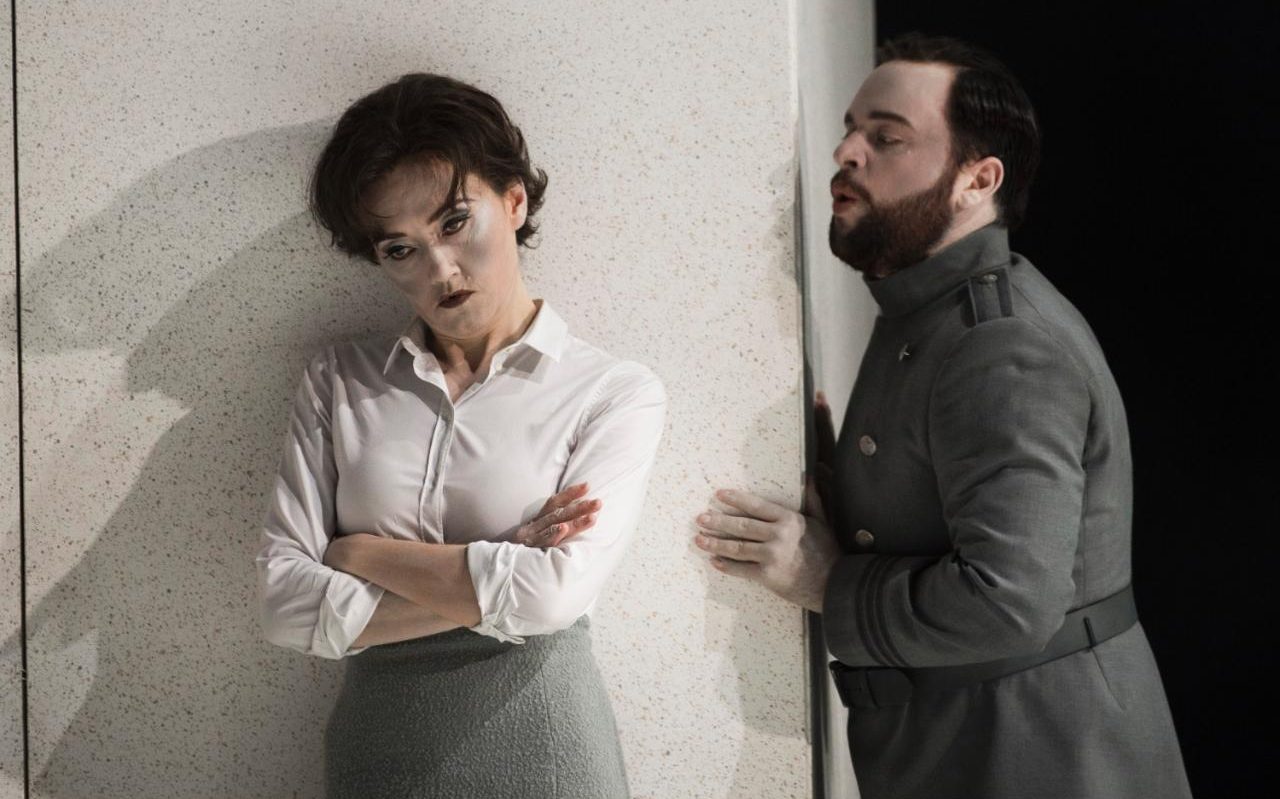
Béatrice et Bénédict

👍🏻
Conductor: Antonello Manacorda*
Director: Laurent Pelly

Béatrice, niece of Léonato: Stéphanie d’Oustrac (soprano)
Bénédict, Sicilian officer: Paul Appleby (tenor)
Héro, daughter of Léonato: Sophie Karthäuser (soprano)
Claudio, general's aide-de-camp: Philippe Sly (baritone)
Somarone, a music master: Lionel Lhote (bass)
Don Pedro, Sicilian general: Frédéric Caton (bass)
Ursule: Katarina Bradić (contralto)
Léonato, Governor of Messina: ? (spoken)

This is utterly charming.  I am speaking of Hector Berlioz' Béatrice et Bénédict from Glyndebourne.  It is based on Shakespeare's Much Ado About Nothing and has a libretto by Berlioz.  Beatrice has fallen victim to love, and she is pissed.

It's staged like a movie in black and white with the set pieces mostly made up of gray boxes.  Symbolism.  You knew that.  Beatrice does not wish to be in a box.  At the end she appears with her Benedict in one of the boxes and declares that tomorrow they will be enemies again.

It is an opera comique that is nothing like an Italian opera buffa.  Frantic tempos are replaced by sweet melodies.  Spoken French dialog replaces recitative.  There is a buffo bass (Somarone) and a lovely, marvelously comic couple that find each other at the end.

I have long loved Berlioz, read The Aeneid because I knew he loved it.  You can feel throughout this excellent opera with duets and trios of female voices, comic choruses and a comic tenor and soprano, how very much he loved Shakespeare.

Philippe Sly looked like the man on the wedding cake when he marries Hero, but it seems he was hired for his beauty and his excellent French because he hardly sings at all.

:-)
#ad