Showing posts with label Fabio Luisi. Show all posts

Saturday, April 18, 2020

I Capuleti e i Montecchi from Zurich

 The Companion, Giulietta, Romeo

Fabio Luisi Conductor
Christof Loy Staging

Joyce DiDonato Romeo
Olga Kulchynska Giulietta
Benjamin Bernheim Tebaldo
Roberto Lorenzi Lorenzo
Alexei Botnarciuc Capellio
Gieorgij Puchalski The companion

Everyone is streaming these days.  Today was Bellini's I Capuleti e i Montecchi from the Zurich opera in 2015.  Joyce performed this role in 2012 in San Francisco, but it is rather astounding how much more intense she is here.  There's something about watching opera two feet from your eyes that makes it seem more personal, more real.  Her Romeo here is intensely emotional, far more than the other characters on the stage.

Background tells us that there are two R&J operas:  Gounod's and Bellini's.  Gounod's opera is French and derives from the Shakespeare play.  The Italian Bellini designs his play around Italian history.  I previously wrote:  "We studied the Guelphs and Ghibellines in my class in Florence. The Guelphs, represented here by Giuletta's family the Capuleti, support the Pope, and the Ghibellines, represented here by Romeo's faction the Montecchi, support the Holy Roman Empire. So you see it isn't just two families that don't like each other. It's a war that went on in Italy from 1140 to 1289."

Christof Loy has made of this history a minimalist regie production with the usual black suits for all the male characters.  The women all seem to wear white dresses which we confuse with wedding dresses.

There is one other regie feature--The companion.  He's an androgynous figure with long hair who dresses sometimes in a black suit and other times in a black dress.  He says nothing but seems to fill holes in the plot.  When Romeo pulls a gun and tries to get Tebaldo to shoot him, The companion disposes of the gun.  When Giulietta needs lifting, he is there to do the job.  [Why do directors assume that tenors can lift sopranos?]

You want this opera for the music.  It is glorious here, beautifully conducted and beautifully sung. 

I couldn't face Butterfly.

Thursday, June 29, 2017

Macbeth rerun


I loved seeing Macbeth again and had pretty much the same reaction as last time.

Conductor: Fabio Luisi
Production: Adrian Noble

Macbeth: Željko Lučić (baritone)
Banquo: René Pape (bass)
Lady Macbeth: Anna Netrebko (soprano)
Duncan, King of Scotland: Raymond Renault
Malcolm, Duncan's son: Noah Baetge (tenor)
Macduff, Thane of Fife: Joseph Calleja (tenor)

The witches with their purses is fun.  This time I liked Željko Lučić more.  I went with a friend who had never seen this opera before.  We both had a wonderful time and are looking forward to Carmen and Otello next month.
 #ad

Saturday, October 22, 2016

Nasty Don Giovanni


Conductor:  Fabio Luisi
Production:  Michael Grandage

CHARACTERS FROM THE UPPER CLASS

Don Giovanni:  Simon Keenlyside (baritone)
Donna Anna:  Hibla Gerzmava  (soprano)
Commendatore, Anna's father:  Kwangchul Youn (bass)
Don Ottavio, Anna's fiance:  Paul Appleby (tenor)
Donna Elvira:  Malin Byström (soprano)

CHARACTERS FROM THE LOWER CLASS

Leporello, Giovanni's servant:  Adam Plachetka  (baritone)
Zerlina:  Serena Malfi  (soprano)
Masetto, Zerlina's fiance:  Matthew Rose  (baritone)

Mozart's Don Giovanni premiered in Prague in 1787 which, I have recently learned, was enjoying a Don Juan vogue at the time.

Nasty is the word of the week, and it seemed suitable for this somewhat raunchy Don Giovanni from the Metropolitan Opera in HD.  General reaction:  Oh, THAT'S what it's about.  Don Giovanni is about sex, a subject we are getting rather a lot of this year.  The Don seems not to focus on certain areas for his sex crimes.  He covers the gamut of entitled male animal.  We have to say that Da Ponte seems to know rather a lot about his subject.  He also knew enough to leave the sex scenes ambiguous so we don't quite know what happened.  We are thus spared the phony sex scenes that permeate modern opera productions.

I didn't mind the drab production this time because the characters filled it so vividly.  The Don begins at the bottom with rape and murder.  He enters Donna Anna's bedroom while she is sleeping, and she awakens to fight him off.  If we take the libretto at its face, she is successful in fighting him off, unless we assume he raped her while she was asleep.  Her father comes in, and Don Giovanni kills him.  There is an amazing piece of blocking where the Don leans over the Commendatore and raises his hand in the air to represent the Commendatore's soul flying away at the moment of death.  Wow.  This is not Don Giovanni as Austin Powers, as I have often imagined, but rather a deeply evil Don.  This Don Giovanni will not escape his doom.  Don Ottavio vows to avenge the Commendatore.

I appreciated Simon's comment that Don Giovanni lies between the American and the French Revolutions.  I separated the characters by class because this would have been what mattered most in the era.  The entitled upper class who in the American Revolution lived across an ocean were still the target.  We sent them back home.  The French Revolution solved the problem by cutting off their heads.  In the opera God intervenes.

Don Giovanni is never far from a woman.  When Donna Elvira appears, Giovanni starts to seduce her until he sees who it is.  He comes upon a wedding party, and from all the women present he chooses to pursue the bride.  He serenades Donna Elvira's maid, and may actually have been successful here.  We don't hear if he was successful.

The first time they go to Don Giovanni's house the singers are actually dancing.  Not well, but dancing.  The second time we are in the Don's house, his first course at dinner consists of fruit being eaten off of a woman's stomach.  In case you had forgotten what the opera was about.  After Giovanni descends into hell, Donna Elvira says,  "I will go into a nunnery."  Zerlina and Masetto say,  "And we will go home to dinner."  Favorite line.  Nothing so trivial as sex will bother us.  In the lower classes women are not traded for political advantage.

I want to discuss the performers.  Simon Keenlyside was a physical dynamo, though clearly no longer young, his Don Giovanni pursued women with fascinating energy.  I enjoyed his performance.  Paul Appleby was just the right singer for Ottavio with a beautiful Mozart legato.  He is young and will grow into his roles.  Hibla Gerzmava has a huge voice that roared over the ensemble.  We could hear her in some Verdi.  Adam Plachetka's Leporello was very genuine and funny.  I liked him, and find that I saw him before in Marriage of Figaro from Salzburg in 2015.  Malin Byström was our Jenufa in San Francisco last Spring.  I thought she was a strong performer.  My only disappointment was the Zerlina of Serena Malfi.  I absolutely adored Mojca Erdmann's Zerlina the last time we saw this production.  It was my impression that Serena did not want to take her eyes off the conductor.  I'm going to be annoying and give advice:  sing with the music. 

We all enjoyed this and felt we understood Don Giovanni as never before.

Thursday, March 10, 2016

Manon Lescaut in HD


Conductor...............Fabio Luisi
Production..............Richard Eyre

Manon...................Kristine Opolais (soprano)
Des Grieux............Roberto Alagna (tenor)
Lescaut.................Massimo Cavalletti (baritone)
Geronte.................Brindley Sherratt (bass)

I missed the live simulcast of Puccini's Manon Lescaut from the Metropolitan Opera but saw the repeat last night.  Our old movie theater is gone, and we are required to drive a much longer distance.

There were a lot of complaints in the reviews about the look of the production.  I know people who only go to the opera if the costumes look like this:


And hate that it now looks like this:


But if I apply my usual criterion, I must say that for explaining the action, you could not beat this.  Every line of dialog in the complex second act was enacted vividly, clearly and understandably. The bombed out church is a "wasteland" idea is iffy, I admit, but the action in that act is not complex.  She complains that she is lost and abandoned, and she dies.  The actors complained about all the stairs.

It is somewhat shocking that Roberto Alagna has never sung this opera before.  He could not be more perfect.  He projected youthfulness incredibly well and sang up a storm.  Both vocally and dramatically Kristine is more in tune with Jonas, but I must say I loved Alagna and Opolais together.  This pairing will repeat for Madama Butterfly.

The Met will be sorry to lose Fabio Luisi.

Thursday, July 09, 2015

La Traviata HD Rerun


Conductor....................Fabio Luisi
Production...................Willy Decker
 
Violetta.....................Natalie Dessay (soprano)
Alfredo......................Matthew Polenzani
Germont....................Dmitri Hvorostovsky
Flora........................Patricia Risley

Parts (or all) of this HD film of Verdi's La Traviata from the Metropolitan Opera are different from the live broadcast in 2012 where Natalie cracked one of her notes.   This version contained no disasters, but did show a certain amount of fatigue in her voice.  It is possible that Violetta is too heavy for Natalie.  It is also possible that she is simply showing the effects of aging.  (I read in the earlier post that Natalie had a cold during the run.)  Natalie is an extraordinary operatic performer who brings considerable acting talents to this role.  It was a pleasure.  I was glad I came back.  For the best Dessay see next weeks Daughter of the Regiment.

I learned from on line comments that I was correct in thinking that there was more music in Act II than I was used to hearing.  The role of Germont was filled out with pieces that are usually cut, no doubt to give us more of Dmitri Hvorostovsky who is wonderful here.  His Germont is a bit of a bully.

I'm not sure why, but I love this production.  The focus is on the inner life of Violetta and not the outer life of the characters.  I am attracted to its simplicity.

Saturday, April 25, 2015

Cavalleria Rusticana and I Pagliacci in HD


CONDUCTOR: Fabio Luisi
PRODUCTION: Sir David McVicar

Cavalleria Rusticana

Turiddu: Marcelo Álvarez (tenor)
Santuzza: Eva-Maria Westbroek (soprano)
Mamma Lucia: Jane Bunnell (contralto)
Alfio: George Gagnidze (baritone)
Lola: Ginger Costa-Jackson (mezzo-soprano)

The final HD from the Metropolitan Opera for this season was a new production of Pietro Mascagni's Cavalleria Rusticana and Ruggero Leoncavallo's I Pagliacci.

It might probably have been a good idea for me to wait to watch the Salzburg film until after this one.  Though in black and white, the Salzburg production was far more visually interesting.  I chose the above picture as the most colorful from the Met's Cavalleria.

I seldom say this so here goes:  The Met Orchestra was absolutely fabulous in both operas.  I know they are supposed to be... but I don't generally have this reaction.  Luisi must get a big piece of the credit. This is a very beautiful opera, and Luisi brought exactly the right feeling to it,  This cannot be said of Thielemann in Salzburg who could have been conducting Strauss.

It is impossible not to compare the two performances.  And there is much to contrast.  The Salzburg performance was beautiful and dignified.  Everyone is dressed for Easter.  Santuzza and Turiddu have a child who is an altar boy.  Mamma Lucia is the most northern Italian mother I've ever seen.  It was unbelievably restrained.

The Met performance despite its extreme low-stimulus production was the right one for Marcelo Alvarez.  His mother is very much the warm Italian mother.  Lola's husband is a tough.  I'm not sure about Eva-Maria Westbroek.  Sing something a bit lighter.


I Pagliacci

VAUDEVILLE CONSULTANT: Emil Wolk

Tonio: George Gagnidze (baritone)
Canio: Marcelo Álvarez (tenor)
Beppe: Andrew Stenson (tenor)
Nedda: Patricia Racette (soprano)
Silvio: Lucas Meachem (baritone)

Pet peeve out of the way--venti-tre ore means twenty-three oclock or 11 pm, not sunset or whatever other goofy times appear in the translations for this.  They have siesta in these places.

I enjoyed very much Susan Graham's interview with Patricia Racette in the intermission.  Racette informed us that Nedda is much closer to her real personality than the parts she generally plays.  She bragged about riding in on a horse with no hands, but she forgot to mention she was side-saddle with no hands.  She was by far the funniest Nedda I have ever seen.  We already knew she could do anything, but now we know that anything includes riding horses, dancing, doing slapstick comedy, and covering the emotional gamut in a single opera.

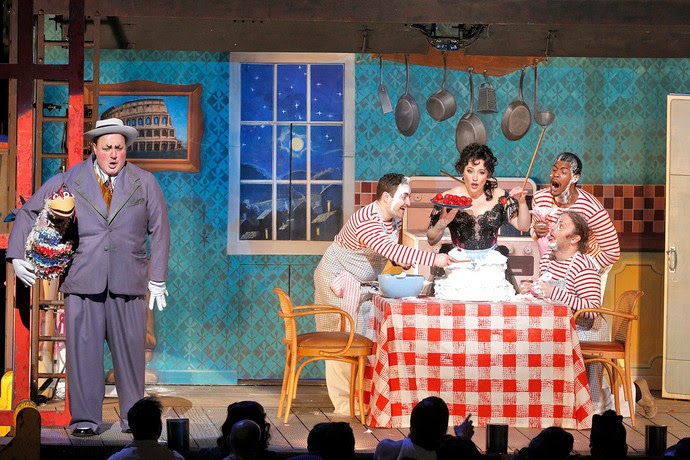
Tonio in the picture above is using the chicken (duck?) as a ventriloquist dummy.  He sang an excellent prolog.

This is the perfect opera for Marcelo Álvarez whom I sincerely doubt is as serious as his character here.  When he needs the big emotions, he rises to the occasion.

I hope you enjoyed this as much as I did.

Footnote.  Some one in our audience asked me what "toi" was, and I said it is "toi, toi, toi," means nothing in particular and is said instead of "break a leg" for good luck.  At this point in life I treasure the first time it was said to me.

Saturday, October 11, 2014

The Scottish Opera


CONDUCTOR: Fabio Luisi
PRODUCTION: Adrian Noble
LIVE IN HD HOST: Anita Rachvelishvili

MACBETH: Željko Lučić (baritone)
BANQUO: René Pape (bass)
LADY MACBETH: Anna Netrebko (soprano)
DUNCAN, KING OF SCOTLAND: Raymond Renault
MALCOLM, DUNCAN’S SON: Noah Baetge (tenor)
MACDUFF, THANE OF FIFE: Joseph Calleja (tenor)

This performance of Verdi's Macbeth simulcast from the Metropolitan Opera is the same opera and the same production that we saw in 2008.  So why doesn't it feel like it?  Because it is about 100 times sexier.  For me Netrebko simply transformed the production.

There are at least two other Scottish operas besides Macbeth, the name you are not supposed to say aloud:  Lucia di Lammermoor and Handel's Ariodante.  There wasn't anything particularly Scottish in this production.  Perhaps the landscape might resemble a wooded part of Scotland.  It bothered me that there were no branches illustrating the movement of Birnam Wood.  In fact there didn't seem to be much relationship between the play and the set.

So much of this performance has been written about already that there is little I could add.  Anna was stunning, truly shocking.  There were lots of chairs.  I've never seen women carry their purses the way the witches did.  If there's a strap, don't they just hang it over their arm?  Perhaps they carried them like that so that they would be easy to open and let the lights shine out.  The witches had lights inside their purses.

There was only one thing I would criticize about Anna's performance--she is intensely self-confident for long stretches of the play and then is suddenly having nightmares about the blood on her hands.  Could we have seen this coming just a little?  Perhaps I am being nit picky.

Lučić was excellent, better than his Rigoletto.  There is a roughness to his voice that doesn't go with Rigoletto for me but was ideal for Macbeth. The entire cast was excellent, especially Rene Pape.

I was struck by how huge both the roles of Macbeth and Lady Macbeth are.  Luisi called the opera short, but we were out after 3 1/2 hours.  Except for the chorus, all the other roles are insignificant.  This is part of why the opera is so difficult.

I was pleased that Netrebko did not try to push into her chest voice.  In the really quite mad intermission interview she said that she would give herself 2 years on Lady Macbeth and then let her go.  I am hoping this is true.  There will probably be a DVD.

No one generates the sheer excitement and intensity that Anna Netrebko can.  She is the singer for our time.

#ad

Thursday, May 15, 2014

La bontà in trionfo


Conductor: Fabio Luisi
Production: Cesare Lievi

Cast

Angelina: Joyce DiDonato
Prince Ramiro: Juan Diego Flórez
Dandini: Pietro Spagnoli
Don Magnifico: Alessandro Corbelli
Clorinda: Rachelle Durkin
Tisbe: Patricia Risley
Alidoro: Luca Pisaroni


This series of Rossini's La Cenerentola at the Metropolitan Opera was a first go for Fabio Luisi, and I must say he was fantastic.  His tempos were great.  His ability to follow the singers was incredible.  Every note was secure, joyful and invigorating.  Someone mentioned in the interviews how nice it was to look down into the pit and see his smiling face.

All of these great singing actors were in form.  I didn't even mind Don Magnifico played by the great Alessandro Corbelli.  He explains that he never plays anything for laughs, and in this performance only the sisters and Dandini seemed to be deliberately aiming for silliness.  Joyce, Juan Diego, Luca, Pietro, all were fabulous.  The entire performance was filled with love and joy.  It was a truly great La Cenerentola.

I apologize to my fellow viewers for conducting and humming along throughout most of this. It is still the opera I have listened to most, and apparently I know every note.

Saturday, January 05, 2013

Les Troyens in HD


Conductor...............Fabio Luisi
Production..............Francesca Zambello

Part I: La Prise de Troie

Cassandra...............Deborah Voigt
Coroebus................Dwayne Croft Aeneas..................Bryan Hymel
Ascanius................Julie Boulianne Priam...................Julien Robbins Hecuba..................Theodora Hanslowe

Part II: Les Troyens à Carthage

Dido....................Susan Graham
Anna....................Karen Cargill
Narbal..................Kwangchul Youn
Iopas...................Eric Cutler
Ascanius................Julie Boulianne
Panthus.................Richard Bernstein
Aeneas..................Bryan Hymel

We liked this picture because the right side of the dome shot, seen at the very end of the opera, is the interior of the Pantheon in Rome.  Berlioz is assigning to his characters the ability to see into the future, in this case the fact that ultimately Rome conquers Carthage.  Hector Berlioz loved Virgil's Aenead and created his own libretto for his masterpiece Les Troyens, simulcast today live from the Metropolitan Opera.

This quote from Wikipedia is interesting. "In 1969, Bärenreiter Verlag of Kassel, Germany, published a Critical Edition of Les Troyens, containing all the compositional material left by Berlioz. The preparation of this critical edition was the work of Hugh Macdonald, whose Cambridge University doctoral dissertation this was. The tendency since then has been to perform the opera complete." This in spite of the fact that earlier in the same article it says, "In this [earlier] published score, [Berlioz] introduced a number of optional cuts which have often been adopted in subsequent productions."  We liked especially the idea, not being ourselves French, that all the ballets would be cut.

It is a huge opera that can be produced only in the largest opera houses.  I think it would work to do a cut down version using only the final three acts, actually the format for the original production called Les Troyens à Carthage. Perhaps in this format we would get to see it more often.  For my taste these are the parts I enjoy; the lyricism, the love duet, the fatal love affair.  I could live without a crowd of women stabbing themselves.

Because we are living in the prime of Susan Graham, an artist of wonderful gifts, especially in the French repertoire.  This is the part we would want to see over and over.  To quote Joyce Didonato, "Berlioz and Susan Graham--a match made in heaven."

The replacement tenor who sang Énée, Bryan Hymel, was incredible.  We were definitely hoping to get to hear more of him.  He received the loudest ovation, both during the opera for his aria in Act V and at the final bows.

Kudos to everyone, especially the chorus which is in virtually every scene.

Tuesday, December 18, 2012

Our Italian is better than your Italian

Just thought I would mention.  I've heard enough of both of these gentlemen, Fabio Luisi and Nicola Luisotti, to know that we got the better of the deal, especially in Italian repertoire. 

Friday, November 09, 2012

James Levine is making a comeback.

[This is copied from the New York Times.]

Saying ‘It’s Miraculous for Me,’ Levine Will Conduct Again at Met
By DANIEL J. WAKIN
Published: October 11, 2012

James Levine is "overwhelmingly happy to be coming back."

Mr. Levine conducting the Met Orchestra in Mozart's "Serenade No. 9 in D Major" at Carnegie Hall last year.

Defying opera world doubters who thought he was too ill, weak or disengaged, the longtime and much loved music director of the Metropolitan Opera plans to return to the podium for the first time in two years, for a May 19 performance by the Met Orchestra at Carnegie Hall and for three productions at the opera house next season.

Mr. Levine, 69, once a workhorse of the baton, has been plagued by health problems since 2006, leading to a drip-drip of cancellations over recent years. A fall in the summer of 2011 that caused severe damage to his spine forced him to bow out of all of last season and cancel involvement this season while he recovered. He hasn’t led a performance since May 14, 2011, when he conducted Wagner’s “Walküre.”

“I’m overwhelmingly happy to be coming back,” Mr. Levine said in a telephone interview on Wednesday. “It’s miraculous for me.”

Peter Gelb, the Met’s general manager, gave the news to the executive committee of the trustees late on Thursday afternoon and planned to tell the company before the evening’s performance.
Mr. Gelb said Fabio Luisi, the principal conductor who was brought in to fill the void left by Mr. Levine’s absences, would remain in the position to preserve musical continuity for the orchestra, but it was not immediately clear how he and Mr. Levine would share responsibilities.

In the interview Mr. Levine disclosed details about his condition. He remains unable to walk because of the spinal damage and acknowledged what many had suspected for a while: he has a nonprogressive condition related to Parkinson’s disease that causes hand tremors, which his doctors called “benign Parkinsonism.”

Mr. Levine said he would conduct from a motorized wheelchair that he uses. Met technicians are devising a podium that mechanically rises and falls, like an elevator, for Carnegie Hall and the Met pit.

The Met’s plans now call for Mr. Levine to lead a revival of Mozart’s “Così Fan Tutte” (nine performances), starting on Sept. 24; a new production of Verdi’s “Falstaff” (10 performances), starting on Dec. 6; a revival of Berg’s “Wozzeck” (five performances), starting March 6, 2014; and the second half of the “Così” run, starting on April 23, 2014. He is also scheduled to conduct three Carnegie Hall performances with the orchestra next season, as well as the concert in May. Mr. Levine, who even before the fall walked with a cane or used a wheelchair and conducted sitting down, said he was on the mend and hoped to regain limited mobility soon. He said that the fall caused complete paralysis in his legs, but that he has recovered sensation and movement, if not the ability to walk.

“For the first few weeks, I could have been reading a newspaper while somebody was moving my leg, and I wouldn’t have known he was moving it,” Mr. Levine said.
Mr. Levine said that he had had the Parkinson’s-related condition since 1994, and that on its own it did not interfere with his conducting. But he explained that the severe pain from back problems would make it worse, resulting in a more pronounced tremor and greater impact on his legs. A Parkinson’s medication he took, L-dopa, “contributed to the shaking in his legs and left hand,” the Met said in a statement.

Mr. Levine has been going into the Met regularly since early September, he said, for administrative meetings, to coach singers in the young artists program and to listen to auditions. He said he would pick up the pace of rehearsing cast members for future productions toward the end of the year.
The whole idea, he said, is to “do what I used to do and then some, because you always learn a lot.”
Mr. Levine’s health woes began in 2006, when he fell onstage in Boston and tore a rotator cuff. A malignant cyst led to the removal of a kidney two years later. Then came three more operations: to repair a herniated disk; to correct curvature of the spine and spinal cord compression; and to fix a nerve problem resulting from the spinal surgery. He resigned as music director of the Boston Symphony Orchestra in early 2011 because of his condition.

Then, that August, he fell down several steps while on vacation and suffered the spinal injury. While the Met held out hope that Mr. Levine would return, he ended up announcing cancellations for this season and last, including high-profile cycles of Wagner’s “Ring,” where Mr. Levine is often considered at his most revelatory. Each cancellation brought intense scrutiny, given his deep association with one of the nation’s most important arts institutions. He has conducted at the Met since 1971 and became its music director in 1976. His tenure has shaped the musical standards of the house and put his mark on several generations of singers.

In Mr. Levine’s absence the Met turned to one of his regular substitutes, Mr. Luisi, the Italian maestro, and named him principal conductor.

Mr. Luisi “understood all along that Jim’s intention was to return,” Mr. Gelb said. “He has a very important role with the orchestra.”

With patrons and operagoers often asking when Mr. Levine would be back, Mr. Gelb came under pressure to make a decision about Mr. Levine’s long-term status, but he said he would not act as long as there was any shred of hope that Mr. Levine could someday conduct.

Matters became acute this fall, as the Met prepared for its 2013-14 season announcement in February. If Mr. Levine were out, substitutes had to be found. His doctors — two neurologists and a spine surgeon — agreed that their patient was recovering enough to go back to work eventually.

In an unusual display of openness, the Met, with Mr. Levine’s permission, released statements from the doctors. They said that his upper-body strength was stronger than it had been in years because of rehabilitation. He was pain-free and unencumbered by the benign Parkinsonism. “His prognosis is good,” said Dr. Patrick O’Leary, a spine surgeon at the Hospital for Special Surgery in Manhattan.

Given so many dashed hopes in the past that Mr. Levine would come back, Mr. Gelb said, “it has to be really clear that his return is credible this time.”

Mr. Levine said it was difficult discussing his medical issues.

“I was brought up in a time when if you had a difficulty like that, it was just good form to solve it and keep your own counsel, if you could,” he said. “Now we live in a different time.”

He said he was also reluctant to mention his benign Parkinsonism to avoid “the very dire idea” associated with it in people’s minds.

Mr. Levine said he would juggle a heavy load of rehabilitative therapy with his increasing Met duties. In a certain sense, those tasks will merge, he added.

“My life commitment is to the Met, and I love the Met so,” he said. “My doctors also think that besides being able to recommend that I should come back, they are ready to say I’m likely to be helped by it as well.”

A version of this article appeared in print on October 12, 2012, on page A1 of the New York edition with the headline: Saying ‘It’s Miraculous for Me,’ Levine Will Conduct Again at Met.

Saturday, April 14, 2012

Crash and Burn

Or to quote Karen Slack:  Ms. Hong WHERE ARE YOU WE NEED YOU BADLY!!!!

We are all speaking of today's Live from the Metropolitan Opera in HD of Verdi's La Traviata with Natalie Dessay.  Even her microphone, just under her clothes on her right side, did not save her.  I have heard Natalie sing Violetta at Santa Fe, so I know it's possible.  My thought is that she was not as recovered from her illness as she wished she was. 

Matthew Polenzani sang his trademark sad sack Alfredo, nice but not very impressive.  Dmitri Hvorostovsky as Germont is the best Verdi baritone around.  He was simply wonderful.  Fabio Luisi was conducting one of 20 performances at the Met this month, either a record or a tie, including Die Walküre last night and Manon tonight.  I have written about the Willy Decker production here.

Sigh.

[See Kinderkuchen History 1850-70]

Saturday, April 07, 2012

Manon in HD


Conductor...............Fabio Luisi
Production..............Laurent Pelly

Manon...................Anna Netrebko
Des Grieux..............Piotr Beczala
Lescaut.................Paulo Szot
Count des Grieux........David Pittsinger
Guillot.................Christophe Mortagne
Brétigny................Bradley Garvin
Poussette...............Anne-Carolyn Bird
Javotte.................Jennifer Black
Rosette.................Ginger Costa-Jackson


Before we get started I have just one question:  what was the basketball in Act III about?  Any ideas would be appreciated. Maybe it's left over from March madness.

Today live from the Metropolitan Opera in HD featured Massenet's Manon in a new production by Laurent Pelly, starring Anna Netrebko and Piotr Beczała, (pronounced pyOtr betchAwa) who is Polish.  Did I know this opera was a comique?

Since we are seeing it next week, I was curious about some of the features Pelly's Manon has in common with Decker's La Traviata.  There are six different sets for Manon with basically only two for Traviata, but both are extremely bare bones.  Both operas have crowds of men in tuxedos and top hats that include cross-dressed women from the chorus.  Other reviewers have complained that the sloping stage ramps look like the handicapped entrance.  The austere last scene was very effective, but in general the sets are big, cumbersome and boring.  And I completely did not buy the bed in the transept, though it made for a nice finish for the scene.

The main difference between the two productions is the presence of women in Manon.  In Traviata Violetta is the only woman.  I rather liked the ballet made up of young women dressed like the dancers from Degas paintings, but I didn't like that they were all carried off screaming when they finished dancing.  I see no reason why rich men couldn't afford to bribe their way to affection.

Paulo Szot (shot) is an excellent actor and a pretty fair singer.  For me Manon really only works if the acting is intense.  Christophe Mortagne was very nasty as Guillot, the villain, but was having a lot of trouble with his English when Debbie Voigt was interviewing him.  We miss Renée.

Beczała is an excellent tenor who projects a very sentimental quality in the role of des Grieux.  He completely lost his sense of the correct pitch in his big aria.  And the Netrebko has it all.  I thought she looked, sounded, and acted beautifully.  I can't really imagine this opera with anyone else in it.  In the Marilyn Monroe scene (you know what I'm talking about) she lost her earring and then threw the other one across the room. 

This was Fabio Luisi's first Manon, and he conducted like it was an old friend.  He's setting records at the Met for most performances conducted in a single month.


[See Kinderkuchen History 1870-90]

Saturday, November 05, 2011

Siegfried Success


What you want and never get with your Siegfried (live from the Metropolitan Opera in HD) is a sexy Siegfried.  We have him in the sexy Heldentenor from Texas, Jay Hunter Morris. In her interview Deborah Voigt mentioned there was more electricity opposite Jay than the tenor he replaced. Those of us who have experienced the male teenager at home recognized him in Jay's portrayal of the 17 year old Siegfried.  All teenagers think they know everything, but this one actually might.

In his interview Morris mentioned that he no longer sang as loud as he could.  He gets through the very taxing role in fine form by allowing the natural ping in his voice to carry the day.  I loved it.  Jay, you need to hire a good photographer.  I have undoubtedly seen him in San Francisco, but I scour my memory without success.

I liked the log machine a lot more this time than I have in the previous two operas.  The technical gimmick of the forest bird was masterful.  A yellow bird appeared to flit around the stage from tree to tree while Mojca Erdmann sang off stage.  The projections grow ever more complicated.


Another thing that I liked much more this time was Bryn Terfel's Wotan the Wanderer.  He seemed to handle the character better as someone who has tried everything and failed.  He is bitter and seems to be fully prepared for the ultimate humiliation when Siegfried breaks his spear.  He roles up his runes and leaves.


The dragon, shown above, is quite handsome.


And here is Deborah Voigt in the final scene.  She tries to convince Siegfried to admire from a distance, but her heart just isn't in it.

Renée Fleming was her usual professional self in the interviews.  It was an excellent Siegfried.  I don't know if Levine would have been an improvement over Luisi.  Everyone seemed well coordinated and dynamic.

P.S.  It occurred to me after posting this that this installment in the Log Machine Ring included no wire walking.  Perhaps it has started to occur to the producers of this mess that scaring the wits out of your performers is not the path to great acting achievements.  Good riddance.

#ad

Monday, October 31, 2011

Don Giovanni in HD


Don Giovanni............Mariusz Kwiecien
Donna Anna..............Marina Rebeka
Don Ottavio.............Ramón Vargas
Donna Elvira............Barbara Frittoli
Leporello...............Luca Pisaroni
Zerlina.................Mojca Erdmann
Masetto.................Joshua Bloom
Commendatore............Stefan Kocán

Conductor...............Fabio Luisi
Production..............Michael Grandage

One of my long time wishes came true in the Live from the Metropolitan in HD broadcast of Don Giovanni on Saturday. I have always wished for a very sexy and aware Zerlina, one who truly meant "vorrai e non vorrai" [I want, and I don't want], where you could see it in her eyes. I wanted to feel the moment when she pauses and finally says "andiam." [we go]  I wanted the vision of her full participation in the seduction. I got her in Mojca Erdmann's Zerlina. She was perfect.


This was an excellent production for a number of reasons. Don Giovanni is hard to stage unless you just bail on the whole thing and stick with a bare stage. The scene is constantly shifting. In this production the stage pictures were pleasing and moved smoothly and easily from scene to scene. This version by Michael Grandage was very comprehensible and well thought out. And the death scene was the best ever.

The cast was well matched, but I felt that the Leperello of Luca Pisaroni stole the show from Mariusz Kwiecien [pronounced KVEE-chen, according the the New York Times, although Renée Fleming seemed to be saying something slightly different] as the Don. Mariusz has a pretty face so we forgive him the dastardly deeds. He showed no effects of his back crisis of only two weeks ago.

The rest of the cast, which included Barbara Frittoli and Ramon Vargas, was also excellent. Vargas is a wonderful singer, but I hated the fact that he sang his whole first aria sotto voce. Sotto voce is a stunt, something done only for a specific effect, and not real singing at all. More than a single phrase is too much. This is a recent phenomenon, and I refuse to just give in and ignore it. It must be weeded out.

Fabio Luisi conducted from the harpsichord where he played the secco recitatives. He explained in the intermission that it is easier for him to keep the music flowing from the harpsichord. Everything worked together to create a Don Giovanni of incredible dramatic effectiveness.


[See Kinderkuchen History 1780-1803]