Showing posts with label Cav/Pag. Show all posts

Thursday, February 18, 2021

Cav/Pag


Production..............Franco Zeffirelli
Conductor...............James Levine 

CAVALLERIA RUSTICANA

Santuzza................Tatiana Troyanos
Turiddu.................Plácido Domingo
Lola....................Isola Jones
Alfio...................Vern Shinall
Mamma Lucia.............Jean Kraft

We are celebrating Franco Zeffirelli week from the Metropolitan.  This Zeffirelli production of Mascagni's Cavalleria Rusticana might be a real place.  This is Italy. Perhaps there should be a list. This film, this production, this cast brings you the real thing.  

My favorite of this cast is Tatiana Troyanos, of course.  She is so intense that your heart is stirred. Plácido treats her badly, but she takes her revenge.  It's sad all these old productions are gone.  It's Easter Sunday and everyone is at church, except Santuzza who has been excommunicated.  She confronts people as they go in and out of the church.

PAGLIACCI

Nedda...................Teresa Stratas
Canio...................Plácido Domingo
Tonio...................Sherrill Milnes
Silvio..................Allan Monk
Beppe...................James Atherton

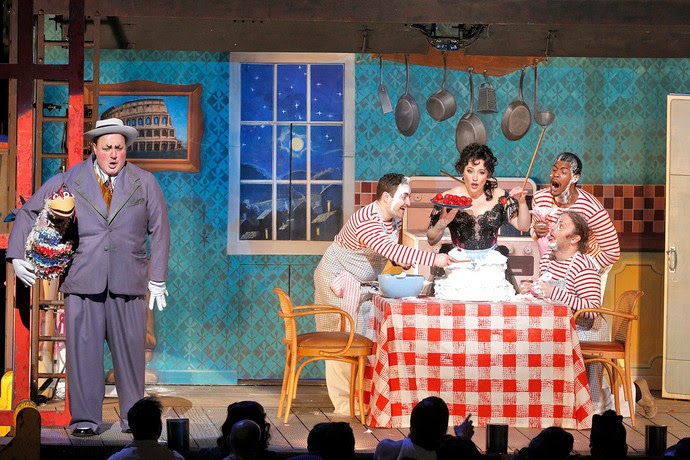
This is just ok.  The set is not particularly interesting after the magnificent summoning of a realistic Italian village in CR.  It's still worth seeing for the great cast.  Milnes does a terrific prologue. I think I prefer the current production of Pagliacci.


Thursday, September 20, 2018

Cavalleria Rusticana and I Pagliacci in San Francisco

Priest places a statue of Jesus in a niche. 
👍🏻
Conductor Daniele Callegari *
Production José Cura *

Turiddu, tenor: Roberto Aronica
Santuzza, mezzo:  Ekaterina Semenchuk
Alfio and Tonio, baritone: Dimitri Platanias *
Lola, mezzo: Laura Krumm
Mamma Lucia, contralto:  Jill Grove
Canio, tenor: Marco Berti
Nedda, soprano: Lianna Haroutounian
Silvio, baritone: David Pershall
Beppe, tenor: Amitai Pati

Mascagni's Cavalleria Rusticana and Leoncavallo's I Pagliacci are now in rotation at the San Francisco Opera.  I have listed the casts of the two operas together because the two operas have here become one. 

The story of this production is reasonably interesting.  In Buenos Aires, Argentina, exists a mural by Omar Gasparini called Escenografico.  Here is a photo of the original.


From my seat in the balcony circle I saw the stage in a manner very much like the photo at the top,  The mural was shown on the wall at stage left which I saw only fleetingly when the conductor entered.  I know about it only from pictures in the program.  The famous Intermezzo was staged as a ballet.

The church is at the back, and near it is a store that sells vegetables.  Mamma Lucia owns the cafe at the front, and when Turiddu sings "O Lola," Lola peeks out one of the windows above and Santuzza peeks out from another.  Silvio from Pagliacci is one of Mamma Lucia's waiters. At the end of Cavalleria Turiddo is killed, and his casket is carried by at the beginning of Pagliacci.  Mamma Lucia and a very pregnant Santuzza also appear in the cafe in Pagliacci. This unified production made the pairing of these two operas make a lot more sense than is generally the case, but everything was much cheerier than others I have seen.

A number of conductors are making their San Francisco Opera debuts this season because we are without a maestro.  Callegari brought us a very beautiful, very Italian verismo experience.  The singing was excellent if a bit on the heavy side.  I even rather liked Berti who was very heavy indeed.  The only thing that seemed missing was acting.

Friday, December 02, 2016

Cavalleria Rusticana in Paris

👍🏻

Cavalleria Rusticana 

Conductor for both: Carlo Rizzi
Director for both: Mario Martone

Santuzza: Elīna Garanča
Turiddu: Yonghoon Lee
Lucia: Elena Zaremba
Alfio: Vitaliy Bilyy
Lola: Antoinette Dennefeld

Sancta Susanna 

Susanna: Anna Caterina Antonacci
Klementia: Renée Morloc
Alte Nonne: Sylvie Brunet-Grupposo

On November 28 we attended Mascagni's Cavalleria Rusticana paired with Sancta Susanna by Paul Hindemith at the Paris Opera.  This double bill was performed without intermission.  Curious, we said to ourselves.  Why would they do that?  And who ever heard of Sancta Susanna?  Well, it turns out that this opera premiered in 1922 in Frankfurt and was a terrific scandal.  I think the modern day European is much harder to scandalize.

The production for Cavalleria Rusticana reminded me of the Cavalleria Rusticana production at the Met. Just furniture and no set.  Normally the Easter mass is celebrated inside a church which appears in the set and Santuzza stands outside.  Here there is no set, so the mass is celebrated on the stage in our view.  My experience of the mass shows the crowd much more active than here.  People stand and sit, occasionally speak, and move to the front to receive the wafer, but here they only mime, of course.  The characters are in front.  I think it was staged this way to emphasize the importance of religious imagery in the story.  The large crucifix becomes a character.

Though I have written extensively about Elīna Garanča, this is my first live experience of her.  In this house her voice was large, full and very suitable for a wonderful Santuzza.  I withdraw all previous reservations about her transition to spinto mezzo.  The singing was spectacular, but the production very much muted the physical parts of her characterization.  Yonghoon Lee is improving.  He looks good and sounds dramatic.


After a brief pause, the curtain rose on the physical parts of the set.  Sancta Susanna was presented as a small chamber surrounded by a giant blank wall.  We had visited the death chamber of Vincent van Gogh in Auvers-sur-Oise the day before and thought Susanna's chamber very much resembled it.  Susanna is a nun dressed in white.  Other nuns appear dressed in black and white.

I was explaining to my son that this is expressionism, an art style that consists of realistic details without context.  Then I thought, "oh."  Thus the giant blank wall.  

We are told that Susanna is dying.  The window in her chamber is open, and she intensely enjoys the scents.  Sister Klementia begins a cautionary tale about a woman seen naked in the woods some 30 or 40 years ago.  A space below the chamber opens up, and we see a nude woman and a crucifix much like the one in the previous opera.  Susanna suddenly rips off her habit, revealing her I must say rather gorgeous breasts and declares herself to still be beautiful.  She runs out and throws herself onto the reclining crucifix.  There is much lamenting and confusion.  This is sort of a wtf opera.

Clearly only the beautiful Anna Caterina Antonacci could be expected to pull this off.  Her acting is superb here but the role is a bit contralto for her voice.  As you know, I do not read explanations of what this is supposed to mean before going, but it does seem to me the pairing of these two operas is intended as a religious commentary.  Santuzza tells us that she has been excommunicated but without explanation.

Symbols can be more powerful than reality, and clearly that is the intention here.  It was only partially successful.  It was oddly pleasing to hear Hindemith who is of course nothing like Mascagni but not in any way shocking to modern ears.

Saturday, April 25, 2015

Cavalleria Rusticana and I Pagliacci in HD


CONDUCTOR: Fabio Luisi
PRODUCTION: Sir David McVicar

Cavalleria Rusticana

Turiddu: Marcelo Álvarez (tenor)
Santuzza: Eva-Maria Westbroek (soprano)
Mamma Lucia: Jane Bunnell (contralto)
Alfio: George Gagnidze (baritone)
Lola: Ginger Costa-Jackson (mezzo-soprano)

The final HD from the Metropolitan Opera for this season was a new production of Pietro Mascagni's Cavalleria Rusticana and Ruggero Leoncavallo's I Pagliacci.

It might probably have been a good idea for me to wait to watch the Salzburg film until after this one.  Though in black and white, the Salzburg production was far more visually interesting.  I chose the above picture as the most colorful from the Met's Cavalleria.

I seldom say this so here goes:  The Met Orchestra was absolutely fabulous in both operas.  I know they are supposed to be... but I don't generally have this reaction.  Luisi must get a big piece of the credit. This is a very beautiful opera, and Luisi brought exactly the right feeling to it,  This cannot be said of Thielemann in Salzburg who could have been conducting Strauss.

It is impossible not to compare the two performances.  And there is much to contrast.  The Salzburg performance was beautiful and dignified.  Everyone is dressed for Easter.  Santuzza and Turiddu have a child who is an altar boy.  Mamma Lucia is the most northern Italian mother I've ever seen.  It was unbelievably restrained.

The Met performance despite its extreme low-stimulus production was the right one for Marcelo Alvarez.  His mother is very much the warm Italian mother.  Lola's husband is a tough.  I'm not sure about Eva-Maria Westbroek.  Sing something a bit lighter.


I Pagliacci

VAUDEVILLE CONSULTANT: Emil Wolk

Tonio: George Gagnidze (baritone)
Canio: Marcelo Álvarez (tenor)
Beppe: Andrew Stenson (tenor)
Nedda: Patricia Racette (soprano)
Silvio: Lucas Meachem (baritone)

Pet peeve out of the way--venti-tre ore means twenty-three oclock or 11 pm, not sunset or whatever other goofy times appear in the translations for this.  They have siesta in these places.

I enjoyed very much Susan Graham's interview with Patricia Racette in the intermission.  Racette informed us that Nedda is much closer to her real personality than the parts she generally plays.  She bragged about riding in on a horse with no hands, but she forgot to mention she was side-saddle with no hands.  She was by far the funniest Nedda I have ever seen.  We already knew she could do anything, but now we know that anything includes riding horses, dancing, doing slapstick comedy, and covering the emotional gamut in a single opera.

Tonio in the picture above is using the chicken (duck?) as a ventriloquist dummy.  He sang an excellent prolog.

This is the perfect opera for Marcelo Álvarez whom I sincerely doubt is as serious as his character here.  When he needs the big emotions, he rises to the occasion.

I hope you enjoyed this as much as I did.

Footnote.  Some one in our audience asked me what "toi" was, and I said it is "toi, toi, toi," means nothing in particular and is said instead of "break a leg" for good luck.  At this point in life I treasure the first time it was said to me.

Monday, April 13, 2015

Cavalleria Rusticana

You can watch the brand new Cavalleria Rusticana from the Salzburg Easter Festival on YouTube. Here are some bits.


Conductor:  Christian Thielemann
Production:   Philipp Stölzl

Turiddu: Jonas Kaufmann (tenor)
Santuzza: Liudmyla Monastyrska (soprano)
Lola: Annalisa Stroppa (mezzo-soprano)
Mamma Lucia: Stefania Toczyska (contralto)
Alfio: Ambrogio Maestri (baritone)

I like both Kaufmann and Lyudmyla Monastyrska in this, Mascagni's Cavalleria Rusticana.

_______________________

I find that I want to comment on the production.  It was hard to understand exactly what was going on.  There was a conductor in the pit and an orchestra, and they were playing.  On the stage it seemed to be a film playing.  Up to six different screens appeared in two rows, and the scenes of people milling around outside the church for Easter services could have actually been films.  The gorgeous choral work could not be seen, and they didn't get a bow.

The only thing I could figure out was a large screen with films of live action which went on behind it.  The maybe four actual sets were shot and put together into what we were seeing.  It was hard to tell exactly since I am possibly seeing a film of a film.  Or who really knows? 

In the scenes with mama Lucia there were two mysterious men that came and went.  I kept rewinding to see what happened.  And who exactly were they?  Mama seemed to be working.

The plot was easy to follow.  It was only confusing if you wanted to understand how they did it.

___________________________

She's right.  You can't tell from a film, but my current guess is two rows of three boxes.  Sometimes they are only frames that make it look like boxes.  Turiddu is respectable but Santuzza isn't, though they live together and have a child together.

The street cleared and mama Lucia's box appeared in the lower row.  They must be rolled around backstage.  Maybe this would only work for the lower row.  One can't help wondering.

_________________________________

There is a film also of Ruggero Leoncavallo's I Pagliacci which I find I don't like quite as much.  There is the same arrangement of two rows of boxes.  In this one when the play is being enacted in one section above, there are closeups projected on the section next to it.  Then at the end there is a big empty stage.  Curious.

Dirigent: Christian Thielemann

Canio:  Jonas Kaufmann (tenor)
Nedda:  Maria Agresta (soprano)
Tonio:  Dimitri Platanias (baritone)
Beppe:  Tansel Akzeybek (tenor)
Silvio:  Alessio Arduini (baritone)

#ad

Sunday, November 20, 2011

Murder and Mayhem


The Sacramento Opera succeeds best when it eschews subtlety.  Leoncavallo's I Pagliacci is a prime example of verismo, opera based in the rough lives of the lower classes.

I don't like the orchestra at the back of the stage with acting in front, but since the first half of the program was a concert by the Sacramento Philharmonic Orchestra, conducted by Michael Morgan, I suppose it was necessary.  For their portion the orchestra was imprecise, both in pitch and rhythm, and the music was spiritually bland.

The contrast with the opera could not have been greater.  The set effectively made the orchastra's presence hidden.  TV screens made the conductor visible to the actors.

It was crude and wild and spectacular.  Special kudos must go to the stage director, David Bartholomew.

The tenor who sang Canio, Eduardo Villa, was a last minute replacement, and he made the production.  Canio should be a middle aged man with a beautiful, too young wife, a scruffy Italian looking man with violent passions lurking just beneath the surface.  Then these violent passions must break forth.  Villa was all those things.  And he has just the right heavy, powerful dramatic tenor voice that kept all this passion well within his grasp.  It was a privilege to see him.

Shana Blake Hills was good and very slutty as Nedda.  Igor Vieira's Tonio was downright creepy.  Zachary Gordin was a good but not great Silvio.

Congratulations.  La comedia è finita.

[See Kinderkuchen History 1890-1910]