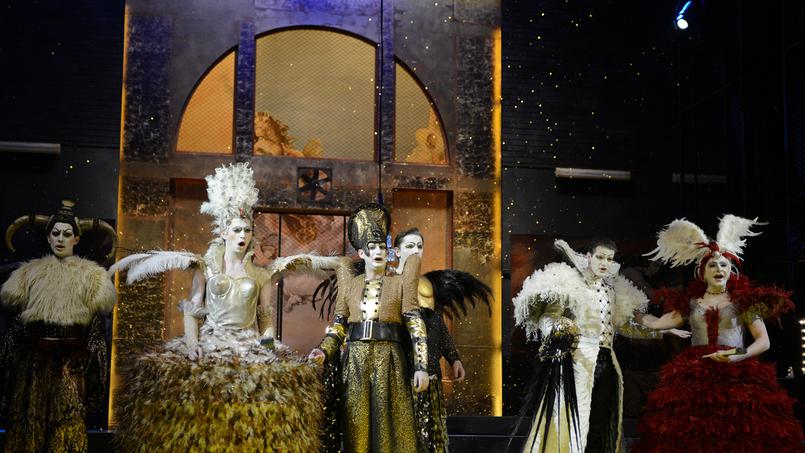
This is a performance of Handel's Messiah from Grace Cathedral, an Episcopal cathedral on Nob Hill in San Francisco, by the American Bach Soloists. They are the original instruments ensemble I visit regularly in Davis, but they perform Messiah only in Grace Cathedral, which is a bit far away for me. They are seriously striving for an authentic style, and I think the effort here was very successful. If you are not getting enough Messiah, I recommend this one. Disclaimer--there is no historical basis for using a countertenor to replace the alto solo. This is my usual complaint.
Friday, January 01, 2021
Messiah from San Francisco
Monday, August 10, 2020
Giulio Cesare from Glyndebourne
Conductor
William Christie
Director
David McVicar
Giulio Cesare -
Sarah Connolly, mezzo
Curio -
Alexander Ashworth
Cornelia, Pompei's wife -
Patricia Bardon
Sesto, Pompei's son -
Angelika Kirchschlager, mezzo
Cleopatra
- Danielle de Niese, soprano
Nireno
- Rachid Ben Abdeslam, countertenor
Tolomeo, Cleopatra's brother -
Christophe Dumaux, countertenor.
Achilla -
Christopher Maltman, baritone
This performance of Handel's Giulio Cesare took place at Glyndebourne in 2005. This is the David McVicar version that ran at the Met with David Daniels and Natalie Dessay in 2013. I called it Julius Caesar the Musical. I enjoy remembering that Natalie was ill for one of the performances, and Danielle de Niese was in town. Naturally she took advantage of the opportunity and stood in for Natalie. That would have been fun to see.
We are projected in time into the British Empire. The Egyptian servants wear the Fez, and the Roman Army are dressed in the red uniforms of the British Army. There is no evidence of Islam, I guess. Cleopatra looks like a modern woman. There are WWII ships and dirigibles.
In the real time of Julius Caesar the rulers of Egypt were descendants of one of the generals of Alexander the Great but still called themselves Pharoahs. This is the original and in my opinion is better than the Met version.
I think I prefer this cast. They are sincere in their change from Roman to British empire. Angelika Kirchschlager is maybe the best trouser singer I have ever experienced. It's worth it to see her alone.
I'm never really wild about countertenors, so I am happy to see that Giulio Cesare is sung by the great Dame Sarah Connolly. She even sort of looks like Caesar and carries herself like a great general. This is Danielle de Niese's first big success, indeed this is her masterpiece. She sings, she dances, she brings us joy.
I notice that the two dead guys, Tolomeo and Achilla, come back to life. I also noticed this in Cecilia Bartoli's version. The characters must have singing in the finale. Here it is staged, but we're not sure what it should mean.
I loved it. It runs for a little longer from Glyndebourne, so try to see it.
Saturday, July 04, 2020
Bach's Matthew Passion
Saturday, February 29, 2020
Agrippina in HD
Conductor...............Harry Bicket
Production..............David McVicar
Agrippina.............Joyce DiDonato
Nerone, her son.........Kate Lindsey
Claudio, her husband the emperor.....Matthew Rose
Poppea, her rival..........Brenda Rae
Ottone..................Iestyn Davies (countertenor)
Narciso.................Nicholas Tamagna (countertenor)
Pallante................Duncan Rock
Deborah Voigt announced that Handel's Agrippina, 1709, was the oldest opera ever presented at the Met. As I mentioned after the last time I saw it, it was composed for Venice early in the era of Neapolitan opera. That means lots and lots of da capo arias and a happy ending. What is more Venice than Naples is the mixing of comic and serious elements. The Venetians weren't fussy about that stuff.
This is the most I have enjoyed a Baroque opera maybe ever. This is regie, of course. The clothes are modern with lots of WWII military uniforms. There is a bar scene where all the characters seem to meet by accident. Maybe it's on the frequently mentioned Campidoglio. When Rome conquers England, they return with Elizabeth II's crown. One of the scenes showed the ceiling of the Pantheon which brought some character to the mostly abstract sets.
What makes this a great opera is the well designed plot. No matter how difficult the complexities are for our heroine, she conquers them all.
I was going to say there is no hit tune until Nerone sang "Come nembo" while snorting cocaine. This is known because Bartoli recorded it. The most unusual thing about this production is the staging of the character Nerone. I think we are to presume that he is a very athletic, well-tattooed juvenile delinquent. He loves his mother and acts up continuously. Kate Lindsey said she had to train for this role. We believe her. Her rendition of "Come nembo" was excellent.
The music was always excellent, but no one topped the magnificent Joyce DiDonato who created a wonderful, perfectly believable evil character and topped it with gorgeous singing.
Tuesday, January 28, 2020
ABS Orphean Enchantments
This is sort of a bad news entry. I have been driving to Davis to see the American Bach Soloists since I moved to Sacramento. My first entry, I believe, was in 2013. I was happy about the fact that they played mostly Bach and in excellent style. I attended performances of the St John Passion, the St. Matthew Passion, the Magnificat, the B Minor mass, Brandenberg Concertos, Orchestral Suites, etc. That's a lot of Bach. Occasionally other things appeared.
Well, Monday they performed only one piece by Bach: Concerto in A Minor for Harpsichord, flute, violin, Strings and Basso Continuo. Well, that sounds like a concerto grosso to me. That's a small group of soloists who play both with and without the larger group of strings. It was just ok.
In addition they played some pieces with Aryeh Nussbaum Cohen, a countertenor. I have recently warmed up to countertenors, but would always prefer to hear a female mezzo. Oh well. I wish I liked him better. He sang:
Vivaldi's Stabat Mater
Buxtehude's Jubilate Domino omnis terra
Johann Christoph Bach's Lamento
Hoffmann's Schlage doch, gewuenswchte Stunde [previously attributted to Bach.]
This is the first time I have not enjoyed one of their concerts. Part of this is old age which makes it exhausting to drive to Davis. The conductor Jeffrey Thomas said that they would be doing less Bach this season. They would teach us to enjoy other things. I have only gotten really enthusiastic about their Bach. That's why I'm here.
Friday, June 28, 2019
Orlando in San Francisco
Conductor: Christopher Moulds*
Director: Harry Fehr*
Production Designer: Yannis Thavoris*
Zoroastro, doctor: Christian Van Horn (bass)
Orlando, hero: Sasha Cooke (originally alto castrato, here mezzo)
Dorinda, nurse: Christina Gansch* (soprano)
Angelica, rich American: Heidi Stober (soprano)
Medoro, patient: Aryeh Nussbaum Cohen* (originally contralto, here countertenor)
Our production of Orlando, an opera in three acts by George Frideric Handel seen at the San Francisco Opera, has leapt into the latest craze in opera regietheater: opera as psychotherapy. We have seen this recently in:
- Bizet's Carmen from Aix-en-Provence 7/9/17. Don Jose is being treated for marital difficulties.
- Weber's Oberon, or The Elf King's Oath live streamed from the Bayerische Staatsoper 7/30/17. Psychiatrists experiment on random members of the audience. Gods and fairies are delusions.
- Berlioz' Les Troyens 2/28/19. After the Trojan War, the survivors are institutionalized in a mental hospital with PTSD.
Orlando is having hallucinations which are projected on the set as seen above. We see handwriting, a large engagement ring, lights, a woman's eyes, etc.
Act I
Orlando is in a hospital bed. He is shown rescuing a woman in a wheelchair. Both Dorinda and Angelica fall in love with Medoro, who has injured his leg. Orlando has given Angelica an engagement ring. Characters are introduced in rooms of the hospital.Act II
Dorinda lets Angelica have Medoro, and Angelica gives Dorinda Orlando's ring. Orlando is furious over this turn events and threatens everyone. At the end of the act we hear bombs explodingAct III
I felt that this modernization was very successful. It fit the story surprisingly well. However, sometimes plot points went by in a way that allowed you to completely miss them.
In Handel's time Orlando was a male castrato and Medoro was a woman. We have the long ago example of Marilyn Horne to reverse this. Our countertenor Aryeh Nussbaum Cohen is nice looking and has a beautiful voice. My favorite singing was by Christian Van Horn, a bass who sings coloratura. Who ever heard of such a thing.
Among the women Christina Gansch received the most applause for her act III aria. She is someone to look out for. Our stalwarts Sasha Cooke and Heidi Stober were both excellent actresses and good in their roles. Their voices didn't always precisely fit the music they were singing. Orlando in particular is quite low.
One becomes impatient with endless da capo arias, but all in all it was very enjoyable. The orchestra included recorders, a small organ but no harpsichord, and a theorbo.
The screens in the balcony are coming down. This is sad. I can't read the titles from where I sit without using binoculars, while the ones on the screens are very clear. This has to do with money. I'm not happy about it.
Monday, April 22, 2019
Ariodante 👍🏻
👍🏻
Conductor: Gianluca Capuano
Production: Christof Loy
Nathan Berg: King of Scotland (bass)
Kathryn Lewek: Ginevra, his daughter (soprano)
Cecilia Bartoli: Prince Ariodante, her betrothed (originally a castrato)
Rolando Villazón: Lurcanio, his brother (tenor)
Christophe Dumaux: Duke Polinesso (contralto countertenor, originally a woman)
Sandrine Piau: Dalinda, Ginevra's attendant (soprano)
Kristofer Lundin: Odoardo (tenor)
This is the Salzburg production of Handel's Ariodante, 2017, starring the one and only Cecilia Bartoli. In Kathryn Lewek they have found an excellent soprano who is smaller than Cecilia to play her love. Their voices are beautiful together. The presence of many men in business suits makes it regie. At the very beginning Cecilia speaks to us in Italian to explain her story. The set is large and almost blank.
Cecilia's entrance is made in a full suit of armor. One cannot stop staring at her. In her first aria after the king has declared Ariodante to be his heir, she sings all that coloratura while getting increasingly drunk. I didn't know this opera was a comedy. Villazon prevents her from falling down. On the eve of the wedding there is a party where people dance in period costumes, including Ariodante and Ginevra. The bits where Cecilia dances are relatively short but enjoyable. So far so good.
The plot is one of those she loves him, while he loves someone else, etc. Polinesso is the villain. He plots to steal Ginevra. Dalinda loves Polinesso, and Lurcanio loves Dalinda. Polinesso bribes Dalinda to disguise herself as Ginevra to fool Ariodante. He succeeds with this ruse and drops one of Ginevra's dresses on the floor outside her room. Ariodante sings "scherza infida" and puts the dress on.
The efforts to bring the story to life seem very successful to me. Ginevra laments the loss of Ariodante, but when he returns, he's wearing his beard and the dress Polinesso gave him, and Ginevra freaks out. Suddenly she's interested in all the other men around her. Hmmm. The aria by Ginevra that appears here is accompanied by a lot of physical violence which looks too real to me.
This entire opera is performed with great emotional intensity. If you've followed the news about this, you know that Ariodante eventually turns into Cecilia Bartoli. So then she's singing and smoking a cigar at the same time. It doesn't
look lit, but.... When I was married long ago, my husband smoked a
pipe, and I swear he would blow smoke rings exactly like that. I
swear. This indicates a level of expertise.
It has a peculiar but happy ending. It is nice to see Rolando, and Kathryn Lewek was marvelous. Hail La Bartoli. I did kind of like the beard.
The production is about gender ambiguity. At the beginning our hero doesn't seem very happy while at the end he/she is full of smiles. For more pictures see here.
Tuesday, March 26, 2019
American Bach Soloists Matthew Passion
In my youth I performed a lot of Bach, including the "Erbarme dich" from this work. I very much admired the performance of mezzo-soprano Agnes Vojtko who sang it here. The entire piece lies in my heart like a buried treasure.
A performance of this monumental, life altering work rises and falls with the evangelist, here Guy Cutting, and the singer who performs Jesus, here William Sharp, both excellent in their roles.
With American Bach Soloists there are no weaknesses. The original instruments orchestra lists the makers of all the instruments below the players' names. The concert mistress Elizabeth Blumenstock plays a Guarneri. The style is perfection, and how can anyone resist the tiny booming chorus.
Thank you.
Tuesday, October 23, 2018
American Bach Soloists in Davis
I enjoyed this concert by the American Bach Soloists in Davis on Monday very much. Above is their conductor Jeffrey Thomas. This concert consisted of 2 Brandenburg Concertos, No.1 and No.3, and The Hunting Cantata. One reason for loving this group is because in addition to calling themselves after Bach they also play a lot of Bach. In this case the entire concert was Bach.
Brandenburg Concerto No. 1 in F Major began the concert. Of the two concertos this one was the less familiar. I believe it was chosen because it includes two parts for natural horns which appear again in The Hunting Cantata. Elizabeth Bloomenstock, the concert mistress, was also a soloists here.
Brandenburg Concerto No.3 in G Major, a very familiar work, orchestrated for three violins, three violas and 3 cellos with continuo, completed the first half. All 9 designated parts perform as soloists It is an unusual orchestration both for Bach and for the world at large. Bach was always trying to stretch himself.
Apparently it is the habit of this group to add movements to established works. Brandenburg No.3 has only two movements, but an allegro from a trio sonata transcribed from an organ piece was inserted between the other two movements. The players reorganized themselves. The complex concerto was well played.
For me the treat of this concert came after the intermission: The Hunting Cantata, a work written to praise the Margrave of Brandenburg Schwedt. The Margrave was named Christian, a word that appears several times in the text. I found it interesting that they would use his first name. Apparently he was much loved and enjoyed hunting. The hit tune from this work I had not heard before is "Sheep may safely graze."
The performance began with the Allegro from Oboe Concerto in F Major featuring the oboist Stephen Bard? The vocal soloists were:
- Hélène Brunet soprano (Pales)
- Julie Bosworth soprano (Diana)
- Derek Chester tenor (Endymion)
- Mischa Bouvier baritone (Pan)
Monday, August 20, 2018
Poppea from Salzburg

👍🏻
Conductor: William Christie, with his ensemble Les Arts Florissants
Director: Jan Lauwers
Poppea: Sonya Yoncheva (Soprano)
Nerone: Kate Lindsey (Mezzo-soprano)
Ottavia: Stéphanie d'Oustrac (Mezzo-soprano)
Ottone: Carlo Vistoli (Countertenor)
Seneca: Renato Dolcini (Baritone)
Monteverdi's L'Incoronazione di Poppea (1643) comes early in the era of Venetian opera, which included women, normal men and castrati in the cast. It was commercial theater, so the casts were kept small to save money. I guess 11 people were all, a much smaller bunch than our cast. They handled this by casting everyone in many roles. I am here to see the first three ladies: Sonya Yoncheva, Kate Lindsey and Stéphanie d'Oustrac, all people I like. Our girls sang pretty much in their standard operatic voices. I have only seen Yoncheva in Verdi and Puccini, so I was surprised this worked so well.
This opens with a prologue by the gods Virtue, Fortune and Love arguing who is more important. Part of the orchestra is on the stage in this scene. Then they move to in front, though the space could hardly be called a pit. Throughout the entire opera the stage is cluttered with dancers in unidentifiable costumes. They seem intended to represent something, but we are not told what.
There is partial nudity and foreplay, which I consider progress in the subject of sex in opera. Yoncheva can do anything, but by the end of the opera the music began to sound repetitive and uninteresting. 3 hours is too long. It did not lure me from the version with Alice Coote and Danielle de Niese. There are lots of DVDs to choose from, and I have not seen all of them.
Friday, June 22, 2018
Giulio Cesare alla PS
Forgive me. I approach everything from the perspective of obsession and am watching Peter Sellars' take on Handel's Giulio Cesare from 1993. There is no indication of a live audience. Jeffrey Gall is Caesar, my fourth countertenor experience in this role. He has a brighter sound than Scholl, Daniels or Fagioli. His coloratura is impressive. One of the firsts for me here is Lorraine Hunt en travisti as Sesto. I would not have gone in quest of Peter Sellars if it weren't for the hidden treasures of Lorraine. This is filmed somewhere in Europe.
Tolomeo, Cleopatra's brother, is sung by Drew Minter, Cleopatra is Susan Larson and Cornelia is Mary Westbrook-Geha. My point of departure for the role of Cleopatra is Cecilia Bartoli, and Susan Larson sounds nothing like her. I don't know how much of this I can watch.
I am mentally reviewing the versions of this opera that I have seen and can only conclude that it is regarded as a comedy. In Zurich the Egyptians wear striped boxers. In Salzburg Cleopatra rides a rocket. At the Met we have wandered into a Bollywood movie. It's hard to take any of these seriously.
This one is also not serious. Caesar is president of the United States, apparently, due to seal of the President on the podium. Tolomeo most resembles a punk teenager. We have begun to notice that Peter Sellars' version of Regietheater moves every opera to somewhere American. This is what he knows, so this is what he does. The first person who appears representing Tolomeo and delivering Pompey's head is dressed a bit like Fidel Castro. This at least is serious.
Caesar and Ptolemy are negotiating, and after a while Caesar starts throwing cups and felt tipped markers at Ptolemy. Caesar has a lot more pens in his pockets and he throws them. Then he opens the water bottles, spills water all around, and exits smiling. He's always smiling. Sellars seems to have anticipated our current administration.
By now I am used to the musical quality of the Bartoli GC. Perhaps I am spoiled forever.
In Act II both Ptolemy and Achilla are harassing Cornelia. They are laying it on pretty heavy. So far she just frowns. Ptolemy wraps her in a garden hose. Sesto plans to accompany his mother into Ptolemy's harem where he can exact his revenge. I am watching this for curiosity. It isn't redeeming itself. Only Lorraine is outstanding. She waves her machine gun around menacingly.
They go with comedy all the way to the end.
#ad
Tuesday, May 15, 2018
Bach Orchestral Suites
II was scored as a transverse flute solo which was played by Sandra Miller. It was rather like a concerto in the form of a suite. It was gorgeous.
This completed their season. See you next year.
Tuesday, April 10, 2018
Monteverdi Vespers
For the last several years I have been attending performances in Davis of the American Bach Soloists led by Jeffrey Thomas.
Sunday, March 25, 2018
Alcina on Medici.tv

Marc Minkowski | Conductor
Adrian Noble | Stage director
Anja Harteros | Alcina
Verónica Cangemi | Morgana
Vesselina Kasarova | Ruggiero
Kristina Hammarström | Bradamante
Alois Mühlbacher | Oberto
Benjamin Bruns | Oronte
Adam Plachetka | Melisso
I have been subscribing to medici.tv without actually watching much of anything. I notice that there are films from San Francisco on here. All are highly recommended.
So I decided I should watch Handel's Alcina from the Vienna State Opera, 2011, with Harteros and Kasarova. This is a typical opera seria with a traditional staging. The best part is at the beginning where Alcina and Ruggiero are flirting.
You would want this for the singing which is very high class. Anja in giant fro gets the most applause. Why isn't Alcina played scarier? This is hard to understand about this opera. Here she seems genuinely in love and hugs everyone at the end.
Alois Mühlbacher is elsewhere called a countertenor who sounds like the boy soprano he is supposed to be according to Wikipedia. This is a significant role, and Minkowski makes a fuss over him at the end.
This is for the Handel lover. The camera makes a quick flash over to the audience, and I thought it might be Donna Leon, a known Handel lover.
#ad
Tuesday, February 27, 2018
St. John Passion in Davis
Remember when I said about the motets concert by American Bach Soloists last April, "Choosing to play all of them on one program would have to do with generating a CD, probably." You probably don't remember it. Well now there is a CD called Bach's Motets for Double Chorus from American Bach Soloists based on the this concert. It was an easy prediction.
Saturday, October 07, 2017
Coffee
Sacramento Baroque Soloists are a new group for me, though I think they have been around Sacramento for a while.
The program was filled out with a concerto by Georg Philipp Telemann and Cantata BWV 54 by Bach. Derek Keller was the soloist in the Bach Cantata where he billed himself as a countertenor, and later in the Coffee Cantata he was a tenor. I didn't hear falsetto from him. For me he sounded more like a haute contra, a French style of high tenor. He sounded fine, just not like a countertenor.
Friday, August 25, 2017
Theodora from Glyndebourne
Conductor: William Christie
Director: Peter Sellars
Theodora, a Christian of noble birth, soprano: Dawn Upshaw
Didymus, a Roman Officer, converted by and in love with Theodora, originally alto castrato, here countertenor: David Daniels
Septimius, Roman soldier and friend to Didymus, tenor: Richard Croft
Valens, President of Antioch, bass: Frode Olsen
Irene, a Christian and friend of Theodora, mezzo-soprano: Lorraine Hunt
Messenger, tenor: Michael Hart-Davis
Someone said that Peter Sellars' production of Handel's Theodora was even better than his La Clemenza di Tito, so I thought I would give it a try. He seems best in things that have religious themes. This is one of Handel's oratorios and is in English. This film is from 1996.
Hmmm. There are soldiers and they wear American flags on their sleeves. It's politics and religion rolled into one. Christians are ordered to bow to idols to show loyalty to Caesar. This is a joy. And then there is Lorraine Hunt. It would be hard to ask for more. He stages the first Christian scene like a prayer meeting, except women speak. Lorraine sings of prosperity and people put money on the floor. Many are in white and kneel on the floor to pray. The chorus always present in any Handel oratorio represents the congregation.
Soldiers enter and warn the Christians that they are tempting fate. "Dread the fruits of Christian folly." This is not the usual oratorio libretto. I understand it was not popular at its premier. Oratorios usually draw their plots from either scripture or mythology. Theodora is an historical Christian martyr.
I begin to grasp Peter Sellars' world view. He sometimes strays too far from it. He is THE outstanding American leader in the world of Regietheater, and this is one of his greatest works. Among his productions, this one makes no alterations to the original text.
Apparently, honoring the Emperor consists of getting falling down drunk. So far I don't find this staging to be at all a distortion of the original. People just look like people today instead of ancient Romans. If this bothers you, you should get over it.
Christians are serious people while pagans are drunks seems to be the general idea. One remembers this primarily for the work of Lorraine Hunt, but I am enjoying also Dawn Upshaw and David Daniels. Theodora is in prison and Didymus visits her. She asks him to kill her, but instead they exchange clothing and she escapes.
This is an extraordinary piece, deeply emotional. One needs exposure to a wider range of Handel's works. Here we still hear the Italian coloratura along side the more English lyricism and Handel's great choral music.
The picture above depicts the application of the death penalty. The ending is sad and strange. Christians wave their arms rather more than is strictly tolerable. My experience of the Baroque does not include anything like this. I came for Peter Sellars and Lorraine Hunt but ended with the joy of some of the most beautiful music of Handel I have ever heard.
#ad
Sunday, July 23, 2017
Artaserse with 5 Countertenors
Conductor–Diego Fasolis
Director--Silviu Purcărete
Artaserse, Prince and then King of Persia; friend of Arbace, in love with Semira--Philippe Jeroussky
Mandane, Sister of Artaserse; in love with Arbace (en travesti) -- Max Emanuel Cencic
Artabano, Prefect of the Royal Guard; father of Arbace and Semira -- Juan Sancho
Arbace, Brother of Semira; Friend of Artaserse; in love with Mandane -- Franco Fagioli
Semira, Sister of Arbace; in love with Artaserse (en travesti) --Valer Barna Sabadus
Megabise, General of the Persian Army, confidant of Artabano; in love with Semira --Yuriy Mynenko
This is a film of the opera Artaserse by Leonardo Vinci on a libretto by Metastasio which was first performed in Rome in 1730. It was the last opera for Vinci who died that year, and the first for Metastasio. Vinci is one of the great Baroque Italian composers whose operas are only now being revived. Women were not allowed on the stage in Rome, so all the characters were originally sung by castrati except Artabano who is a tenor and the villain. This performance exists to remind us that opera is an Italian art form.
All the castrati are here countertenors and some of the most famous countertenors of our time. These guys are amazing. The opening pair are Cencic and Fagioli, both incredible, and the music is gorgeous. The range of colors in our 5 countertenors is pretty fascinating. It remains to be seen if the fascination will wear off before the opera ends. So far 6 Rossini tenors pales in comparison. They have been assembled in Nancy in the west of France.
At the start there is some breaking of the fourth wall in case you missed that these are all guys. Some start out in their modern clothing, for instance. Stagehands appear, and all of them are girls. Hmmm. These are theatrical stagehands--when the real stagehands appear, they are all men.
There is an attempt here to present Baroque costumes, though they seem to suddenly appear and disappear. Now that Artaserse is king he appears in an incredible white wig with horns and a white outfit. Then Artabano appears in the same outfit. Jeroussky has the most beautiful voice, but there is much to admire here. The most spectacular is probably Fagioli, but they're all pretty amazing.
Plot. There is an offstage murder of the present king, Artaserse's brother. This makes Artaserse king and causes a lot of accusations. Artabano is probably to blame. He and Megabise plot to marry Semira to Megabise instead of Artaserse. Since the male characters all wear the same white outfit, it's very hard to keep track of who is who. Some visual help would have been good. Artabano tries to poison Artaserse, but when it appears that Arbace will drink the poison, Artabano confesses. It has a happy ending, as do almost all opera seria.
What it is actually about is singing, of course. If you are at all curious to know what Baroque opera was really like, this is probably your best opportunity. This is the Italian Baroque opera and not the French version which had no castrati. These guys belt it out in a way that is surprising. It is a unique experience, unlike anything I have seen in all my years of going to the opera.
Jaroussky removes his hats and wigs as soon as possible, giving the impression that he doesn't much care for dressing up. The tenor is banished. All six characters return for a song at the end. One of the "girls" brings out the conductor. The music is spectacular, not just the singing. Find a way to add this to your experience of opera.
#ad
Saturday, July 08, 2017
Ariodante from Salzburg
She's still got it.
Saturday, April 29, 2017
Rameau’s Le Temple de la Gloire
Le temple de la Gloire (The Temple of Glory) is an opéra-ballet by Jean-Philippe Rameau with a libretto by Voltaire. This is all rather well explained in the Mercury News. This performance by Philharmonia Baroque and the New York Baroque Dance Company was of the 1746 version in a prelude and 3 acts.
Nicholas McGegan, conductor
New York Baroque Dance Company, Catherine Turocy, director
Philharmonia Chorale, Bruce Lamott, director
Catherine Turocy, stage director and choreographer
Gabrielle Philiponet, soprano: Arsine, Une prêtresse, Plautine
Chantal Santon-Jeffery, soprano: Lydie, Une bacchante
Camille Ortiz-Lafont, soprano: Une bergère, Érigone, Junie
Artavazd Sargsyan, haute-contre: Un Berger, Bacchus
Aaron Sheehan, haute-contre: Apollon, Trajan
Philippe-Nicolas Martin, baritone: Bélus, Un guerrier
Marc Labonnette, baritone: L'Envie, Grand prêtre
Caroline Copeland, principal dancer.
This is a large and complex undertaking. There is at least as much dancing as singing. There are three supplicants to enter the temple of glory: Bélus, a conqueror who forces the kings he has defeated to carry him in on a sedan chair; Bacchus who celebrates love and wine; and the emperor Trajan, who forgives and releases those he has conquered. Only Trajan is deemed worthy. We are viewing Voltaire's outlook on virtue. I understand it to have been a failure because it did not enjoy the king's approval.
This is something that modern commercial opera productions simply don't do--an attempt at an authentic reproduction of a Rameau theatrical work as it would have been presented at the time. A modern company like the Santa Fe Opera will make the frog Queen look as much like a real frog as possible, such as in Platée here. Or Glyndebourne will stage his characters inside a refrigerator, such as in Hippolyte et Aricie here. Or the Bayerische Staatsoper will choreograph break dancing, such as in Les Indes Galantes here. So an attempt to show something as it might possibly have been in the eighteenth century is a rare treat. The period style dancing was pleasant to see. A peak part of the dance experience was when someone danced an ostrich in the Bacchus act.
The music still sounded very sweet and nothing like Handel.
The stage is well populated and the stories complex and a bit hard to follow. There is an intended political message. Our kings should be seeking more than their own glorification.