Showing posts with label Review Streaming. Show all posts

Sunday, June 12, 2022

Lyric Symphony by Zemlinsky

  Davidsen, Petrenko, Gerhaher

1. Ich bin friedlos, ich bin durstig nach fernen Dingen - baritone

2. O Mutter, der junge Prinz -  soprano

3. Du bist die Abendwolke -  baritone

4. Sprich zu mir, Geliebter -  soprano

5. Befrei mich von den Banden deiner Süße, Lieb -  baritone

6. Vollende denn das letzte Lied - soprano

7. Friede, mein Herz -  baritone

Alexander von Zemlinsky - Lyrische Symphonie, Op. 18 (1923), Lise Davidsen and Christian Gerhaher performed with the Berliner Philharmoniker and Kirill Petrenko conducting.  Texts are taken from The Gardener by Rabindranath Tagore in a German translation by Hans Effenberger.

I admit to being fascinated by this piece which I will call post romantic.  It's intense.  The purpose of the concert is to bring back memories of three Jewish composers driven out of Germany and Austria by the Nazis.  The other two composers are Erwin Schulhoff and Leone Sinigaglia.

I am here for Lise Davidsen, of course.  I am beginning to feel curious about Zemlinsky.  His opera Der Zwerg was supposed to be presented in San Francisco, but was cancelled due to covid.  Perhaps I should look into it.  Both Davidsen and Gerhaher express the music well.

Sunday, November 28, 2021

Cosi fan tutte in San Francisco


Conductor: Henrik Nánási 
Director: Michael Cavanagh 

Ferrando: Ben Bliss*
Guglielmo: John Brancy
Don Alfonso: Ferruccio Furlanetto
Fiordiligi: Nicole Cabell
Dorabella: Irene Roberts
Despina: Nicole Heaston 

The San Francisco Opera is currently showing Mozart's Cosi fan Tutte.  Starting this season if you do not want to go into a crowded opera house, you can for a fee watch the opera at home on live stream.  I would like to suggest that it should be possible to make this available to play later for the same fee.  This would allow friends in Europe to watch it.  It's the middle of the night there.

This production began in 2019 with Figaro as part of a Mozart/Da Ponte trilogy and will continue to its conclusion later this season in Don Giovanni.  All three operas are set in the same basic house structure.  In this opera the house is now a country club with sports, dining, and other facilities.  I felt that the concept worked very well.  In the picture above the guys are in the men's locker room.  I liked the look of it and felt that it served very well to clarify the story.  The singers were expected to be rather more athletic than is generally a good idea. 

My only problem with it was with the music.  The music sounded very much like a performance of a Mozart symphony--intense and dramatic.  It wasn't exactly bad, but didn't make me feel like I was seeing a comedy.  My overall take is positive.  This opera is often hated, and I overcame my tendency in this direction.  It was good to see Ferruccio Furlanetto.


Monday, September 27, 2021

Der fliegende Holländer from Bayreuth


Mary, Erik, Senta

Conductor: Oksana Lyniv
Director: Dmitri Tcherniakov
 
Daland:  Georg Zeppenfeld
Senta: Asmik Grigorian
Erik: Eric Cutler
Mary: Marina Prudenskaya
Der Steuermann: Attilio Glaser
Der Holländer: John Lundgren

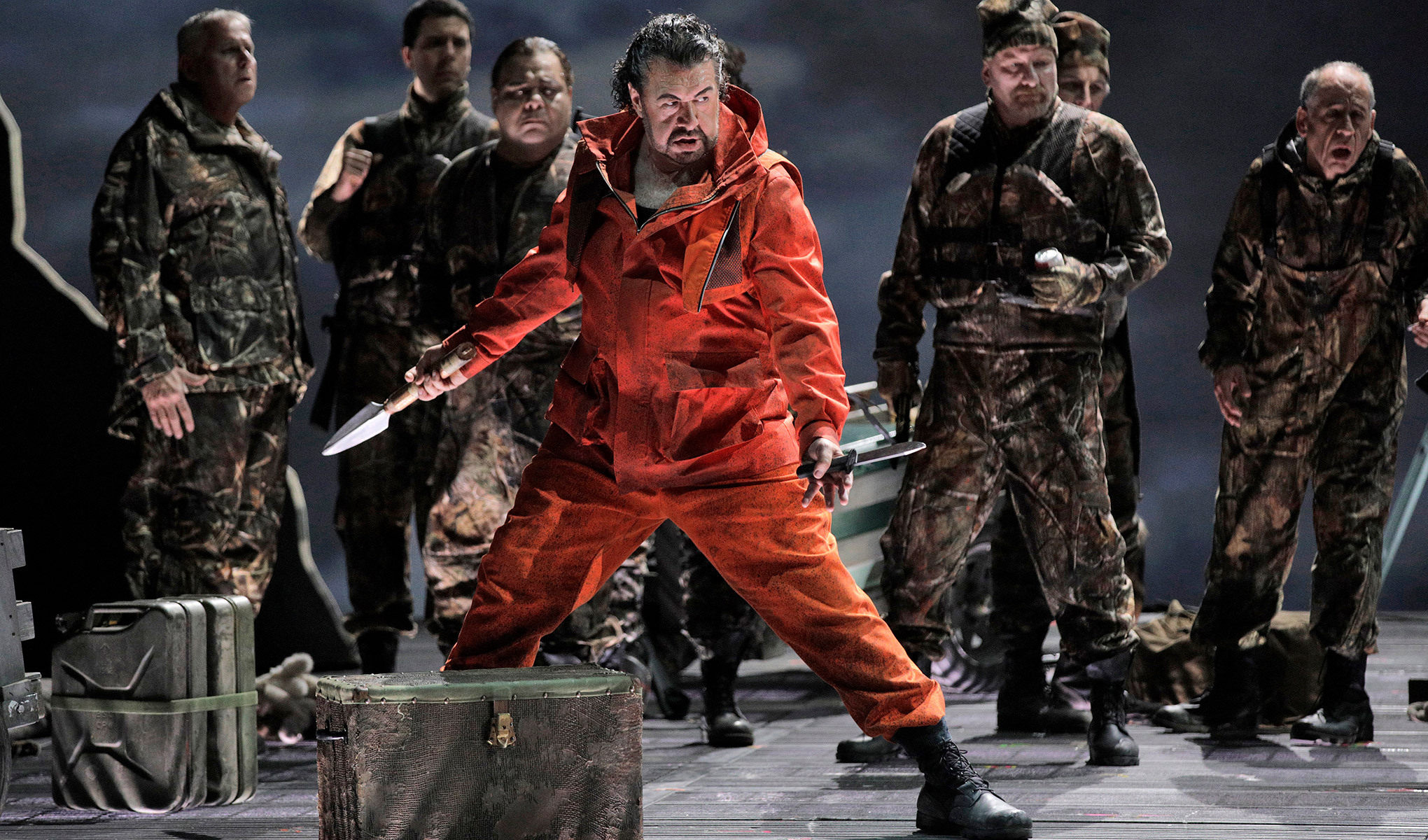
Richard Wagner's Der fliegende Holländer streamed from Bayreuth this summer on July 25.  It's regie, of course.  That means that the staging is modernized.  During the overture a mother hangs herself.  It's rather wildly realistic looking.  This doesn't seem to be the traditional plot about a sailor.  I'm here for Asmik Geigorian.

The sailors sit around drinking in a bar and never go to sea.  The girls don't spin, but instead practice the spinning chorus.  Senta smokes.  Erik comes in and chases the other girls away.  He warns Senta that her father wants to find her a husband.  Erik and Senta are exes and fight like it.  

Asmik is 40 but here passes for younger.  She is good looking, her voice is strong and her acting good.  The sound of her voice does not particularly appeal to me.  For me it is the feeling in the music.

Daland brings the Dutchman home and introduces him to his daughter as her bridegroom.  She swears to be faithful until death.  This takes place around the dining room table.  She gets excited over him for no apparent reason.  The ho hum everydayness of the staging takes all the fizz out of it.  Asmik tries to make up for it, but it's too much to ask.

In Act III everyone is outside eating and drinking except the sailors who sit glumly.  The townspeople ridicule them until the Dutchman takes out his gun and shoots a few.  Ugh.  Everyone but Senta runs off.  Erik complains to Senta who sits staring.  They sing about eternity on the sea, but there is no sea.  The Dutchman throws Senta on the floor.  Mom comes in and shoots him.  Senta laughs and tries to comfort her.  That's it.  I'll probably never watch this again.  The chorus is excellent.

Thursday, August 12, 2021

Tristan und Isolde from Munich 👍🏻


Conductor -  Kirill Petrenko 
Production - Krzysztof Warlikowski 

Tristan - Jonas Kaufmann 
Isolde - Anja Harteros 
King Mark - Mika Kares 
Kurwenal - Wolfgang Koch 
Brangäne - Okka von der Damerau

This is Wagner's Tristan und Isolde from the Bayerische Staatsoper.  It's a regie production, naturally.  Almost everything from there is.  I'm not sure it provides a context.  They all wear modern clothing, and we don't seem to be on a ship.

Act I.

Tristan has traveled to Ireland to bring back the future bride of King Mark of Cornwall.  He is there in his official capacity as representative of Cornwall.  Actually Tristan and Princess Isolde have an already existing relationship.  In a war between the two kingdoms, Tristan has killed Isolde's fiance and been seriously wounded in the process.  Isolde with the help of Brangäne nursed him back to health.  

On the journey she tries to order him around.  He remains distant and sends his assistant, Kurwenal.  This bit is not precisely clear.  Brangäne prepares a potion that Tristan and Isolde are to share.  Tristan drinks half, and then Isolde drinks the rest.  They seem to think it will kill them, but instead they fall hopelessly in love.  I thought the sudden falling in love was well handled.  We appear to be doing social distancing in this production.  No one touches in this part.

Act II

Isolde keeps turning the lights on and off.  I'm not sure what that's about.  I've never seen this character portrayed as perverse.  A feature of this production is that we see the characters live on the stage and projected on the wall in the form of a film at the same time.  Brangäne blames herself for administering the potion, but Isolde blames the Love Spirit who spreads love all around.  Isolde sees herself without love as destined for death.

I am an hour and a half in and did not ever before realize what a bear of a part Isolde is.  Other characters make brief appearances.  Finally Tristan enters and they talk about their time traveling to Cornwall.  She feels that she loved him then, but he was there in the role of foe.  Now they cannot simply forget that they love one another.  There is much discussion of which is better:  day or night?  Night is chosen.  Tristan wants to die.  The picture above comes from this section.

In the real world they sit in chairs and sing, but in the film behind they meet in the bedroom.  I don't know why I like this, but I do.

They sing for a long time about death, then suddenly they take needles from a bowl on the table and give themselves shots.  Death?  The bed in the background is suddenly surrounded by water.  Then people begin to enter.  They are discovered.  King Mark tells his story, that it was Tristan who thought he should marry.  Isolde is hearing this story for the first time.

This hardly seems like the same opera.  We want these two singers together in this opera because they are together emotionally.

Isolde says that she will follow Tristan to his home.  Melot, the betrayer, complains and the two men draw swords.  The bald person reappears.  Melot stabs Tristan.

Act III

Bald people in uniforms drinking coffee?  This part of the production I don't get.  Tristan sits with them and drinks coffee.  Next to him they look like children.  All but one appear to be puppets. A return to childhood?  An English horn plays on the stage.  

Kurvenal sings to the puppet Tristan while Jonas sings.  Then they exchange places. The puppet in the yellow blouse is Isolde herself.  I don't think I realized before how little time Tristan and Isolde spend on stage together.  I feel like I have never seen this opera before.  Opera's greatest singing actors have brought it to life as never before.  Absolutely stunning.

Old age advice.  Do not mourn that your love cannot be fulfilled.  Rejoice that passion can come to you.

Wednesday, July 28, 2021

Tannhäuser from Bayreuth 👍🏻


Conductor: Valery Gergiev 
Director: Tobias Kratzer

Tannhäuser: Stephen Gould
Landgraf Hermann: Stephen Milleing
Elisabeth: Lise Davidsen
Wolfram von Eschenbach: Markus Eiche
Walther von der Vogelweide: Daniel Behle
Venus:  Elena Zhidkova
Shepard:  Katharina Konradi

Tannhäuser from Bayreuth from 2019, which can be found in Opera on Video, is a confusing mix of images.  The first scene suggests that we add it to the caravan series, since we see Tannhäuser, Venus and her troop wandering around in an RV in the guise of a carnival.  Venus drives.  They live outside the law.  When the vehicle runs out of gas, they siphon some from a nearby vehicle.  They go through the Burger King drive through and steal their food.  This is not realistic since you always have to pay before they give you anything.  A policeman tries to stop them and Venus runs him down, making Tannhäuser uninterested in going on with her.

In the second scene the curtain opens on an exterior shot of the Bayreuther Festspielhaus.  He is met by a bunch of guys in black outfits drinking beer out of the bottle.  They recognize him in his clown outfit and welcome him back.  At the end of the scene Venus arrives in her RV.

Lise Davidsen is utterly magnificent.  I adore her "Dich teure Halle."  Our boy is back in normal clothes.  Or at least the clothes suitable for the singing contest that is to come.  People begin to enter.  Outside Venus and her gang are trying to get inside.  This must play like a film inside the hall.  Venus steals a suitable outfit from one of the dressing rooms and participates in the ceremony.  This whole thing is like a movie with cameras behind the scenes.  Is that the trend of the future?

The contestants sing about love back and forth until Tannhäuser tells the crowd that he has been in Venusberg.  The women in the crowd all escape except for Elisabeth, Venus removes her disguise, and her group all appear together with Tannhäuser.  Elisabeth prevents the men from killing him, and he thanks her.  The scene is strange.  While Tannhäuser thanks Elisabeth, he is also happy to see Venus.  Someone calls the police.  The Landgraf curses Tannhäuser for admitting he was with Venus.

I am enjoying the idea that the teure Halle is the Festspieshaus itself.  A song contest with pieces that are more like songs would have been nice.  The story is concerned with salvation, and the music is a bit droning.   Tannhäuser chooses to go to Rome with the pilgrims and the giant black man in drag drapes a rainbow flag over the harp that accompanied the singers.

This is almost the Tannhäuser as comedy version. Frei im Wollen! Frei im Thun! Frei im Geniessen!  R.W. [Free in the wanting! Free in the doing! Free to enjoy!]  This seems to be the opposing of two life views that make up the struggle of modern life:  The path of individual freedom represented by Venus and the path of adhering to social norms represented by Elisabeth.  The sign outside the Festspielhaus seems to place Wagner on the side of freedom.  Our hero vacillates back and forth between them.  One gives him a life of earthly pleasure and the other brings salvation to his soul.  He seems to want both.

It ends horribly.  In the libretto first Elisabeth dies, and then he sees her body borne past him, and Tannhäuser dies.  In this version Tannhäuser goes off with Venus, Wolfram sees his opportunity and dresses up in Tannhäuser's clown outfit so Elisabeth will think he is the man she loves.  He seduces her in this disguise, and later we see her covered in blood.  She seems to have killed herself.  This is truly hideous.  

_____________________________________________

 P.S

I watched the film of Tannhäuser from Bayreuth in 2019 again because it is now playing again in Bayreuth in 2021 and I cannot go. Ekaterina Gubanova is Venus in the current version, and this may be an improvement.  I had already seen all the shocking parts, and was content to watch the whole opera.

I noticed the part where it is indeed Katarina Wagner who calls the cops, as a joke, I assume.  I saw that Wolfram puts on Heinrich's clown outfit, but isn't actually trying to fool Elisabeth.  She laughs and draws him into the van.  That puts a completely different spin on it.  It's too bad she doesn't love Wolfram who is quite charming.

The more I see and hear of Lise Davidsen, the more I admire, enjoy, respect and indeed love her.  She is very well suited to this role.  I am a long distance from having too much of her.  Es lebe die Lise.


Tuesday, May 11, 2021

Lise Davidsen at la Scala


Lise Davidsen successfully made her La Scala debut last night in a concert with her as the featured soloist.  These days Lise starts everything at the top.  The above film shows the orchestra on the floor with the audience in the boxes above. Riccardo Chailly conducted.  I remember him primarily as the conductor of Cecilia Bartoli's La Cenerentola recording.

Program

Giuseppe Verdi

From Macbeth  "Patria oppressa"  [chorus]

Henry Purcell

From Dido and Aeneas  "When I am laid in earth" with Lise 


Richard Wagner From Die Meistersinger von Nürnberg  Vorspiel (Prelude)
Richard Strauss From Ariadne auf Naxos  "Es gibt ein Reich, wo alles rein ist" with Lise
Giuseppe Verdi

 From La forza del destino Sinfonia

"Pace, pace mio Dio"  with Lise

Richard Wagner

From Tannhäuser Ouvertüre
"Dich, Teure halle"  with Lise

Giuseppe Verdi From Nabucco  "Va’, pensiero" [chorus] 

Only "When I am laid in earth" was something I had not heard Lise sing before.  It was good but unspectacular compared to the other things.  She wore black in the first half and looked radiant.  These songs are basically all tragic, so black was ok.  For the second half she wore a beautiful pastel outfit which brightened the mood.  Her hair is enhanced with an extension down to her waist. 

The two pieces in German are Lise's signature pieces, both of which I love dearly in her voice.  The most spectacularly sung of all was the Verdi "Pace, pace mio Dio".  It would not do for her to omit the Italian language.  All of her languages were beautiful.

I was intrigued by the interplay between Chailly and Davidsen.  He seemed to be looking to her for expressive cues.  This is something singers long for.  I felt it allowed Lise to feel secure and give her utmost.  As a result she made the greatest impression in the great Italian aria "Pace, pace mio Dio."  They were a magical pair.  This is La Scala after all.

I found this to be one of the most intense and spectacular vocal concerts I've ever seen.  The audience stood up a lot.  It's out there.

Thursday, April 22, 2021

Lise -- Vocal Arts DC 👍🏻


March 19, 2021?  This picture is of the people performing, Lise Davidsen and James Baillieu, but the venue shown is wrong.  This recital is in London on a different date.  I am discussing the Lieder recital streamed from London to Washington, DC.

I feel a certain musical kinship to Lise, not for her glorious Wagner and Strauss operatic triumphs, but more for her Bach, Brahms, Schumann and Strauss Lieder.  When I started at IU, I told the professors that I had performed the alto solos for all the major works of Bach.  They responded, "No you haven't."  So I said,  "Matthew Passion, B minor mass, Magnificat, St John Passion, Christmas Oratorio.  What does that leave?"  I love it that Lise has sung some of the same music.   I once did a whole recital of Lieder by Brahms so it is nice to see a couple of them here.

"Auf dem Kirchhofe" Op.105 No. 4    Johannes Brahms
"Da unten im Tale"  WoO. 33 No. 6
"Mädchenlied"  Op. 107 No. 5
"Liebestreu" Op. 3 No.1
"Von ewiger Liebe" Op. 43 No. 1

Gedichte der Königin Maria Stuart     Robert Schumann

Abschied von Frankreich
Nach der Geburt ihres Sohnes
An die Königin Elisabeth
Abschied von der Welt
Gebet

Luonnotar  Op. 70                             Jan Sibelius  She tells us this is a tone poem.

Five Songs  Op. 37                          Jan Sibelius

Three Songs from Six Songs  Op. 48                   Edvard Grieg

From Acht Gedichte aus "Letzte Blaetter"  Op. 10        Richard Strauss
Zueignung
Allerseelen
Die Georgine  "ob spät, ob früh, es ist deselbe"  [Early or late it is the same.]  She has come to me late in my life,  It is a wonderful gift.
 
"Wiegenlied"      Richard Strauss  I have grown to love this in Lise's version.

"Malven"      Richard Strauss
 
"Befreit"      Richard Strauss
 
"Caecilie"      Richard Strauss     This makes a great ending.

This is an entirely different style of singing than the Wagner and Strauss operas she is rapidly becoming famous for.  It is true Lieder singing.  I'm pretty sure the only two languages are German and Finnish.  The film includes the original text with an English translation below it.

Between each group she talks to us, generally about the songs and about how much she is missing the audience.  She would like to say hello to each of us.  I can only hope that this will happen.  I wish her a wonderful career and a life of happiness.  I've never been famous, but I've had fun.

If you want a disinterested review of Lise Davidsen, you will have to look elsewhere.  I find that I love it because she does.  In the not too distant future there should be a Grieg song album.

Saturday, April 17, 2021

Cherubini's Medea Audio


Stephen Barlow, conductor

Medea – Lise Davidsen
Giasone – Sergey Romanovsky
Glauce – Ruth Iniesta
Neris – Raffaella Lupinacci
Creonte – Adam Lau

This is an audio recording from the 2017 Wexford Festival of Luigi Cherubini's opera Medea, 1797. I haven't been able to locate a video.  I am here for Lise Davidsen, of course.  There will be no confusion about when Lise is singing.  

Cherubini was born only 4 years after Mozart and lived well after Beethoven.  Listening to this one has to wonder why one never hears his music.  There needs to be someone to sing the leading role which has a certain weight.  The opera is performed here in Italian and sung throughout.  Originally it was an opera comique in French with spoken dialog.  In the 21st century there is generally a return to French, but not here.  It's rather like Beethoven's early period without the melodrama.

Giasone (Jason) is marrying Glauce and Medea is not happy about it.  She shows up to prevent the marriage and failing that to destroy everyone.  The aria from Lise Davidsen's recent album is in the first act. It sounds wonderful here, too.  Medea pretends to give the fiance a gift, but it is poisoned.  I prefer to see operas.  In this one you need at least to see the children to get the idea.

What a wonder she is.  She roars like a lion  One can only adore.

Sunday, March 28, 2021

San Francisco Ring -- Götterdämmerung


Conductor - Donald Runnicles 
Director - Francesca Zambello 

Brünnhilde - Iréne Theorin 
Siegfried - Daniel Brenna 
King Gunther - Brian Mulligan 
Hagen, Alberich's son - Andrea Silvestrelli 
Gutrune, sister of Gunther - Melissa Citro 
Waltraute - Jamie Barton 
Alberich - Falk Struckmann 

Götterdämmerung completes the Richard Wagner Ring cycle.  This is my first time for this production.

Act I

The balance between the orchestra and the three Norns is terrible. Why is this always such a problem?  Why don't properly placed microphones solve this?  Instead of threads, these strands of fate are fat electrical cables, and when one breaks, the Norms die.

We see Siegfried and Brünnhilde after their night together still blissfully in love.  He gives her the ring and goes off to explore.  The Rhein valley looks like a refinery.  

Siegfried ends up at the posh home of Gunther, Hagen and Gutrune.  He has taken the tarnhelm with him and tells them where he got it.  He drinks a potion, falls immediately for Gutrune and forgets all about Brünnhilde.  

Now we are back with Brünnhilde where she waits for Siegfried.  Her sister Waltraute arrives.  I like very much Iréne Theorin.  I remember that she was an emergency replacement.  I'm not sure I think Jamie Barton is a Wagnerian.  Waltraute tells Brünnhilde about how much Wotan has changed.  

After Waltraute leaves, Siegfried returns with the tarnhelm on his head.  The other three parts of the San Francisco Ring had subtitles, but this one does not.  It's hard.  He takes the ring from Brünnhilde and leads her off.

Act II

Alberich shows up to lecture his son Hagen.  If the ring is so powerful, why doesn't it work for anyone but Alberich?  I have always wondered about this.  I'm trying to make it all the way to the end, but it's pretty rough going.  Gunther drags Brünnhilde onto the stage in front of a crowd of his subjects.  Siegfried has eyes only for Gutrune, and she for him.  Siegfried swears he doesn't know Brünnhilde, and she swears things, too, only hers are true and his are not.  I enjoy very much how Theorin enthusiastically jumps about in her role.

Act III

All the fun parts of this opera are in this act.  The Rhein maidens are back, and they are covered in plastic bags full of garbage.  Siegfried enters and I'm booing. He's carrying a military style rifle which the maidens take from him.  Perhaps none of them can rule the world with the ring because they haven't renounced love.  It's harder than you think. The bad acoustics at the San Francisco Opera House are all too apparent in this recording.  They give him back his gun and he goes off.

One both hates and loves Daniel Brenna's Siegfried.  One loves the singer and hates the character.  One is no longer charmed by his egotism.  I'm shouting at the screen "You f**d up buddy."  Hagen, Gunther and Siegfried are together.  Hagen gives Siegfried a potion to reverse the other one, and he tells the story of Brünnhilde in the ring of fire.  That means he lied when he swore he didn't know her.  So Hagen kills him.  The big discovery of this Ring cycle was Andrea Silvestrelli as Hagen.  Magnificent.

For the ending we return to Gutrune with Siegfried's body.  When Hagen tries to steal the ring from Siegfried's dead hand, S raises it in the air and Brünnhilde appears.  It works out as it should.  My favorite thing is Brünnhilde gets to be Brünnhilde again.  Big finish.  I'm crying.  The sheet of gold is back where it belongs.  It's all about women now.  A great ending.

We loved Donald Runnicles, and it's great to see him again.

Friday, March 26, 2021

Lise Davidsen from Trondheim in Norway


Lise gave a concert today from Trondheim with James Gaffigan who is their regular guest conductor.  The program alternated instrumental numbers and vocal numbers.  On Monday Lise gave an all Grieg recital with 100 in the audience. The Norwegian government reimposed the lockdown just before this concert.  There are more than no people here but maybe 10?  We don't get to see them.

Verdi                    Overture from the Sicilian Vespers

Verdi                   "Ma dall 'arido stelo divulsa" from Ballo in Maschera                          

Verdi                     Dance from Act III Macbeth  

Verdi                    "Tu che la vanita" from Don Carlo

Intermission

Beethoven             Leonore Overture #3

Beethoven            "Abscheulicher" from Fidelio

Wagner                 Forrest Murmers from Siegfried

Wagner                 "Dich teure Halle" from Tannhaeuser


It was nice to see so many young women in the orchestra in Trondheim.  Lise stays in the wings until just before she sings as though perhaps this were an opera. Each of her numbers is introduced by an instrumental piece by the same composer.  So we are hearing instrumental pieces by Verdi.  For the second Verdi she comes out in the break which is what is expected.  I have heard her sing the Verdi Requiem from a few years ago, but this is the most Verdi opera I have heard.  I think she will work her way into the Verdi heroines, and perhaps Don Carlo would make a good start.

The Beethoven and Wagner I have heard before, of course, but they are wonderful again.  This concert is all Lise sings big, which is what she is famous for.  I find her very exciting.

After the end of the concert, Decca released the new recording which can be found on lisedavidsen.com.  Only the third aria from the Thursday concert is from the new recording.  She is very wonderful and has a style uniquely her own.  Future things include a recording of Fidelio and a whole Grieg album.  Forgive me if I can't act like this glorious soprano is all new to me. James Gaffigan recommends being in the room with her.  I'm working on it.

James Gaffigan is very lively and entertaining in addition to being a good conductor.  I enjoyed him.


Saturday, March 20, 2021

San Francisco Ring -- Siegfried


Conductor: Donald Runnicles 
Director: Francesca Zambello 

Mime: David Cangelosi 
Siegfried: Daniel Brenna *
The Wanderer (Wotan): Greer Grimsley 
Alberich: Falk Struckmann 
Fafner: Raymond Aceto 
Forest Bird: Stacey Tappan 
Erda: Ronnita Miller 
Brünnhilde: Iréne Theorin 

I am enjoying that at the beginning of Siegfried Mime is banging in the rhythm of the score.  We are up to the part of the San Francisco Ring that I have not seen before.  The last time I simply was too tired to do four long operas in a row.  This is part of the caravan series.  Mime and Siegfried live in a busted up caravan.  We actually get a bear--not an actual bear.  

Wotan comes in to check on Siegfried.  I actually love Greer's harsh, growly voice as Wotan.  Mime and the The Wanderer are exchanging riddles and Mime recognizes that this is Wotan.  He is too dumb to figure out who it is who has never known fear.  We figure this out easily.  How about someone who brings a live bear home with him?  The reforging of the sword is very convincing.  In retrospect I suspect that Mime is pretending not to know.

This scene with Alberich and The Wanderer is reminding my of my rule of 3 baritones.  "Never go to an opera with three baritones."  This is a hell of a lot of snarling and growling.  Wotan by himself is fine.  Wotan wanders from place to place seemingly to provide Wagner with someone to explain what is going on.  I insist on my no explaining/all showing philosophy.  These operas are so long because someone is always explaining something.

The character of Siegfried in the person of Daniel Brenna is enjoyable.  The production seems to work in spite of the fact that the dragon is a machine.  Theoretically the machine should disappear when Siegfried takes the Tarnhelm from Fafner.

I like more and more the Wotan of Greer Grimsley.  However, he summons Erda and then doesn't really ask her anything.  He predicts the end of the gods, including her.  Then when Siegfried breaks Wotan's spear with Notung, all truly is over.

This is very cool.  "Mother, behold your fearless child."  He's terrified of a sleeping woman.  Herr Wagner, at last you have done it.  He kisses her awake like sleeping beauty.  We waited a very long time, but this is the best thing ever.  He thanks his mother for giving him life.  If it only ended here!


Monday, February 22, 2021

Starry Heavens Concert

Selfie

All the music on this concert is by Ludwig van Beethoven.

Programm

Ludwig van Beethoven
Irish Songs

 Baritone Edwin Crossley-Mercer and piano trio.

1. Since grey beards inform us (WoO153, Nr. 4)
2. The Pulse of an Irishman (WoO154, Nr. 4

Ludwig van Beethoven
Schottische Lieder op. 108

 Baritone Edwin Crossley-Mercer and piano trio.

1. The Shepherd’s Song
2. O sweet were the hours
3. Come fill, fill, my good fellow
4. O Mary, at thy window be
5. Faithfu’ Johnie
6. Sunset
7. Bonny Laddie, Highland Laddie

Ludwig van Beethoven
Sechs Lieder von Gellert, op. 48

Soprano Lise Davidsen with Sophie Raynaud on piano.

1. Bitten
2. Die Liebe des Nächsten
3. Vom Tode
4. Die Ehre Gottes aus der Natur  "The heavens declare the glory of Gott"
5. Gottes Macht und Vorsehung
6. Bußlied

Ludwig van Beethoven
Heiligenstädter Testament (Brief des Komponisten Ludwig van Beethoven an seine Brüder Kaspar Karl und Johann von 1802) 

Nikolaus Bachler, reader.  There is no music.

Ludwig van Beethoven
Streichquartett a-Moll, op. 132, 3. Satz
Canzona di ringraziamento. Molto adagio 

Musicians from the orchestra of the Bayerische Staatsoper

One knows from hanging around in libraries that these songs exist.  They're in the complete works, after all.  But one never hears them performed.  Schubert seems to have kicked other people's songs out of the way.   The Scottish songs are in Scottish dialect, and Lise sings only in German.  She hits just the right religious note.  I wish I was seeing more of her.  I noticed that both singers rushed on to the next song with no pause between.  Just because songs appear together on the same opus doesn't mean it is all one piece.  It was possible to tell how many songs had been sung only by looking at the program.  A small separation would have worked better for me.  One wishes to characterize each song individually.

For the speaking there are no titles.  Nikolaus Bachlere has a lot of confidence in his diction. 

This virtual concert comes with a sound machine in case you were missing the normal noises of a concert.  It includes booing.


Tuesday, February 09, 2021

Royal Opera Fidelio revisited

There is an audio copy floating around the internet from a radio broadcast from the Royal Opera of the Fidelio from last summer that includes Jonas Kaufmann.  He became ill before the broadcast into movie theaters, but this is an earlier performance.  So we have Lise Davidsen, Jonas Kaufmann and Tony Pappano together.  Look on rai?  I'm told it has been taken down.  This is the one.  We can only hope we will get other opportunities to see them together.  Two of my opera loves on the same stage might be too much for me.  O Gott, welch ein Augenblick.

My first take is here.  I love this opera as no other and can't really explain why.  Pappano understands.  All it misses is Jonas.  Lise goes back into women's clothes, but looks nothing like she did at the beginning.  She is wonderful in this role, and I hope to see her in it again.

Brahms Requiem from Zurich

Today I am listening to Ein Deutsches Requiem by Johannes Brahms from Zurich.  Lydia Teuscher, soprano, and Konstantin Shushakov, baritone, are the soloists and Gianandrea Noseda conducts.

The orchestra sits on the stage in much the same arrangement as always.  The chorus is distributed around the house.  The audio is ghastly.  I was once in the greatest ever performance of this work with the San Francisco Symphony with Robert Shaw conducting and Kathleen Battle singing, so I am unimpressed.  That's the worst part of getting most of ones music from the internet--the audio seems to be consistently bad.  Professional recordings do a much better job.

Saturday, February 06, 2021

Netrebko Recital

Day:

The Program 

“Lilacs,” Op. 21, No. 5 By Sergei Rachmaninoff 

“Before my window,” Op. 26, No. 10 By Sergei Rachmaninoff 

“How fair this spot,” Op. 21, No. 7 By Sergei Rachmaninoff 

“The lark’s song rings more clearly,” Op. 43, No. 1 By Nikolai Rimsky-Korsakov 

“Morgen!” Op. 27, No. 4 By Richard Strauss 

“Il pleure dans mon cœur” By Claude Debussy 

“Depuis le jour” From G. Charpentier’s Louise 

“It was in the early spring,” Op. 38, No. 2 By Pyotr Ilyich Tchaikovsky 

“Tell me, in the shade of the branches,” Op. 57, No. 1 By Pyotr Ilyich Tchaikovsky 

“Mattinata” By Ruggero Leoncavallo 

Night:

“Uzh vecher … Oblakov pomerknuli kraya” From Tchaikovsky’s The Queen of Spades  (duet with Elena Maximova)  [Once upon a time I was the alto in this duet.]

“The clouds begin to scatter,” Op. 42, No. 3 By Nikolai Rimsky-Korsakov 

“Nights of Delirium,” Op. 60, No. 6 By Pyotr Ilyich Tchaikovsky 

“Die Nacht,” Op. 10, No. 3 By Richard Strauss 

“Ständchen,” Op. 17, No. 2 By Richard Strauss 

“Songs my mother taught me” from Gypsy Songs By Antonín Dvořák 

“The Dream,” Op. 8, No. 5 By Sergei Rachmaninoff 

“Belle nuit, ô nuit d’amour” (Barcarolle) From Offenbach’s Les Contes d’Hoffmann (duet with Elena Maximova)

“Amidst the day,” Op. 47, No. 6 By Pyotr Ilyich Tchaikovsky

Languages:  Russian, French, Italian, German, Czech

This is Anna Netrebko's Met recital from Vienna.  They talk a lot about her career at the Met, but my first time with Anna was at the San Francisco Opera in Glinka's Ruslan and Lyudmila in 1995.  This was during the reign of Lotfi Mansouri who brought the production, conductor and cast from Russia for us.  Of course, Anna was the person we noticed most.  We've all been fans ever since.  

She is accompanied by pianist Pavel Nebolsin and is joined in 2 duets with Elena Maximova.  This was hosted by Christine Goerke.

Anna performed this recital as only Anna would.  It was a lot of fun seeing her stroll around and dramatize each song.  The Russian songs are her specialty.  I am a long time fan and look forward to future performances.  It is good to remember that Anna had covid last year.


Friday, January 29, 2021

Fidelio from Birmingham

                                                     Marzelline - Leonore

ConductorWilliam Lacey
DirectorGraham Vick

FlorestanRonald Samm
Leonore Jane Leslie MacKenzie
Rocco Jonathan Best
Marzelline Donna Bateman
Jaquino John Upperton
Don Pizarro Keel Watson
Don Fernando Michael Druiett


This version of Beethoven's Fidelio from Birmingham, England, 2002, by way of Operavision, is sung in English in modern dress.  The performance is inside a large tent with the audience and performers all packed into the same space.  A row of washing machines lines one side.  The translation is excellent.  This is fun for some unknown reason.  They haven't fractured it as is sometimes the case.  The main difference is that between scenes there is rioting with a lot of anarchist shouting.  These are the political fights of today.  

I love this opera as I do not love other operas.  Here there is goodness and love.  In this production all is serious.  Rocco is never a clown.  We see the truth of the story even though it is very chaotic.  Only the camera brings sense and organization.  I love Leonore who risks everything for love.  One can't help wondering what it would be like to experience all this chaos and intensity live and in person.  I know what's going on, so I don't become confused by the at times overwhelming intensity.

For the second half many of the audience members stand on numbered spots and when told, put bags over their heads.  I have never experienced anything like this and think it would be amazing.

I like this tenor who does an excellent reading of Florestan's aria.  Much of the credit for the excitement in this performance must go to the young conductor William Lacey.  In the middle of the act, after Florestan and Leonore have sung of their nameless joy, comes a long instrumental part which must be one of the Leonore overtures.  It is staged with people coming out of their cells in the ground.

I've never seen anything like it, but I wouldn't have missed it.  Thank you, Graham Vick, and thank you Beethoven.


Saturday, January 23, 2021

Samson et Dalila


Conductor - Patrick Summers 
Production - Nicolas Joël 

Samson - Clifton Forbis
Abimélech - Eric Jordan
The High Priest of Dagon - Juha Uusitalo
A Philistine Messenger - Noah Stewart
An Old Hebrew - Oren Gradus 
Dalila - Olga Borodina

This performance of Camille Saint-Saëns' Samson et Dalila, 1877, comes from the San Francisco Opera in 2007.  I saw Olga sing this opera three times around that time.  Read about it here.

I love Olga's voice for this.  For me she has the perfect sound.  And all the good stuff in this opera is written for her.  For her type of heavy mezzo this is the peak experience.  I don't mind Elina in the role, but true love is only for Olga.  The second verse of "Mon coeur" is a duet.  For some reason I didn't remember this.  I think it's better without the tenor.

I enjoy the other singers in this production.  This is old fashioned, lush late romantic, in singing, in conducting, and in visual tone.   It is well worth a visit.