Showing posts with label Laurent Pelly. Show all posts

Saturday, October 26, 2019

Manon with Lisette Oropesa

👍🏻
Conductor...............Maurizio Benini
Production..............Laurent Pelly

Manon...................Lisette Oropesa
Des Grieux..............Michael Fabiano
Lescaut.................Artur Rucinski
Count des Grieux...Kwangchul Youn
Guillot.................Carlo Bosi
Brétigny................Brett Polegato
Poussette...............Jacqueline Echols
Javotte.................Laura Krumm
Rosette.................Maya Lahyani

Nadine Sierra.....hostess

I love knowing things.  I can't help it.  In this performance of Massenet's Manon from the Metropolitan Opera in HD I noticed for the first time that there was quite a bit of melodrama.  This does not mean corny, overacted soap operas, but instead refers to spoken dialog with orchestral accompaniment instead of recitative or spoken dialog.  Since the orchestra never stops playing, it is easy to overlook that occasionally the actors are speaking.  Then I read that Manon was a mainstay of the Opéra-Comique in Paris after it premiered in 1884.  The original novel is from 1731.  The only problem with the opera is that it is too long.

I didn't realize it has been already 7 years since this production debuted.   The basketball is still there, but there have been hints that it is supposed to be a hot air balloon.  Hot air balloons are not precisely spherical.  Enough.  Please read the other review for more discussion of the production.

I have only seen Artur Rucinski before in Lucia with Lisette from Madrid.  He is very attractive on camera and sings beautifully.

But the performance belonged to Manon and her Des Grieux who received much loud shouting in their bows.  This is a great opera for Michael Fabiano, suiting both his voice and his personality to a T.  You believe in his love.  He made the initial pickup very believable.  More Michael please.

Lisette Oropesa precisely embodies the 15 year old innocent who arrives on the train on her way to the convent.  It is impossible to picture this lively, passionate and curious girl cut off completely from life.  Des Grieux has only good intentions toward her and she towards him.  When she learns that Des Grieux's father intends to kidnap him, she knows she must make other plans.  Lisette is physically trained and fully capable of the physical requirements of the staging.  She ran up and down stairs, fell down and was dragged about, all while singing strongly.

I don't see the diabolical Manon, the evil Manon.  I see only someone who wants to enjoy her life, to have fun while she is still young.  Everyone seems to work against this.  Lisette Oropesa changes as the opera progresses to acquire less innocence and more sophistication.  This is an opera for our time, because she is destroyed by a rich old man.  Her cheers were well deserved.

I still don't see the bed in the sanctuary.  This is bogus.

Saturday, March 02, 2019

La Fille du Regiment

👍🏻
Conductor..................Enrique Mazzola
Production.................Laurent Pelly

Marie......................Pretty Yende
Tonio......................Javier Camarena
Marquise of Berkenfield....Stephanie Blythe
Sergeant Sulpice...........Maurizio Muraro
Hortentius.................Paul Corona
Duchesse of Krakentorp.....Kathleen Turner

Today's HD from the Met is Donizetti's La Fille du Regiment, a revival of the Laurent Pelly production.  I didn't think this was possible, but it was even more fun than with Natalie Dessay.

Tonio is a Tyrolean, and Marie is a found child raised by a regiment of the French army invading Tyrol.  Marie does laundry and peels potatoes.  She also wanders off into a neighboring village where she meets Tonio.  Pretty Yende does the best job ever of seeming to be a young woman raised by a troop of soldiers.  She swears, though I noticed they didn't translate this.

This was also an historic occasion:  we had the first bis (encore) in any HD performance.   Of course this was for Javier Camarena's performance of "Ah mes amis" with the famous 9 high Cs.  So with a bis that makes 18 high Cs.  Dare we say it?  He is the new king of the high Cs.

This is such a marvelous cast with gorgeous singing and lively acting that swept us along.  We laughed and cried and rejoiced when aunt/mother allows Marie and Tonio to wed.  Wonderful.

I missed the sprouted potato found with Marie's souvenirs in previous performances.

Saturday, April 28, 2018

Cendrillon in HD

A carriage in the form of the French word for carriage.
👍🏻
Conductor...............Bertrand de Billy
Production..............Laurent Pelly

Cendrillon (Lucette)....Joyce DiDonato
Prince Charming.........Alice Coote
Fairy Godmother.........Kathleen Kim
Pandolfe................Laurent Naouri
Madame de la Haltière...Stephanie Blythe

Today we were treated to the first production of Massenet's Cendrillon ever to appear on the stage of the Metropolitan Opera.  We begin with a French conductor, a French production and a Frenchman to speak the only spoken dialog heard in the opera.  The rest of the cast is not French but is nevertheless spectacular.

The story divides into three contexts:  1. The home of Pandolfe, his wife Madame de la Haltière, his daughter Lucette and his two stepdaughters.  2.  The palace of the King and his son Prince Charming.  3.  A dream-like fairy land populated by the Fairy Godmother and her minions.

Thursday, September 29, 2016

Don Pasquale

Dr. Malatesta, Norina, Don Pasquale, Ernesto

Conductor: Giuseppe Finzi
Director: Laurent Pelly

Don Pasquale: Maurizio Muraro
Norina: Heidi Stober
Ernesto: Lawrence Brownlee*
Dr. Malatesta:  Lucas Meachem

I knew there was something that looked familiar about this production of Donizetti's Don Pasquale.  It is shared with the Santa Fe Opera.  In Santa Fe there are no overhead flies and things often slide out from the sides.  Well that's what this does.  The colors are drab in the extreme and only brighten up later through the introduction of colored chairs and flowers.  I thought it was functional but drab.  Drab in a comedy doesn't make much sense to me.  Laurent Pelly retained his credit but did not come out to bow.  I suspect this is not actually his production.


The highlight of this performance was the company debut of Lawrence Brownlee as Ernesto.  He had the most slapstick comedy and performed it expertly.  Besides being a fabulous singer.  We loved him.  He was well matched to Heidi Stober, by now a company favorite.  Larry, please come back.

It was in fact a fabulous cast.  Everyone met and exceeded expectations.  This is my list of where I have seen these people.

  • Maurizio Muraro SFO live (Don Pasquale, Barber of Seville) London (Manon Lescaut, I due Foscari) Met (Cosi fan tutte)
  • Heidi Stober SFO live (Don Pasquale, Show Boat, Xerxes, Falstaff, Un Ballo in Maschera, Sweeney Todd) at Santa Fe live (Platée, Arabella, La Boheme) Berlin live (vocal recital)
  • Lawrence Brownlee* SFO live (Don Pasquale)  Met (La Cenerentola, Armida, Barber of Seville)
  • Lucas Meachem  SFO live (Die Tote Stadt, Le Nozze di Figaro, Don Pasquale, I Pagliacci, Barber of Seville) Santa Fe live (Don Giovanni)
For me the fabulous singing actors saved this.  But then don't they always?  The intermission was extended by about 20 minutes without explanation.

Footnote:  the program cover showed a picture of Gina Lollobrigida.

Tuesday, August 09, 2016

Béatrice et Bénédict

👍🏻
Conductor: Antonello Manacorda*
Director: Laurent Pelly

Béatrice, niece of Léonato: Stéphanie d’Oustrac (soprano)
Bénédict, Sicilian officer: Paul Appleby (tenor)
Héro, daughter of Léonato: Sophie Karthäuser (soprano)
Claudio, general's aide-de-camp: Philippe Sly (baritone)
Somarone, a music master: Lionel Lhote (bass)
Don Pedro, Sicilian general: Frédéric Caton (bass)
Ursule: Katarina Bradić (contralto)
Léonato, Governor of Messina: ? (spoken)

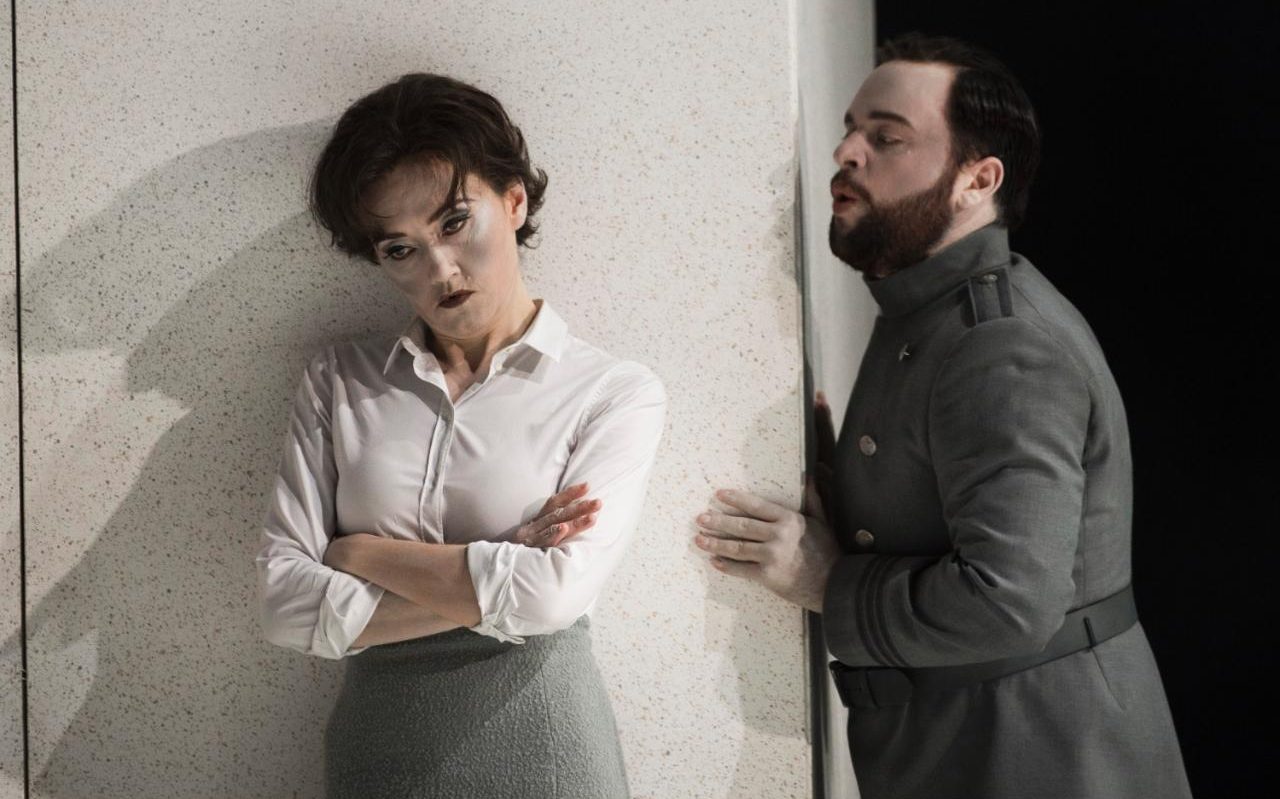
This is utterly charming.  I am speaking of Hector Berlioz' Béatrice et Bénédict from Glyndebourne.  It is based on Shakespeare's Much Ado About Nothing and has a libretto by Berlioz.  Beatrice has fallen victim to love, and she is pissed.

It's staged like a movie in black and white with the set pieces mostly made up of gray boxes.  Symbolism.  You knew that.  Beatrice does not wish to be in a box.  At the end she appears with her Benedict in one of the boxes and declares that tomorrow they will be enemies again.

It is an opera comique that is nothing like an Italian opera buffa.  Frantic tempos are replaced by sweet melodies.  Spoken French dialog replaces recitative.  There is a buffo bass (Somarone) and a lovely, marvelously comic couple that find each other at the end.

I have long loved Berlioz, read The Aeneid because I knew he loved it.  You can feel throughout this excellent opera with duets and trios of female voices, comic choruses and a comic tenor and soprano, how very much he loved Shakespeare.

Philippe Sly looked like the man on the wedding cake when he marries Hero, but it seems he was hired for his beauty and his excellent French because he hardly sings at all.

:-)
#ad

Saturday, December 27, 2014

Hänsel und Gretel


Conductor:  Kazushi Ono
Production: Laurent Pelly
 
The Witch (Rosina Loechermaul): Wolfgang Ablinger-Sperrhacke
The Sandman: Amy Freston
The Dew Fairy: Malin Christensson
Mother: Irmgard Vilsmaier
Father: Klaus Kuttler
Hänsel: Jennifer Holloway
Gretel: Adriana Kučerová

I'm watching Humperdinck's Hänsel und Gretel from Glyndebourne.  It is a work that lies deep in memory.

These are modern children who live in a cardboard box which is delivered to the stage door. The credits run while each actor is introduced with his turn at holding the box.  One throws it out the window.  Hansel and Gretel fight over it.

When the angels appear, they wait for the children to sleep.  Their angels are wonderful children of their own age, just as one would wish.  I am immensely grateful that it is done in German. One of the beauties of this opera is its wonderful libretto which is filled with made up beautiful and astounding words. You can't actually hear that when they shout into the wings "Wer da? [Who is there?]" that the answer is "Erda."

Once the love comes into your heart, it never completely leaves you.  One's childhood should be spent in the company of great music, for wherever you go or whatever life may bring you, it will never leave you. Ich sehe jetzt keine Lebkuchenkinder. When the cookie children all appear, they are wearing fat suits.


This guy is one ugly witch. There's no cookie witch at the end, which is disappointing. After all, they say, "Look how the Knusper witch has now herself turned into a cookie."

The treatment of the orchestra is quite wonderful, very romantic and beautiful.  This is fun.

Monday, June 24, 2013

Poor Hoffmann


Conductor; Patrick Fournillier
Director & Costume Designer; Laurent Pelly

Hoffmann Matthew Polenzani
The Muse/Nicklausse Angela Brower
Lindorf Christian Van Horn
Luther Hadleigh Adams
Olympia Hye Jung Lee
Antonia Natalie Dessay
Crespel James Creswell
Dr. Miracle Christian Van Horn
Voice of Antonia's Mother Margaret Mezzacappa
Giulietta Irene Roberts
Schlemil Hadleigh Adams
Dapertutto Christian Van Horn
Stella Jacqueline Piccolino

Poor Hoffmann, our hero in Jacques Offenbach's Les Contes d'Hoffmann currently in rotation at the San Francisco Opera.  He has this muse/tormentor who follows him around and messes up all his relationships with women.  On the way he kills a couple of people and loses his reflection.  I would think that not having a reflection would make shaving difficult.  It's still an incredibly fun opera.

I don't know what to think of the staging.  All that black and gray is pretty depressing.  In the Venetian scene we were relieved to see some green on the stage.  However, I felt that this constantly moving and changing set, literally constantly moving in parts of the Giulietta scene, made the action absolutely clear in this complex drama.

The singing was much better in the actual performance than it had been in the rehearsal.  I knew this and did not comment about the performances.  Matthew Polenzani was our desolate, drunken poet who charms women with his words.  I liked him a lot.  He spent a lot of his time lying drunk on the floor but managed to remain lovable in spite of it.


I enjoyed Natalie Dessay's performance of Antonia. Above is a film from Barcelona of Natalie as Antonia in our production with a different tenor. Natalie has announced her retirement from opera, and this is her next to last appearance. We are grateful to have seen her and hope that someday she will return.

The constant villain sung by Christian Van Horn was a very dark, sinister version.

Angela Brower as Nicklausse was also excellent.  A double was used to facilitate the quick changes from her female muse attire to her male student.  This worked well.

Natalie made a very low bow in front of Patrick Fournillier, the capable French conductor.   It was fun even the second time.

Monday, June 03, 2013

Dress of Tales of Hoffmann


Matthew Polenzani; Natalie Dessay; Christian van Horn


This was a version of the opera Les Conte d'Hoffmann by Offenbach that I have probably never seen.  It is called in the program "Performing edition based on the integral edition of the opera by Michael Kaye and Jean-Christophe Keck."  According to Wikipedia, this is a recent version which was successfully produced in Lyon and Hamburg.  It is supposed to reflect Offenbach's original music.

The acts are in the standard order:

Act I:  Prologue--Luther's Tavern in Nuremberg.
Act II:  Spalanzani's house (Olympia)
Act III:  Crespel's house in Munich (Antonia)
Act IV:  Giulietta's Palace in Venice (Giulietta)
Act V:  Epilogue--Luther's Tavern (Stella)

The Met reversed acts iv and iii.  In San Francisco we have French spoken dialogue, all relatively well done, while I have only ever heard recitative before.  This makes the opera shorter.

There was dialog about a violin I don't remember hearing before in the Antonia act.  Hoffmann stabs ...spoiler.  Maybe this whole entry is a spoiler, so don't read it.

Never mind.  This is perhaps the busiest staging I have ever seen.  Pieces of the set are constantly moving from place to place even while the scene is progressing.  In some of the scenes the only color on the set is the marks to tell where the pieces of set go--a different color for each scene, no doubt.

Olympia is fun.  At first she is raised into the air over and over, then released from her gadget, she skates around the stage like a mysterious hover craft.  Hy Jung Lee handles everything wonderfully.

It would appear this is another musicology incident.  Make up your own mind.  I hope those who love this opera are happy with anything that has changed.  Matthew Polenzani will be wonderful.  The opera opens Wednesday.


Saturday, April 07, 2012

Manon in HD


Conductor...............Fabio Luisi
Production..............Laurent Pelly

Manon...................Anna Netrebko
Des Grieux..............Piotr Beczala
Lescaut.................Paulo Szot
Count des Grieux........David Pittsinger
Guillot.................Christophe Mortagne
Brétigny................Bradley Garvin
Poussette...............Anne-Carolyn Bird
Javotte.................Jennifer Black
Rosette.................Ginger Costa-Jackson


Before we get started I have just one question:  what was the basketball in Act III about?  Any ideas would be appreciated. Maybe it's left over from March madness.

Today live from the Metropolitan Opera in HD featured Massenet's Manon in a new production by Laurent Pelly, starring Anna Netrebko and Piotr Beczała, (pronounced pyOtr betchAwa) who is Polish.  Did I know this opera was a comique?

Since we are seeing it next week, I was curious about some of the features Pelly's Manon has in common with Decker's La Traviata.  There are six different sets for Manon with basically only two for Traviata, but both are extremely bare bones.  Both operas have crowds of men in tuxedos and top hats that include cross-dressed women from the chorus.  Other reviewers have complained that the sloping stage ramps look like the handicapped entrance.  The austere last scene was very effective, but in general the sets are big, cumbersome and boring.  And I completely did not buy the bed in the transept, though it made for a nice finish for the scene.

The main difference between the two productions is the presence of women in Manon.  In Traviata Violetta is the only woman.  I rather liked the ballet made up of young women dressed like the dancers from Degas paintings, but I didn't like that they were all carried off screaming when they finished dancing.  I see no reason why rich men couldn't afford to bribe their way to affection.

Paulo Szot (shot) is an excellent actor and a pretty fair singer.  For me Manon really only works if the acting is intense.  Christophe Mortagne was very nasty as Guillot, the villain, but was having a lot of trouble with his English when Debbie Voigt was interviewing him.  We miss Renée.

Beczała is an excellent tenor who projects a very sentimental quality in the role of des Grieux.  He completely lost his sense of the correct pitch in his big aria.  And the Netrebko has it all.  I thought she looked, sounded, and acted beautifully.  I can't really imagine this opera with anyone else in it.  In the Marilyn Monroe scene (you know what I'm talking about) she lost her earring and then threw the other one across the room. 

This was Fabio Luisi's first Manon, and he conducted like it was an old friend.  He's setting records at the Met for most performances conducted in a single month.


[See Kinderkuchen History 1870-90]

Thursday, July 14, 2011

Rerun News

I spotted the microphone on both of Natalie Dessay's costumes last night at the rerun of La Fille de Regiment.  The entire 2 1/2 hours was smile worthy.  For some reason I am enjoying the comedies most.

The picture is a double exposure of the ad for La Traviata.

Thursday, October 29, 2009

Daughter


The San Francisco Opera presented the Natalie Dessay version of Donizetti's La Fille du Regiment without Natalie. Diana Damrau who sang Marie maintained the high level of slapstick comedy established by Natalie. It is simply a very pleasing concept. I think I could support slapstick opera wherever it might appear.

Special kudos must go to Meredith Arwady as the The Marquise of Berkenfeld. This is already my fourth encounter with Ms. Arwady, who I first heard as Gaea in Daphne at Santa Fe. She bills herself as a contralto, that rarest of operatic birds, nowadays rarer than countertenors. She was the other contralto in Il Trittico earlier this season. She was also Pasqualita in the Met simulcast of Doctor Atomic. Her voice sounds like a pleasingly feminine foghorn, and her comic acting for Daughter was outstanding. She ad libbed a bit of "Mon coeur s'ouvre à ta voix" that left me wanting more.

Diana Damrau isn't French, but neither is anyone else in the cast, so there was a consistent mangling of French across the cast. Juan Diego Florez was adorable as Tonio and hit all 9 of his Cs.

My favorite bit in this production is when Marie in exile pulls out her souvenirs from the regimental days and produces a sprouted potato. Love it. Love the opera done this way.

Wednesday, August 05, 2009

Dessay's Traviata


In the autobiographical novel La Dame aux Camélias by Alexander Dumas the Younger the life of the courtesan Marguerite Gautier is presented in flashback after she has died. The production of La Traviata at the Santa Fe Opera uses this device. During the somber music that opens the opera, Violetta’s coffin is carried across the stage while Alfredo looks on. The novel formed the basis for the play of the same name, which in turn formed the basis for the opera by Verdi.

What makes this production special is that it is Natalie Dessay’s first Violetta on any stage. The performance is about her.

It is clearer than it has ever been that we are being shown in act I and the second scene of act II two parties being thrown by two prostitutes, Violetta and her friend Flora, for their rich clients. There is no sedate nineteenth century dignity here. When Natalie is carried on to the stage in her flaming red dress, she raises her arms and screams as loud as she can. There is drinking and carousing. At last we see why we should be shocked by her. Violetta is a party girl.

At Flora’s party the gypsy music is staged as the girls displaying what they have to offer to the highest bidder, and the men pretending to be matadors in pursuit of them. This was very effective.

However, we are not always sure of our footing with regard to period. The men wear nineteenth century top hats, especially the already quite tall Laurent Naouri who sang Giorgio Germont. But in the same scene Violetta wears pants, something I don’t recall hearing of anywhere outside the wild west. It gives her freedom of movement to show how healthy and happy Violetta is feeling at this time.

The floor of the stage is littered with large gray rectangular boxes, requiring Natalie to jump from one to another throughout the opera. Violetta may be dying, but Natalie Dessay is obviously quite athletic.

It is a Traviata for Natalie. Her vocal fragility becomes the heart of her characterization. We feel the emotions of each scene instead of merely seeing them written on the translation screens. We felt her reluctance to give herself to love followed by her complete commitment. We felt Violetta’s growing illness and death as real events. In this production she dies entirely alone.


Laurent Naouri is a beautiful singer one would like to hear more of. Alfredo was sung by Saimir Pirgu who is Albanian and quite adorably handsome. Is that enough to guarantee him a career? We’ll have to see.

Frédéric Chaslin conducted. He is part of a whole team that accompanied Natalie from France, including Louis Désiré, Laurent Polly, Chantel Thomas, and Jean-Jacques Delmotte who did the scene and costume designs.

I think at this point there will need to be a personal moratorium on La Traviata.

[See Kinderkuchen History 1850-70]

Saturday, April 26, 2008

Daughter of the Regiment


Marie...................Natalie Dessay
Tonio...................Juan Diego Flórez
Marquise of Berkenfield.Felicity Palmer
Sergeant Sulpice........Alessandro Corbelli
Hortentius..............Donald Maxwell
Duchesse of Krakentorp..Marian Seldes
 
Conductor...............Marco Armiliato
Production..............Laurent Pelly

What separates Natalie Dessay from the pack is that you completely believe whatever she does. If she frowns, you frown. And if she smiles, you smile, too. When she smiles at Juan Diego, it is true love.

Donizetti's La Fille du Regiment may well be the most naive and joyous comic opera of them all. Or maybe it's the production from the Metropolitan Opera. One can't help wondering why she longs so heartily for a life where she does laundry and peels potatoes all day? Or where her keepsakes include a sprouted potato? Perhaps it is love.

Is it my imagination or does Juan Diego Florez get handsomer and funnier by the day? He admitted in the intermission interview that the high D in the second act aria is his own addition. I think we can expect more of this. All 9 high C's were spectacular as well, but there was no encore.

And one can certainly see why Peter Gelb is attracted to Felicity Palmer, the Marquise of Berkenfield in this production. She also appeared in Peter Grimes. Singing actors are what opera is about these days. Everyone is talking about Regietheatre, and this opera is one of the best examples. We're not completely clear about the difference between Regietheatre and Eurotrash. One is new and exciting and the other is hated and reviled. I'm not really sure they aren't just terms for the same things.

If you want real photographs of this production which came from the Royal Opera, see here. I shouted out a "brava" in the movie theater, but it felt foolish.

Sunday, July 29, 2007

Platée


It is astounding to think how little changed in France between the 1745 of Rameau's Comédies lyriques Platée, the Swamp Queen, and the banana dance of Josephine Baker. The mind boggles. The taste for absurdity and low comedy is exactly the same.

The work is more a ballet than an opera. At its premiere it was called a ballet bouffon. In the San Francisco Bay Area it was presented by the Mark Morris dance company. Folly, a coloratura soprano here sung by Heidi Stober, presents some spectacular singing, but hers is the only truly operatic role.

The set begins looking like a section of portable bleachers borrowed from the neighborhood high school and gradually disintegrates into the swamp.

The chorus enters in couples led by suspiciously thin ushers and is seated in the bleachers in a way that mirrors the audience it is facing. Then the ushers go berserk and start forcing everyone to change seats, sometimes crawling on the floor, sometimes climbing over the rows.

The plot is an attempt to reconcile Jupiter and Juno by making it seem that Jupiter is marrying a hideous monster. To avoid offending women by presenting an ugly woman as a character, the role of Platée is composed for a tenor and always played by a man. At the Santa Fe Opera the role is sung by Jean-Paul Fouchécourt, the current master of this role wherever it is presented. He is what I would incorrectly call a Spieltenor. (I would call him that because I am ignorant of French opera and don't know what they call anything. This blog is subtitled the education of DrB.) He was very funny and quite unselfconscious.


The jokes came thick and fast, and the ballet numbers were very creative. Gods descended from the ceiling. Scum gradually grew until it covered everything. When she was rejected by Jupiter and ridiculed by everyone, Platée vowed to get her revenge.

And the music? Varied and amusing in a late Baroque, early Rococo way, very suitable for dancing.


See pictures of Santa Fe Opera's Platée here. It's almost like being there.

Friday, April 14, 2006

La Belle Hélène

👍🏻
Forget all this boring stuff you've been reading in the newspaper and go see Offenbach's La Belle Hélène at the English National Opera.

The premise of the production is that a middle aged woman, such as the charming Felicity Lott, turns off the television, gets into bed for the night, smiles alluringly at her already asleep and uninterested husband, and dreams that she is Helen, the most beautiful woman in the world. I bought it completely. She dreams of a hunky blond gentleman perhaps half her age who pursues her relentlessly, until at last she gives in.

Why not? After all, ones dreams are always in the prime of life, are they not? Though I think if I were fantasizing Greeks, I would not have imagined quite so much hair.

Would the French always have loved Josephine Baker and Jerry Lewis? It is easy to give oneself over to the passion of the Italians or the earnestness of the Germans, but it may be harder to allow oneself to feel the love of the absurd that is so French. Jacques Offenbach's works are more burlesques than operettas, though I did detect a bit of homage a Rossini.

PS. I had the ENO patented ginger ice cream in the interval. Very unusual.

[See Kinderkuchen History 1850-70]