Showing posts with label Art. Show all posts

Thursday, January 23, 2020

Gauguin Portraits from London


The film about portraits by Paul Gauguin (1848-1903) in my local movie theater came in two parts.   The portraits in the exhibition were used to illustrate a biography which also included a few photographs.  The above picture, a self portrait, was compared to Christ on the Mount of Olives. 

Gauguin was born in Paris but lived for several years in Peru with his Peruvian mother.  Who knew?  He also married a Danish woman, had four children, and abandoned her.  He lived in Arles for a short time with Vincent van Gogh.  It may have been his fault that Vincent cut off his ear.  As a young person, Gauguin's paintings look pretty conventional.  He argued with Vincent but was very much influenced by him.

I tried to compare this historical context with my idea that you should just look at the paintings and let them form an idea in your mind.  Gauguin may provide a possibility because the pictures only vaguely represent reality.  It is what they look like, not what they represent that matters.  He is not painting reality, and it is important to realize that.  Photographs show that Tahiti was forever changed by Christian missionaries by the time Gauguin arrived there.  He had to die before he became famous.

The second half showed the exhibit at the National Gallery in London with commentary by artists and art critics. 

Friday, January 19, 2018

Klimt at the Legion of Honor


At the Palace of the Legion of Honor in San Francisco is currently an exhibition of Klimt paintings. Above is The Virgin, a strange painting with I counted 6 heads.  I presume the named person is the one with two arms in the center.


I love this landscape.  All of his styles are very attractive.


This last example is a copy of a section from the Beethoven Frieze.  I visited this in Vienna when I went there in 2007, and I was pleased to have recognized it.  It is near the opera house, so when you go to Vienna to see the opera, be sure to drop by.  It's an entire room with paintings up high on the wall.  That's what makes it a frieze.

Thursday, April 16, 2015

The Woman in Gold


I remember that I went to New York when the Klimt paintings went on display at the Neue Gallerie after the legal settlement.  It was wonderful to see them up close.

So it is only fair that I should see the Woman in Gold movie.  I liked it much more than I thought I would.  It was a beautiful and emotional film.  Helen Mirren is the best.

I tend to feel that art belongs to everyone and should be on display, and that wasn't the point of view of the movie.  They made it clear that if the museum owners had behaved respectfully at any point she might have decided differently.  I feel myself that being treated with respect is what matters most.

She plays a song on her victrola, and I was pleased to recognize Schubert's "Du bist die Ruh."  And at the wedding he sings "Deh Vieni a la finestra" from Don Giovanni.

I must add--the most amazing thing about this movie is that they found a German speaking actress who looked exactly like Adela Bloch-Bauer.
#ad

Monday, October 20, 2014

Man Ray

Most of my comments about the photographer Man Ray were from friends.  We have samples.


Here's a picture of Lee Miller in the bathtub with a photo of Hitler.

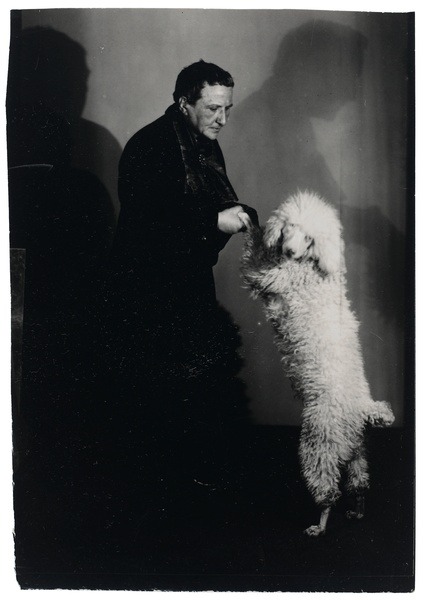
I knew about Man Ray only in relationship to Gertrude Stein whom he photographed on many occasions.


This is Gertrude posing for Jo Davidson in a photo by Man Ray.


This is Gertrude and Basket.

Can you get a famous photographer to photograph your dog?


And here is Gertrude with her portrait by Picasso.

Tuesday, April 29, 2014

Blogging

 Renoir - Cesanne

I have had rather a busy weekend.

On Friday I went to the Legion of Honor in San Francisco to see Intimate Impressionism, an exhibition of small paintings from the collection of the National Gallery of Art in Washington. The exhibition covered the broad spectrum of artists of the period, but there were no blockbusters.

Then in the evening I went to the Weill-Poulenc mashup reviewed here.

I drove home in the morning in time to make the Cosi fan tutte simulcast, but I quickly tired and went home.  After all, I've already seen this opera twice this year.  One goes to see how the ending is done.  Does anyone but me notice that men are never expected to be faithful?

Then on Sunday I attended a Capitol Chamber Players concert.  They are noted for their varied programming, which this time included:

Tchaikovsky's None but the Lonely Heart (I always want to hear the original Goethe poem.)
Lawrence Frank's My Favorite Oregon Scenes (world premiere)
Lee Hoiby's Last Letter Home
Samuel Barber's Dover Beach
Mozart's Quartet No. 17 "The Hunt" (Must be the corniest piece ever written by Mozart.)
The vocals were by James Gentry.

Monday I viewed a little over half of the stream of Antonio Pappano at the Academia Nazionale di Santa Cecilia in Rome.  They played a program consisting of parts of Beethoven's Fidelio, all of Il Prigioniero by Luigi Dallapiccola, and Beethoven's Ninth.  I was sorry to have missed the beginning of Il Prigioniero.  I find Dallapiccola to be a vastly underrated composer that I would certainly like to hear more of.  The opera, however, was originally written for the radio and is far too static to be completely successful theatrically.  The Ninth was exciting but fast almost to the point of frantic.

I tuned into this stream because there was someone else there whom I also would like to hear more of:  this year's Opera Awards male singer winner Stuart Skelton.  I will try to catch the rest of the program to hear his Fidelio.  He was great, especially in the Ninth.  "Wie ein Held zum siegen."

Then Monday afternoon American Bach Soloists came up in my Facebook feed.  "Oh s**t.  That's tonight."  So off I went to Davis for a choral concert.  Jeffrey Thomas, the director, is a choral guy so it was bound to happen eventually.

Saturday, November 16, 2013

Hockney

While in San Francisco, between performances of Barber, I went to the De Young to see the David Hockney exhibit.


Apparently after living in Los Angeles for 25 years, he has returned to England, thus renewing his interest in English landscape.  He has also started painting on an iPad.  One of these "paintings" was mounted in such a way that we could see the strokes being added one by one.  The picture below (Yosemite) is one of these, and perhaps the one above is also.


Almost everything in the exhibition has been done after the millennium.  He is a bit too realistic for my taste.


But this picture, also in the exhibition, may counteract that general impression.  It reminded me of Picasso and concerns itself with problems in displaying a massacre.

There were also films of landscapes made with multiple cameras mounted on the same truck.  Interesting.

I can only say that for him the process of transformation to art is now consistent.  Go out and see it, and make up your own mind.


Friday, February 17, 2012

Leonardo

Last night I sat in a movie theater and watched the HD broadcast of the Leonardo da Vinci in Milan exhibition from the National Gallery in London.  It is better to see the paintings live, but it is already too late.  The entire exhibition is sold out. 

Included in the exhibition is a copy of the Last Supper by one of Leonardo's students.  They explained how slowly Leonardo painted, thus providing the reason he didn't want to do fresco to paint the Last Supper.  For fresco you have to paint very fast.  You must finish the painting before the plaster dries.

Saturday, February 11, 2012

Masters of Venice


It was the last week of the Masters of Venice exhibition at the De Young Museum in Golden Gate Park, so I hurried over to the city.  These paintings are all from the Kunsthistorisches Museum in Vienna. At one time in the 19th century the Hapsburgs were in charge of Venice, so we can easily imagine these were looted. The fact that there are fewer small paintings in Venice than are in this exhibition might lead one to believe this. In Venice are a lot of giant paintings that would be hard to cart off without someone noticing. The painting shown, Susanna and the Elders by Tintoretto, is the only one I recognized. My hero Giorgione was well represented.


This is more Giorgiones than there are in Venice.

Sunday, February 05, 2012

Camille Claudel


The 30th anniversary of the Alexander String Quartet in Herbst Theater brought us a very high class concert.

Joyce DiDonato and her accompanist Jake Heggie began the program with Venezia, a cycle of 6 songs in Venetian Dialect by Reynaldo Hahn.  From the stage Joyce told us that these songs were originally performed in Venice in a gondola.  The composer had a small piano put into a gondola and sang them floating around in the lagoon.  You can possibly picture this.  Joyce did not smoke or play the piano herself as Hahn would have done.  This is completely charming and charmingly performed.

This was followed by the Debussy string quartet played by the Alexander String Quartet.  We are so accustomed to this style of music that its effects are no longer remarkable.

Heggie was asked to compose a piece for the anniversary, and he replied that he was an opera composer.  They responded not to worry--they intended to provide a singer, one Joyce DiDonato.  This is a heavenly idea.

Executed like a work from heaven.  The result of this collaboration is Camille Claudel:  Into the Fire (2012), a work for string quartet and mezzo-soprano.  I am pleased to have pulled myself together and made the trip to see it.

This is a remarkable work.  First there is a sculpture--Camille Claudel was a sculptor.


Then there is a poem--"Rodin" in this case--written by Gene Scheer, who is also the librettist of Heggie's Moby-Dick and Picker's An American Tragedy.  So the profession of librettist is not dead after all.  Then there is a song, simultaneously sweet and dramatic to fit images.


"La Valse" "Take me one step closer one step back one step spins one step hovers Take me!"

"La Petite Châtelaine" we all cried.


The story has an unhappy ending.  She began to destroy her sculptures and was subsequently confined to a mental hospital.  The song cycle ends with Claudel as an old woman still in the asylum being visited by an old friend.

The words are lovely.  Heggie is developing into a wonderful composer.  His use of DiDonato's voice is skilled and sensitive.  His writing for string quartet is lyrical and romantic.  It is a very good sign that he calls himself an opera composer.  It was truly a significant occasion.

The encore, "Morgen" by R. Strauss, used everyone in a charming arrangement.

Here is a short blog post from Jake Heggie about this concert.

Saturday, June 11, 2011

Gertrude Stein in Art

This is a kind of homage to the current exhibition at the San Francisco MOMA of paintings collected by members of the Stein family.

Picasso

Warhol

Valloton

Picabia

Rose--instead of the virgin enthroned we have Gertrude enthroned.  The white dog is Basket.

Three of these pictures were in the exhibition. The other two are around the corner at the Contemporary Jewish Museum.  There are actually quite a few more. I wonder why the attraction.

Thursday, October 21, 2010

Thiebaud

The Crocker Art Museum is currently doing a Wayne Thiebaud exhibition.  These women twirling batons is an example.  The new wing and the art on exhibit are worth the trip.

Thursday, July 29, 2010

Greatest Sculpture


In one of my trips to Florence I lived across the street from the Academia.  One morning the door was open, resulting in this shot.

When you grow up knowing about something--like Michelangelo's David--it disappears on you. When you see it, you think "David" and not "beautiful" or "glorious." So you must teach yourself to see it again.

I tried to see it differently by buying the refrigerator magnet and putting clothes on him. In our class it was proposed that traditionally David was 10-14 when he slew Goliath. The instructor thought he looked about 25. With clothes on he is a teenager about 16 years old. You'd worry that a 16 year old was so serious.

I have a book at home--the Oxford book of Classical Art--that shows every ancient statue. The two bronze Greek men at Reggio di Calabria are very beautiful and real looking, but their attitudes are casual, like men marching through a town and flirting with the girls.

I like very much the Farnese Hercules as reconstructed, but he is a man of at least 35, perhaps 40, who is well bulked up.

I can think of nothing that so completely captures the perfection of youth as the David. For realism we see that he sculpts the veins on the backs of his hands. Who else does that?

David was originally intended to be up on the roof of the Duomo and has a slightly big head and hands to compensate for the intended angle of view. Perhaps this contributes to the look of youthfulness in clothing.

There can be no question that David captures great physical masculine beauty. It matches or exceeds other male statues.

But what separates it from all others is the action. This is the moment. David is skilled in the sling from working as a shepherd and holds his weapon casually. The rock is in his right hand by his side.

It compares favorably to the moment when the baseball pitcher has settled on the correct pitch. The count is 3&2 in the ninth inning. He has decided on the pitch and has just extended his left foot for the beginning of the windup.

This is the moment of perfect intention, and it is this that makes David the greatest piece of sculpture ever made.

Wednesday, July 14, 2010

Caravaggio e Caravaggeschi a Firenze

I hadn't realized that Artemisia Gentileschi was considered a follower of Caravaggio. The exhibition at the Uffizi is the first time I have seen more than one picture at a time. There is Judith cutting off the head of Holofernes, followed by sneaking the head out in a basket. She is the most interesting in these. The about 6 pictures all seem like self portraits.

Caravaggio painted a Judith. She seems to be saying "Oh ick!". Artemisia's Judith is all business.

Caravaggio painted from life, many think using the camera obscura, resulting in pictures that look like photographs.

Each person was painted one at a time, sometimes resulting in odd effects fitting them together. He used a single light source, and sometimes he filled in around the figures with objects or landscapes, sometimes just with black.

The followers seem to like just the single light source and the fading to black. Being a Caravaggeschi means realistic looking figures in black backgrounds. They look at Caravaggio and see a technique they can imitate. They miss the genius.

Tuesday, June 29, 2010

Homage

I enjoy very much the AT&T commercial with orange fabric falling, falling from the St Louis arch and the Los Vegas casinos, and I thought of Christo and Jeanne-Claude. Then I saw the disclaimer across the bottom of the screen saying Christo and Jeanne-Claude have no affiliation blah blah blah. So is it or isn't it? My impression is that surely it must be. 

I Googled them and found that Jeanne-Claude had died last year.  Perhaps the commercial is an homage.  Perhaps not.

The picture above is Running Fence from Marin County in California.  It was the work we knew best.  They have made us see reality in a new way.

Monday, April 26, 2010

Musical Neon

I'm going to try to explain what this is. It is an object from an art exhibit at the Asian in San Francisco. It is taller than my head and wider than my arm span, and consists of dozens of small strips of neon, each strip wired separately.

I wasn't supposed to take a picture of this, but it was irresistible. The rule for museums these days is photos without flash in the regular exhibits, nothing in the special exhibits.

I could hear it playing from the next room, like a mystical sound track, single notes of random pitches with a tone like a cello or bassoon. What could it be?

Each individual strip of neon goes on and off, and when it goes on it plays a note. At the moment of the photograph most were on. If you bought this, you could put it in your living room and stay in tune with the universe.

Sunday, February 07, 2010

Women in Art

One of the things I wanted to do in Paris was visit the exhibition of women artists at the Centre Georges Pompidou.

Early in the exhibition is a poster pointing out that while only a small percentage of art in museums is by women artists, almost all the nudes are women. So here we are with a giant museum full of women artists--where are the male nudes? Women artists in the twentieth century seem obsessed with the politics of gender, with the condition of being female.

Of course the art work that is the Centre is the most fascinating. I will have to return before I leave.

Thursday, October 22, 2009

Mucha

In Munich there was an exhibition of works by Alphonse Maria Mucha [pronounced Mook-ha], a native of Moravia whose fame stems from a six year association advertising the performances of Sarah Bernhardt in Paris. The above poster of Gismonda, 1 January 1895, was the first in the series. I have long been an admirer.

Damaged murals from the 1900 Universal Exhibition in Paris, also shown, were new for me. Art Nouveau was originally called Mucha Style. This should clarify his relationship to the style. In German speaking countries this is called Jugendstil.

The posters are bigger than I thought--more the size of a door than a window.

Friday, September 18, 2009

Avedon at the MOMA

There was a photo exhibit of Richard Avedon at the San Francisco MOMA. It included a gigantic photo of Warhol and his movie studio people, most nude. I am embarrassed to say I instantly recognized Joe Dallessandro and then looked around for Warhol. The photo showed two groups of people, the nude actors and the fully clothed production staff.


This is Marian Anderson.

Tuesday, August 11, 2009

Roxanne Swentzell


The sculptor Roxanne Swentzell has a website here. She is entirely out of my price range.