Showing posts with label David Alden. Show all posts

Saturday, July 07, 2018

Lucia from Madrid

👍🏻
Conductor: Daniel Oren
Director: David Alden

Lucia: Lisette Oropesa
Edgardo: Javier Camarena
Enrico Ashton: Artur Rucinski
Raimondo Bidebent: Roberto Tagliavini
Lord Arturo Bucklaw: Yijie Shi
Alisa: Marina Pinchuk
Normanno: Alejandro del Cerro

I've never actually seen a live bis in an opera before (they do them all the time in concerts in Italy, usually of something you'd rather not hear again).  When I realized what it was, I burst into tears.  And an ensemble, the sextet, on top of it.  I'm seriously loving this.  Everyone is a shit except Lucia.  She's already pretty insane before the mad scene.   We had a glass harmonica.

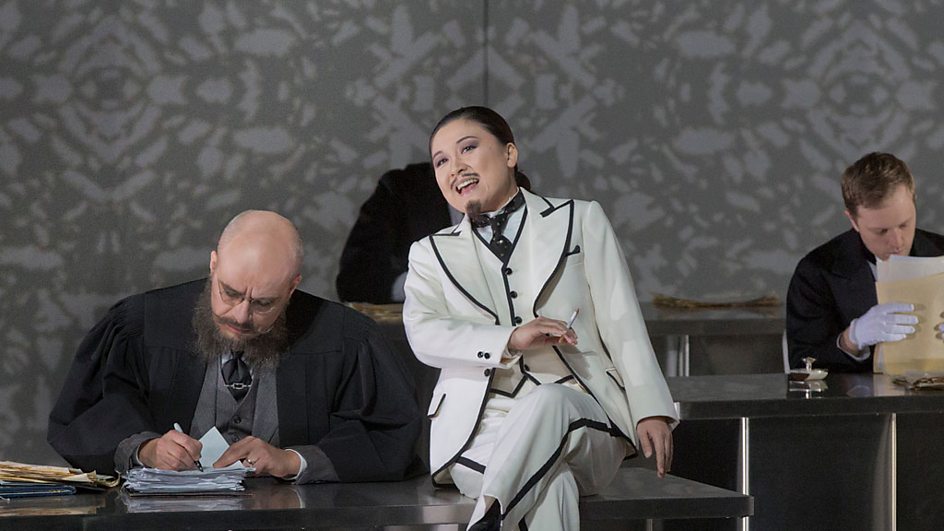
I am speaking, of course, of Gaetano Donizetti's Lucia di Lammermoor streamed live from Teatro Real Madrid.  The set is like your high school gym.  There's a radiator.  I think the theme is "you'd go nuts too if everyone you knew was this awful."  We're doing a play within a play.  At the end of the mad scene the chorus claps very slowly.  It's not at all like the loud shouting from the real audience.  The production does nothing to explain the opera but focuses entirely on the atmosphere.

The singing and for me also the acting were very good.  I love Lisette, but she will need to stay light in this role.  I came for Lisette and Javier, two of my favorites of the young singers, and they did not disappoint.  Javier wears a kilt in this, a first for me.

Lisette has also performed the ROH Lucia which I reviewed with Diana Damrau.  This version will be available on OperaVision for a while.  If you missed the live stream, watch it now.

I have to add a comment.  Lisette's physical training gives her a kind of absolute control over the phrase.  It's stunning.

Saturday, March 04, 2017

Semiramide from Munich

👍🏻
Conductor: Michele Mariotti
Production:  David Alden

Semiramide, Queen of Babylon, widow of King Nino: Joyce DiDonato
Assur, a prince, descendant of Baal: Alex Esposito
Arsace, Commander of the Assyrian army: Daniela Barcellona
Idreno, an Indian king: Lawrence Brownlee
Oroe, high priest of the Magi:  Simone Alberghini 
Azema, a princess, descendant of Baal: Elsa Benoit 
Mitrane, Captain of the Guard:  Galeano Salas
Nino's Ghost:  Igor Tsarkov

The role of Semiramide in Rossini's opera Semiramide is usually sung by the same people who sing Lucia, people like Montserrat Caballé, Joan Sutherland, June Anderson, etc.  It was, however, composed for Isabella Colbran who is generally considered a mezzo-soprano.  (Elisabetta, regina d'Inghilterra, Otello, ossia Il Moro di Venezia, Armida, Mosè in Egitto, Ricciardo e Zoraide, Ermione, La donna del lago, Maometto II,  Zelmira, and Semiramide are the operas written for Colbran.)  After her success in La donna del lago, Joyce DiDonato clearly wanted to try her hand at another Colbran role.

I experienced a lot of technical difficulties with this stream from the Bayerische Staatsoper and finally ended up listening on my iPhone, not an ideal medium for watching an opera. 

The cast for this opera was simply spectacular.  DiDonato and Barcellona sing beautifully together.  It is one of the great bel canto operas with an endless stream of gorgeous music.  It may well be considered Rossini's masterpiece.

As with most of the streams from the Bayerische Staatsoper, this performance will probably disappear forever.  This makes me sad.

Wednesday, January 15, 2014

Ercole Amante


No expense has been expended to explain the plot of Cavalli's Ercole Amante (1662).  Perhaps a dissertation would be required.

Here we go.  In Act II Scene 4 someone explains that:

"Hyllus [son of Ercole, Jeremy Overden] loves Iole and she loves him, but she hates Ercole [Luca Pisaroni] who loves her;  Nicander loves Licoris, and she loves Orestes who loves Olinda; Olinda and Celia love gold and jewels...."

Ercole is married to Deianira, mother of Hyllus, and Iole hates him because he killed her father.  Ercole thinks he should kill Deianira and Hyllus.  Apparently, explained in Act III, Iole's father promised her to Ercole.  Iole then talked him out of it, and Ercole killed him.  Ercole blames everything on her.

There is a lot of hanky-panky in this opera which was supposed to be given at the marriage of Louis XIV to Maria Theresa of Spain.  I'm not sure, but I think there is a confusion of Ercole with Louis.  It's a kind of Iron Man plot where as the king of France he is skinny like, well, like Luca Pisaroni, and then he puts on his muscle suit and turns into the super buff Hercules.  This suit doesn't help him fight crime, it's just for attracting women. 


Doesn't seem like a particularly suitable plot for a wedding celebration.  They could not perform the opera at the wedding in 1660 because the construction of the stage machinery was not complete.  I imagine things soaring through the air or flying down from above, things which don't seem to happen in modern productions.

This is all miserably hard to understand.  Much like in the Ring, there are gods littering the stage who take sides with the mortals.  Venus is with Ercole.  Juno [Anna Bonitatibus], naturally sides with Deianira and tells Iole how wonderfully virtuous she is.  Neptune and Juno advise Hyllus.  Oy.  It's exhausting.

The music is mostly Florentine recitative with arias and ballet interspersed.  Because it's meant for Paris, there is quite a lot of ballet.  There are some funny scenes.  The dialog refers to Atlas, so he appears holding up the world, which Ercole takes out of his arms and carries easily around before giving it back to Atlas.  The program notes call this an opera buffa, but we know that it is before the split into seria and buffa.  It can't be a buffa because there was at least one castrato who sang Juno.

In Act IV there are giant fish, boats and water for Neptune to rise out of.  They could have more successfully differentiated the gods from the humans.  But then what to do with Ercole who is some of each?  Luca is adorable in his muscle suit.

In the end Ercole becomes a god who marries Beauty.  In his guise as a god he goes back to resembling Louis XIV, a significantly thinner person who wears a sun crown.  
#ad

Saturday, December 08, 2012

Ballo in HD


Conductor:  Fabio Luisi
Production: David Alden

Sondra Radvanovsky as Amelia Anckarstrom
Marcelo Álvarez as the king, Gustavo III (Riccardo), who loves her
Dmitri Hvorostovsky as Count Anckarstrom (Renato), his most trusted adviser (and Amelia’s husband)
Stephanie Blythe as the fortuneteller Madame Arvidsson (Ulrica)
Kathleen Kim as Oscar

Today we were treated to the Metropolitan Opera's HD version of Verdi's Un Ballo in Maschera.  This opera is usually crudely shoehorned into a setting in Boston where it feels quite foreign.  Today all pretense is cast aside and we return to the real historical setting in Stockholm, Sweden.  For you see, these are real people and real events.  The reality is long forgotten, but in Verdi's time when the idea of monarchy was not entirely secure it was considered a scandal to portray real royalty behaving badly.  When the characters in the opera are speaking each others' names, they are neither American nor Swedish but Italian.

We are informed in the intermission that Madame Arvidsson was a real woman who accurately predicted the assassination of King Gustavo.  This ended her career as a fortune teller.  I have searched in vain for a photograph of Stephanie Blythe in her twentieth-century outfit complete with purse.  She was simply the best Ulrica ever.

It's one thing for an exotically dressed black Ulrica to summon the devil in cave-like surroundings and quite another to see her sitting at an ordinary table dressed in middle-class clothes while she first takes a swig from her flask and then takes a skull out of her purse.  This is the fascination of productions which move events closer to our own time.

The painting of Icarus partially shown above which appeared in every scene is hard to fit into a Swedish context.  Gustavo was something of a foolhardy daredevil, so perhaps that is the connection.  He leaps into a love affair with a married woman, puts himself in disguise in order to visit Ulrica, tracks down Amelia to the place of execution and goes to the ball in spite of the fact that he knows someone will try to assassinate him.


And what a cast.  It would be difficult to imagine anyone now active who could expect to improve on any of them.  Kathleen made her dance debut in this production, and perhaps she is ready for a new career.  I finally found a picture of her in her Chanel pants suit and cigarette.  This production needs more pictures.  I enjoyed very much Sondra's passionate fluidity.  This is the best I have experienced of Marcelo Alvarez.  He conquered every mood of this wide-ranging opera, from comedy to romance to death.


And Dmitri reigns over Verdi baritones today as few singers ever have.  His voice will do anything. 
He looks beautiful, too.

Friday, August 17, 2012

Maometto II


This was the world premiere of the new critical edition of Rossini's Maometto Secondo to be published next year.  In his liner notes Dr. Philip Gossett goes out on a limb and says, "...Maometto II is one of the greatest serious operas written during the 19th century."

In my youth there was no serious Rossini in the repertoire.  I feel especially blessed to be living in the era of Rossini revival.

I thought I detected the Gossett touch in this performance--not just in the perfection of the score but also in the ornamentation of the singers.  And sure enough, he was here helping with the preparation.  And for me what is the Gossett touch?  Ornamentation suitable for each voice and powerful self-confidence in its execution.

The odd thing about Maometto is all the ensembles.  By 1820 we are living in the dying ends of opera seria, a form that is more pure in Handel, a time when da capo arias are almost the whole thing.  In Maometto II everyone gets an aria, Anna gets a lot more, but that still leaves a lot of ensembles. 

It is a monumental opera, more like something by Verdi and not at all the kind of opera usually taken on by Santa Fe.  This season the excellent chorus is especially prominent.

This opera requires four magnificent singers, and it got them.  My fellow bloggers, who have already come and gone, seemed critical of these singers.  Bah humbug!  They were all wonderful.

At the top is Luca Pisaroni as Maometto.  According to Wikipedia he is from Venezuela but moved to Italy when he was 4.  That's Italian enough for me.  I also understand that he is Thomas Hampson's son in law.  Hampson was in our audience.


In the picture above we have our other three artists.  Left is Patricia Bardon as Calbo, a contralto almost in the Ewa Podleś tradition.  This part is wickedly difficult with lots of notes on either extreme of the range, and she handled it well.

Center is the magnificent Leah Crocetto as Anna, an individual fanatically devoted to duty.  In one night I am suddenly a fan.  It is a very long and difficult role which Leah executed with increasing assurance.  Right is the tenor Bruce Sledge as Erisso.  He was also excellent.  I stood for Leah.

There is a glaring flaw in this production.  At the end Maometto faces stage left and Anna faces stage right.  This puts Maometto's sword on his upstage side, so when Anna uses it to stab herself, this is completely invisible to the audience.  Obviously if you reverse where they are standing, all this changes.  We were warned.

Thank you for this wonderful experience.