Showing posts with label San Francisco Opera. Show all posts

Sunday, November 28, 2021

Cosi fan tutte in San Francisco


Conductor: Henrik Nánási 
Director: Michael Cavanagh 

Ferrando: Ben Bliss*
Guglielmo: John Brancy
Don Alfonso: Ferruccio Furlanetto
Fiordiligi: Nicole Cabell
Dorabella: Irene Roberts
Despina: Nicole Heaston 

The San Francisco Opera is currently showing Mozart's Cosi fan Tutte.  Starting this season if you do not want to go into a crowded opera house, you can for a fee watch the opera at home on live stream.  I would like to suggest that it should be possible to make this available to play later for the same fee.  This would allow friends in Europe to watch it.  It's the middle of the night there.

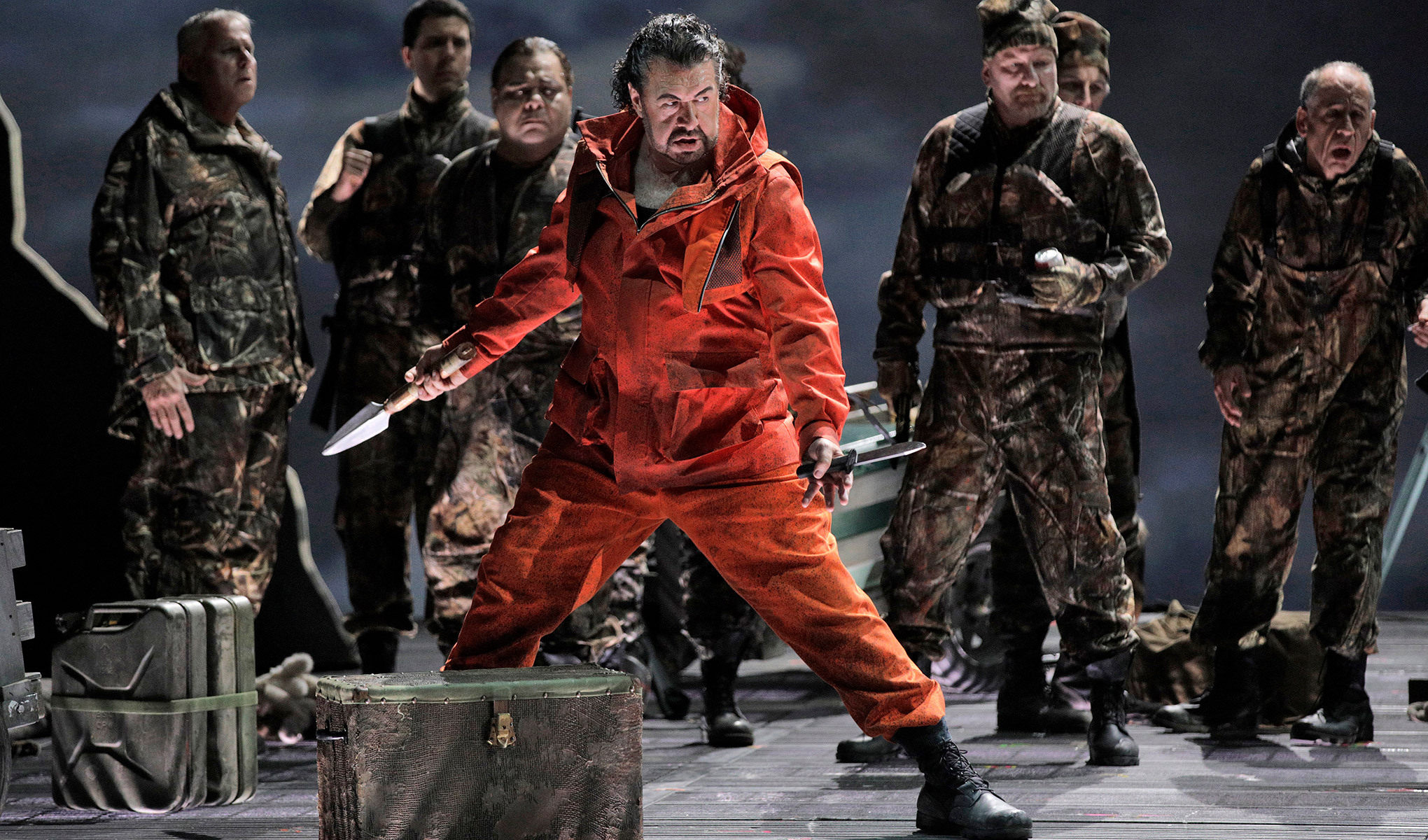
This production began in 2019 with Figaro as part of a Mozart/Da Ponte trilogy and will continue to its conclusion later this season in Don Giovanni.  All three operas are set in the same basic house structure.  In this opera the house is now a country club with sports, dining, and other facilities.  I felt that the concept worked very well.  In the picture above the guys are in the men's locker room.  I liked the look of it and felt that it served very well to clarify the story.  The singers were expected to be rather more athletic than is generally a good idea. 

My only problem with it was with the music.  The music sounded very much like a performance of a Mozart symphony--intense and dramatic.  It wasn't exactly bad, but didn't make me feel like I was seeing a comedy.  My overall take is positive.  This opera is often hated, and I overcame my tendency in this direction.  It was good to see Ferruccio Furlanetto.


Friday, October 15, 2021

Fidelio in San Francisco


Conductor Eun Sun Kim 
Director Matthew Ozawa

Leonore: Elza van den Heever 
Florestan: Russell Thomas 
Don Pizarro: Greer Grimsley 
Rocco: James Creswell 
Don Fernando: Soloman Howard 
Marzelline, Rocco's daughter: Anne-Marie MacIntosh * 
Jaquino:  Christopher Oglesby

Last night I attended the premier of a new production of Beethoven's Fidelio at the San Francisco Opera.  I'm going to work my way slowly through the production before going on to the music.

The single set is shown above.  It can be rotated, and the other side shows different spaces.  In Act II it looks different from Act I.  In Act I the back of the side presenting to us is covered with mirrors.  The director always sits in the middle of the orchestra to view his creation, but from my seat in the balcony circle the lights from the pit reflect in the mirrors to create a tremendous distraction.  The screens which drop down in the balcony are back, and they are shot from a lower angle which doesn't show the reflection.  I watched the screens.  [More about the screens later.]  No director ever seems to think of walking around the house to see what it looks like from other places.

Much of the drama of this production is created through costumes.  It's regie of course.  The last person in the upper left above might be Leonora dressed as a prison guard.

This will give you a better idea.  Left is Leonora, then Marzelline, then Rocco and last Jaquino.  It's probably the canon quartet.  Each of these people has a different role to play.  Leonora is in her guard's uniform.  Jaquino is wearing a business suit and Marzelline is wearing upscale office attire.  They seem to work in an office section of the prison.  Rocco who is supposed to be the boss is dressed no better than the prisoners without a uniform.  Jaquino is someone I have always seen as a flunky, so why is he in a business suit?  And why does Rocco look like a janitor?  I'm very confused.  This production does not give any clues about why Marzelline would prefer Fidelio.  The yellow outfits above are prisoners.

The one thing that makes Fidelio hard to stage is that in Act II while appearing to be still in the dungeon where Florestan has been hidden, there suddenly appears a fair sized mixed chorus to celebrate Leonora's rescue of Florestan [which she here accomplishes with a gun].  Until that point Leonora and Marzelline are the only women in the opera.  In this production the women are in the prison with their men and appear at the end when their men are released.  This sort of makes sense.

Enough about the production.  This was my first experience of our new conductor Eun Sun Kim.  She kept good tempos and maintained a suitable balance between the singers and the orchestra, things that make or break a performance.  The chorus was its usual spectacular self.

Russell Thomas sang a magnificent Florestan.  Greer Grimsley makes a good villain.  The make or break character is, of course, Leonora/Fidelio, here sung by Elza van den Heever.  She cried in the applause which was warm.  Everyone is so emotional about being back.  Elza, I hope you enjoyed your performance.

Which brings us back to the screens.  The San Francisco Opera is now offering live streams of its performances.  Streams require cameras, undoubtedly the same cameras that brought us the pictures on the screens that hang down in the balcony.  In addition streams bring money.  This makes me happy.  If you are unfamiliar with the San Francisco Opera, it provides a quality product.


Monday, July 12, 2021

San Francisco Opera 2021-2022

The season has been announced for 2021-2022 at the San Francisco.  To reduce the number of people in the house at any given time, they are switching to the kind of season where only one opera plays at a time.  This change will result in only 5 operas.  We can only hope for a return to normal in the following season.


August 21, 27, 29; September 3, 5  Puccini's Tosca with the new music director Eun Sun Kim and starring Ailyn Pérez, Michael Fabiano, and Alfred Walker.  This is an excellent group.  


October 14, 17, 20, 22, 26, 30  Beethoven's Fidelio in a new production by Matthew Ozawa, starring Elza van den Heever and Russell Thomas. Music Director Eun Sun Kim conducts.  These are also excellent singers.  Fidelio is one of my favorites.


November 21, 23, 27; December 1, 3  Mozart's Cosi fan tutte.  Henrik Nánási conducts an  ensemble featuring Nicole Cabell, Irene Roberts, Benjamin Bliss, John Brancy, Ferruccio Furlanetto, and Nicole Heaston.  This is part 2 of the Mozart/Da Ponte trilogy production by director Michael Cavanagh.  I saw part 1 in 2019 here.  It seemed to work well.


June 4, 10, 12, 15, 18, 21, 26; July 2, 2022  Mozart's Don Giovanni conducted by Bertrand de Billy and starring Étienne Dupuis, Luca Pisaroni, Adela Zaharia, and Carmen Giannattasio.  This is part 3 of the Mozart/Da Ponte trilogy production by director Michael Cavanagh. 


June 14, 17, 19, 23, 25; July 1, 3, 2022   Sheng's Dream of the Red Chamber.  I saw this opera in 2016 at the world premier.  They have not provided much additional information.


Sunday, March 28, 2021

San Francisco Ring -- Götterdämmerung


Conductor - Donald Runnicles 
Director - Francesca Zambello 

Brünnhilde - Iréne Theorin 
Siegfried - Daniel Brenna 
King Gunther - Brian Mulligan 
Hagen, Alberich's son - Andrea Silvestrelli 
Gutrune, sister of Gunther - Melissa Citro 
Waltraute - Jamie Barton 
Alberich - Falk Struckmann 

Götterdämmerung completes the Richard Wagner Ring cycle.  This is my first time for this production.

Act I

The balance between the orchestra and the three Norns is terrible. Why is this always such a problem?  Why don't properly placed microphones solve this?  Instead of threads, these strands of fate are fat electrical cables, and when one breaks, the Norms die.

We see Siegfried and Brünnhilde after their night together still blissfully in love.  He gives her the ring and goes off to explore.  The Rhein valley looks like a refinery.  

Siegfried ends up at the posh home of Gunther, Hagen and Gutrune.  He has taken the tarnhelm with him and tells them where he got it.  He drinks a potion, falls immediately for Gutrune and forgets all about Brünnhilde.  

Now we are back with Brünnhilde where she waits for Siegfried.  Her sister Waltraute arrives.  I like very much Iréne Theorin.  I remember that she was an emergency replacement.  I'm not sure I think Jamie Barton is a Wagnerian.  Waltraute tells Brünnhilde about how much Wotan has changed.  

After Waltraute leaves, Siegfried returns with the tarnhelm on his head.  The other three parts of the San Francisco Ring had subtitles, but this one does not.  It's hard.  He takes the ring from Brünnhilde and leads her off.

Act II

Alberich shows up to lecture his son Hagen.  If the ring is so powerful, why doesn't it work for anyone but Alberich?  I have always wondered about this.  I'm trying to make it all the way to the end, but it's pretty rough going.  Gunther drags Brünnhilde onto the stage in front of a crowd of his subjects.  Siegfried has eyes only for Gutrune, and she for him.  Siegfried swears he doesn't know Brünnhilde, and she swears things, too, only hers are true and his are not.  I enjoy very much how Theorin enthusiastically jumps about in her role.

Act III

All the fun parts of this opera are in this act.  The Rhein maidens are back, and they are covered in plastic bags full of garbage.  Siegfried enters and I'm booing. He's carrying a military style rifle which the maidens take from him.  Perhaps none of them can rule the world with the ring because they haven't renounced love.  It's harder than you think. The bad acoustics at the San Francisco Opera House are all too apparent in this recording.  They give him back his gun and he goes off.

One both hates and loves Daniel Brenna's Siegfried.  One loves the singer and hates the character.  One is no longer charmed by his egotism.  I'm shouting at the screen "You f**d up buddy."  Hagen, Gunther and Siegfried are together.  Hagen gives Siegfried a potion to reverse the other one, and he tells the story of Brünnhilde in the ring of fire.  That means he lied when he swore he didn't know her.  So Hagen kills him.  The big discovery of this Ring cycle was Andrea Silvestrelli as Hagen.  Magnificent.

For the ending we return to Gutrune with Siegfried's body.  When Hagen tries to steal the ring from Siegfried's dead hand, S raises it in the air and Brünnhilde appears.  It works out as it should.  My favorite thing is Brünnhilde gets to be Brünnhilde again.  Big finish.  I'm crying.  The sheet of gold is back where it belongs.  It's all about women now.  A great ending.

We loved Donald Runnicles, and it's great to see him again.

Saturday, March 20, 2021

San Francisco Ring -- Siegfried


Conductor: Donald Runnicles 
Director: Francesca Zambello 

Mime: David Cangelosi 
Siegfried: Daniel Brenna *
The Wanderer (Wotan): Greer Grimsley 
Alberich: Falk Struckmann 
Fafner: Raymond Aceto 
Forest Bird: Stacey Tappan 
Erda: Ronnita Miller 
Brünnhilde: Iréne Theorin 

I am enjoying that at the beginning of Siegfried Mime is banging in the rhythm of the score.  We are up to the part of the San Francisco Ring that I have not seen before.  The last time I simply was too tired to do four long operas in a row.  This is part of the caravan series.  Mime and Siegfried live in a busted up caravan.  We actually get a bear--not an actual bear.  

Wotan comes in to check on Siegfried.  I actually love Greer's harsh, growly voice as Wotan.  Mime and the The Wanderer are exchanging riddles and Mime recognizes that this is Wotan.  He is too dumb to figure out who it is who has never known fear.  We figure this out easily.  How about someone who brings a live bear home with him?  The reforging of the sword is very convincing.  In retrospect I suspect that Mime is pretending not to know.

This scene with Alberich and The Wanderer is reminding my of my rule of 3 baritones.  "Never go to an opera with three baritones."  This is a hell of a lot of snarling and growling.  Wotan by himself is fine.  Wotan wanders from place to place seemingly to provide Wagner with someone to explain what is going on.  I insist on my no explaining/all showing philosophy.  These operas are so long because someone is always explaining something.

The character of Siegfried in the person of Daniel Brenna is enjoyable.  The production seems to work in spite of the fact that the dragon is a machine.  Theoretically the machine should disappear when Siegfried takes the Tarnhelm from Fafner.

I like more and more the Wotan of Greer Grimsley.  However, he summons Erda and then doesn't really ask her anything.  He predicts the end of the gods, including her.  Then when Siegfried breaks Wotan's spear with Notung, all truly is over.

This is very cool.  "Mother, behold your fearless child."  He's terrified of a sleeping woman.  Herr Wagner, at last you have done it.  He kisses her awake like sleeping beauty.  We waited a very long time, but this is the best thing ever.  He thanks his mother for giving him life.  If it only ended here!


Sunday, March 14, 2021

San Francisco Ring -- Die Walküre


Conductor: Donald Runnicles 
Director: Francesca Zambello 

Sieglinde - Karita Mattila 
Siegmund - Brandon Jovanovich 
Hunding - Raymond Aceto 
Wotan - Greer Grimsley 
Brünnhilde - Iréne Theorin 
Fricka - Jamie Barton 

Die Walküre is of course the next installment in the San Francisco Ring.  Wotan lives in a skyscraper high over a relatively small city somewhat like San Francisco.

Act I is in Hunding's house which looks like an American house in the woods.  Inside is a cabinet full of sport trophies.  This Hunding is really a brute.  There's no question about whose side we are on.

Act II Scene 1.  is in the high rise built by the giants in Das Rheingold.  Jamie Barton is a truly magnificent Fricka.  She storms with great style.  He is clearly for Siegmund, but Fricka turns him to Hunding's side.  The goddess protects marriage no matter how bad it is.  There is lots of plot stuff in this act.  At the beginning Wotan orders Brünnhilde to defend Siegmund.  Then after Fricka's complaints, he reverses himself and tells her Siegmund must die.

Act II Scene 2.  In this scene Sieglinde and Siegmund are under a freeway, the latest symbol of urban wilderness.  Sieglinde has begun to feel guilt, both for staying with a husband who did not love her and for leaving him for Siegmund.  Brünnhilde enters and tells Siegmund he must come with her to Valhalla, thus at least attempting to fulfill Wotan's orders.  Siegmund says he will not go without Sieglinde.  This is all quite wonderful.  Brünnhilde changes her mind when Siegmund threatens to kill both himself and his twin even after Brünnhilde tells him Sieglinde is carrying his child.  The child must live.  I think we have here not at all the normal ending.  Hunding kills Siegmund, Wotan kills Hunding and Brünnhilde rescues Sieglinde.  Wotan just says to tell Fricka that he killed Siegmund, but he didn't actually.

Act III is the only part I remember vividly.  During the Ride of the Valkyries they enter on wires, which I see now are supposed to be parachutes.  I love this.  They are all wearing flying suits except Brünnhilde.

I just realized that Siegfried is a joining of the words for victory and peace.  One who brings peace in victory.  Forgive me Karita, but I long to hear Sieglinde in the voice of LD. Karita's performances always bring us her own personal intensity.

The Ring is very unliberated.  Where is Susan B Antony when you need her?  The gods can only imagine women belonging to men.  I enjoy Greer in many scenes, but he seems able to bring only anger into his voice.  And now I'm going to do what I criticize in others.  For me there is only one Wotan's Farewell and that is James Morris.  Greer has done well, but I want to hear the love bursting forth.  This is the only Wagner I truly love.  The ring of fire is perfect.


Saturday, March 06, 2021

San Francisco Ring -- Das Rheingold


Conductor: Donald Runnicles
Director: Francesca Zambello

Wotan, head god:  Greer Grimsley
Loge, god of fire:  Štefan Margita
Alberich, Nibelung: Falk Struckmann*
Fricka, Wotan's wife:  Jamie Barton
Erda, goddess of the earth, Ronnita Miller
Mime, Alberich's brother: David Cangelosi
Fasolt, giant: Andrea Silvestrelli
Fafner, giant: Raymond Aceto
Donner, god of thunder: Brian Mulligan
Froh, god:  Brandon Jovanovich
Freia, goddess of the apples;  Julie Adams
Woglinde, Rhinemaiden:  Stacey Tappan
Wellgunde, Rhinemaiden:  Lauren McNeese
Flosshilde, Rhinemaiden:  Renée Tatum

I've seen this San Francisco Opera production of Wagner's Das Rheingold twice before.  I don't remember the other times hardly at all.  I can read about them in this blog, of course, here and here. 

Runnicles still feels like the best Wagner conductor around.  I liked the production better than before and found that it clarified all plot points even to my fussy standards.

It is a surprise how much I like Greer Grimsley as Wotan.  I don't seem to be able to write a lot these days.  They are streaming the entire Ring throughout the month of March.  I am determined to make it through all four operas this time.


Saturday, January 23, 2021

Samson et Dalila


Conductor - Patrick Summers 
Production - Nicolas Joël 

Samson - Clifton Forbis
Abimélech - Eric Jordan
The High Priest of Dagon - Juha Uusitalo
A Philistine Messenger - Noah Stewart
An Old Hebrew - Oren Gradus 
Dalila - Olga Borodina

This performance of Camille Saint-Saëns' Samson et Dalila, 1877, comes from the San Francisco Opera in 2007.  I saw Olga sing this opera three times around that time.  Read about it here.

I love Olga's voice for this.  For me she has the perfect sound.  And all the good stuff in this opera is written for her.  For her type of heavy mezzo this is the peak experience.  I don't mind Elina in the role, but true love is only for Olga.  The second verse of "Mon coeur" is a duet.  For some reason I didn't remember this.  I think it's better without the tenor.

I enjoy the other singers in this production.  This is old fashioned, lush late romantic, in singing, in conducting, and in visual tone.   It is well worth a visit.


Monday, November 30, 2020

The Elixir of Love


Conductor:  Bruno Campanella
Director:  James Robinson

Giannetta: Ji Young Yang
Adina: Inva Mula
Nemorino:  Ramón Vargas
Belcore: Giorgio Caoduro
Dr. Dulcamara: Alessandro Corbelli
 
This version of Donizetti's L’Elisir d’Amore from 2008 at the San Francisco Opera is completely new to me.  How is this possible?  We are in Napa in California before the US entrance into WWI.  Uncle Sam is recruiting for the army.  For people from California this completely works.  Farms, wine, a rich lady farm owner.  Yes.  Adina and Nemorino are singing and eating ice cream.  They just nibble, or we would worry. 
 
Ramon Vargas is the perfect Nemorino, overflowing with cheerfulness..  This performance includes the greatest of all comic Italian baritones--Alessandro Corbelli.  He seems like the ideal con man.  This is charming and fun.  This is Inva Mula's only appearance at the San Francisco Opera.  She is not my favorite Adina but projects the too good for Nemorino aura required.  Stylistically she is dead on.

There is an ice cream truck and a motorcycle with a side car.  Belcore has boxing gloves instead of a uniform.  All the young men put on military uniforms as volunteers for the war.  It's fun and transfers effectively to Napa.

Sunday, November 22, 2020

Rigoletto SFO stream


Conductor Nicola Luisotti 
Director Harry Silverstein 

The Duke of Mantua - Francesco Demuro 
Rigoletto - Željko Lučić
Gilda - Aleksandra Kurzak 
Maddalena - Kendall Gladden 

I appear to have missed this series of Rigoletto performances at the San Francisco Opera in 2012.  It's the same production as the one I saw in 2017.  I saw the second cast in 2012 which consisted of Marco Vratogna as Rigoletto, Albina Shagimuratova as Gilda and Arturo Chacón-Cruz as The Duke of Mantua.

We have more name artists than in the other presentations.  Perhaps this was Zeljko Lucic's preparation for his Met performance in 2013.  I like Željko Lučić in roles where he is truly nasty:  Iago, Scarpia.  That sort of thing.  Rigoletto is a truly tragic figure who demands more.  He was fine in the clownish rat pack version from the Met.  He does not replace Quinn Kelsey from 2017 in my heart.  "Cortigiani" should tear your heart.

This may be my first view of a performance by Aleksandra Kurzak, whom I know mostly for her relationship with Roberto Alagna.  I will have to listen to something more recent.  She very successfully brings us the youth and innocence of Gilda.  For this innocent child Rigoletto should have had an entirely different reaction.

The ending is excellent. Lučić rises to the occasion.  I'm sorry I missed them the other time.

Saturday, October 31, 2020

Lucia di Lammermoor in San Francisco


ConductorJean-Yves Ossonce†
Production designer-Paul Brown

Normanno-Matthew O'Neill
Enrico Ashton-Gabriele Viviani †
Raimondo Bidebent-Oren Gradus
Lucia-Natalie Dessay
Alisa-Cybele-Teresa Gouverneur
Edgardo Ravenswood-Giuseppe Filianoti
Arturo-Andrew Bidlack

This is Natalie Dessay in San Francisco in 2008 singing Donizetti's Lucia di Lammermoor.   I attended and reviewed at that time.  This is Donizetti's most popular serious opera, but perhaps I only like the comedies. 

I've seen 6 different productions of this opera by now, and my favorite by a wide margin is the Zimmerman version with the fountain and the ghost.  The ghost is my favorite.  I understand they are retiring it, which seems very sad to me.  This one from San Francisco is rather dull.

I am enjoying Filianoti more this time.  The singing is fine. I have only seen 6, so from the ones I've seen, I prefer the one with Lisette and Javier I saw in 2018.  I apologize for all this comparing.

Tuesday, October 20, 2020

Attila


Conductor - Nicola Luisotti
Director - Gabriele Lavia

Attila, King of the Huns - Ferruccio Furlanetto
Uldino, Attila's Breton Slave - Nathaniel Peake*
Odabella, daughter of the Lord of Aquileia - Lucrecia Garcia
Ezio, a Roman general - Quinn Kelsey*
Foresto, a knight of Aquileia - Diego Torre*
Leone (Pope Leo I) - Samuel Ramey

The San Francisco Opera reran last weekend Verdi's Attila from 2012.  It is a fabulous baritone feast with Furlanetto, Kelsey and Ramey.  I'm sorry if you missed it. 

The sets all relate to interiors of theaters.  You may feel free to make up a reason for this.  This version seems to be shortened.  A film played in one of the theaters, and this has been omitted.  In house one sees everything in full screen, while in a film a full screen is unusual.  This diminishes the effect of the theater interiors and increases the importance of the singers.  It's much better this way.

Here's my review when I saw it live.


Sunday, October 11, 2020

Tosca


Conductor - Riccardo Frizza
Director - Jose Maria Condemi

Mario Cavaradossi - Brian Jagde
Floria Tosca - Lianna Haroutounian
Baron Scarpia - Mark Delavan

When this performance of Tosca first played in San Francisco in 2014, I must have missed it.  It is being streamed today from the San Francisco Opera.  I saw Brian sing Cavaradossi in Santa Fe in 2012, and may have felt it was to soon to see him again.

There are some fun things in this production.  From the evidence, Tosca seems to be the most conservatively dressed female in all of Rome.  In the Te Deum we have men in uniforms of the Swiss guards.  In Act II we see that the walls are painted with figures, as they would be in the Palazzo Farnese,  but the lighting is too dim to allow us to see them.  In general they have done a wonderful job of creating the atmosphere of Rome.  A little more light would have been nice.

Mark Delavan is fine but not really snarly enough for Scarpia who needs to project evil in the sound of his voice.  But then I've seen Thomas Hampson in the role, and he isn't snarly at all.

Brian is lovely, handsome and romantic.  Better than at Santa Fe. And Lianna Haroutounian plays the Diva with charm and intense jealousy.  She's trying to make the best of a bad situation, and ultimately fails.  She presents the varied emotions of the character vividly.  I like her very much.  She is why you would want to see this.  She crosses herself before jumping.  Of course.


Wednesday, July 29, 2020

The Makropulos Case -- Rerun

I have copied my previous review of this performance shown again from the San Francisco Opera.  I find that I liked seeing the closeups. 


Conductor:  Jiří Bělohlávek
Production:  Frank Philipp Schlössmann

Vítek:  Thomas Glenn
Albert Gregor:  Miro Dvorsky
Kristina:  Susannah Biller*
Dr. Kolenatý:  Dale Travis*
Emilia Marty:  Karita Mattila*
Baron Jaroslav Prus:  Gerd Grochowski
A Cleaning Woman:  Maya Lahyani*
A Stagehand Austin Kness*
Janek:  Brian Jagde*
Count Hauk-Šendor:  Matthew O'Neill*
A Chambermaid:  Maya Lahyani
*Role Debut

I am embarrassed to confess that this opening of The Makropulos Case at the San Francisco Opera in 2010 was my first experience of the opera.  Everyone asked me where was I when so and so did it?  I have no excuse.  The series of performances was dedicated to Sir Charles Mackerras, the father of modern Janáček performance.

This was my fifth Janáček opera after Katya Kabanova, Jenůfa and The Cunning Little Vixen in San Francisco and From the House of the Dead on DVD.  The music never makes me think of Wagner.  He eschews Romantic tonality without even seeming to notice it exists.  I'm going to say something outrageous now so please duck:  to me he almost reminds me of Mussorgsky.  Almost.  Am I too far out on a limb yet? Wikipedia says he was influenced by Puccini.  I can see that in the vocal writing.  It's sort of verismo without the Italian soul.

The act I set is shown in the picture above.  The other two scenes are equally simple.  There was a giant clock in two acts that showed the actual time.

We begin with a court case that has been going on for almost 100 years.  Count Prus died intestate, and the members of the Prus family possess the estate.  One Albert Gregor claims that Count Prus named his ancestor Ferdinand Gregor as the intended heir.  The case drags on rather like Bleak House.

Then one day Emilia Marty is in town in her guise as a famous opera singer and drops by the law office to ask about the case.  Though none of them have ever seen her before, except possibly across the footlights, she seems to know all about the case.  She describes an existing will and tells them exactly where to find it.

Characters speculate about Emilia's age.  She must be at least 30, they say.  She is very beautiful and all the men fall in love with her.  It would be better to see it without knowing what's going on, perhaps.  She knows where the will is because she was present when it was placed there almost 100 years before.  Emilia has had many names and is over 300 years old.  She began her life in Crete as Elina Makropulos and has returned because she feels herself to be dying and wants another dose of the life-sustaining drug.

Isn't this fun!  Five of the smaller parts were played by Adler Fellows, and another was played by Thomas Glenn, a former fellow.  If there is a Janáček style, no one knows what it is, so don't worry.  Susannah Biller as Kristina was especially nice.

The star of the show, singing the virtually immortal Elina, is Karita Mattila.  She is towering, intense, gorgeous, outrageous, and utterly fabulous.  There was lots of audience screaming.  They closed the curtain before we were finished screaming, seemed not to know what to do with sustained applause.


Tuesday, June 23, 2020

Salome from San Francisco


 👍🏻
Conductor - Nicola Luisotti 
Director and Choreographer - Séan Curran 
 
Garrett Sorenson - Narraboth
Elizabeth DeShong - A page
Greer Grimsley - Jokanaan
Nadja Michael - Salome
Kim Begley - Herod
Irina Mishura - Herodias

I loved seeing this again.  I mean, of course, Salome from the San Francisco Opera.  I saw it live here, 11/2/2009.  Each of the main characters represented their role to a T.  This opera is based on a play by Oscar Wilde and follows the original closely in German.

The biggest problem with Salome is that Salome is 15 and the voice required to sing her is about 40, I would say.  Nadja overcomes all this.  She convinces as a young woman insanely in love.  I don't know what would improve on this.  In the house I could not see the dance well enough to tell what was going on.  It turned out to be very sexy and merely suggestive of nudity.

I also found Greer Grimsley beautiful and believable.  This Johanahan might lure young women to follow him with his charisma. 

As an overall theatrical experience, this may just possibly be the best.  I'd have to watch Maria Ewing again to be sure.

Sunday, June 14, 2020

Trittico Stream from San Francisco

ConductorPatrick Summers
DirectorJames Robinson

 👍🏻
Il Tabarro


Michele-Paolo Gavanelli
Giorgetta, Michele's wife-Patricia Racette
Luigi-Brandon Jovanovich

It's hard to like this opera.  It's rough and nasty.  Since their child died, Giorgetta has grown tired of her husband and their life on a barge and flirts with his employees, including the incredibly handsome Brandon Jovanovich.  In this opera Patricia Racette is overdressed for her environment.  However, they are in Paris, Giorgetta's native city, so we will cut her some slack.  There is much wonderful singing from our three stars.


Suor Angelica

Catherine Cook-Sister Monitor
Patricia Racette-Sister Angelica
Meredith Arwady-The Abbess
Ewa Podleś-The Princess

I realized watching Suor Angelica that I could not be a nun.  Obedience isn't something I do.  I guess that leaves out the army, too.  My mother knew exactly how to deal with this.

This opera is deep with religious significance.  Angelica has had an illegitimate child, it was immediately taken from her, and she was forced into a convent.  She has been here for 7 years with no news from her family.

Then suddenly out of the blue a high class carriage carrying her aunt appears.  The aunt is here not to see Angelica, but to get her signature on a document that disposes of the family wealth and titles.  Angelica has to ask to find out that her son has died.  These two together are wonderful singing actresses who thrill us and break our hearts.

Angelica knows about herbs and plants.  In short she knows how to poison herself and does.  She realizes perhaps before it is too late that she has committed a mortal sin, and begs the Madonna to forgive her.

Only Patricia Racette and Ewa Podleś came out for bows.  They were both magnificent, towering performances.  This was Ewa's San Francisco Opera debut.


Gianni Schicchi

Michael Harvey-Buoso Donati
Meredith Arwady-Zita
Paolo Gavanelli-Gianni Schicchi
Patricia Racette-Lauretta

Someone smokes in all three operas, but in this one they all do, are in a hospital room.  It is amusing that Buoso Donati gets a casting credit since he's already dead.  It would be strange to play a dead body.

The house that Gianni Schicchi acquires is apparently in a high rise next door to the Duomo in Florence.  There is, of course, no building in Florence anything like that.

Magnificent in the dual roles of Michele in Il Tabarro and Gianni Schicchi was Paolo Gavanelli. He was both very funny and terrifying (in the appropriate places--not very funny as Michele and terrifying as Schicchi).

This is Patricia Racette's masterpiece where she triumphs in three different roles.  Hers was by far the silliest "O mio babbino caro" I've ever heard.  Her Lauretta is virtually a child.

I loved seeing it again.  Original review here from 2009.

Sunday, May 31, 2020

Lucrezia Borgia


Conductor - Riccardo Frizza
Director and Production Designer - John Pascoe

Michael Fabiano - Gennaro
Renée Fleming - Lucrezia Borgia
Vitalij Kowaljow* - Duke Alfonso
Daniel Montenegro* - Rustighello
Ryan Kuster* - Astolfo
Blanche Hampton* - Princess Negroni
Elizabeth DeShong - Maffio Orsini

The most fun part of Donizetti's Lucrezia Borgia from the San Francisco Opera is Michael Fabiano in a wild blond wig.  We are used to him bald, but with hair he is completely gorgeous.  Sigh. 

I was present at the original performance series in 2011.  Hearing it again, I am most impressed with the ensembles.  Musically it is a joy, and with a film acoustic and balance problems are fixed. 

The production and singing are enjoyable, but it is clear that Lucrezia creates her own tragedy.  She has searched for Gennaro and has finally found him in Venice.  He shows her a letter from his mother.  No matter how dire the circumstances, she never tells anyone that she is his mother.  Not even him.  She's willing to risk killing him but not this.  She would not risk her own status.  It's ok for men to have illegitimate children, but not women.  So everyone dies.  One does not identify with this story.


Tuesday, February 04, 2020

San Francisco Opera 2020-21 First half cancelled

Only the 2021 performances will actually be performed.
  • Beethoven's Fidelio  Sept 12, 2020 -- Oct 1, 2020  This is for the Beethoven year and stars Elza van den Heever as Leonora and Eric Owens as rocco. Our new maestra Eun Sun Kim will conduct.  This is a new production.  I would like to see Elza in this role.
  • Verdi's Rigoletto Sept 14 -- Oct 4.  For me this is too soon.  We saw Quinn Kelsey triumph in this production in 2017, and I don't think Rigoletto is that good.  Rigoletto is George Gagnidze, Gilda is Nina Minasyan and The Duke of Mantua is Pene Pati.
  • Mozart's Cosi fan Tutte  Oct 6, 2020 -- Oct 28.  This is a new production by Michael Cavanagh, part 2 of the new Da Ponte series which began last fall with Nozze di Figaro.  I liked part 1 very much so curiosity is working.  There is a swimming pool, so perhaps the singers will all look good in swimming suits.  Speranza Scappucci will conduct.
  • Poul Ruders' The Handmaid's Tale Oct 29 -- Nov 22.  This opera premiered in 2000 in Copenhagen, and it comes with a violence warning.  It will star Sasha Cooke who has recently drawn our attention.
  • Puccini's La Bohème  Nov 15 -- Dec 6, of course.   Nicola Luisotti, our former maestro whom I liked very much, will conduct.  There are two casts for this, so you must choose your favorites.
  • Rossini's Barber of Seville  April 25 -- May 16, 2021.  Almaviva and Rosina are double cast, so choose your favorites.  I am very happy to see the return of Larry Brownlee, a personal favorite.  Last time I went to both casts, but probably not this time.
  • Zemlinsky's Der Zwerg [The dwarf] April 27 -- May 15, 2021.  I've never seen this.  Naturally it comes in a new production.  Heidi Stober will appear here.  The conductor is Henrik Nánási.
  • A Celebration of Verdi & Wagner, Concert May 2, 6, 8, 2021.  The conductor is Henrik Nánási, and the singers are Lianna Haroutounian and Iréne Theorin, both excellent.  There is no mention of which pieces they will sing.

Thursday, December 05, 2019

New Music Director at SFO


This is a very news heavy day in the opera world.

FINALLY the San Francisco Opera has named a new music director:  Eun Sun Kim, a woman from South Korea.  She will assume the title in August 2021.

She first appeared at SFO to conduct Rusalka last June.  For some reason I no longer remember I chose to skip this opera.  I apologize.  Everything I heard about it said it was fantastic. There isn't much to go on, but she has conducted extensively throughout Europe.   See here for details.

Here is a brief sample of her work.


Thursday, October 17, 2019

Le Nozze di Figaro from the San Francisco Opera

Marcellina, Bartolo, Count, Curzio, Figaro
👍🏻
Conductor Henrik Nánási
Director Michael Cavanagh
Set Designer Erhard Rom

Figaro Michael Sumuel
Susanna Jeanine De Bique *
Count Almaviva Levente Molnár *
Countess Almaviva Nicole Heaston *
Cherubino Serena Malfi *
Doctor Bartolo James Creswell
Marcellina Catherine Cook
Don Basilio Greg Fedderly
Don Curzio Brenton Ryan
Barbarina Natalie Imag
* San Francisco Opera debut

The new production of Mozart's Le Nozze di Figaro at the San Francisco Opera is made for me, or perhaps for anyone who for all their life has experienced architectural dreams.   My mind invents buildings that don't exist in reality.  The building of this new production is in the style of American colonial Philadelphia, Pennsylvania, at the time of the Revolutionary War.  Because it's Pennsylvania, a colony founded by Quakers, and not Virginia, I think we may presume that the servants are not slaves of the Count Almaviva.

The American Revolution concept only occurs occasionally.  In one scene the Betsy Ross flag is unfurled quickly, and when Cherubino is assigned to the army, he appears in a George Washington style army uniform.  The Count appears in a variety of colors including red, so we are not quite sure which side he is on.


In the pre-talk the host mentioned that this opera observes The Unities which require a play to have a single action occurring in a single place and within a single day.  I learned about this in school long ago and have not heard of it since.  Observing the unities doesn't happen very often in opera.  I'm tempted to make a list.  The place is in and around the Count's house. The action is getting Figaro and Susanna married, and this is accomplished in a single day.  There is an irrelevant subplot involving the Count's page Cherubino and his sudden, overwhelming interest in women.  The staging suggests a pairing with Barbarina, but we know he will go on in this direction.
 
Susanna, Cherubino, Figaro

We were treated to conceptual continuity throughout.  The handling of all plot elements was smooth and painstaking.  The production contributed to this by providing curtains decorated in the architectural style and easily movable scenic elements.  The curtain comes down, and we quickly move to the next scene. There was great attention to detail. 

Obstacles to the wedding are many.  The count has become interested in Susanna and moves forward with his desire to force himself on her.  He threatens to refuse to allow the marriage.  He also helps Marcellina in her desire to marry Figaro who has borrowed money from her.  Spoiler alert:  she turns out to be his mother.  I enjoyed that my rule of colorblind casting was observed.  A comic element was added to the story when the two white actors, Marcellina and Don Basilio, were found to be the parents of black Figaro.  "Suo madre?"  This obviously long time couple were included in the wedding ceremony.

By far my favorite bit of this production was the Count.  He was the biggest asshole I've seen in the part.  He gets his comeuppance in the end, or you might find he has gone too far.

I had a strong impression toward the end that this opera might be thought of as a symphony with the voices orchestrated into the texture.  I don't know if I could explain this.  I might be describing the conducting which was done by a man who previously led Strauss' Elektra here.  The singing was consistently excellent and blended more than usual with its accompaniment.

It isn't my favorite, but for overall quality and a complete lack of confusion about the plot it wins.