Showing posts with label ONew2Me. Show all posts

Saturday, December 18, 2021

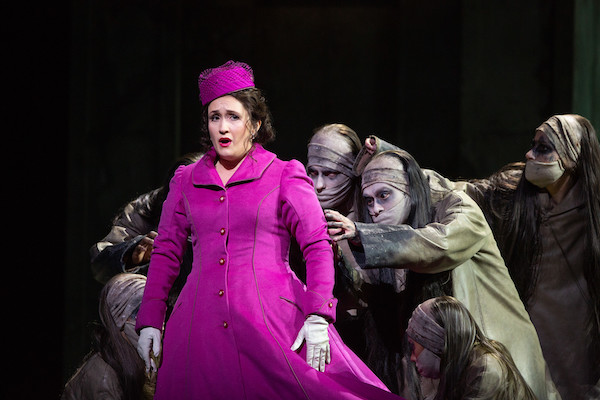
Eurydice in HD


Eurydice................Erin Morley (soprano)
Orpheus.................Joshua Hopkins (baritone)
Orpheus’s Double....Jakub Józef Orlinski, countertenor 
Father.....................Nathan Berg (baritone)
Hades.....................Barry Banks (tenor)
Little Stone............Stacey Tappan (soprano)
Big Stone...............Ronnita Miller (mezzo)
Loud Stone............Chad Shelton (tenor)

Conductor............Yannick Nézet-Séguin 
Director................Mary Zimmerman 

The opera Eurydice by Matthew Aucoin on a libretto by Sarah Ruhl premiered in Los Angeles in 2020. It's based on a play by Sarah Ruhl and is in English. This is the Orpheus myth from the woman's point of view. It's a preferred topic for operas because it's about the power of music even over the gods. Orpheus can lure the gods into releasing Eurydice from hell. 

We are 20 minutes in and they have violated an important rule: there should be an aria, preferably for the soprano, in the first 10 minutes. So far just talky stuff. They tried all recitative operas at the beginning of opera, but it didn't work out. We go to hell and see Eurydice's father who still remembers life before death and how to read and write. He writes to Eurydice and sings about it. This is the closest we've come to an aria so far. 

Eurydice comes out in her bridal dress, and father watches her while he sinks back into the earth. Orpheus and Eurydice sing their vows, kiss and dance. Hades arrives and he has a conversation with Eurydice over the water cooler. He brings her the letter from her father. For me the lyrical bits don't go on nearly long enough. Eurydice goes off with Hades and Orpheus comes looking for her. 

I'm sorry. This just isn't happening for me.

Saturday, October 23, 2021

Fire Shut Up in My Bones in HD

 
Charles, Father's girl friend, Billie, Father
 
Co-Directors:.. James Robinson and Camille A. Brown
Conductor: ......Yannick Nézet-Séguin 

Destiny/Loneliness/Greta:  Angel Blue
Billie, Charles' mother: .....Latonia Moore 
Charles: ...........................Will Liverman 
Char'es-Baby: .................Walter Russell III

Fire Shut Up in My Bones, 2019,  by Terence Blanchard on a libretto by Kasi Lemmons was shown in HD from the Metropolitan Opera today.  I'm sorry.  This didn't happen for me.  The singers were excellent, especially Angel Blue whom I very much admire, but I didn't enjoy the music.  That's the make or break for me.

I have decided to add more comments.  I tend to shy away from cruelty and crime within families.  I don't watch Law and Order SVU because it's all about the personal.  I never go to Madama Butterfly because it is about cruelty in intimacy.  Political and financial crimes don't bother me at all, but people abusing the innocent is just something I would rather not see.  The sexual abuse of children is the worst category.


Friday, July 23, 2021

Saariaho's Innocence


Conductor: Susanna Mälkki 
Production:  Simon Stone

Waitress:  Magdalena Kožená, 
Mother-in-law: Sandrine Piau,  \   Groom's parents
Father-in-law: Tuomas Pursio,  /
Bride: Lilian Farahani, 
Groom:  Markus Nykänen, 
Priest:  Jukka Rasilainen, 
Teacher:  Lucy Shelton

Kaaija Saariaho's new opera in 5 acts without intermission is called Innocence.  There is a film available from Aix en Provence which runs under 2 hours.  

Something terrible has happened before the start of the opera.  Research tells me that there are two groups:  The wedding party, and the teacher and her students who were present at a shooting that took place at their school 10 years before.  [It is strange to me that I am watching this on the 10th anniversary of a shooting in Oslo--irrelevant, or perhaps not.]  I found this in a review, and without it I would have had a hard time figuring out what was going on.

The father talks about another son he had and how he taught him how to shoot. This is dense and very complicated.  I think that they are reliving the tragedy.  This would be more possible with English subtitles. 

Attempt at a plot summary:  ten years ago at the International School in Helsinki one of the students stole his father's gun and shot a number of his fellow students.  Quite by accident the Waitress is serving a wedding in modern times.  Her daughter was one of the victims, and she recognizes the family.  The Groom is the brother of the boy who killed the others, including her daughter.  We learn that the murderer is out of jail and has been given another identity because he was a child at the time of the incident.  The Groom has not told his bride, whom he met in Bucharest.

The subtitles are in French, but I am hearing English occasionally.  One character speaks German. Some speak French.  Some characters change languages.  I hear other languages which I do not speak.

Some are wearing microphones:  the ones who only speak and the teacher.  The wedding party have no microphones.  I guess and suggest that this distinguishes people from the present from people from the past.

This is a story of modern times, a story where people think of shooting others around them.  Perhaps it is a suitable subject for an opera.  The thing I have seen recently which most resembles this is the recent production of Die Tote Stadt.  We seem to change from one reality to another with no transitions.  At the end everyone goes off on their own.

It's deeply gripping and very relevant.  I was drawn to it, but I would need more explanation and English subtitles.

Read more here.

____________________________________

It turns out it is more than a coincidence that I was reminded of the recent Korngold Die tote Stadt. The same guy directed both. Since I assign to the director the task of explaining the story, he is not focusing on that. 


Tuesday, January 26, 2021

Linda di Chamounix from Firenze


Conductor - Michele Gamba
Production - Cesare Lievi
 
Linda - Jessica Pratt
Pierotto - Teresa Iervolino
Carlo - Francesco Demuro
Antonio, Linda's father - Vittorio Prato
Maddalena, Linda's mother - Marina De Liso
Il Marchese di Boisfleury, Carlo's uncle - Fabio Capitanucci
Il Prefetto - Michele Pertusi
L'Intendente del feudo - Antonio Gares

Maggio Musicale Fiorentino brings us Donizetti's Linda di Chamounix, 1842.  There are subtitles, but they are in Italian.  The chorus and orchestra are wearing medical masks, so we may assume this performance is current, last week.  

Our heroine has just made her entrance and sings "O luce di quest'anima," the hit tune of this opera.  Well done.  Pierotto is a pants role, and his song does not appear to be part of the story.  Nevertheless, it's good.

There is a stereotypical plot element in this opera.  A male member of the upper class pretends to be poor so he can flirt with girls from the lower classes.  La Donna del Lago.  Rigoletto.  These are some other examples.  Linda is the daughter of tenant farmers in Chamounix, France, though her father is played as far too feeble to be a farmer.  Her boyfriend Carlo is the nephew of  the Marchese who owns the land where Linda's parents farm.  She, of course, does not know this.  I have no idea how Pierotto fits into the plot.
 
The Marchese wants Linda for some reason and will evict her parents if he cannot take her back to his palace.  This is a new twist.  The Prefetto tells her she must go to Paris with the boys for the winter to escape the Marchese.  Pierotto will take care of her.

The music is very beautiful.  In Act II Linda and Pierotto have a charming duet.  He explains to her that he has not been with her because he has been ill.  She explains that Carlo has been there to help her.  Pierotto leaves, and the Marchese arrivcs and tries to get her to go with him to his palace.  After he has gone, Carlo appears in a military uniform, and they sing of love.  He goes over to her and starts unbuttoning her clothing.  She falls on the floor and appears shocked.  Duet.  He leaves.  

It is convenient how each person appears one at a time.  Next comes padre.  She thinks maybe she should button her clothes before he recognizes her.  She reveals herself, he gets angry, Pierotto tells him and her that Carlo is the Viscount.  He gets really angry, curses her and leaves.

Enough plot.  People aren't behaving as they should.  The role of Linda is HUGE.  It all has a happy ending, which makes it lots less interesting than Lucia, I guess.  There's lots of talking.  You shouldn't expect it to enter standard repertoire any time soon, but it's enjoyable.  Lovely cast.
 

Friday, January 01, 2021

Three Decembers


Composer --  Jake Heggie
Librettist --  Gene Scheer from play by Terrence McNally
Conductor -- Christopher James Ray
Director -- Tara Branham

Madeline Mitchell, theater icon -- Susan Graham
Beatrice, Madeline's daughter -- Maya Kherani
Charlie, Madeline's son --  Efraín Solís

Heggie's Three Decembers premiered at the Houston Grand Opera in 2008. This performance streams from the San Jose Opera.  The singers are accompanied by two grand pianos.  The pianists wear masks and were separated by a sheet of plastic.

Christmas 1986

This part is just for people who have walked across the Golden Gate Bridge in San Francisco and then down into Sausalito.  As I have.  With son Chris.  We took the ferry back to the City.  This is Madeline's memory of their father on Christmas when he was still alive.  All three are on the same stage singing, but each is in a different place.  Mom has written a letter and kids are discussing it on the phone.  Mom is going to star in a Broadway musical.  Mom sends greetings to Charlie's gay lover, calling him Curt instead of Burt.  Burt has AIDS.  

Mom and daughter fight in a dressing room somewhere.  Then Charlie and Bea walk across the Golden Gate Bridge and complain about how cold it is.

This opera is socially distanced.  Each of the three characters has their own part of the stage, and they talk on the phone. 

1996

Burt has died.  Charlie is boxing up his stuff.  Mom sings him a lovely lullaby when he lays down to sleep.  Mom is taking Bea to the Tonys with her.  She expects to win.  The children sing about shoes as they prepare to accompany their mother to the Tonys.  When she finally arrives, they fight and Mom reveals that their dead sainted father was a drunk and jumped in front of the subway.  The children storm off, leaving her to go to the Tonys alone.

2006

Mom dies in her sleep, and everyone talks about her.  She appears to talk about herself.  She praises life, art, music and theater, all things that I love, too.  Susan Graham is in her element.

It streams to the end of January from San Jose Opera.

Tuesday, November 17, 2020

Die Vögel


Conductor: Ingo Metzmacher
Production: Frank Castorf

Prometheus: Wolfgang Koch (baritone)
Wiedhopf, einstens ein Mensch, nun König der Vögel [hoopoe; once a person, now king of the birds]  Günter Papendell (baritone)
Nachtigall [nightingale] Caroline Wettergreen (soprano)
Zaunschlüpfer [wren] Emily Pogorelc (soprano)
1. Drossel [thrush] Yajie Zhang (soprano)
2. Drossel [thrush] Eliza Boom (soprano)
Adler [eagle] Bálint Szabó (bass)
Rabe [raven] Theodore Platt (bass)
Flamingo [] George Vîrban (tenor)
Hoffegut [Good Hope] Charles Workman (tenor)
Ratefreund [Loyal Friend] Michael Nagy (bass)

Die Vögel [The Birds], 1920, by Walter Braunfels, after Aristophanes, comes to me from the Bayerische Staatsoper München, Germany, from this year.  It's 100 years old and was popular in its day. 

This opera appears to be about politics.  Two human guys, Hoffegut and Ratefreund, come looking for the king of the birds, Wiedhopf, to talk him into overthrowing the gods by building a city in the sky.  He was once a human and probably carries some of this desire for dominance with him from the human state.   The humans wear their regie uniforms of black suits.  The birds all have fancy feathers, including Wiedhopf.  The sets only suggest human life and never bird life.  It looks like a construction site, perhaps suggesting that building a city in the sky is already under way.

Spoiler Alert!  Aristophanes writes that the birds replace Zeus and become rulers of the world.  This band of birds fail in their quest.

I liked everything about the Nightingale, her voice, her costume, the music for her character, and so forth.  She is a modern day coloratura soprano.  Hoffegut courts her in an extended scene, but I don't think she's buying it.  Alfred Hitchcock makes an appearance.  You remember he had a movie called The Birds.  It's a horror film which this is not.  Briefly scenes from the movie appear.  Another reference is to a rock group called THE BYRDS poster in English.

A man enters in a NAZI uniform.  This appears to be Ratefreund.  There are long stretches with no singing which are filled up with political activities.  Two pigeons are to get married.  Clearly the opera allows for much range of interpretations, and this one is dark.  Perhaps birds and humans cannot cheerfully mix.

Finally a man with a gray beard is announced.  This at last is Prometheus.  Wolfgang Koch is magnificent in this role.  The dream fails.  They praise Zeus once again and return to the city.

The music is rather heavy neo-romanticism.  Only the nightingale brought lightness of feeling.  She returns at the end.


Wednesday, September 30, 2020

Weber's Euryanthe


Conductor- Constantin Trinks
Director- Christof Loy

Euryanthe- Jacquelyn Wagner, soprano
Count Adolar, her betrothed- Norman Reinhardt, tenor
Eglantine- Theresa Kronthaler, soprano
Count Lysiart- Andrew Foster-Williams, baritone
King Louis VI- Stefan Cerny, bass

Weber's Euryanthe, 1823, comes to me from Operavision. The performance is Theater an der Wien, Vienna, in 2018.  It's unusual for an early German language opera because there is no spoken dialog.  We seem to be getting orchestral recitative.

Women's costumes are from the 1950s.  We are in a large room with windows on the left and a door at the back, containing only a small hospital bed and a grand piano.Throughout the opera a super plays the queen.

Adolar loves Euryanthe and praises her purity.  Lysiart says purity is not to be found among women.  They argue and make a bet.  The King must hold the proofs of the bet.  They all just look like business men in dark suits.

A blond woman enters and sings about her Adolar.  She must be Euryanthe.  And the dark haired woman must be Eglantine.  Euryanthe has rescued Egalantine, but despite this she still tries to ruin Euryanthe's life by betraying her.  Because she too loves Adolar.  The music is very serene.  If you didn't know what was going on, would you guess it was this?  Egalantine has a nice rage aria to liven things up.  

At the beginning of Act II we have an extended male nude scene with Lysiart.  The lighting and camera angles are carefully managed to blunt the effect of this.  Why do it if you can't see it?  This is an opera about violent jealousy.  The two villians, Eglantine and Lysiart sing an extended duet where they swear revenge on Euryanthe.  At the end of Act II Eglantine is seen banging away theatrically on the piano.  I don't really hear a piano.  They blame Euryanthe for revealing a secret she has sworn to keep, and she runs out.  Even Adolar rejects her.  The secret is personal, so I don't see what the fuss is about.  Adolar's sister Emma has killed herself and her ghost still roams.  She needs the tears of an innocent to put her soul to rest.

Act III same room, no furniture.  They're supposed to be outdoors and attacked by a giant serpent.  Instead we're still in the same white room.  There are no hit tunes in this opera, but there is a very nice hunting chorus with horns.  This is Weber, after all.

The scene changes, and the hospital bed is back.  This production explains nothing.  Eglantine is marrying Lysiart, who appears to love her.  They sing about roses, but the flowers appear to be lilies.  Eglantine is killed, and Euryanthe marries Adolar.  Emma goes to her rest.

The women have all the fun in this opera.  The villain is a woman.  Small people with evil passions, but good wins in the end.


Friday, August 21, 2020

Gloriana


Stage director.....David McVicar
Conductor..........Ivor Bolton

Queen Elizabeth I........................Anna Caterina Antonacci
Robert Devereux, Earl of Essex...Leonardo Capalbo
Frances, Countess of Essex..........Paula Murrihy
Charles Blount, Lord Mountjoy...Duncan Rock
Penelope, Lady Rich...................Sophie Bevan
Sir Robert Cecil..........................Leigh Melrose
Sir Walter Raleigh......................David Soar
Henry Cuffe................................Benedict Nelson

This production on medici.tv of Benjamin Britten's Gloriana comes from Teatro Real de Madrid, 2018.  The opera was composed to honor the coronation of Elizabeth II in 1953.  The queen herself came to the first performance.  It looks as you wish it to.  The costumes are magnificent.

The relationship between Elizabeth I and the Earl of Essex is well known.  Less well known is his rivalry with Lord Mountjoy.

There is a masque portraying Concord dancing.  I am fascinated to see that this female role is played by a man in drag.  Accurately in short.  All the dancers are guys.  It's fun.  All is to glorify the Queen who adores it.

The star of this production is Anna Catarina Antonacci whom I have seen in Carmen with Kaufmann, in La Ciociara by Marco Tutino in San Francisco, in Sancta Susanna by Paul Hindemith at the Paris Opera, and in La Voix humaine by Poulenc in San Francisco.  This is a wonderful variety of roles all performed by a great singing actress.  There is great range in her portrayals, and that certainly is true here as well.  Her Elizabeth is mature.

Here we see Essex and Mountjoy plotting treason against the Queen.  Other versions slant the story more in favor of Essex. I'm fascinated that with the inclusion of period musical forms Britten is trying to bring the past to us.  The music is still Benjamin Britten and not Elizabeth's time.  There is a gathering of the court for entertainment, and Essex has brought his wife dressed more beautifully than the Queen.  Elizabeth orders the women to change their attire and steals Frances's dress.  When everyone reappears, Elizabeth is wearing the beautiful dress which she declares too long.  It is surprising that at this moment she sends Essex off to Ireland.  The scene ends with yet another dance.

In the next scene Essex returns from Ireland offering a truce.  The Queen wanted victory, not a truce.  There is something stunning about this.  The use of musical forms to frame the scenes is very attractive.  Why have I never seen it before?  I feel they are trying to show the truth, very rare in an opera.

Thursday, July 09, 2020

Hamilton Disney+


Jonathan Groff - King George III
Daveed Diggs - Marquis de Lafayette and Thomas Jefferson
Leslie Odom Jr. - Aaron Burr
Lin-Manuel Miranda - Alexander Hamilton
Phillipa Soo - Eliza Hamilton, wife of Hamilton
Renée Elise Goldsberry - Angelica Schuyler, sister of Eliza?
Christopher Jackson - George Washington

I am watching the Disney+ version of Hamilton, 2020.  This is not a movie of a musical like The King and I, but rather a movie of a live performance of the musical.  You are there.  The guys above are the USA founding fathers.  The guy on the left is Aaron Burr and next is Alexander Hamilton.  They are in their uniforms for the revolutionary war.  No wigs, and certainly no racial makeup.  Each actor looks like they would look on the street.

The plot runs from when Hamilton is studying law and runs through the duel where he dies.

Lin-Manuel Miranda both created this and plays the main character.  The content is astounding, but it goes by so fast that some plot points are lost.  My version doesn't include text.  The quality of the reproduction is excellent.  I have another copy but it's the usual too loud orchestra and fuzzy diction.  The Disney+ version is much better.

I can see the attraction.  It may be the most American thing that ever existed.  It's an opera because there's almost no talking.  Constant singing is opera.  Rap replaces recitative.  I don't know if I will ever feel the urge to see it again, but if you are American, you will need this.  I don't know what other people make of it.

Burr knows he will be remembered only as the man who killed Alexander Hamilton.

Friday, March 20, 2020

Korngold's Das Wunder der Heliane

Conductor: Marc Albrecht 
Stage director:  Christof Loy  

Heliane: Sara Jakubiak
The Ruler, her husband: Josef Wagner
The Stranger: Brian Jagde
The Messenger: Okka Von der Damerau
The Doorman: Derek Welton
The Blind Judge: Burkhard Ulrich
The Young Man: Gideon Poppe

From Deutsche Oper Berlin from 2018 on Medici.tv we have Korngold's Das Wunder der Heliane, 1927.  I am watching it because Lotte Lehmann said Heliane was her favorite role.  It is the outer extreme of post Romanticism.

In Act I there are three characters:  The Stranger, the Ruler and his wife Heliane.  She is the only one with an actual name.  The Ruler is pissed because his wife doesn't love him.  So he kills anyone who seems happy, including The Stranger who wanders into town and cheers people up.  While he is in jail awaiting his execution, Heliane comes in to comfort him.  She announces herself as the Queen.  This is one of the wildest scenes in opera.  At The Stranger's request she first takes down her hair, then takes off her shoes, and finally takes off everything else.  Is this part of comforting?  So did Lotte like the nudity?  Husband comes back and things go from bad to worse.  The music is very intense.

In Act II Heliane is tried for being unfaithful to her husband.  The blind Judge enters, and both The Ruler and Heliane call him Father.  He speaks to Heliane as though she were a child, so I presume that he is her father.  She testifies in a long amazing aria "Ich ging zu ihm."


The Stranger comes into the courtroom and asks to be left alone for a moment with Heliane.  The King and the Judge allow this.  Our Stranger is very persuasive and gets Heliane to kiss him "for the first and last time."  She does, and he stabs himself and dies.

The chorus enters complaining that The Stranger has been taken from them.  She tells her husband she is pure and he decides that if she is pure she will bring The Stranger back to life.  The act ends with her swearing that she will.

The ending in Act III is complex.  The Stranger rises from the dead, but this only enrages the King who stabs his wife.  You should know it has a happy ending.  What is one to make of such a thing?  They played it very low key, but the music is large and soaring.  I'm glad I took the time to see it.


Sunday, January 26, 2020

Bones of Girls


Composer:  Ryan Suleiman
Librettist:  Cristina Fries
Pianist, music director:  Jennifer Reason
Director:  Omari Tau

Idiot Girl:  Carrie Hennessey  (puppeteers:  Gwenyth Alberto, Mara Patton)
Moon/Father:  Kevin Doherty
Dogs:  Omari Tau (puppeteers:  Ruhan Whittington, Jesse Raga)

Bones of Girls by Ryan Suleiman was given its world premier this weekend by Rogue Music Project in Sacramento.  I enjoyed this quite a lot, but it's going to be hard to explain.

They are in tune with their time.  The music, though scored only for piano, was densely modern.  Interesting remark in the lectures after the opera, "The words take a lot longer set to music."  This was a complaint from the composer.  If they want a lot more words with the same music, they shift to talking.  But no talking here.  That's a current fad.  There did not appear to be any vocal ensembles.  The three singers, Carrie Hennessey, Kevin Doherty and Omari Tau, a kind of priest-like character, sang well this somewhat difficult music.  They created their characters while being upstaged by children.

The story is something that is written about more recently than it was earlier in my lifetime.  A woman remembers sexual advances from her father when she was a child.  In this story he wishes to marry her.  She escapes.  We see this part of her life in a flashback. 

The staging was complex.  The chosen performance space isn't really suitable for a daytime performance, which is what I chose to attend.  The moon shines down, only here just in your imagination.

The four children who are the puppeteers play together before the opera begins.   The girls handle the child Idiot Girl who is quite attractive.  The boys are a pack of dogs as hand puppets.  It was complex and surprisingly moving.  The lively children at the beginning lie inert on the floor at the end.

I found it to be a quality product.

Sunday, December 29, 2019

The Snow Queen


Conductor Cornelius Meister
Production Andreas Kriegenburg 

Gerda Barbara Hannigan
Kay Rachael Wilson
Kay Thomas Gräßle
Grandmother/Old Lady/Finn Woman Katarina Dalayman
Snow Queen/Reindeer/Clock Peter Rose
Princess Caroline Wettergreen
Prince Dean Power
Forest Crow Kevin Conners
Castle Crow Owen Wil
  
The Snow Queen by Hans Abrahamsen from Denmark was written for Barbara Hannigan.  This is her Fach.  It is more of a sound scape than an opera, though the singing, in English, is reasonably pleasant.  Hannigan can sing anything.  It is dated 2019 and premiered in Copenhagen.  Here it streamed live on Saturday from the Bayerische Staatsoper.

As soon as two nurses appear, we know we are in a hospital of some kind.  There is snow everywhere, even inside.   To begin an older woman is reading to children about a queen bee in the snow.  Then the story shifts to people.  Gerda is trying to rescue her husband Kay.  The Snow Queen is a baritone.  Just go with it.

The star here is the orchestra who create a rather fascinating mixture of sounds that never settle into anything tonal.  It's very heavy on percussion.

We move into the forest where Gerda meets two crows, a Prince and a Princess.  They tell her they will help her, but she must rest.  This music is very pleasing.  Gerda is looking for Kay who lies quietly and stares.  Gerda and Kay have known one another since childhood.  This is communicated by showing younger people at different ages dressed in the same outfits.  One of the younger Kay characters sings but the adult Kay so far only stares.  Where did they find someone who could go so long without blinking?  There is an uncanny Barbara Hannigan look alike who says nothing.

Each character has multiple incarnations, but only one of each sings.  That means that most of the story telling comes from the production.  You could stage this completely differently.

Did I like it?  It's rather like a long tone poem.  I wouldn't need to do it again.  Barbara Hannigan was her usual magnificent self.

Saturday, November 23, 2019

Akhnaten in HD


👍🏻
Conductor.................Karen Kamensek
Production................Phelim McDermott

Akhnaten................Anthony Roth Costanzo (countertenor)
Nefertiti, his wife.....J'Nai Bridges (contralto)
Queen Tye, his mother...Dísella Lárusdóttir (soprano)
Amenhotep III, ghost of his father....Zachary James (speaking)
Aye, Nefertiti's father............Richard Bernstein (bass)
High Priest of Amon............Aaron Blake (tenor)
General Horemhab........Will Liverman (baritone)

This performance of Akhnaten from the Metropolitan Opera is my seventh opera by Philip Glass, the others being Einstein on the Beach (live), Satyagraha (live), Appomattox (live), The Perfect American, Orphée (live), and Hydrogen Jukebox (live).  Surely this must make me something of an expert.  All around me were experiencing a Glass opera for the first time.

The story is told on three levels.
  1. Captions appear on the screen describing what is going on in this scene.  "Coronation of Akhnaten" for example.  
  2. There is an English speaking narrator who represents the spirit of Amenhotep III and quotes characters from the opera.  
  3. Action by the singers and actors on the stage show the actions.
The narrative method of most operas is missing.  People in conversation telling their own emotions does not happen.  What does happen that I haven't seen before is juggling.  Everyone juggles.  Sometimes a juggler would drop his ball, and at the end they all do.  I was especially pleased to see an Egyptian tomb painting shown in the intermission of women juggling.  So does juggling belong in the list above?

Akhnaten was an idealist, obsessed with the sun, in love with his wife and wishing to separate himself from the politics of his era.  I felt that this music and theatrical presentation represented his life in a profound way that could not have been imagined, at least by me.

There was only one real aria for which text was provided:  The Hymn to the Sun by Akhnaten.  The singing was beautiful if completely abstract.  The costumes were gorgeous and represented the exalted nature of their status in Egypt.

As a Glass expert, I declare this to be his masterpiece.  Here is an excerpt from the "Hymn to the Sun."


Friday, October 25, 2019

The Bassarids


In honor of World Opera Day I have chosen to watch Henze's The Bassarids from the Komische Oper Berlin.  It both is and is supposed to be in English.

Conductor Vladimir Jurowski
Director Barrie Kosky

Dionysus, god-- Sean Panikkar, tenor
Pentheus, present king-- Günter Papendell, baritone
Cadmos, founder and former king-- Jens Larsen, bass
Tiresias, old blind prophet-- Ivan Turšić , tenor
Captain of the Royal Guard-- Tom Erik Lie, baritone
Agave, daughter of Cadmos-- Tanja Ariane Baumgartner, mezzo
Autonoe, daughter of Cadmos-- Vera-Lotte Böcker, soprano
Beroe, old slave-- Margarita Nekrasova, contralto

I've never actually seen an opera by Henze, so this seemed suitable.  We are in Thebes.  Semele is buried here, and a flame is kept burning for her.  While opera purports to be based on Greek theater, the plots generally come from other ancient sources.  This however is based on Euripides.  Imagine that.  It turns out to be a revenge opera.

The plot is hard to follow, at least at first.  Dionysus wishes to be worshiped, but the new young King Pentheus thinks this is childish.  Everyone runs off to the mountains when they hear Dionysus is coming.  Pentheus puts out the flame of Semele.  The king opposes the revelry that happens on the mountain and swears not to eat, drink or lie with women.  But then he has never been there, and knows nothing of what happens.

What makes this hard to follow is that we are not given much in the way of visual clues.  Tiresias must be identified by the fact that he wears dark glasses.  Everything else is the usual black and white regie costuming.  In the photo above the people in vivid outfits are ballet.  When Pentheus asks who leads the singing and dancing, a beautiful black man in a black suit stands up. This is my first time to see Sean Panikkar, an American.  He brings true expression to this angular modernist music.

To entertain themselves the Thebans perform The Judgement of Calliope.  This is the myth of Adonis.  Don't make me explain it.  And suddenly they're tearing off their clothes and running off.

We are immediately back to Pentheus and Dionysus fighting.  Dionysus persuades Pentheus to dress up like a woman.  He's having trouble with the high heels.  Dionysus uses his god power to control Pentheus.

Komische Oper Berlin is the right context for this work.  It is a small theater with a portion of the stage in front of the orchestra.  The pit is too small, so parts of the orchestra are at the sides of the stage. The music is like background music to a movie.  If viewed in this way, it works well.  It gets very intense to the end.  It ends with some beautiful music for Agave who kills her son while under the influence of Dionysus.  It is a kind of universal tragedy.  I thought worshiping Dionysus would be more fun.


Saturday, October 19, 2019

Cabaret Revival


Master of Ceremonies  Alan Cumming
Sally Bowles  Michelle Williams

I am viewing a film of the 2014 Broadway revival of Cabaret.  I can easily see why Alan Cumming won a Tony for this.  I also remember him saying when it ended how glad he was to never have to wear the costume again.

The music is stimulating, but as the show goes on, NAZI salutes and arm bands appear.  This is the real thing with all the ugliness left in, something that doesn't usually happen in movies.  The politics is hard to take, but I'm glad I saw this.

Tuesday, October 08, 2019

I masnadieri


Conductor Michele Mariotti
Staging David McVicar

Massimiliano, Count Moor..Michele Pertusi, bass
Carlo, his elder son......Fabio Sartori, tenor
Francesco, his younger son..Massimo Cavalletti, baritone
Amalia, his niece........Lisette Oropesa, soprano
Moser, priest...... Alessandro Spina, bass
Arminio, servant..Francesco Pittari, tenor
Rolla...Matteo Desole, baritone

This year Verdi's I masnadieri (The Bandits) was presented at La Scala.  We have taken notice because the female role is sung by Lisette Oropesa.

This traditional production completely violates my rules of portraying a plot.  The director's primary job is to explain the plot.  So who the hell is this guy in the military uniform that wanders around the stage in all these scenes?  Carlo before he became a bandit?  Francesco before he became a shit? Who?  Carlo is the fat guy.  So perhaps the director didn't like him and gave all his stuff to someone else.  Sigh.  I hate that.  He carries around a notebook where he occasionally writes, so the speculation is that he might be Schiller, the original writer of the story.

Lisette is spectacularly good in this, moving gently away from her soubrette Fach into full lyric repertoire.  I like her sound, her technique, her phrasing, anything else I can't think of.  She is developing into a truly wonderful singer.  This role was written for Jenny Lind who appears to have been a lyric soprano.  There is a lot of bombastic early Verdi singing throughout this opera, but the soprano is sweet and lyrical throughout.  It is an excellent role for Lisette.

The bandits seem to be having a lot of fun except for Carlo.  They leap and dance around. Francesco repents but the priest refuses to forgive him.  The silent writer comes to life and kills Francesco.  Then Amalia comes out and says that whether Carlo is an angel or a devil, she will always be his wife.  So then he kills her.  This plot is basically BS.

The male singers are all on the same page with the big Verdi sound.  The most applause was for Pertusi, Sartori and Oropesa, all well deserved.  I never have to see this opera again.  Just listening and ignoring the action is always an option.


Thursday, September 12, 2019

New Operas I liked

I keep a list of operas that are new to me, label ONew2Me.  Since I started the blog, I have seen 193 operas that were new to me.  Only 49 of these are operas that were themselves new within 5 years of my first viewing. That means their first performances were in 2000 or later.  Everything else was new to me before the blog.  Since my total list of operas seen ever as of 9/12/19 is 370, I could be doing a lot better.

Out of these 49 operas only 9 made my favorites for that year list. These are:


L'Amour de Loin Saariaho Finnish National Opera 10/28/2005 Peter Sellars Esa-Pekka Salonen
Tea: A Mirror of Soul Dun Santa Fe Opera 7/27/2007 Amon Miyamoto Lawrence Renes
Bonesetter's Daughter Wallace San Francisco Opera 9/26/2008 Chen Shi-Zheng Steven Sloane
Il Postino Catán LA Opera 11/26/2011 Ron Daniels Grant Gershon
Moby-Dick Heggie San Francisco Opera 10/22/2012 Leonard Foglia Patrick Summers
Ainadamar Golijov Opera Parallèle 2/17/2013 Brian Staufenbiel Nicole Paiement
27 Gordon Saint Louis 6/18/2014 James Robinson Michael Christie
Autumn Sonata Fagerlund Finnish National Opera 10/23/2017 Stéphane Braunschweig John Storgårds
Lessons in Love and Violence Benjamin ROH 5/26/2018 Katie Mitchell Benjamin
Marnie Muhly Metropolitan Opera 11/10/2018 Michael Mayer Robert Spano

It doesn't seem like much of a list. The dates are for the blog entries.  I haven't done a list for 2019 yet, but here are some candidates:

 
Bon Appétit! Hoiby Des Moines 7/18/2019

If I Were You Heggie San Francisco Opera 8/5/2019 Keturah Stickann Nicole Paiement
Breaking The Waves Mazzoli West Edge 8/11/2019 Mark Streshinsky Jonathan Khuner


I would welcome opinions on these.  Something might be omitted because it came before I began blogging.  Feel free to suggest others.


Saturday, August 31, 2019

Ice


Music Jaakko Kuusisto
Text Juhani Koivisto
Conductor: Jaakko Kuusisto
Director: Anna Kelo

Petter Kummel, priest: Ville Rusanen
Mona Kummel, his wife: Marjukka Tepponen
Sanna Kummel, his child: Sointu Wessmann
Anton, postal boatman:  Markus Groth
Sacristan: Jussi Merikanto
Irina Gyllen: Jenny Carlstedt
Adele Bergman Jenni Lättilä
Elis Bergman Pekka Kuivalainen
Artur Manström Hannu Niemelä
Lydia Manström Tiina Penttinen

Kuusisto's Ice is testing the theory that anything might be an opera.   It is by a Finnish composer, presented by the Finnish National Opera, is based on a Finnish book and is sung and also spoken in Finnish.  Nothing in Finnish sounds even remotely familiar to me.

We follow the ice through the seasons.  In winter it connects the two islands in the story.   The ice shapes their lives.  The mail boatman tells us of mystical beings that guide you over unsafe patches where the ice is thin.  The boatman is a speaking role, and the mystical beings that surround him are the ballet.

The story concerns a new priest, Petter Kummel, who arrives with his wife and child.  They exclaim over how beautiful it is.  Everyone warns them to beware of the danger in the ice.  He wants to cross the ice, the spirit creatures warn against it, but he pays no heed and dies.  He joins the other spirit creatures.

The music is filled up with homophonic chorus who sing "Shall we gather at the river?" in Finnish.  It all sounds just a bit like the other Finnish composer Saariaho with the mixture of orchestral and electronic sounds.

It is the production that makes this work.  It's a masterpiece.  I'm glad I watched this.  It's going away very soon.

Monday, August 26, 2019

Florencia en el Amazonas


Conductor: Christopher Allen
Stage Director: Nicholas Muni

Singers: Jennifer Schuler, Andrew René, Zoe Johnson, Matt Arnold, Jacob Wright, Karl Buttermann, Kathleen Felty. Lindsay Mecher, Cameron Jackson, Eric Powell

At last I have found a film of  Daniel Catán's opera Florencia en el Amazonas, 1996, from Stevens Center, Winston-Salem, North Carolina.  The strength of Daniel Catán's work is that he writes beautifully for the voice. This opera plays everywhere except somewhere near me.

She is going up river to visit the opera house at Manaus, the same house that Pavarotti visits in the film of the same name.  This part of the story is real.

Our Amazon is full of magical beings, people that disappear and things that go wrong.  And lots of big singing.  Florencia is a famous opera singer, and the boat she is traveling in is filled with fans who do not recognize her.  This includes Rosalba who hopes to interview her.  At the end of Act I there is a storm which eliminates some of the characters.

I would describe this opera as neo-verismo.  To make the best effect it requires first class singers.  These people are working too hard.  The set is dark throughout, and there were no subtitles. 

Saturday, August 24, 2019

The Yeomen of the Guard


Conductor:  Anne-Marie Endres
Director:  Debbie Baad
 
Our Cast
Sir Richard Cholmondely (Lieutenant of the Tower): Timothy Power
Colonel Fairfax (under sentence of death): Anthony Tavianini
Sergeant Meryll (of the Yeomen of the Guard): Mike Baad
Leonard Meryll (his Son): Samuel Palmer
Phoebe Meryll (his daughter): Paige Kelly
Jack Point (a Strolling Jester): Charlie Baad
Elsie Maynard (a Strolling Singer): Jadi Galloway
Wilfred Shadbolt (Head Jailer and Assistant Tormenter): Eric Piotrowski
Dame Carruthers (Housekeeper to the Tower): Lenore Sebastian
Kate (her Niece): Rebecca Cox


Gilbert and Sullivan's The Yeomen of the Guard played last night by the Sacramento Light Opera Theater.   If I stay in Sacramentlo long enough, Perhaps I will see them all.  This work is alternately called The Merryman and His Maid, which refers to the two strolling players. The action takes place inside the Tower of London during the reign of Henry VIII.  The yeomen guard the tower, as they do today.  They managed some excellent uniforms for them.

There is much to be explained here.  Some questions:
  • Why is Colonel Fairfax under sentence of death?  Wikipedia says sorcery.
  • What are Strolling players doing inside the Tower (not tourist attraction then)?
  • Why does Colonel Fairfax want to get married before he dies?  Wikipedia says doesn't like heir.
  • etc.

Plot:  Wilfred loves Phoebe, Phoebe loves Colonel Fairfax who is scheduled to die the next day.  Leonard wants Fairfax released because he saved his life in battle.  Leonard, his father and his sister hatch a plot where Leonard will hide and Fairfax will pretend to be him.  Phoebe steals the key from Wilfred and off we go.

Side story:  Fairfax wants to die married so his evil relation will not inherit his estate and offers a bribe to any woman who will marry him.  Elsie marries Fairfax in secret, Leonard hides and Fairfax appears in disguise as Leonard.

We end up with three happy couples and one very sad Jack Point.

The diction could have been better.  The songs were titled but the dialog was not.  I should have returned to the old days and read the plot before.  The music was excellent and well done.  My favorite singers were Anthony Tavianini and Jadi Galloway, the main couple.