Showing posts with label Recommended. Show all posts

Saturday, March 20, 2021

Dichterliebe

Sometimes I post films of music just because I love them.  This film of Jonas Kaufmann singing Schumann's Dichterliebe is an example.  I tried while I was still singing to fit in things that I wanted to perform.  Many I succeeded, but a few I did not.  I regret that I never sang Dichterliebe, a truly glorious cycle. I wanted very badly to play Orlovsky, but no one seems to have been able to picture me as a guy.  Sigh.

For me you cannot beat Jonas in Lieder.  My heart says this is the best.  Enjoy.

Jonas has said this before, and I've heard it from others as well.  Without an audience it's not the same.  If I could give him a hug, I certainly would.  Bravo.  There's no one like you.

Tuesday, March 31, 2020

Il Barbiere di Siviglia

👍🏻

Conductor...............Maurizio Benini
Production..............Bartlett Sher 

Figaro..................Peter Mattei
Rosina..................Joyce DiDonato
Count Almaviva....Juan Diego Flórez
Dr. Bartolo.............John Del Carlo
Don Basilio.............John Relyea

The Met is streaming Rossini's Il Barbiere di Siviglia that originally played in 2007 while I was driving across the country.  I don't seem to have had much enthusiasm for it, but seeing it now I like it a lot.  This is such a marvelous cast.  Every one is among the best in their class.  At this point in my life Mattei may be my favorite Figaro.  He plays the role with great vigor.  There is a strange, ghost-like man who wanders the stage.  The main trio are young and lively, great singers, actors, musicians.

This opera was originally called Almaviva and ended with the big aria usually heard as the finale to La Cenerantola, here sung by the tenor.  Later Rossini removed it from this opera and assigned it to Angiolina, a coloratura mezzo.  In modern times it is only rarely heard in Il Barbiere di Siviglia, and only when a company wishes to particularly honor a tenor.  Juan Diego's performance is excellent.

I find this is highly recommended.


Friday, December 14, 2018

Vivaldi Part II

👍🏻
Happy birthday to me.  This arrived just in time.  Thank you, dear.  The voice is as good as new.  Perhaps she is immortal, a goddess.  There is only one Bartoli. 

OMG.  Track 2 from Orlando Furioso is magnificent.  Spectacular phrasing.  Sigh.  She knows that it's all in the music.

The ensemble is completely with her.  They are Ensemble Matheus conducted by Jean-Christophe Spinosi. I hope you weren't expecting a regular review.

I wish you could see me smiling.
#ad

Thursday, November 29, 2018

Contrabandista

👍🏻
I first saw Javier Camarena in Zurich about a decade ago in Carmen.  I like him very much and have DVDs of him in Rossini's Otello and Le Comte Ory.  In his Fach (leggiero tenor) he is the best today.  This CD is an homage to Manuel Garcia, the famous tenor who was the father of Malibran and Viardot.  This homage is like similar ones in that Javier performs works from Garcia's singing repertoire.  In addition he also performs works by him; in fact fully half of the tracks are by Garcia.  The ones that sound familiar are all by Rossini.

One of the Rossini tracks is a duet from Armida with Cecilia Bartoli.  This is charming.  The recording may be regarded as a tour de force.

Cecilia Bartoli is listed as Mentor on this album.  Her orchestra Les Musiciens du Prince accompany conducted by Gianluca Capuano.
 #ad

Thursday, January 11, 2018

Die Fledermaus from Glyndebourne

Prince Orlofsky, Herr von Eisenstein
👍🏻
Conductor:  Vladimir Jurowski
Director:  Stephen Lawless

Gabriel von Eisenstein tenor/baritone Thomas Allen
Rosalinde, Eisenstein's wife soprano Pamela Armstrong
Adele, Rosalinde's maid soprano Lyubov Petrova
Alfred, a singer teacher tenor Pär Lindskog
Dr Falke, a notary baritone Håkan Hagegård
Dr Blind, a lawyer tenor Ragnar Ulfung
Frank, a prison governor baritone Artur Horn
Prince Orlofsky mezzo-soprano (en travesti) Malena Ernman

I'm always on the lookout for a good Die Fledermaus in German, and I have found one from Glyndebourne 2003.  The deutsche Ausprache [German diction] is excellent.  It is for a long time commonplace to change the book for Fledermaus.  If you see 3 of them from 3 different places, the story will use 3 different versions of the spoken dialog, and I don't mean because it was translated.  In this version they talk quite a lot, thus the importance of good diction, but they skip the part in act I where Dr Falke personally invites Rosalinde to Orlofsky's party.

This is truly an outstanding cast.  Thomas Allen is perfect for Eisenstein, both as singer and as actor.  He is both affectionate and a bit indifferent toward his wife.  There is a joke where he pretends to be a tenor by tuning his wife's piano down.  He knows she prefers tenors.  I like the Rosalinde very much.  The dialog makes clear that Rosalinde and Alfred were former colleagues in the musical theater.

It is mentioned more than once that Prince Orlofsky is 18 and bored.  Bored is nothing new, but I don't recall hearing how old he is.  And Malena Ernman may be the greatest of all cross-dressers.  Why did I not mention her in my cross-dressing discussion?  Partly because I haven't seen her that much.  She doesn't make it to the west coast.  Did you know she sings Olympia and Queen of the night?  I certainly didn't.  She enjoys very much the theatrical side of opera.  She goes around patting the men on the butt.  Genial.  She ornaments the final verse of "Chacun a son gout."  I don't recall ever seeing that.

The stage rotates to show the entertainment.  Doctor Falke reveals many things to Rosalinde about her husband, all of which she forgives, until he tells her that he is actually not a tenor.  Then she threatens to murder him.  Herr and Frau Eisenstein go immediately to the watch seduction which she already knows all about.  "You may remove my mask tomorrow at breakfast."  He answers "Morgen habe ich andere Sorgen."  [Tomorrow I have other problems.]  One of my favorite lines.  Tomorrow he will be in jail.  She steals his watch and leaves. The watch scene is reasonably amusing.

Now comes the Csárdás.  This is the wrong order but works fine.  "Brüderlein und Schwesterlein" for Falke and chorus is a personal favorite.  There's a guy taking photographs.  Oops.

On to the jail.  Frosch's long pantomime is cut.  All proceeds exactly as it should except Orlofsky removes his disguise and shows Malena Ernman.  I smile and sing along.  "Und mein Schlafrock?"  "Requisite."  [And my dressing gown?  Properties.]  In this version everyone is part of the revenge set up, which explains a lot.  A good English translation of the title would be Revenge of the Bat.  I do love it so.
#ad

Friday, August 25, 2017

Theodora from Glyndebourne

 👍🏻
Conductor:  William Christie
Director:  Peter Sellars

Theodora, a Christian of noble birth, soprano: Dawn Upshaw
Didymus, a Roman Officer, converted by and in love with Theodora, originally alto castrato, here countertenor:  David Daniels
Septimius, Roman soldier and friend to Didymus, tenor:  Richard Croft
Valens, President of Antioch, bass:  Frode Olsen
Irene, a Christian and friend of Theodora, mezzo-soprano:  Lorraine Hunt
Messenger, tenor:  Michael Hart-Davis

Someone said that Peter Sellars' production of Handel's Theodora was even better than his La Clemenza di Tito, so I thought I would give it a try.  He seems best in things that have religious themes.  This is one of Handel's oratorios and is in English.  This film is from 1996.

Hmmm.  There are soldiers and they wear American flags on their sleeves.  It's politics and religion rolled into one.  Christians are ordered to bow to idols to show loyalty to Caesar.  This is a  joy.  And then there is Lorraine Hunt.  It would be hard to ask for more.  He stages the first Christian scene like a prayer meeting, except women speak.  Lorraine sings of prosperity and people put money on the floor.  Many are in white and kneel on the floor to pray.  The chorus always present in any Handel oratorio represents the congregation.


Soldiers enter and warn the Christians that they are tempting fate.  "Dread the fruits of Christian folly."  This is not the usual oratorio libretto.   I understand it was not popular at its premier.  Oratorios usually draw their plots from either scripture or mythology.  Theodora is an historical Christian martyr.

I begin to grasp Peter Sellars' world view.  He sometimes strays too far from it.  He is THE outstanding American leader in the world of Regietheater, and this is one of his greatest works.  Among his productions, this one makes no alterations to the original text.

Apparently, honoring the Emperor consists of getting falling down drunk. So far I don't find this staging to be at all a distortion of the original.  People just look like people today instead of ancient Romans.  If this bothers you, you should get over it.

Christians are serious people while pagans are drunks seems to be the general idea.  One remembers this primarily for the work of Lorraine Hunt, but I am enjoying also Dawn Upshaw and David Daniels.  Theodora is in prison and Didymus visits her.  She asks him to kill her, but instead they exchange clothing and she escapes.

This is an extraordinary piece, deeply emotional.  One needs exposure to a wider range of Handel's works.  Here we still hear the Italian coloratura along side the more English lyricism and Handel's great choral music.

The picture above depicts the application of the death penalty.  The ending is sad and strange.  Christians wave their arms rather more than is strictly tolerable.   My experience of the Baroque does not include anything like this.  I came for Peter Sellars and Lorraine Hunt but ended with the joy of some of the most beautiful music of Handel I have ever heard.
#ad 

Sunday, July 23, 2017

Artaserse with 5 Countertenors

Artabano, Mandane, Arbace, Megabise, Artaserse, Semira.  I think.
👍🏻
Conductor–Diego Fasolis
Director--Silviu Purcărete

Artaserse, Prince and then King of Persia; friend of Arbace, in love with Semira--Philippe Jeroussky
Mandane, Sister of Artaserse; in love with Arbace (en travesti)                   -- Max Emanuel Cencic
Artabano, Prefect of the Royal Guard; father of Arbace and Semira            -- Juan Sancho
Arbace, Brother of Semira; Friend of Artaserse; in love with Mandane        -- Franco Fagioli
Semira, Sister of Arbace; in love with Artaserse (en travesti)                       --Valer Barna Sabadus
Megabise, General of the Persian Army, confidant of Artabano; in love with Semira --Yuriy Mynenko

This is a film of the opera Artaserse by Leonardo Vinci on a libretto by Metastasio which was first performed in Rome in 1730.  It was the last opera for Vinci who died that year, and the first for Metastasio.  Vinci is one of the great Baroque Italian composers whose operas are only now being revived.  Women were not allowed on the stage in Rome, so all the characters were originally sung by castrati except Artabano who is a tenor and the villain.  This performance exists to remind us that opera is an Italian art form.

All the castrati are here countertenors and some of the most famous countertenors of our time.  These guys are amazing.  The opening pair are Cencic and Fagioli, both incredible, and the music is gorgeous.  The range of colors in our 5 countertenors is pretty fascinating.  It remains to be seen if the fascination will wear off before the opera ends.  So far 6 Rossini tenors pales in comparison.  They have been assembled in Nancy in the west of France.

At the start there is some breaking of the fourth wall in case you missed that these are all guys.  Some start out in their modern clothing, for instance.  Stagehands appear, and all of them are girls.  Hmmm. These are theatrical stagehands--when the real stagehands appear, they are all men.

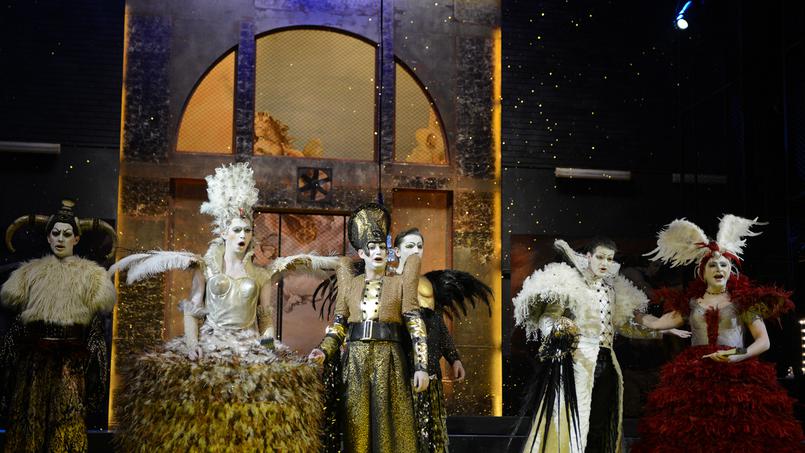
There is an attempt here to present Baroque costumes, though they seem to suddenly appear and disappear.  Now that Artaserse is king he appears in an incredible white wig with horns and a white outfit.  Then Artabano appears in the same outfit.  Jeroussky has the most beautiful voice, but there is much to admire here.  The most spectacular is probably Fagioli, but they're all pretty amazing.

Plot.  There is an offstage murder of the present king, Artaserse's brother.  This makes Artaserse king and causes a lot of accusations.  Artabano is probably to blame.  He and Megabise plot to marry Semira to Megabise instead of Artaserse.  Since the male characters all wear the same white outfit, it's very hard to keep track of who is who.  Some visual help would have been good.  Artabano tries to poison Artaserse, but when it appears that Arbace will drink the poison, Artabano confesses.  It has a happy ending, as do almost all opera seria.

What it is actually about is singing, of course.  If you are at all curious to know what Baroque opera was really like, this is probably your best opportunity.  This is the Italian Baroque opera and not the French version which had no castrati.  These guys belt it out in a way that is surprising.  It is a unique experience, unlike anything I have seen in all my years of going to the opera.


Jaroussky removes his hats and wigs as soon as possible, giving the impression that he doesn't much care for dressing up.  The tenor is banished.  All six characters return for a song at the end.  One of the "girls" brings out the conductor.  The music is spectacular, not just the singing.  Find a way to add this to your experience of opera.

#ad

Friday, June 23, 2017

Diana Damrau Meyerbeer


I bought Diana Damrau's new recording Meyerbeer Grand Opera because I am virtually unfamiliar with his work.  In 1988 I saw L'Africaine at the San Francisco Opera with Shirley Verrett and Placido Domingo.  I think this is the only Meyerbeer opera I have seen.

Diana is the perfect soprano for this album with her big voice and spectacular coloratura.  Meyerbeer was the principle composer of French Grand Opera, the dominant form of opera in the middle of the 19th century.  He focused on giant subjects suited for huge spectle.  She is the grandest diva we have today.

We have arias from 10 different operas in three languages.  There is pleasing variety.  For the lover of coloratura it is very highly recommended.

#ad

Saturday, April 15, 2017

All Who Wander


Jamie Barton won the Cardiff Singer of the World competition in 2013, including the Song Prize.  Then in 2015 she won the Richard Tucker Prize.  This cannot help but arouse ones curiosity.  So I bought her recording.

Mahler: [sung in German]

Rückert Lieder:
No. 1. Ich atmet' einen linden Duft
No. 2. Liebst du um Schönheit
No. 3. Blicke mir nicht in die Lieder
No. 4. Um Mitternacht
No. 5. Ich bin der Welt abhanden gekommen

Lieder und Gesänge aus der Jugendzeit, Book 2: No. 2. Ich ging mit Lust
Lieder und Gesänge aus der Jugendzeit, Book 1: No. 2. Erinnerung
Lieder und Gesänge aus der Jugendzeit, Book 3: No. 3. Scheiden und Meiden

Dvořák:  [sung in Czech]

Gypsy Songs, Op. 55, B. 104:
No. 1. Má píseň zas mi láskou zní
No. 2. Aj! Kterak trojhranec můj přerozkošně zvoní
No. 3. A les je tichý kolem kol
No. 4. Když mne stará matka zpívat, zpívat učívala
No. 5. Struna naladěna
No. 6. Široké rukávy a široké gatě
No. 7. Dejte klec jestřábu ze zlata ryzého

Sibelius:  [sung in Finnish]

Svarta rosor (Black Roses)
Säv, säv, susa (Reed, Reed, Rustle)
Flickan kom ifran sin alsklings mote (The girl returned from meeting her lover)
Kyssens hopp (Kiss's Hope)
Marssnon (The March Snow)
Var det en dröm? (Was it a dream?)

I suppose I enjoyed the Mahler most because I speak German and her diction is excellent.  And the Rückert Lieder are the most famous pieces on the album.  Some of the Dvořák also sounded familiar, but the Sibelius did not.

Why would you want this?  Because Jamie has one of the most beautiful dark mezzo voices I have ever heard, because she sings every song with great intelligence.  Every note is just as you would want it to be.  If you are charmed by beauty, listen to this.

Could we have more Mahler, please?
#ad 

Wednesday, April 05, 2017

Orphée et Eurydice

👍🏻
My education with regard to Gluck's Orfeo ed Euridice is woefully inadequate.  In part to compensate for this I have purchased this DVD of Orphée et Eurydice starring Vesselina Kasarova.  The other reason was to see more of Kasarova.

This is the version created by Hector Berlioz in 1859 for Pauline Viardot, making it a legitimate vehicle for a star like Kasarova.  The role in Italian was written for a castrato, and in French it is often sung by a haute-contre (French high tenor).  Only since 1950 has the role been taken by a countertenor.  At Glimmerglass I saw Michael Maniaci who bills as a male soprano.

The curious feature of this production is the genderless costuming.  Whatever style is on display, it is worn by both males and females.  I've always wondered what this would be like.  At first everyone is dressed in men's tuxedos.  The fires of hell are tended by laborers in bakers' hats. Then we see Greek outfits which look a bit odd on the men.  Then back to tuxedos.

An annoyingly large amount of time in this not that long opera is consumed by ballet.  If you are French, this probably is not a problem.  The chorus mimes an orchestra.  Vesselina does not play her violin, but she sings and acts gloriously.  To fully understand why Berlioz would make such an arrangement for Viardot requires that you see such a towering performer in the role of Orphée.  It is a tour de force.

#ad

Tuesday, January 03, 2017

Giulio Cesare

👍🏻
I watched the live stream of Handel's Giulio Cesare from Salzburg in Cecilia Bartoli's inaugural season as artistic director of the Whitsun Festival in 2012.  The production was enormously distracting, so much so that I wrote mostly about it.  There were crocodiles, a Rolls Royce, deals over oil wells, a fan dance, etc.  And occasional obscene gestures.

What I noticed less of was the incredibly gorgeous singing, especially by Cecilia Bartoli, Andreas Scholl, Anne Sofie von Otter, and Philippe Jaroussky, with Giovanni Antonini conducting.  Jaroussky is at his most beautiful, and his duet with Anne Sofie von Otter is emotional. 

In the past year the stream has become a DVD, and in the last month this DVD has received a Grammy nomination for best opera recording.  Does that happen?  I notice that of this year's 5 nominees, Król Roger and Giulio Cesare are DVDs. 

This is the standard for modern Baroque performance.

#ad

Friday, September 02, 2016

Verismo is Here


Folks.  It doesn't get better than this.  Tony is also in top form.  I like best the schmaltzy ones.  I'm sure others will be able to find a lot of words,  but I just let my heart go where it wants.

I love Anna.  She is one of my favorite singers.  The reasons are many, but it has to have begun with her incredible charisma.  I'm a long timer--my first encounter was a live performance of Ruslan and Lyudmila in San Francisco in 1995.  I love the sound of her voice and think it only becomes more beautiful and her technique more spectacular.  With this album she is at her peak.  Her heart is always present in the music.  For this she will live forever.


#ad

Monday, June 22, 2015

Semiramide CD

👍🏻
My first encounter with Anna Bonitatibus was in 2005 in Zurich where she sang Sesto in Giulio Cesare. From that day to this I have admired her work.

And now comes this amazing CD titled Semiramide.  Until the moment it appeared I had no idea this character appeared in so many operas.  She is a legendary Assyrian figure, sometimes an Amazon, sometimes a queen, perhaps real, perhaps only a legend.  The selection of pieces covers the history of Italian opera, from Caldara to Manuel Garcia the elder, all are masterfully presented by this great singer.  It is good enough to win the Opera Award for CD operatic recital.
#ad

Tuesday, November 25, 2014

Christmas Presents


This Kaufmann album of songs from German operettas would probably make good presents.  I very much prefer the far more serious Winterreise, but I am not really an average person.


This Netrebko album will be out in time for Christmas.  You can preorder now.


If your friends love Baroque, this Jaroussky album is the one.


Or perhaps they would like Baroque from an entirely new perspective.


For the lover of bel canto you will need Joyce DiDonato.


The Met didn't produce much this year so I recommend these Rossini albums.  I even liked the productions.  One is comedy and the other tragedy.


If your heart is only for Kaufmann, this is the best of the Verdi year.


#ad

Friday, May 16, 2014

Rossini's Otello on DVD

👍🏻
Conductor: Muhai Tang
Production: Moshe Leiser & Patrice Caurier

Otello: John Osborn, tenor
Desdemona: Cecilia Bartoli, mezzo (originally Isabella Colbran)
Elmiro (Desdemona's father): Peter Kálmán, baritone
Rodrigo (man chosen by Elmiro to marry Desdemona): Javier Camarena, tenor
Jago: Edgardo Rocha, tenor
Emilia (Jago's wife): Liliana Nikiteanu

This DVD of Rossini's Otello (1816) from the Zurich Opera records the same series of performances I reviewed here from a live stream on medici.tv.

The plot of this opera is not the same as Shakespeare or Verdi.  It is clearly an opera seria but shows none of the traditional traits.  Twelve years before La Muette de Portici changed opera forever, the two main characters die.  This was unheard of.  My researches tell me that this opera was provided with an alternate happy ending, but we in the English speaking world would be outraged.  There are four scenes.  All of the action takes place in Venice rather than Cyprus.

Act I
In the Doge's palace Otello is presented to the Doge as the hero of a recent battle where he recovers Cyprus for Venice.  He has already married Desdemona, but this is a secret.  Desdemona's father Elmiro has a candidate to marry her in Rodrigo.  Otello announces that he and Desdemona are already pledged to one another, enraging Elmiro.

In this version Desdemona contributes however innocently to her own doom.  She writes a letter to Otello and encloses a lock of her own hair, but the letter falls into her father's hands.  In order to prevent an argument with Elmiro she tells him the letter is intended for Rodrigo.  Jago tells this version to Otello who believes him.

Act II  Scene 1
We are in Desdemona's room in the palazzo. She tells Rodrigo she is Otello's wife. 

Act II Scene 2
We are in Otello's hangout, a dump with a pool table and refrigerator.  Not only is Otello black, but he is not from Desdemona's social class either.  There are simply too many things against him, hero or not.  There are small issues of continuity in this scene but they shouldn't distract from the incredible singing.  Jago stirs the pot.  The ever hovering Emilia is there to save the situation.  Desdemona has a mad scene here and pours beer over her head.  P.S. I now interpret this as defiance of her father who has come to take her home.

Act III
We are in Desdemona's room in the palazzo.  She writes "Nessun maggior dolore che ricordarsi del tempo felice"  ["Nothing is Sadder than the Memory of Happiness."] on the wall.  She sings a very beautiful rendition of the willow song.  She kisses Emilia because she knows she's doomed.  When Otello arrives, she is angry and defiant with him, very different from Verdi.  Otello kills her then himself.

John Osborn as Otello is in black-face.  Since race is the whole point of the story, this seems right.  Black-face is a comic minstrel tradition only in the United States, so criticizing a French/Swiss production for doing it would seem pretty silly.  It is shocking how much Otello hates Desdemona. 

Cecilia is taking on heavier repertoire these days, and Otello seems on the heavy end of her abilities but still well within her grasp.  She is very intense here.  Someone asked me about her the other day.  She was everywhere for a while and then suddenly she was gone.  I explained that her Columbia Artists Management manager moved back to Europe and she along with him.  I followed her there, at least in spirit, but for most Americans she ceased to exist.

This is an outstanding sample of her work now, her emotional intensity turned to serious drama.  This is bel canto at its most serious extreme.  For people who hate regie it won't work, but I'm not one of them.  Perhaps you aren't either.  Love it along with me.
#ad

Tuesday, April 08, 2014

Zurich Le Comte Ory

👍🏻
Timed perfectly to coincide with the opening night of Rossini's Otello in Paris, my DVDs of Le Comte Ory and Otello from Zurich (that is the Opera Awards winning Zurich Opera) have arrived.  Since I saw Otello stream on medici.tv, I am watching Ory first.

Conductor: Muhai Tang
Production: Moshe Leiser & Patrice Caurier (they are growing on me)

Le Comte Ory:  Javier Camerena
La Comtesse Adele:  Cecilia Bartoli
Isolier (Ory's page):  Rebeca Olvera (Adalgisa in Cecilia's Norma at Salzburg)
Ragonde (La Comtesse's companion):  Liliana Nikiteanu
Le Gouverneur (Ory's tutor):  Ugo Guagliardo
Raimbaud (Ory's co-conspirator):  Oliver Widmer

The opera begins with Ory and his assistant Raimbaud brushing their teeth in flip flops and shorts.  Then they go into the trailer and Ory changes into his outfit as a blind hermit who lures young women.  The men of the town are away on crusade and have left a token force at home to guard the women.  Cough, cough.


I notice I said that Florez did not get an aria at the Met, but here Camarena opens the opera with a lovely aria which he sings in his blind hermit outfit.

Cecilia drives up to visit Ory in a blue Peugeot, called an Ente when I lived in Germany.  I have been searching diligently for a photo of Cecilia in her entrance outfit, in vain.  She has her hair back, steel rim glasses, a fancy collar, white pearl earrings, a dark suit, a handbag and a pair of white gloves, in every way the perfect woman of 1959.  I love this.  Rebeca Olvera in her soldier's outfit as Isolier is also adorable.  This is as close as I could get. 


I find the plot much easier to follow here, and less offensive for some reason.  Perhaps hanky panky among the moderns seems better.  It actually seems funny.  Camarena plays everything straight which makes him seem less slimy.  Pardon me.  I hated the Met version, didn't laugh even once.

In the castle the women are holding up a picture of Charles de Gaulle who was president of France from 1959 to 1969.  We may presume that the husbands are off fighting in Algeria.  I was ready to throw this opera out on its ass, but this is charming.  Bartoli and Camarena are marvelous in French, very suave and cute.  Musically it could not be more sweet and graceful.  This is, of course, the new critical edition, and the Met used the old souped up romantic edition.  I am in danger of becoming a convert.  Perhaps this lightness and graceful subtlety is due at least in part to the lighter orchestration obvious here.  The orchestra is La Scintilla.

The staging of the bedroom trio was also very much superior.  It is clear here that Isolier and the Countess are conspiring against Ory.  They exchange clothing, and Isolier places the Countess lovingly on the floor where it is presumed a mere page would lie.  There is no ambiguity about what is going on. 

Everything is staged and sung, and indeed played to perfection.  If you want an Ory, try this one.

And now the prompter has crawled out of his hole in the floor and is receiving a bow.  That generally means his services were needed.  He faces upstage until one of the actors turns him toward the audience.

Try Presto Classical for early releases of classical material.  If you doubted my psychic abilities, please review this post from 2012.
#ad

Thursday, March 13, 2014

Porgy and Bess from San Francisco


The San Francisco Opera has released on DVD and Blue Ray their 2009 Porgy and Bess that I praised so highly here. This is the Eric Owens Porgy and Laquita Mitchell Bess. It was the experience of a lifetime.
#ad

Saturday, March 08, 2014

Winterreise

👍🏻
For me opera came last. There was Bach first. And then came Lieder. "Die Blumen sind verstorben." I am perhaps too depressed for this. It is so intense. Afterward one should go out into the cold and cry. "Wo find ich gruenes Grass?"  We have finally had some days of rain so at least the grass is green here.  In California it's green in winter and brown in summer.

We have come to the one I know. "Am Brunnen vor dem Tore da steht ein Lindenbaum."  I see the gate and the tree.

The idea of an art song came from Schubert. The idea is that the piano and the singer are one, that the song exists exactly as it is, that you, pianist and singer, must make it yours without altering even the smallest thing. 

Before that there was tune and figured bass. Modern song making is much like that. Take this broad outline, these words and outline of chords and make of them your own song. It rises and falls with you and your imagination. But with Schubert you have only your heart to make it music.

And Winterreise is the peak.  We see the gray landscape he has painted and feel the emptiness of loss.

This is how German is supposed to sound.  Think how easy it is to understand. The Lieder music is perhaps the closest to my own soul, touches my musical heart in its deepest place.  It's as though to actually know Jonas Kaufmann would make it too personal.  It is already too personal.

He is the singing artist of today and is at his peak now.  We believe when he sings them the most bizarre things.  Puccini even.  But here he is at home in his own land, his own language, his own music. 

He is singing about a crow that is following him.  It's very creepy.  I haven't seen very much written about this, so I will have to make up my own mind.  I often reject Lieder recitals because it is not as I would have sung them.  I only wish I could have made anything this perfect.

#ad

Friday, February 21, 2014

Jaroussky Farinelli


This is an album of arias and duets by Nicola Porpora which were composed for the castrato Farinelli.  Porpora was famous as the great trainer of castrati, including, of course, Farinelli.  He was born in Naples in the middle of the early days of the Neapolitan opera school.

The album includes 11 tracks, 2 with Cecilia Bartoli, 7 of which are world premiere recordings.  The very long aria "Alto Giove" is apparently not one of the world premieres, but it is very beautiful in Jaroussky's voice.

The duets are lovely.  Cecilia generally sings soprano to his alto.  I especially love the second duet "La Gioia Ch'Io Sento" which bursts upon us unexpectedly.  It is all very very sweet.  Have a little sweetness in your life.

#ad

Sunday, December 29, 2013

Stream La Forza del Destino from Munich

Papa, Don Carlo, Leonora, Curra, priest, servant
👍🏻
Conductor Asher Fisch
Production Martin Kušej

Il Marchese di Calatrava / Padre Guardiano: Vitalij Kowaljow
Donna Leonora: Anja Harteros
Don Carlo di Vargas: Ludovic Tézier
Don Alvaro: Jonas Kaufmann
Preziosilla: Nadia Krasteva
Fra Melitone: Renato Girolami
Curra: Heike Grötzinger
Un alcade: Christian Rieger
Mastro Trabuco: Francesco Petrozzi
Un chirurgo: Rafał Pawnuk

I'm having trouble deciding how to approach this writing. I have some very specific memories of this opera that I would like to share. This was Leontyne Price's second opera--Aida and then Forza--so I saw it live with her at the San Francisco Opera and on tv from the Met as part of her farewell from staged opera performances.

Then I remember being a flunky in it in Germany, kneeling on the floor in excruciating pain. We performed it in German.  We performed everything in German.

Or should I talk about the table shown above?  This table shows up in almost every scene with different numbers of chairs surrounding it.  Each person is assigned a place even when they are not in their assigned chair.  We presume that the chair with its back to us is for Don Alvaro who shows up late.  The accidental shooting was well staged.  This is usually confusing for the audience.  In each scene there are different numbers of chairs around the table and different singers.  Papa and the Padre are the same singer.

In the next scene years later we see Don Carlo in his green sweater and glasses at first, and then he changes into military clothing.  This is so we can follow who this is in the rest of the opera.

The music is wonderful, but the opera is too long. You lose interest, or at least I do, when the soprano is missing for scene after scene.

Pride of place in the bows and most enthusiasm in the applause went to Anja Harteros.  Is it possible to explain her?  Her voice is not beautiful, but it's beautiful enough.  In most Verdi you are not really looking for beauty.  Maria Callas' voice was also not beautiful.  Nor is Sondra Radvanovsky's, Anja's only real rival today.  I prefer Anja.  For me she has more emotional range, draws me in to the scene more.

Kaufmann and Tézier are well matched.  I can't help it, I want the duets to be with the soprano.  She dies at the end with a pathetic lack of excitement.  I used to blame the lack of popularity of this opera on the opening scene, but now I think it's the whole thing.  It just doesn't work.

I was viewing from a Mac in Ohio, and the stream was very jerky.  I haven't had that problem at home.

P.S.  I didn't mind the production.

#ad