I wanted to see Tosca, but the recent one from the Met is too soon for me. Besides it was just ok. I looked around and found this amazing one from the Wiener Staatsoper 2016.
Conductor: Jesus Lopez Cobos
Stage Designer: Nicola Benois
Tosca: Angela Gheorghiu,
Cavaradossi: Jonas Kaufmann,
Scarpia: Bryn Terfel
Bryn is astounding. I've seem him in a variety of roles--Falstaff, Méphistophélès, Figaro, Wotan, etc. --, but this is not the Bryn I know. He roars and terrifies. Perhaps Scarpia should always be like this. He's peeling fruit while he interviews Cavaradossi.
Jonas is the great romantic hero of our time, and is perfect in this role. He receives extended applause for his aria at the beginning of the third act. In fact he gets an encore here. This is the performance where Angela missed her cue. I'm very surprised they left it in. Maybe you could get an edited version. Because it's funny but spoils an otherwise fabulous performance.
I recommend this. All are on the same page, with great intensity and beautiful singing.
Les Contes d'Hoffmann from Paris, 2016. I'm watching this because I'm a huge fan of Stéphanie d'Oustrac. She's doing the male-Nicklausse/female-Muse thing with great expertise.
Our Olympia treats us to a bit of pseudo-nudity before being shockingly disassembled. She is fun.
There are no titles. This is what going to the opera used to be like. Perhaps this is why opera has shifted its values toward the theatrical. They used to just stand around singing. Nobody really knew more than just vaguely what was going on. Now everyone acts.
In the Antonia act we are in a theater orchestra pit, where she steals the conductor's score. Her aria is my favorite part of the opera. Her mother appears on the stage above, Antonia runs about trying to get up on the stage, and finally she succeeds. This segment of the story is confusing. In opera everyone sings all the time. So Antonia is told if she sings she will die. She sings. She dies. But how do we tell which singing is the singing that kills her? The orchestra appears in the pit and the act ends.
Now we are in the audience of the same theater? Nicklausse and Giulietta sing the barcarole from the seats. The audience files in and begins making out with one other. This is Paris where there seems always to be hanky-panky on the stage. Being in the chorus there is a whole different thing. We're supposed to be in Venice.
When all Hoffmann's loves are gone, the muse returns. I loved only the one I came to see. For the bows she changes quickly back into her Nicklausse outfit. Enjoyable if not very romantic.
This is the list of HD broadcasts this season from the Metropolitan Opera shown in reverse order. Because the season was cut short, I saw only six operas. They were nevertheless an amazing set of operas.
👍🏻Agrippina by Handel. From 1709 this is the oldest opera ever presented at the Met. It Starred Joyce DiDonato, Kate Lindsey and Brenda Rae in a new production by David McVicar. Considering the Met's lack of experience in Baroque opera, it was excellent.
👍🏻Porgy and Bess by Gershwin in a new production by James Robinson, starring Eric Owens and Angel Blue. This was an enormous hit. Performances were added and encores of the live in HD were added in the following 2 weeks.
Wozzeck by Berg. The William Kentridge production was new at the Met, but came originally from Salzburg. Peter Mattei starred. I had already seen the production which took some of the excitement out of it for me.
👍🏻Akhnaten by Glass. Phelim McDermott created the very abstract new production. It was long and included a lot of juggling. I found it much more interesting than I thought I would. In fact it was so popular the Met has arranged to bring it back in 2022.
Manon by Massenet. with Lisette Oropesa. Revival. This production by Laurent Pelly was new with Anna Netrebko. This is a good role for Lisette.
Turandot by Puccini. Revival of the ever popular Zeffirelli production. Christine Goerke and Yusif Eyvazov. Perhaps I've seen this too many times.
All of these were very good, but one and two exceeded all expectations:
Porgy and Bess
Akhnaten
Agrippina
Manon
Turandot
Wozzeck
Neither one of these starred one of the great names of today, and neither one is a frequently performed opera.
Joyce DiDonato Romeo
Olga Kulchynska Giulietta
Benjamin Bernheim Tebaldo
Roberto Lorenzi Lorenzo
Alexei Botnarciuc Capellio
Gieorgij Puchalski The companion
Everyone is streaming these days. Today was Bellini's I Capuleti e i Montecchi from the Zurich opera in 2015. Joyce performed this role in 2012 in San Francisco, but it is rather astounding how much more intense she is here. There's something about watching opera two feet from your eyes that makes it seem more personal, more real. Her Romeo here is intensely emotional, far more than the other characters on the stage.
Background tells us that there are two R&J operas: Gounod's and Bellini's. Gounod's opera is French and derives from the Shakespeare play. The Italian Bellini designs his play around Italian history. I previously wrote: "We studied the Guelphs and Ghibellines in my class in Florence. The
Guelphs, represented here by Giuletta's family the Capuleti, support the
Pope, and the Ghibellines, represented here by Romeo's faction the
Montecchi, support the Holy Roman Empire. So you see it isn't just two
families that don't like each other. It's a war that went on in Italy
from 1140 to 1289."
Christof Loy has made of this history a minimalist regie production with the usual black suits for all the male characters. The women all seem to wear white dresses which we confuse with wedding dresses.
There is one other regie feature--The companion. He's an androgynous figure with long hair who dresses sometimes in a black suit and other times in a black dress. He says nothing but seems to fill holes in the plot. When Romeo pulls a gun and tries to get Tebaldo to shoot him, The companion disposes of the gun. When Giulietta needs lifting, he is there to do the job. [Why do directors assume that tenors can lift sopranos?]
You want this opera for the music. It is glorious here, beautifully conducted and beautifully sung.
The daily rerun from the Metropolitan Opera is Puccini's La Rondine with Angela Gheorghiu and Roberto Alagna. Now I know that the maid Lisette is played by Lisette Oropesa who is far more famous today. It is lovely to see her.
Wonderful things in Act I: Angela's lightness and enthusiasm, Roberto's youthfulness, the gorgeous art nouveau set, the aria, Lisette's charm. Not so wonderful is the sharp decline in the voice of Sam Ramey from earlier years. At his peak I loved him madly, but here not so much. Prunier the poet says he wants Salome or Berenice, larger than life women. Magda is a kept woman, but sneaks out of the house looking for love.
In Act II Magda has gone to a place with small round tables and bentwood chairs where there is dancing. She happens on Ruggero whom she did not notice in Act I. Magda and Ruggero dance. Then couples come out and do what I would call Apache dancing where the men throw the women around. Roberto is rather incredibly adorable. I realize that I can't remember the ending.
Lisette and Prunier also come to entertain themselves in this student hangout. Both Magda and Prunier think they will not see anyone they know, and when they do see someone they know they pretend not to know them. Lisette is not sophisticated. Magda asks Prunier, "Is she Salome or Berenice?" No longer pretending. Love music is followed by the arrival of Rambaldo, the man who is keeping her. She tells him she's leaving him for true love. He is rather nice about it. "I hope you don't regret it."
In Act III Magda is still with Ruggero, this time in another gorgeous art nouveau set. They are still in love. The ending is not happy.
This is not like any other Puccini opera. I suppose it is nearest to Fanciulla in plot, but the music here is much sweeter. It started its life as an operetta and was later turned into an opera. So this is more like Lehar than Puccini. It never quite feels like Puccini, but one might still love it, especially this one.
Q. Here is a question for you:
Can you differentiate country/culture of origin of a singer solely by listening to them?
How about an Asian singer vs European or even American?
Me: I would guess not. Unless they're singing in their native style. If you mean people singing opera, today they are from everywhere.
Q.They are from everywhere- mostly.
So you cannot tell a Russian soprano singing Puccini from an English woman singing Tchaikovsky?
A German singing Gershiwin?
We were also trying to call to mind Big Name singers from Asia?
Me. Kathleen Kim is from Korea. Sumi Jo also. Yonghoon Lee tenor also. These are the main ones I know.
The biggest hot singer today is Pretty Yende, a black woman from South Africa. And yes, she is very pretty.
Some foreigners sing other languages quite well. If I'm listening to Song to the Moon, I know that only Lucia Popp is Czech, but the other people don't have accents from their own countries. I for instance have no trace of an American accent in German. I don't speak Czech so I can't tell. People on YouTube who speak Czech complain a lot.
Q,And Pavarotti could sing in another language without a trace of Italian accent?🤗
Me. I know he sang in English in his pop singer phase, but I don't know if he bothered to try to sound American. He was famous for Daughter of the Regiment which is in French. This is very wowie.
If you speak the language, the crucial bit is to understand what they are saying. If you are in Munich and they are singing in German, and you speak German, you will understand a lot more than you will other places. This can be attributed to the coaches.
Q.And wasn’t Fledermaus one of his roles? German?
Me. In Fledermaus there is a party scene. He appeared with Sutherland as one of the entertainers at the party. No role. No dialog. He also appeared in Rosenkavalier as The Italian Singer. He sings in Italian in both places.
P.S.
If you see a film of people rehearsing for a professional opera recording, in the circle of professionals will be the language coach. It is very important that everyone seem to be speaking the same language. There is a very wide variation in how singers perform in foreign languages. In every professional company there are coaches.
In Ulm we did everything in German, and the coaches came from the theater part of the house. We learned Buehne Deutsch. The main person who did this was from Berlin and spoke an almost incomprehensible dialect in real life. This always made me laugh. Her stage German was very beautiful, but it would be like learning a foreign language.
PPS.
It is important to distinguish language and style. I took this question to mean language, and maybe there would be a completely different answer if it referred to style. OK. Pavarotti is the very definition of Italian style and shows it in everything he sings.
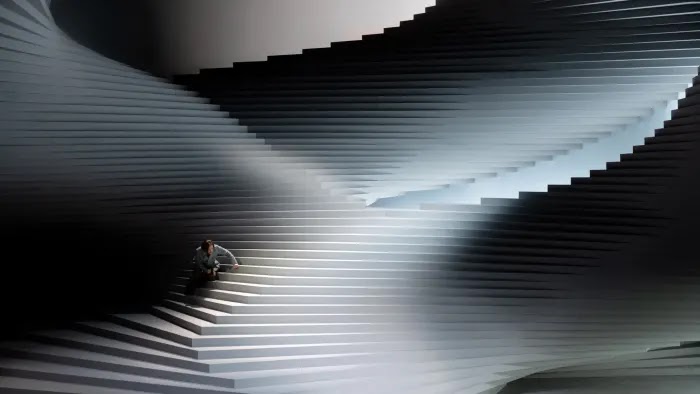
You could stare at this picture for hours and nothing about it would make you think of Beethoven's Fidelio. This performance takes place in the Theater an der Wien (Vienna, Austria) where the opera made its debut in 1805. This performance is of the 1806 version and was performed before cameras but no audience. It was intended as part of the 250 anniversary of the birth of Ludwig van Beethoven. It came to me via medici.tv.
Manfred Honeck | Conductor
Christoph Waltz | Stage director
Eric Cutler | Florestan
Nicole Chevalier | Leonore/Fidelio
Gábor Bretz | Don Pizarro
Christof Fischesser | Rocco
Mélissa Petit | Marzelline
Benjamin Hulett | Jaquino
Károly Szemerédy | Don Fernando
Throughout the performance people walk up and down the stairs without falling down. I am not able to forget the danger. Seated on the stairs in chains is Florestan. For some reason this picture which suggests nothing at all is never confusing.
The plot is not complex. Jaquino loves Marzelline. Marzelline, who smokes and wears pants, probably to reduce the possibility of falling, loves Fidelio. Fidelio isn't who he seems to be. This is the liveliest staging of the opening scene with Marzelline and Jaquino that I've seen. They are seriously fighting. It's fun. Except for the stairs. These two young people are quite enjoyable.
There seems to be some confusion about Rocco. He's Marzelline's father, I believe, but at the end when Florestan is rescued, they seem to blame him for everything. It's my understanding that he just works there.
I love this opera and always know what is going on. Someone with less experience would have to tell me if the staging worked. I enjoyed all the singing, especially Eric Cutler, Nicole Chevalier and Mélissa Petit.
Conductor: Nicola Luisotti Production: Giancarlo Del Monaco
Minnie: Deborah Voigt Dick Johnson: Marcello Giordani Jack Rance: Lucio Gallo Sonora: Dwayne Croft Wowkle: Ginger Costa-Jackson
From California to the Metropolitan Opera, thank you for this spectacular presentation of our opera, Puccini's La Fanciulla del West from 2011. There's something about sitting home alone with no distractions, with the faces so near to ones own face that makes the performances seem so present, so alive and personal.
I have never loved Deborah Voigt this much. This is her masterpiece. She becomes this character as no one else. There is intensity and joy throughout the cast. Thank you all. Life is better.
Don Carlo-Roberto Alagna
Elizabeth of Valois-Marina Poplavskaya
Princess Eboli-Anna Smirnova
Rodrigo-Simon Keenlyside
King Philip II-Ferruccio Furlanetto
Grand Inquisitor-Eric Halfvarson
The Metropolitan Opera is treating us in our hibernation to some streams of marvelous past performances. It is interesting to see these films again. I am having very different reactions, Don Carlo being no exception. I feel no inclination to compare Marina Poplavskaya to anyone. She had a brief but glorious career. She crossed my path only between 2009 and 2011. I enjoy her today very much. I think she became a real estate agent in Manhattan.
The peak of Ferruccio Furlanetto's career is the great scene here where he laments that his wife does not love him. It is a great opera with a great cast. They are mostly giving us traditional productions.
Smirnova isn't that interesting in the role of Eboli, but she gives a barn-burning "O don fatale." Each character has a wonderful scene.
This is the era of the Inquisition, and Spain was at its center. They ruled over a protestant land and killed many people. As political operas go, this one is at the top of the heap, with glorious music, great characters, and here a beautiful performance.




.jpg)


