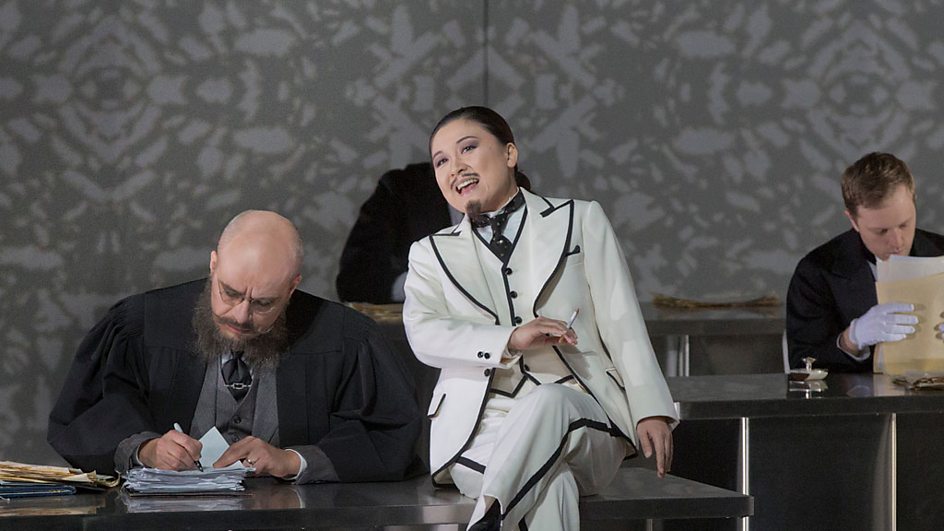
Here you go. Her name is pronounced Eileen, like in Farrell. Who knew?
When I was young, my two younger brothers both played the trumpet. They would take our dog into the bedroom, shut the door and play their trumpets, and he would sing loudly along with them. My mother was sure they were torturing him and made them leave him outside the bedroom when they played. Then he would sit outside the door howling as loudly as he ever had and scratching to get back in.
I read in Opera Now that the Welsh National Opera is going to perform Gordon Getty's opera Plump Jack. This reminded me that while I was in the San Francisco Symphony chorus, we performed this work with the orchestra and a second string conductor. There was much merriment behind the stage about this opera, but we were told in no uncertain terms by the chorus master Vance George that we were not to be seen laughing once we got out on the stage. This was one of several bones that I had to pick with Mr. Getty.
My Operas Seen list doesn't include this opera because this performance was not staged.
This is Samuel Barber's "Knoxville: Summer of 1915" with Leontyne Price singing and Schippers conducting, 1959. Maybe I could learn to like Barber.
When I hear this, it sounds American to me. I am after all these years simply awed by her. I cannot help wondering if this piece is really this magnificent.
I have been contemplating the writings about Jonathan Miller I posted
recently. He imagines himself to be important. Perhaps in his original
context he actually is important. But in opera he is quite a distance
down the list of who is important.
It's like football. An owner
carefully amasses a roster of outstanding players in the hope that his
team will win. Then he hires a coach to train them. The opera stars are
the players and Jonathan Miller is the coach. If there is a problem, no
one fires the players. For one thing in the world of opera it is the
players who sell the tickets.
LISZT EFFECT: Child speaks rapidly and extravagantly, but never really says
anything important.
BRUCKNER EFFECT: Child speaks very slowly and repeats himself frequently. Gains
reputation for profundity.
WAGNER EFFECT: Child becomes a megalomaniac.
MAHLER EFFECT: Child continually screams - at great length and volume - that
he's dying.
SCHOENBERG EFFECT: Child never repeats a word until he's used all the other
words in his vocabulary. Sometimes talks backwards. Eventually, people stop
listening to him.
IVES EFFECT: The child develops a remarkable ability to carry on several
separate conversations at once.
GLASS EFFECT: The child tends to repeat himself over and over and over and over
and over and over and over and over and over and over and over and over and
over again.
STRAVINSKY EFFECT: The child is prone to savage, guttural and profane outbursts
that often lead to fighting and pandemonium in the preschool.
BRAHMS EFFECT: The child is able to speak beautifully as long as his sentences
contain a multiple of three words (3, 6, 9, 12, etc.) However, his sentences
containing 4 or 8 words are strangely uninspired.
CAGE EFFECT: Child says nothing for 4 minutes, 33 seconds. (Preferred by 10 out
of 9 classroom teachers.)
Posted by Fred Zinos
[Stolen from Facebook. I don't recall any Ives as a child, but you never know.]
Sondra Radvanovsky as Amelia Anckarstrom
Marcelo Álvarez as the king, Gustavo III (Riccardo), who
loves her
Dmitri Hvorostovsky as Count Anckarstrom (Renato), his most trusted adviser (and Amelia’s
husband)
Stephanie Blythe as the
fortuneteller Madame Arvidsson (Ulrica)
Kathleen Kim as Oscar
Today we were treated to the Metropolitan Opera's HD version of Verdi's Un Ballo in Maschera. This opera is usually crudely shoehorned into a setting in Boston where it feels quite foreign. Today all pretense is cast aside and we return to the real historical setting in Stockholm, Sweden. For you see, these are real people and real events. The reality is long forgotten, but in Verdi's time when the idea of monarchy was not entirely secure it was considered a scandal to portray real royalty behaving badly. When the characters in the opera are speaking each others' names, they are neither American nor Swedish but Italian.
We are informed in the intermission that Madame Arvidsson was a real woman who accurately predicted the assassination of King Gustavo. This ended her career as a fortune teller. I have searched in vain for a photograph of Stephanie Blythe in her twentieth-century outfit complete with purse. She was simply the best Ulrica ever.
It's one thing for an exotically dressed black Ulrica to summon the devil in cave-like surroundings and quite another to see her sitting at an ordinary table dressed in middle-class clothes while she first takes a swig from her flask and then takes a skull out of her purse. This is the fascination of productions which move events closer to our own time.
The painting of Icarus partially shown above which appeared in every scene is hard to fit into a Swedish context. Gustavo was something of a foolhardy daredevil, so perhaps that is the connection. He leaps into a love affair with a married woman, puts himself in disguise in order to visit Ulrica, tracks down Amelia to the place of execution and goes to the ball in spite of the fact that he knows someone will try to assassinate him.
And what a cast. It would be difficult to imagine anyone now active who could expect to improve on any of them. Kathleen made her dance debut in this production, and perhaps she is ready for a new career. I finally found a picture of her in her Chanel pants suit and cigarette. This production needs more pictures. I enjoyed very much Sondra's passionate fluidity. This is the best I have experienced of Marcelo Alvarez. He conquered every mood of this wide-ranging opera, from comedy to romance to death.
And Dmitri reigns over Verdi baritones today as few singers ever have. His voice will do anything.
He looks beautiful, too.
Here is something to read about the latest incident of booing at La Scala, this time for Cecilia Bartoli. Unlike Alagna, she does not seem to have stormed out. We rely on Italy for opera rioting. There seems to have been an issue with the ticket prices.
P.S. It is now my understanding that this has to do with paying off the claque.
I went to see the new movie Anna Karenina starring Keira Knightley as Anna, Jude Law as Karenin, and Aaron Taylor-Johnson as the beautiful Count Vronsky. The acting is outstanding.
If you go to the opera, this movie will seem pretty normal to you. If you don't, well what can I say. Much of the filming takes place inside an old theater. Remind you of anything? Like last summer's Atilla where each act was in a different falling down theater. At least in the movie there wasn't another movie playing in the background. And the Met's The Tempest was similarly staged inside of a theater instead of on an island.
The back of the theater would open and suddenly you would be outdoors somewhere, always a different place each time. Like the end of Giulio Cesare in Salzburg.
There is some pretty peculiar looking waltzing, trains and horse racing that ran through the theater. I haven't seen horse racing in an opera. Yet. I read somewhere that many of the images were from paintings. I felt right at home. #ad
Conductor: Harry Bicket
Production: Jean-Pierre Ponnelle
Tito: Giuseppe Filianoti
Vitellia: Barbara Frittoli
Sesto: Elina Garanca
Servilia: Lucy Crowe
Annio: Kate Lindsey
Today was the simulcast of Mozart's La Clemenza di Tito from the Metropolitan Opera.Why isn't this opera more popular? It has some of Mozart's most beautiful music. The libretto is by Metastasio with additional material by the court poet Caterino Mazzolà.
The production is by Jean-Pierre Ponnelle who died in 1988 and places the opera squarely in the 18th century. No authentic Roman while residing in his capitol city would be seen in anything but his toga. They loved the toga simply because if you were not Roman there was no hope of you keeping it on. The people in our opera are dressed in wigs and trousers somewhat like people in the 18th century would have worn.
The single set looks a little like Rome, but the buildings are rough and falling down like they are now rather than relatively new looking as they would have been when Titus was Emperor. During his reign the coliseum was completed, Vesuvius erupted, burying Pompei, and Rome burned. This opera refers to the fire and his romance with Berenice, a Jewish queen.
Giuseppe Filianoti is an Italian lyric tenor, and I liked him enormously today. He made a point of mentioning that he studies with Alfredo Kraus. He is in good hands.
Barbara Frittoli sang Vitalia beautifully and portrayed her at her most nuts. One can't help wondering if any of them deserve the clemency they are receiving. She was excellent singing the almost baritonal "Non piu di fiori."
Kate Lindsey sang a fine Annio. Susan Graham listed off Kate's pants roles at the Met, like Siebel in Faust, Tebaldo in Don Carlo, Stéphano in Roméo et Juliette, Cherubino in Figaro and most notably Nicklausse in Tales of Hoffmann. She makes a very handsome young man, but I was surprised to see that she is not as tall as Elina. Lucy Crowe made her Met debut as Servilia.
Elīna Garanča as Sesto received star billing and star bows. It was she who led out the conductor Harry Bicket at the end, though she did not stand near the center of the stage. She received a well deserved ovation for everything about her work in this role. Though written for a castrato, the role fell beautifully into her voice, and her dramatic phrasing was inspiring. Susan Graham who also sings this role in this production was impressed by how Elina walked down the steps without looking down. You probably had to be Susan Graham to be impressed by this.
I loved this. This is some of Mozart's best music, but is generally dismissed as uninspiring. My handout doesn't name a replacement director for the long dead Ponnelle, but someone must have led them to this intensity of acting. All the performers bring great emotional depth to their roles.
This interview with Filianoti has a lot of interesting things.
Most interesting to me is his remarks on how hard it is to sing the recitatives by Franz Xaver Süssmayr compared to the arias by Mozart. Maybe that's why they dropped them in Zurich.