Wednesday, July 31, 2013

ReJoyce


This is the new album of The Best of Joyce DiDonato.  I follow Joyce on Facebook and have watched as she coaxed her fans into creating this album.  First the fans chose which of her many lovely and exciting tracks should be included in the album.  Then she asked them to title the album.  Joyce preferred another name, but the fans were solidly behind ReJoyce.

And now we have the cover photo also provided by a fan, Xenia Varelas.  There is a rumor that this renders producers officially obsolete.  Of course, they were already unofficially obsolete.

I'm not sure when it will be released. ----  August 27.


Tuesday, July 30, 2013

Pre-bought CDs

I have already purchased a few albums out soon.  First we have our two Verdi albums.

Jonas Kaufmann's Verdi on his new Sony label due to be released on September 17 in US.  He will sing arias from Aida, Il Trovatore, Un Ballo in Maschera, La Forza del Destino, Don Carlo, Louisa Miller, Simon Boccanegra, I Masnadieri, Otello and Macbeth. 

Anna Netrebko's already announced album will be out on August 20 in the US.  She will sing arias from Macbeth, Giovanna d Arco, I Vespri Siciliani, Don Carlo and Il Trovatore.

And this is the Agostino Steffani Stabat mater, the latest installment in Cecilia Bartoli's Mission project due out on September 10 in US.   I see that Fasolis and I Barocchisti already recorded this over a decade ago.

When they arrive, I'll let you know how I like them.  In addition you may be interested in Rolando Villazon's already released Verdi album which overlaps only a little with Jonas's album.


Best Wagner

I've only seen one complete Ring cycle done in successive performances over a few days, and it was the one conducted by Edo de Waart at the San Francisco Opera.  It remains in memory as something truly wonderful.

And now virtually all of it is posted on YouTube.  On part 2 of Die Walküre you can hear James Morris' very first performance of Wotan's Farewell.  For my ears it is the most beautiful Wagner singing I have ever heard, far better than the later Met performance also available on YouTube.  He just sings.  He lets his gorgeous voice roll out.  At the Met he becomes manipulative and self-conscious, slips in and out of sotto voce, and all of that stupid stuff.  What made Kirsten Flagstad the greatest Wagner singer in history?  She sang in the phrase and let the music do the work.  Don't try to squeeze the emotions out.  Just let them flow from your soul.  In comments Morris said he sang it as though it were Verdi.  Wagner would have loved this.

In the modern world of Wagner singing there is a desire (I would say a tendency, but it very much exceeds that) to turn the music into talk.  The modern Wagner singer would have you believe that it's all recitative, that recitative did not die but lived on to consume the entire genre of Wagner.  For the greatest Wagner singers it's all aria. 

When I go to see Die Walküre, my heart waits for this emotion to come again.  So far it is in vain.


Sunday, July 28, 2013

Did you know about this?


And if you did why didn't you tell me?  I didn't know the English ever censored anything.

Friday, July 26, 2013

Hippolyte et Aricie from Glyndebourne


Jean-Philippe Rameau's opera Hippolyte et Aricie (1733) is basically the same plot as Phèdre by Jean Racine (1677), a play that was done at my college when I was an undergraduate. This is only my second experience of a Rameau opera--the first was Platée at Santa Fe, a comedy.


Hippolytus Ed Lyon, high tenor
Aricia Christiane Karg, soprano
Phaedre Sarah Connolly, mezzo
Theseus Stéphane Degout, bass
Diana Katherine Watson, soprano
Pluto/Jupiter/Neptune François Lis, baritone
Œnone Julie Pasturaud, soprano
Cupid/A female sailor Ana Quintans, same voice type as Hippolytus but sung by a mezzo
High Priestess/Huntress Emmanuelle de Negri, soprano

Conductor William Christie
Production Jonathan Kent

"It has an extraordinary quality of meandering."  Phaedre, wife of Theseus, falls in love with her step son Hippolytus who wishes to marry Aricia.  This is a serious opera, filled with gods and mortals.  Cupid and Diana vie for the souls of men, and Jove grants that one day a year Cupid will reign.  Racine is dark and very tragic, but we are now in the high Baroque which demands its happy ending. 

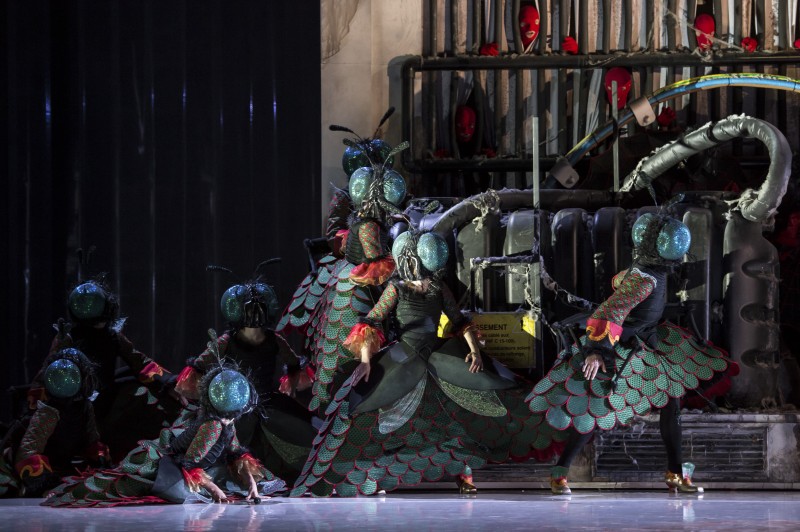
In this production the mortals are modern and the gods are Baroque.  In the beginning Diana's servants live inside a refrigerator and proceed to prepare broccoli and cauliflower.  Cupid pops out of one of the eggs.  Theseus and Phaedre live in an ordinary small apartment with a fishless fish tank.  Perhaps that's their fish poking their heads out of the radiator below.


Hell is the most fun.  Pluto whose realm is pictured as a giant radiator is served by a variety of insects, include two spiders who perform a charming duet.  We aren't sure what Theseus is doing in hell, but the change of scene is welcome.

After Phaedre kills herself, the young lovers are reunited to happy rejoicing.

Though they are contemporaries, you will not hear the wondrous variety of Handel here.  If the tempo starts to pick up a bit, it must be a ballet.  There are, of course, no castrati in French opera and little of the intense display of coloratura that is present in Italian opera.  Perhaps we might even call this the Rococo.  It is graceful, elegant and formal above all else.  Rameau is pleasant but not particularly exciting.

This opera came to me via a live stream from Glyndebourne.  If it is considered a success, the opera and its production may start showing up other places. Between the scenes is the head of an old bald guy staring out at us.  If they make a DVD, they could think about leaving him out.
 

You may be curious to know that the version on YouTube with Emmanuelle Haim is traditional in its staging.  Diana descends from above just as she should.  The subtitles are in French.

Sunday, July 21, 2013

Retraction

Apparently Alexander Pereira, the Salzburger Festspiele and La Scala Milano have all come to an agreement that he will become the head of La Scala on October 1, 2014.  See here.  This means he will continue to manage in Salzburg through next year's festival.  This change is a year earlier than planned and represents a large drop in salary for Pereira.

Reports seem to say that he left because of restrictions to his budget.

Antony and Cleopatra

I became interested when I noticed that there is a complete film of Samuel Barber's opera Antony and Cleopatra on YouTube.   All I have known about it has been rumors of a giant catastrophe.

This opera was composed for the opening of the New Met on September 16, 1966 with Leontyne Price as Cleopatra.  She is known to have loved this work.

According to the Met archives, this opera was given one series of performances the first of which was broadcast.  As a Price fan, I feel it would be wonderful to hear this. There can be no question that the Met has at least an audio recording of the complete opera.   Look in Met on Demand.

Everything was criticized about this opening.  The preparation seems to have been inadequate, resulting in an embarrassing performance by the orchestra.  Carping about the text is a little silly, don't you think?  It is from the Shakespeare play and selected by Franco Zeffirelli.  Operas always have less text than plays.  This performance was pre-supertitles, so perhaps that is the problem.  It isn't one of Shakespeare's best plays but has an outstanding role for a woman.

The complete film on YouTube (pt1, pt2) is of a performance that occurred at the Lyric Opera of Chicago in 1991 in a revised version created by Gian Carlo Menotti.  Here is the cast of that performance.

Cleopatra - Catherine Malfitano, soprano
Mark Antony - Richard Cowan, baritone
Octavius Caesar - Jacque Trussel, tenor
Enobarbus - Eric Halfvarson, bass
Charmian - Wendy White, mezzo-soprano
Iras - Nancy Maultsby, mezzo-soprano
A Messenger - Paul Jacobsen, tenor

Conductor - Richard Buckley

I don't mind Malfitano but she is not in the same league with Price, one of the greatest singers of the 20th century.   Everyone sings big.  Richard Cowan is a gorgeous, hunky baritone, and Catherine is beautiful enough.  After all, it is Cleopatra's infinite variety that pleases.  And perhaps that is what is missing--variety.

The work is unrelentingly somber, following slavishly the tenets of the Wagnerian Gesamtkunstwerk.  Think how much more fun is the ever changing Cleopatra of Giulio Cesare.  I cannot think of an opera more intensely tragic and dark without any hints of self-parody or cynicism.

I am able to imagine a singing actress who could make a success of this.  She would have to be a giant.  People are more inclined to sympathize with women with tuberculosis or dying geishas.  Your knowledge of opera is incomplete without it.


Thursday, July 18, 2013

Becoming La Traviata

This is all in French but great if you like to watch rehearsals.


And this one is the official trailer.


I don't think this movie ever came to Sacramento.