Monday, February 28, 2011

Renée Fleming


People are always jumping on Renée Fleming. Maybe she has a sign on her back that says "Kick me."

This reminds me of a story. When my son was about 10 years old, we were in the Marina Safeway, and he took a sticker off one of the watermelons and put it on my back. It said, "Try me. I'm sweet and yellow inside."

Never mind. My mind wandered. So on February 21, 2011, the New York Times ran a review for the return of Armida, and thoroughly trashed Ms Fleming. They trashed the production and just about everything else except Lawrence Brownlee, but that is not my concern.

Since I've started blogging, I've heard Renée Fleming twice live--in recital at Carnegie Hall and in concert at the Kennedy Center in DC--plus a number of times in HD. Before that I heard her in Streetcar, Hérodiade and Rusalka at the San Francisco Opera, and maybe other things.

Her voice was never that big. I have never heard her live at the Metropolitan Opera, but the acoustics there aren't nearly as bad as the War Memorial.  Hearing her in HD does not really give an idea of how she sounds in the house. But I can tell you that a lot of singers you would never suspect--Leontyne Price springs to mind--are simply not that loud in the opera house.

The young we want to hear for the vigor of their young voices. The older artists we hear for their art. Certainly Renée's voice has changed, as has also her body and mind. As an artist, she is at her peak. In fact it was just 2 years ago I wrote, "For my ear she is now singing her best ever. The middle of her voice is quite gorgeous while she retains her top."

She has her own identity which isn't to everyone's taste, but it is precisely her unique identity which makes her a great artist.

I expected better of the New York Times.

Post script. Colbran, who created Armida, retired before she reached 40.

Renée isn't going to come out and blast you with sound to show an enraged Armida. Nor in my experience of her would she ever have.

For a lot of people, apparently Zachary Woolfe is one of them, criticism consists of deciding in advance what something is supposed to be like and then criticizing every departure from that preconceived notion. My son hated the movie Alice in Wonderland because Tim Burton changed the plot. Let's just say things are a lot more fun when you open yourself up to new ideas.

Mary Zimmerman's production wasn't for an enraged Armida. Giant insects emphasize the enchantment and charm of the situation. Renée sang the charm. What you are seeing is a woman's Armida.

News from the New York Times

I read that Riccardo Muti has had a pacemaker installed after falling off the podium during a rehearsal in Chicago.

Sunday, February 27, 2011

Gossip, sort of


I was watching a long German interview with Cecilia Bartoli--link is here--and she was asked if she were engaged and intending to marry Oliver Widmer.  That is what I understood the question to mean.  Cecilia answered "yes" and went on to comment about what lovely men they have in Switzerland.  Not just cheese.  Oliver is Swiss.  Another lovely Swiss man she likes is Roger Federer.

She went on to say that she had met Oliver when she was 21, long before Cosi.  I hope this is now cleared up.

She likes Lady Gaga.

The interviewer spoke Hochdeutsch and Cecilia answered in Italian.  Occasionally the interviewer had to translate her questions into Italian. We could hear only fragments of Cecilia speaking since her words were covered over by a German translation.

Cecilia called herself a perfectionist.  This should not be a surprise to anyone.  She also said that difficulties are there to overcome.

Several people spoke about her, including Ada Pesch, the concert mistress of La Scintilla, and Donna Leon, the crime novelist.  There was a short clip from Il Trionfo, which I reviewed here with different singers.  We are wishing for a DVD of this.

Interview with Thomas Hampson


THE INTERVIEW
Thomas Hampson

Gustav Mahler is a priority. The range of issues that Thomas Hampson touched on in conversation with our colleague Dr. Thomas Baltensweiler reaches from the Hamburg Elbphilharmonie to Verdi plans. Excerpts from the interview.

2010 marks the 150th Anniversary of the birth of Gustav Mahler, in 2011 follows the 100th anniversary of his death. You have made this the occasion for a new recording of "Des Knaben Wunderhorn," the cycle you have already recorded with Geoffrey Parsons on CD. Why now again?


With Geoffrey Parsons I had recorded the world premiere of the piano version. That was in 1993. The orchestral version I've never recorded commercially. For the Mahler year I wanted to do something special. This has brought me to the idea of recording the cycle with the Vienna Virtuosi, with whom I had already been on tour. The Vienna Virtuosi are a chamber ensemble without a conductor. Mahler wrote, "Des Knaben Wunderhorn" should be played in a "chamber sound." Certainly, such a "chamber sound" is not dependent on the number of instrumentalists, and a large orchestra can create intimacy. The name probably means above all that the instruments are as important as what the singer sings. That does not mean that a chamber orchestra should play the music, especially a contemporary chamber orchestra that is different from one of Mahler’s time. With the Vienna Virtuosi I have – in order to come to this particular project - experimented, how many musicians a recording of this cycle really needs. We have adhered closely to Mahler's musical instrument list and we dealt strongly with the particular iconographic significance of the instruments, such as the harp, which refers to the afterlife. I have produced the album myself and given the license over to Deutsche Grammophon.

Your song recordings are also often unconventional in the choice of program, I think for example of your album "I Hear America Singing". How would you describe your approach in practice in the compilation of a program?


The selection of songs that I want to sing from the many that exist is purely subjective. In the American songs project I focused on American and European composers that have set American poetry to music or have been Americans. I have created a network that shows how a nascent American culture has unfolded in stages. The aim was to tell something about America. To seek the American Schubert would certainly have failed; I tried to capture the spirit of various decades, rather than to look through the eyes of a single composer.

In Hamburg, in a large-scale cooperation between tour operators and orchestras 2010/2011 Mahler's complete works are to be performed. It is marketed under the label "Elbe Philharmonic Hall,” a building that is still not completed. They will interpret in this context the complete Mahler Lieder. How did this commitment happen?

With the Intendant Christoph Lieben-Seutter I share a long-standing friendship. I have already experienced "Mahler residences" elsewhere, as in Vienna, and the mid-1990s I sang in Amsterdam every Mahler song. Certainly behind the concept of "artist in residence” stands a commercial interest, because you can put together an interesting "series." Hamburg is one of those: Here you can hear all the songs with piano and most with orchestra, and this is very enlightening.

You are also still active on the operatic stage, currently your debut in Zurich's "I Masnadieri" stands on the program, an early masterpiece by Verdi with music that seems to be elemental in its power but in contrast to the subtlety of the art song. What attracts you to such a role?

When you talk about Thomas Hampson, one can say nothing more than a lyric baritone with dramatic abilities. Purely technically I need with such a role to pay close attention to myself. But song and opera are not so close to each other. One can indeed focus on one of the two, but if you sing both, you become better. The song is not a specialist sanctuary, and the idea that one speaks a song with certain sounds does not correspond to my idea of singing.

You have recently taken up Scarpia in your repertoire, there the orchestra brings out the heavy artillery!

Yes, but with Scarpia I would always think what kind of house will I sing the part in. I love the character of Scarpia. His intelligence and sophistication, with its concomitant malignancy, which is never vulgar, is an acting and vocal challenge. In a singing career like mine often after a “heavy” role comes again “light,” and after light again heavier. So for example, after my first Posa [Rodrigo in Don Carlo?] I embodied again the "Barbiere -Figaro, who I respect very much not only for his comedy, but also his wisdom. It would be very appealing to me to sing again the barber.

Which brings us to your opera plans.


Next season is the new Iago in "Otello" at the Zurich Opera House. I have performed in the last 26 years, each season in Zurich, where I now have an apartment again. I was nowhere else as regularly heard over such a long period of time. I have also sung in this house many of my premiere roles. Now I'm looking forward to another role debut - my first Iago.

[This is translated from the online version of Opernglas.]

Saturday, February 26, 2011

Iphigénie en Tauride


Iphigénie:  Susan Graham
Oreste:  Plácido Domingo
Pylade:  Paul Groves
Thoas:  Gordon Hawkins
Diane:  Julie Boulianne

Conductor:  Patrick Summers
Production:  Stephen Wadsworth

I listened to every version of "O malheuruese Iphigénie" from Gluck's Iphigénie en Tauride on YouTube and while the sound recording is not that great and there is no picture, Susan Graham owns this aria. No one comes close.

There is a cold going around. I had it 2 weeks ago, and today for the simulcast from the Metropolitan Opera Peter Gelb came out to tell us that both Susan Graham and Placido Domingo had it. They sang anyway, and Susan overcame a bit better than Placido.

You may have noticed strategically placed seats around the set. This is for the aging Placido who still has more power as a baritone than Paul Groves.


The production is colorful and used statues of the many-breasted Diana of the Ephesians to represent the goddess who rescued Iphigénie and carried her off to serve her as a priestess. No attempt was made to make the costumes appear to be Greek, but I still thought everything looked good.

There was some very effective wire work at the beginning and end. The deus ex machina descended on a wire.  The lady on the wire had only the normal number of breasts.

To enjoy this opera you kind of have to like Gluck.  When you think of all the vocal fireworks going on in Italian opera at that time, it can seem a little dull.  Actually you would only want this for Susan Graham who was magnificent.

[See Kinderkuchen History 1760-1780]

Bluebeard


Last night at the Mondavi Center was my third live Bluebeard's Castle since starting this blog. The first was at the Washington National Opera and starred Samuel Ramey and Denyce Graves. The second was at the Berkeley Opera and starred a giant computer screen.  Both of my previous Bluebeards made elaborate choices about what to show when the doors were opened. The drama shifted to these pictures.

Opera News once designated the libretto for Bluebeard as one of the best ever. Huh? First I would like to say that Judith is an idiot. I don't tend to go for operas where the main female character is an idiot. I guess I tend to prefer stories that actually imply some action. Here we just have a castle, seven doors which are opened one by one, and the idiot Judith.

The Davis production made some pretty interesting choices. Judith arrives in her wedding dress.  This tells us exactly where we are in the story. The dialog seems to say only that they have arrived at the castle and that she is leaving her family behind.

On either side of the stage at the Mondavi Center are doors, and these doors became two of the seven doors. That meant that the set required only five doors.

Thomas Munn, formerly the lighting designer for the San Francisco Opera, works now at UC Davis and designed the lighting here. The solution to the problem of what we see when each door is opened is lighting. Colored lights shine out of each door in turn and Judith describes what she sees.  The drama shifts back to the people.

Only when the seventh door opens does anything come out: Bluebeard's three previous wives still in their wedding dresses. They look like zombies, and Judith immediately turns into a fourth zombie and goes into the room with them.

The star of this opera is always Béla Bartók’s score.  I felt the orchestra was occasionally much too loud, covering the singers, but otherwise played well.  It seems different each time I hear it.  Bartók was a musicologist who collected Hungarian folk music, and therefore his music is always said to sound like Hungarian folk music. We have never heard any Hungarian folk music and will have to take their word for it. I always hear early modernism, ethnic only in the absence of German Romanticism but still carrying the burden of the classical orchestra.

The program notes point out the unusual writing for voices, always eight syllables per line with generally descending phrases, and no hint of ornamentation. Gregory Stapp as Bluebeard was ominous and imposing, but also sometimes out of tune. Jessica Medoff seemed to have just the right voice, manner and aura of arrogant youth for the idiot Judith.

I grow fond of it.

Friday, February 25, 2011

Renata Scotto as DJ

If you click here, you will see a discussion with Renata Scotto on NPR along with a short list of selections of arias by herself, her precursors Maria Callas and Jussi Bjorling, and two modern singers Natalie Dessay and Jonas Kaufmann.

This is oddly timely. Natalie sings the mad scene from Hamlet.

For her selection for Jonas Kaufmann she chooses what must also be my favorite track for him: the Prize Song from Wagner's Die Meistersinger.

The screen lets you explore the vast NPR archive. See it now before the yahoos get to it.

Tuesday, February 22, 2011

Hamlet with Natalie


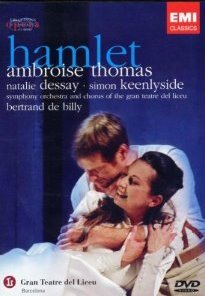
After seeing Hamlet from the Met, I felt a certain lack of completeness about the whole thing and ordered the DVD with Simon Keenlyside and Natalie Dessay. It needs Natalie. No one does mad scenes like Natalie. In this film she does coloratura while slashing her wrists. The minor characters are not as strong as the Met production, but this is definitely the one you want.

I have now seen both endings for this opera. The Metropolitan Opera simulcast used the Anglo-Saxon approved ending where Hamlet dies. This DVD shows a wounded Hamlet singing about going to be with Ophelie while the chorus hails him as the new king. He could still die from his wounds, but that isn't shown.
#ad

Ancient History


When I was 23, my college presented a fully staged version of Rigoletto with orchestra and the whole 9 yards. It has long lived in my imagination as something truly wonderful.

It turns out it has lived also on tape and now on CD. Lou Clayson who was a member of the faculty sang the Duke. Dan Elias who had had polio as a child and was genuinely crippled took off his brace and sang Rigoletto. My friend Gloris Blackburn was perfectly cast as Gilda, and I was Maddalena.  My mentor John Lewis was the conductor.

So yesterday I went to visit Gloris to hear the CD.   We looked at the old pictures and marveled at how young we were and how fabulous Lou looked in tights.  And how glorious it all sounded.

The orchestra was spectacular. John had a love/hate relationship with Verdi, complained about sopranos showing their tonsils on high notes and never gave an inch on tempos no matter how badly the singer was handling it. But the rhythmic excitement that is the heart of Verdi was stunning to the point of overwhelming.

It is nice to hear that he was as great as I had imagined him.

The singing is also wonderful. Lou didn't just look good. Dan had a very exciting tone to his voice, and Gloris was the perfect Gilda. She took all the high notes whether John liked it or not, and long stretches of "Caro nome" are completely unaccompanied, allowing the singer to add as much rubato as she wants.

I was fine. Gloris and I looked at each other and said "soprano."

I can't tell you how pleased I am to report that it was far more wonderful than I had remembered it.

Saxophone

In my musical club meeting on Sunday Keith Bohm played the saxophone and accompanied himself with a piece of software called Smart Music.  This is a teaching tool that includes repertoire for each instrument.

That isn't what I wanted to write about. He studied in France, Germany and the United States, and he described how the vibrato is taught in each country. Apparently the French like a very fast vibrato with an intense tone, while here in the USA a slow vibrato is preferred. He said this wasn't an issue for him since he couldn't do the fast French vibrato.

He also said that Massenet was an early proponent of the saxophone. This reminded me of last year's two Werthers. In Paris I hardly noticed that Charlott's aria "Va! Laisse couler mes larmes" has a wonderful saxophone solo, while in San Francisco I immediately recognized it. Perhaps to me the saxophone with the fast vibrato didn't even sound like a saxophone.

I had the sense at the time that the romantic orchestra in Paris was an entirely new experience for me.