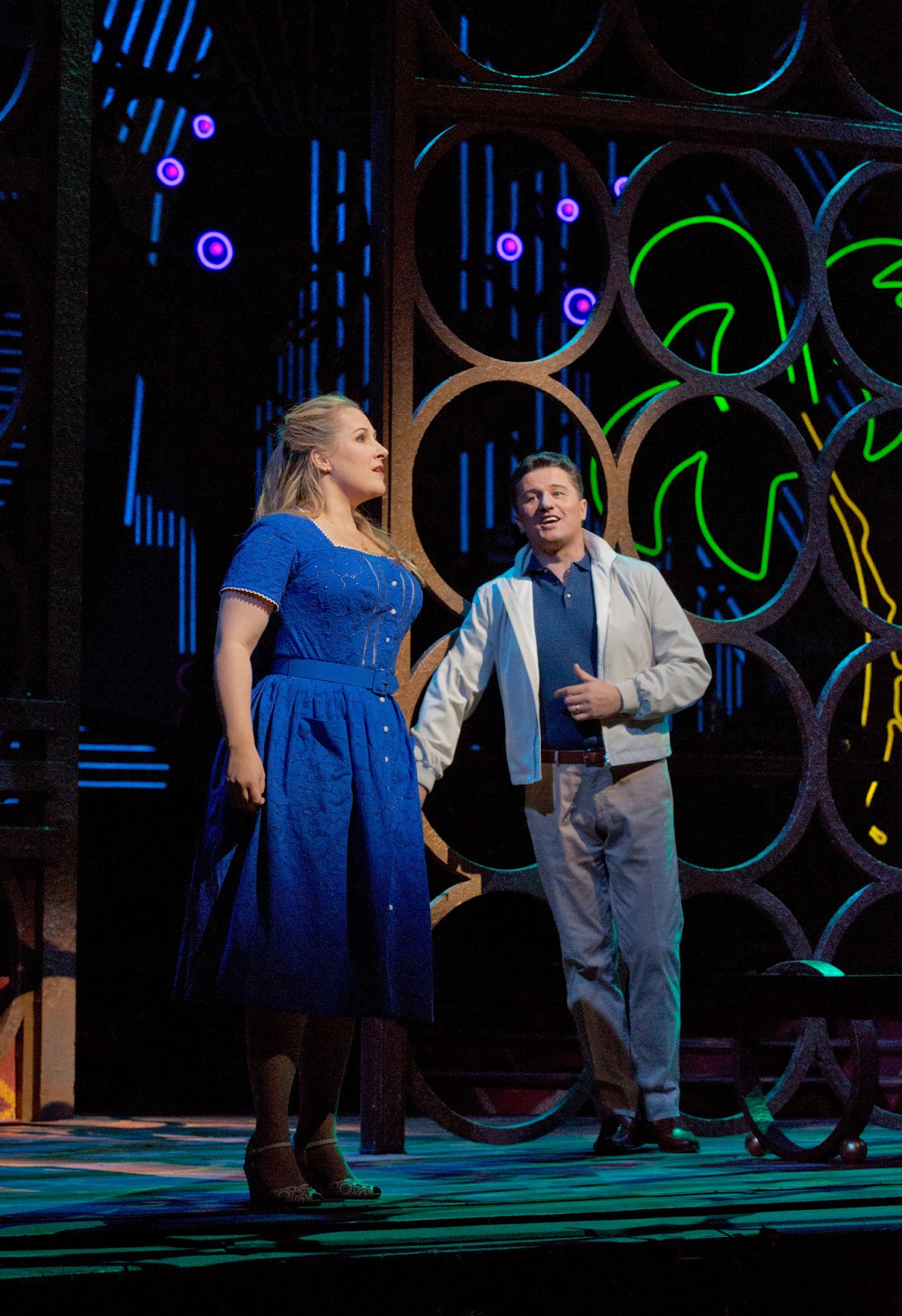
Sunday, December 29, 2013

Stream La Forza del Destino from Munich

Papa, Don Carlo, Leonora, Curra, priest, servant
👍🏻
Conductor Asher Fisch
Production Martin Kušej

Il Marchese di Calatrava / Padre Guardiano: Vitalij Kowaljow
Donna Leonora: Anja Harteros
Don Carlo di Vargas: Ludovic Tézier
Don Alvaro: Jonas Kaufmann
Preziosilla: Nadia Krasteva
Fra Melitone: Renato Girolami
Curra: Heike Grötzinger
Un alcade: Christian Rieger
Mastro Trabuco: Francesco Petrozzi
Un chirurgo: Rafał Pawnuk

I'm having trouble deciding how to approach this writing. I have some very specific memories of this opera that I would like to share. This was Leontyne Price's second opera--Aida and then Forza--so I saw it live with her at the San Francisco Opera and on tv from the Met as part of her farewell from staged opera performances.

Then I remember being a flunky in it in Germany, kneeling on the floor in excruciating pain. We performed it in German.  We performed everything in German.

Or should I talk about the table shown above?  This table shows up in almost every scene with different numbers of chairs surrounding it.  Each person is assigned a place even when they are not in their assigned chair.  We presume that the chair with its back to us is for Don Alvaro who shows up late.  The accidental shooting was well staged.  This is usually confusing for the audience.  In each scene there are different numbers of chairs around the table and different singers.  Papa and the Padre are the same singer.

In the next scene years later we see Don Carlo in his green sweater and glasses at first, and then he changes into military clothing.  This is so we can follow who this is in the rest of the opera.

The music is wonderful, but the opera is too long. You lose interest, or at least I do, when the soprano is missing for scene after scene.

Pride of place in the bows and most enthusiasm in the applause went to Anja Harteros.  Is it possible to explain her?  Her voice is not beautiful, but it's beautiful enough.  In most Verdi you are not really looking for beauty.  Maria Callas' voice was also not beautiful.  Nor is Sondra Radvanovsky's, Anja's only real rival today.  I prefer Anja.  For me she has more emotional range, draws me in to the scene more.

Kaufmann and TĂ©zier are well matched.  I can't help it, I want the duets to be with the soprano.  She dies at the end with a pathetic lack of excitement.  I used to blame the lack of popularity of this opera on the opening scene, but now I think it's the whole thing.  It just doesn't work.

I was viewing from a Mac in Ohio, and the stream was very jerky.  I haven't had that problem at home.

P.S.  I didn't mind the production.

#ad

Favorites by Year 2013 👍🏻

Outstanding Verdi year

This year was 200 years of both Giuseppe Verdi and Richard Wagner.  The only Wagner of interest was the Met Parsifal.  In sharp contrast I experienced quite a lot of great Verdi.  Kaufmann and Harteros together brought me Il Trovatore, Don Carlo and La Forza del Destino.  The Met brought me Rigoletto and a magnificent Falstaff.  Kaufmann released Wagner albums and a Verdi album, Netrebko released a Verdi album.  This was a truly great year for some other things, too.  Jamie Barton won Cardiff Singer of the World.  I also traveled to Salzburg for Norma.  I reviewed 45 performances, including 2 DVDs, 10 HDs, 22 live, 1 movie, and 10 streams at home.

For another perspective on 2013 see KK Awards.

Favorite Performances


  • (JK) Parsifal in HD  **  I stayed all the way to the end, which is odd for an opera I've always hated.  Everything worked together to create a performance which even I loved.   Met HD

  • Verdi-Neon Rigoletto in HD  **  I adored the flashing neon in the last act that accompanied the storm music, but Gilda in a car trunk?  Maybe not.  It does make it more plausible that Rigoletto mistakes her for the duke. Met HD
  • Ainadamar in San Francisco ** Opera Parallèle brought excitement and joy and a completely coherent production for this complex opera.  Do this opera in your town.  You will love it.   Local


  • American Bach Soloists in Davis **  I discovered this group this year, and they play very close to home over in Davis.  The consistent high quality of their work is encouraging, They aren't just named after Bach, they also play a lot of Bach.  Occasionally they perform a bit of opera in concert format.   Local


  • (CB) Cecilia Bartoli's Norma CD  I was irresistibly drawn to this recording and played it over and over.  I could not be more amazed.  Cecilia recorded the new critical edition, of course, instead of the traditional late romantic orchestration.  CD

  • (CB) Norma in Salzburg **  In fact I was so amazed I traveled to Salzburg to see it for myself.  This modern regie production was very effective and completely right for herself.  It was a revolutionary transformation of a staid favorite, turning straw figures into passionate human beings..  Travel  ##20


Singer of the Year


The singing prize is hard this year.  No offense, Cecilia, but I must award to Jonas Kaufmann and Anja Harteros for so much wonderful Verdi.

Didn't like


This was such a fabulous year I have nothing to disparage and cannot reduce the list to 10.  Since then I have felt an emotional let down.  I want endless thrills.

New to Me Opera


With the addition of streaming my new operas list grows longer:

  1. Adamo's The Gospel of Mary Magdalene (2013) was live at SFO. **
  2. Barab's A Game of Chance (1957) was live in Sacramento. **
  3. Barber's Antony and Cleopatra (1966) was seen on YouTube.
  4. Barber's A Hand of Bridge (1958) was live in Sacramento. **
  5. Bucci's Sweet Betsy From Pike (1953) was live in Sacramento. **
  6. Donizetti's Maria Stuarda (1834) was HD from the Met. **
  7. Gasser's The Secret Garden (2013)was live in Berkeley. **
  8. Glass' The Perfect American (2013) was a stream. 
  9. Golijov's Ainadamar (2005) was live in San Francisco. KK new to me award. **
  10. Humperdinck's Königskinder (2010) was a DVD with Jonas Kaufmann.
  11. Picker's Dolores Claiborne (2013) was a live world premier from SFO **
  12. Rameau's Hippolyte et Aricie (1733) was streamed from Glyndebourne. Regie **
  13. Rossini's La Donna del Lago (1819) was on YouTube from the ROH.
  14. Shostakovich's The Nose, (1929) HD from the Met. **
  15. Spontini's La Vestale (1807) was on YouTube.
  16. Verdi's Les VĂŞpres siciliennes (1855) was streamed from London. **

##20 top 20 all time
** live, live stream or live in HD

Things recommended to buy


#ad 

Thursday, December 19, 2013

NEA Opera Award Defunct

I don't remember hearing about this, but the National Endowment for the Arts opera honors list ceased after the 2011 award.  They awarded for only 4 years. 

2011 John Conklin
Speight Jenkins
Risë Stevens
Robert Ward

2010 Martina Arroyo
David DiChiera
Philip Glass
Eve Queler

2009 John Adams
Frank Corsaro
Marilyn Horne
Lotfi Mansouri
Julius Rudel

2008 Carlisle Floyd
Richard Gaddes
James Levine
Leontyne Price

Wednesday, December 18, 2013

Die Macht des Schicksals


Or Forza as it's usually known--don't forget it streams on Dec 28. This picture makes me smile.  I remember once long ago I was in Vienna and the newspaper said they were doing Die Macht des Schicksals.  I puzzled over this for a long time.  In those days the opera might have been performed in German.

For more pictures see here.

Trailer:


I was sent a link on my phone for this opera from the BSO--a first--which I can't find now in YT.  There was a lot of talking in German.  The regisseur compared Schicksal to Murphy's Law.  You know:  if it can go wrong, it will.  This is sort of the programmer's motto.

I find that it is Forza that I love.

Sunday, December 15, 2013

Cross-dressing Research

A brief chronological list of male opera roles sung from the beginning by women.  The purpose of this seems to be to make the character seem youthful.  Since I first posted this, it has acquired a few roles where the character is female but the singer is a man.


role opera composer  Fach
Lenia Eliogabalo Cavalli tenor
Ottone Agrippina Handel contralto
Sesto Giulio Cesare Handel soprano
L'Amour Les Indes Galantes Rameau soprano
Bellone Les Indes Galantes Rameau baritone
Platée Platée Rameau haute-contre
Sesto La clemenza di Tito Gluck mezzo-soprano
Amore Orfeo ed Euridice Gluck soprano
Cherubino Nozze di Figaro Mozart mezzo-soprano
Annio La clemenza di Tito Mozart mezzo-soprano
Tancredi Tancredi Rossini mezzo-soprano
Roggiero Tancredi Rossini mezzo-soprano
Ottone Adelaide di Borgogna Rossini contralto
Malcolm La Donna del Lago Rossini mezzo-soprano
Arsace Semiramide Rossini contralto
Puck Oberon Weber contralto
Isolier Le comte Ory Rossini mezzo-soprano
Jemmy William Tell Rossini soprano
Romeo I Capuletti e I Montecchi Bellini mezzo-soprano
Smeton Anna Bolena Donizetti mezzo-soprano
Maffio Orsini Lucrezia Borgia Donizetti contralto
Vanya A Life for the Tsar Glinka contralto
Urbain Les Huguenots Meyerbeer mezzo-soprano
Ascanio Benvenuto Cellini Berlioz mezzo-soprano
Pierroto (?) Linda di Chamounix Donizetti contralto
Ratmir Russlan and Ludmilla Glinka contralto
Adriano Rienzi Wagner mezzo-soprano
The Shepherd Tannhäuser Wagner soprano
Siebel Faust Gounod mezzo-soprano
Oscar Ballo in Maschera Verdi soprano
Stephano Romeo and Juliet Gounod soprano
Tibaldo Don Carlo Verdi soprano
Fyodor Boris Godunov Mussorgsky mezzo-soprano
Orlofsky Fledermaus Strauss, J mezzo-soprano
Nicklausse Tales of Hoffmann Offenbach mezzo-soprano
Walter La Wally Catalani soprano
Hansel Hänsel und Gretel Humperdinck mezzo-soprano
The Sand-Man Hänsel und Gretel Humperdinck soprano
The Dew-Man Hänsel und Gretel Humperdinck soprano
Cricket Cricket on the Hearth Goldmark soprano
Le Prince Charmant Cendrillon Massenet soprano/tenor
The Kitchen Boy Rusalka Dvořák soprano
Yniold Pelleas et Melisande Debussy soprano
Page Salome Strauss contralto
Chérubin Chérubin Massenet mezzo-soprano
Octavian Rosenkavalier Strauss mezzo-soprano
The Composer Ariadne auf Naxos Strauss mezzo-soprano
Aljeja, a young Tartar From the House of the Dead Janáček mezzo-soprano
Cherubino Ghosts of Versailles Corigliano mezzo-soprano
Ariel The Tempest Ades soprano
Pilgrim L'Amour de Loin Saariaho mezzo-soprano
Pip Moby Dick Heggie soprano

The list isn't intended to be complete but instead tries to show how this spans all eras and nationalities of opera.  Nicklausse in Conte d'Hoffmann is a special case, since the character represents both Hoffmann's female muse and male friend.  There is another list at least this long of roles originally sung by castrati, but the date range is earlier.

Saturday, December 14, 2013

Born to Play Falstaff


Ambrogio Maestri
👍🏻
Conductor: James Levine
Production: Robert Carsen 

Nannetta: Lisette Oropesa
Alice: Angela Meade
Mrs. Quickly: Stephanie Blythe
Meg Page: Jennifer Johnson Cano
Fenton: Paolo Fanale
Falstaff: Ambrogio Maestri
Ford: Franco Vassallo

He is a giant man who does not require any padding to fully represent the magnificent Sir John Falstaff.  His voice precisely fits the role.  He can remain cheerful in the most horrendous of circumstances.  He is Italian and has the native Italian's regard for Verdi.   Ambrogio Maestri must surely have been born to play Falstaff.  It was simply a joy to watch and hear him. He also brought risotto which you can find the recipe for on the Met website.  

However, we couldn't help reinterpreting the entire story from a much more Italian perspective.  We weren't alive in England in Shakespeare's time, but we were more able to imagine the English wanting to take revenge on mere flirting than we were able to imagine Italians from the 1950s wanting it.  Isn't this how an Italian man is expected to behave?  Would Italian women be surprised or shocked by it?  We think "yes" and "no" are the appropriate answers to these questions.

The Robert Carsen production for this Metropolitan Opera live in HD presentation moved the drama to the 1950s, we imagine because he could not resist the 50s clothing and kitchen styles.  Falstaff visits Alice in her kitchen to allow for far more than linens to throw around the stage.  (I bought this much more than I bought Ochs visiting Faninal in his kitchen here.)  Sir John is a gentleman, and it is thought that gentlemen last enjoyed their full privileges while the British Empire was still in tact.  

I especially liked the opening scene.  Sir John is reading the morning paper while still in bed and still in his night clothes.  It is a large, significant bed, and round it are several small tables still covered with debris from last night's drunken party.  With this setting we require no help making our way through the dialogue of the opening scene.  All is clear as day.  They read the list of expenses, and we see immediately that these are for the party.

The only complaint is trivial--there was no oak tree in the final scene.

Stephanie Blythe sang "Reverenza" exactly as Marilyn Horne would have done, and then tells us that her first performance of the opera was as Marilyn Horne's understudy.  Era perfetto.

Of my three Falstaffs this year, this was definitely the best.  Everyone seemed to be having a wonderful time. 

#ad

Thursday, December 12, 2013

Les VĂŞpres Siciliennes


Now that the Met has had such success with simulcasts into theaters, everyone wants to do it.  The Tower Theater shows performances from the Royal Opera House in London, so I went down to catch Verdi's Les VĂŞpres siciliennes.

Conductor: Antonio Pappano
Director: Stefan Herheim

Guy de Montfort, French governor: Michael Volle
Henri, young Sicilian: Bryan Hymel
La Duchesse HĂ©lène:  Lianna Haroutounian
Jean Procida, Sicilian doctor:  Erwin Schrott

This is a grand opera in French, one of Verdi's earliest ventures into the world of French opera.  I kept listening to hear Verdi and really did not.  It seems he was very much trying to sound French.  There is a coloratura aria called Bolero near the end, the hit tune for this opera, but that was all I could hear of bel canto.

The setting has been moved from the historical event in 1282 to the 1850s period of Verdi's opera.  It is common to stage an opera in the style of the date of its premier instead of what it says in the libretto, and I felt it worked fine here.  The French and Italians seem to fight in almost every era.

The production seemed to try to crowd as much on to the stage as it could possibly hold.  There is the interior of the Paris Opera and the female part of the corps de ballet.  There's scenic shots of Sicily.  There's a very large chorus and a lot of supers.  If you like everything in motion, you would love this.  For instance, in the tenor and soprano love duet they constantly circle the chopping block, seeming to avoid instead of embrace each other.  The ballet dances the prologue and various other scenes throughout the opera, but the traditional long ballet in act 3 was omitted.


There is politics.  France occupies Sicily, and the Sicilians make periodic attempts to throw them out.  Procida is the most anti-French, along with HĂ©lène whose brother was killed.  She first enters holding her brother's head wrapped in a cloth.  The whole production is like that.  The governor rapes one of the dancers in the middle of the stage.  People are shot.   At the masked ball and other times, too, the masks are skulls held like lorgnettes.  It is a dense, complicated, dark and violent opera made more so by the production.  They spared us an actual massacre at the end.

I went to see Erwin Schrott in a dress.  It came near the end.  Why he wore a dress in this scene remains a mystery, but he looked great in it.  He also sang and acted very well.  Next in order of impressive performances came Bryan Hymel.  I think I was right about what I said about him here.  With a bit of extra polish he could be a very impressive singer.

The sound and picture quality at the Tower Theater in Sacramento were excellent.  This is my first time for the French version.  I saw the Italian version in San Francisco in 1993 with Carol Vaness and James Morris, and conducted by Charles Mackerras.
#ad

Monday, December 09, 2013

My Mahler Soul


I follow my musical loves wherever they may lead me, but despite whatever new loves I may acquire along the way, my deepest musical soul belongs only to the songs of Gustav Mahler.  This recording of Lieder eines fahrenden Gesellen IV by Anne Sofie von Otter is simply unbelievably beautiful.  She sings for me.

Sunday, December 08, 2013

Leah Crocetto at Mondavi

Leah Crocetto with her accompanist Mark Markham appeared at Mondavi Center in Davis last night.  She sang:

"All the things you are" by Jerome Kern
"Rejoice greatly" from Handel's Messiah

Three songs by Samuel Barber
"Sleep now, oh sleep now," "Sure on this shining night," and "Nocturne"

Three songs by Richard Strauss
"Die Nacht," "Morgen" and "Cäcilie."  I apologize for having a coughing fit in the middle of this group.  I got out as fast as I could.  My cough drops didn't work.

Marietta's Lied from Korngold's Die tote Stadt.  This piece is becoming common for me.

Intermission.

Eternal Recurrence by Gregory Peebles.  This is a piece written for Leah.

Three songs by Fernando Obradors
"Con amores la mi madre," Del cabello mas sutil," and "Ciquitita la novia."

Encores
"Can't Help Lovin' Dat Man" by Jerome Kern
"Have yourself a merry little Christmas" from Meet me in St. Louis.

Leah has a voice of operatic proportions, and she chose pieces which suited both her voice and her musical loves.  The music included classic American pop songs, including one done expertly in dialect.  I'm seeing a lot of Obradors lately.

The new cycle by Gregory Peebles would have been helped by printed text.  We couldn't tell when the songs ended.  I would describe the style of this group as post modern.

She sang what she loves, and we loved it too.

Saturday, December 07, 2013

I went to a party


I went to a party on Thursday, and this recording came up.  Jussi is probably the tenor I have listened to most in my life.  He finds the emotion in the simplest possible way.


This aria was also mentioned.  Does anyone do it this slow?


GlĂĽck, das mir verblieb (Marietta's Lied), Marietta's aria from Die Tote Stadt

GlĂĽck, das mir verblieb, Joy, that near to me remains,
rĂĽck zu mir, mein treues Lieb. Come to me, my true love.
Abend sinkt im Hag Night sinks into the grove
bist mir Licht und Tag. You are my light and day.
Bange pochet Herz an Herz Anxiously beats heart on heart
Hoffnung schwingt sich himmelwärts. Hope itself soars heavenward.

Wie wahr, ein traurig Lied. How true, a sad song.
Das Lied vom treuen Lieb, The song of true love,
das sterben muss. that must die.

Ich kenne das Lied. I know the song.
Ich hört es oft in jungen, I heard it often in younger,
in schöneren Tagen. in better days.
Es hat noch eine Strophe-- It has yet another verse--
weiĂź ich sie noch? Do I know it still?

Naht auch Sorge trĂĽb, Though sorrow becomes dark,
rĂĽck zu mir, mein treues Lieb. Come to me, my true love.
Neig dein blaĂź Gesicht Lean (to me) your pale face
Sterben trennt uns nicht. Death will not separate us.
MuĂźt du einmal von mir gehn, If you must leave me one day,
glaub, es gibt ein Auferstehn. Believe, there is an afterlife.

Translation by Lisa Lockhart (aida_figaro@hotmail.com)

We got into a lot of arguments--I don't hate regie, as you may have noticed, and don't hysterically adore Wagner--but it did make me curious to learn about Birtwistle.